
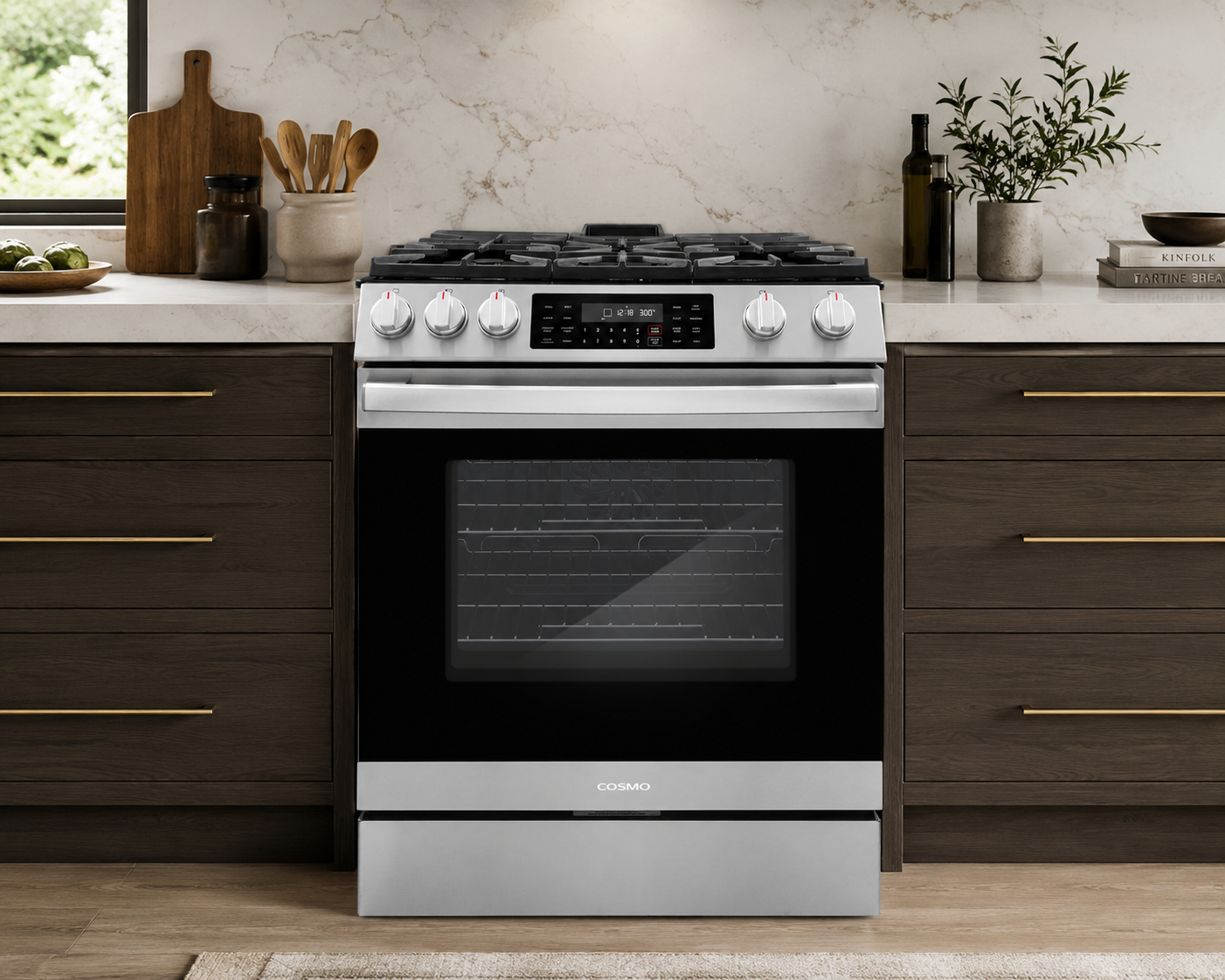
The COS-GRC305KTD Gas Range: 30-Inch with 6.1 Cu. Ft. Air Fry Oven and Self-Clean
Most ranges are bought for their cooktop and treated as though the oven is just along for the ride. The COS-GRC305KTD from Cosmo’s KTD Series inverts this assumption, the oven is the headline. At 6.1 cubic feet it’s one of the largest single oven cavities available in a 30-inch range, and it includes a built-in air fry function that handles what countertop air fryers do, but in a 6.1 cubic foot space rather than a 5-quart basket. The five sealed gas burners handle everything the stovetop needs, including high-heat cooking with cast iron grates providing the stability and heat distribution that serious cooking demands. Eight oven functions, self-cleaning, a digital display with clock and timer, a lower storage drawer, and LP convertibility round out a range that covers serious ground for everyday cooking without requiring a premium kitchen budget to access it. The KTD Series targets households that cook regularly across a range of methods, weeknight dinners on the stovetop, weekend baking in the oven, and air-fried foods that have become a regular part of how a lot of people cook now. Having a dedicated countertop air fryer alongside a full range solves the problem, but it costs counter space and creates another appliance to maintain. Building air fry directly into the oven cavity is a more practical solution that keeps the counter clear while expanding what the oven can do beyond conventional cooking functions. Why 6.1 Cubic Feet Changes What the Oven Can Handle Oven capacity is one of those specifications that sounds straightforward but reveals its importance only when you’re trying to cook something that doesn’t fit. Scale Context: Standard 30-inch ranges typically offer oven cavities in the 4.8-5.4 cubic foot range. The COS-GRC305KTD’s 6.1 cubic feet sits meaningfully above this, roughly 15-25% more usable space than typical competitors in the same width class. In practical terms, this difference shows up when you’re fitting a 20-pound turkey with clearance around it for hot air circulation, when you’re running two full sheet pans simultaneously without stacking them too close together, or when you want to roast a large prime rib alongside a pan of vegetables without compromise. Multi-Rack Cooking: The larger cavity creates more vertical space between rack positions, which matters significantly when baking multiple items simultaneously. Racks too close together restrict heat circulation and produce uneven browning, particularly a problem for baked goods. The 6.1 cubic foot cavity allows generous spacing between racks while still accommodating multiple levels of cooking, making the oven genuinely functional as a multi-rack cooking environment rather than technically capable but practically frustrating. Air Fry Capacity Advantage: The built-in air fry function benefits from the large cavity more than any other oven mode. Countertop air fryers work through a small basket that limits batch size, a family of four often needs multiple batches to air fry enough chicken wings or fries for everyone. The 6.1 cubic foot oven air fries in the full cavity space with multiple racks available, handling quantities that would require three or four countertop air fryer batches in a single run. Entertaining Scale: Holiday cooking, dinner parties, and large family meals consistently exceed what standard oven cavities can accommodate comfortably. The 6.1 cubic foot cavity handles the scale that these occasions require, not as an occasional luxury but as a reliable cooking environment for the events that matter most. Air Fry Function Explained Built-in oven air fry represents a meaningful evolution from the first ovens to offer this feature, and understanding what it actually does helps set realistic expectations for results. How Oven Air Fry Works: Air fry mode runs the convection fan at higher speeds than standard convection, circulating heated air more aggressively around food surfaces. This intense circulation removes surface moisture rapidly, creating the dry-heat environment that produces crispy exterior textures without submersion frying. The combination of high-speed airflow and consistent oven temperatures cooks food through while developing the surface texture that makes air-fried food satisfying. Why Results Differ from Countertop Air Fryers: Countertop air fryers concentrate airflow in a very small space around a basket, creating extremely intense localized heat. Oven air fry works across a larger volume, producing results that are very good but slightly less aggressive in surface crisping than dedicated compact units. The tradeoff is batch size, oven air fry handles significantly more food at once and doesn’t require the constant shaking and monitoring that basket-style air fryers need to cook evenly. Foods That Work Well: Air fry mode in the COS-GRC305KTD handles chicken wings and pieces, frozen foods typically prepared in a conventional oven, french fries and vegetables, fish fillets, and anything where crispy exterior texture with less oil than deep frying is the goal. The larger cavity allows using air fry racks that position food away from the oven floor, maximizing airflow contact with all surfaces simultaneously. Foods Less Suited: Very small items that would fall through oven rack gaps, anything requiring the basket-shaking process that countertop units accommodate easily, and extremely delicate items that can’t handle the aggressive airflow don’t translate as well from basket air fryers to oven air fry mode. For most practical air-frying tasks, however, the oven function performs excellently. Counter Space Benefit: For households that air fry regularly, keeping a dedicated countertop air fryer on the counter means either permanent counter occupation or storing it between uses. The built-in function eliminates this entirely, no countertop appliance, no storage challenge, and no switching between appliances during cooking sessions that involve both oven and air fry. Eight Oven Functions The eight oven functions in the COS-GRC305KTD cover the full range of cooking methods that home kitchens require, from the most basic baking to the specialized functions that make this range distinctive. Bake: Standard radiant baking using bottom and top elements for conventional oven cooking. Recipes developed for traditional ovens work in this mode without timing or temperature adjustments. Most baked goods, cakes, cookies, breads, use this as their baseline function. Convection Bake: Fan-assisted baking distributes heated air throughout