
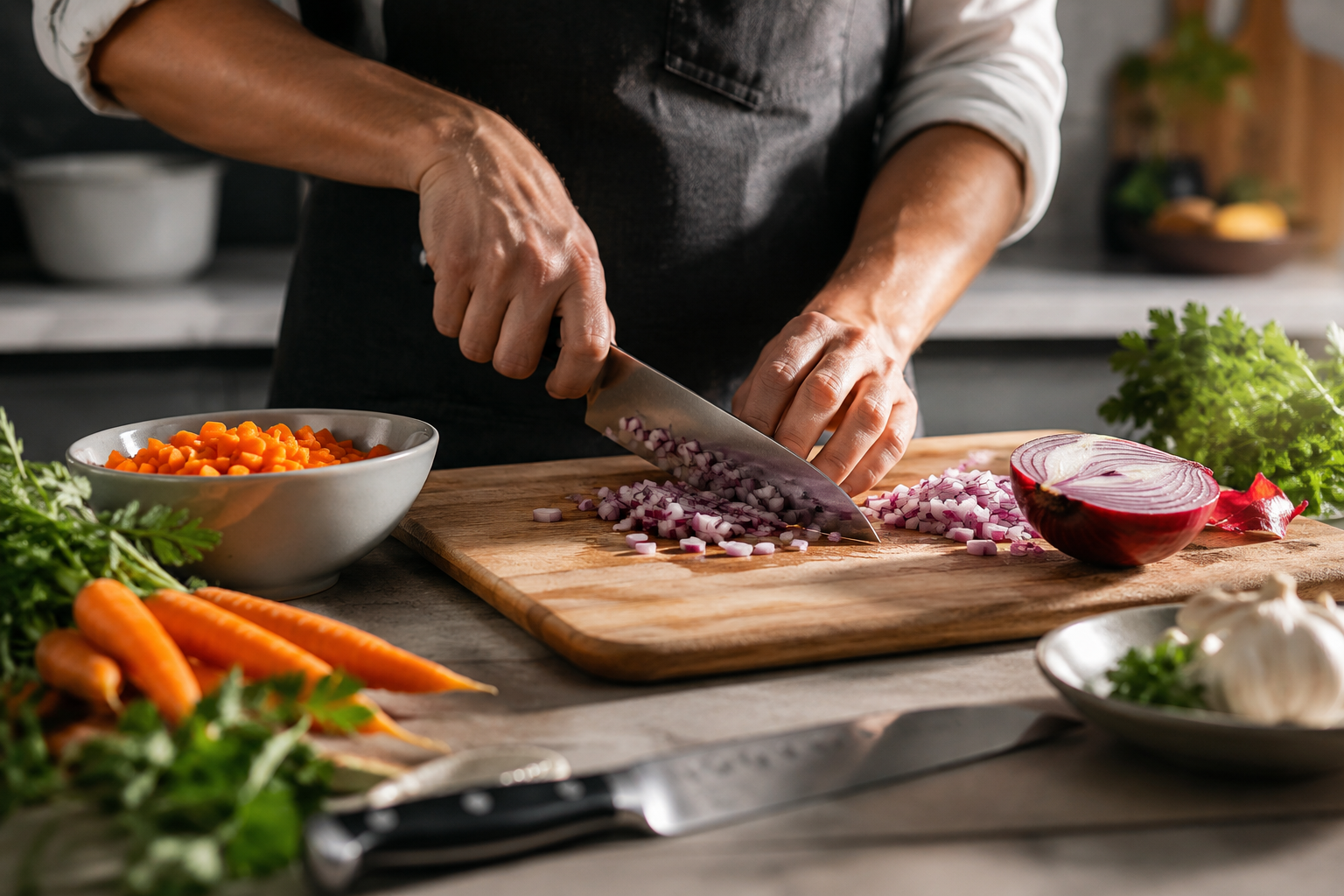
The Knife Skills Gap: Why Most Home Cooks Never Close It and How To Actually Fix That
Knife skills sit in an unusual position in home cooking education. Everyone knows they matter. Cooking shows, culinary schools, and food writers universally emphasize them. Yet the overwhelming majority of home cooks never meaningfully improve their knife skills after the first few years of cooking on their own, no matter how many years or decades they continue cooking. They develop a functional baseline, rough chopping, imprecise slicing, occasional injuries, and stay there permanently, improving at recipes and flavor combinations while the knife technique that underlies all of it stagnates. This isn’t because knife skills are unusually difficult to learn. It’s because of specific patterns in how home cooks encounter information about knife skills, how they practice them, and what feedback they receive during that practice. Understanding these patterns explains why cooking experience alone doesn’t improve knife skills, and what a different approach looks like for someone who actually wants to close the gap rather than just knowing it exists. Why Cooking More Doesn’t Automatically Improve Knife Technique The intuitive assumption is that knife skills improve through accumulated cooking experience, the more you cook, the better your knife work becomes. This is true up to a basic functional threshold and almost entirely false beyond it. Repetition Without Correction Reinforces Bad Habits: Deliberate practice in any skill domain requires feedback that identifies errors and allows correction. Cooking at home provides neither. When you mince garlic inefficiently for the five hundredth time, no mechanism exists to tell you that you’re doing it inefficiently. The garlic gets minced, the dish gets made, and the inefficient technique gets practiced and reinforced five hundred times rather than improved upon. Repetition without corrective feedback doesn’t build skill, it builds habit, and habits are considerably harder to change than skills that haven’t yet been learned incorrectly. The Outcome Disconnect: Home cooking provides outcome feedback, did the dish taste good? But not process feedback, was the technique that produced it efficient, safe, and correct? A cook can produce excellent food for twenty years using knife technique that a culinary student would have corrected in their first week. The food’s quality doesn’t reveal the technique’s quality, so the feedback loop that would prompt improvement never activates. Functional Adequacy as a Ceiling: Most home cooks reach a level of knife competence that feels adequate for their cooking, they can get through recipes without significant difficulty even if they’re working harder and less safely than necessary. This adequacy removes the urgency that drives deliberate improvement. The cook who takes 8 minutes to dice an onion doesn’t feel the inefficiency the way a professional who needs to dice twenty onions does. Comfort with functional adequacy creates a ceiling that experience alone doesn’t push through. Tool Familiarity Without Technique: Many home cooks develop familiarity with their specific knife and cutting board setup without developing transferable technique. They know how their particular 8-inch chef’s knife behaves, where to grip it for their specific hand size, how much pressure their cutting board requires. This familiarity feels like skill but doesn’t transfer to different knives or environments, and it often accommodates poor technique rather than correcting it. What Knife Skills Actually Consist Of Before addressing how to improve, it’s worth being specific about what knife skills actually involve, since most home cooks have a vague understanding that they need work without clarity about what specifically needs improving. Grip and Control: The most fundamental knife skill is grip, how the hand holds the knife for maximum control during different cuts. The pinch grip, where the thumb and index finger pinch the blade just above the handle with remaining fingers wrapping the handle, provides the most control for most cutting tasks. The vast majority of home cooks use a handle grip where the entire hand wraps the handle, it feels more secure but reduces blade control and increases fatigue during extended cutting. This single technique difference explains a large portion of the speed and precision gap between practiced and unpracticed cutters. The Guide Hand: The non-knife hand is half of cutting technique and receives almost none of the attention. The guide hand uses the curled-finger position, fingertips curled under so knuckles guide the flat of the blade, to control food position and protect fingers simultaneously. Without this technique, cutting speed is limited by caution about finger proximity to the blade. With it, the knuckle acts as a fence that guides consistent slice thickness while protecting fingers. Most home cooks use flat-finger or pinch-hand positioning that neither guides cuts nor protects as effectively. Board Contact and Rocking Motion: Efficient chef’s knife technique uses a rocking motion where the knife tip stays in contact with the cutting board as the handle rises and falls, pivoting rather than lifting completely with each cut. Many home cooks lift the entire knife with each stroke, requiring more effort per cut and producing less consistent results. The rocking motion conserves energy, improves consistency, and allows faster cutting once the motion becomes automatic. Food Preparation Before Cutting: Knife technique starts before the knife touches food. Creating a flat stable surface by halving round vegetables before attempting to slice them, understanding the grain direction in proteins that affects how to cut against it, and knowing when to use different knife types for different tasks, these preparation decisions affect cutting quality before grip and motion even come into play. Knife Maintenance: A dull knife requires more force per cut, increases fatigue, reduces precision, and paradoxically increases injury risk because more pressure means less control and greater consequence when the knife slips. Knife maintenance, regular honing before each use and periodic sharpening, isn’t separate from knife skill, it’s a prerequisite for practicing knife skill on an appropriate tool. Practicing cutting technique on a dull knife is like practicing piano on an out-of-tune instrument, the mechanics may improve but the feedback is wrong. The Specific Techniques That Produce The Largest Improvements Not all knife technique improvements deliver equal returns. A few specific changes produce disproportionate improvements in speed, precision,