
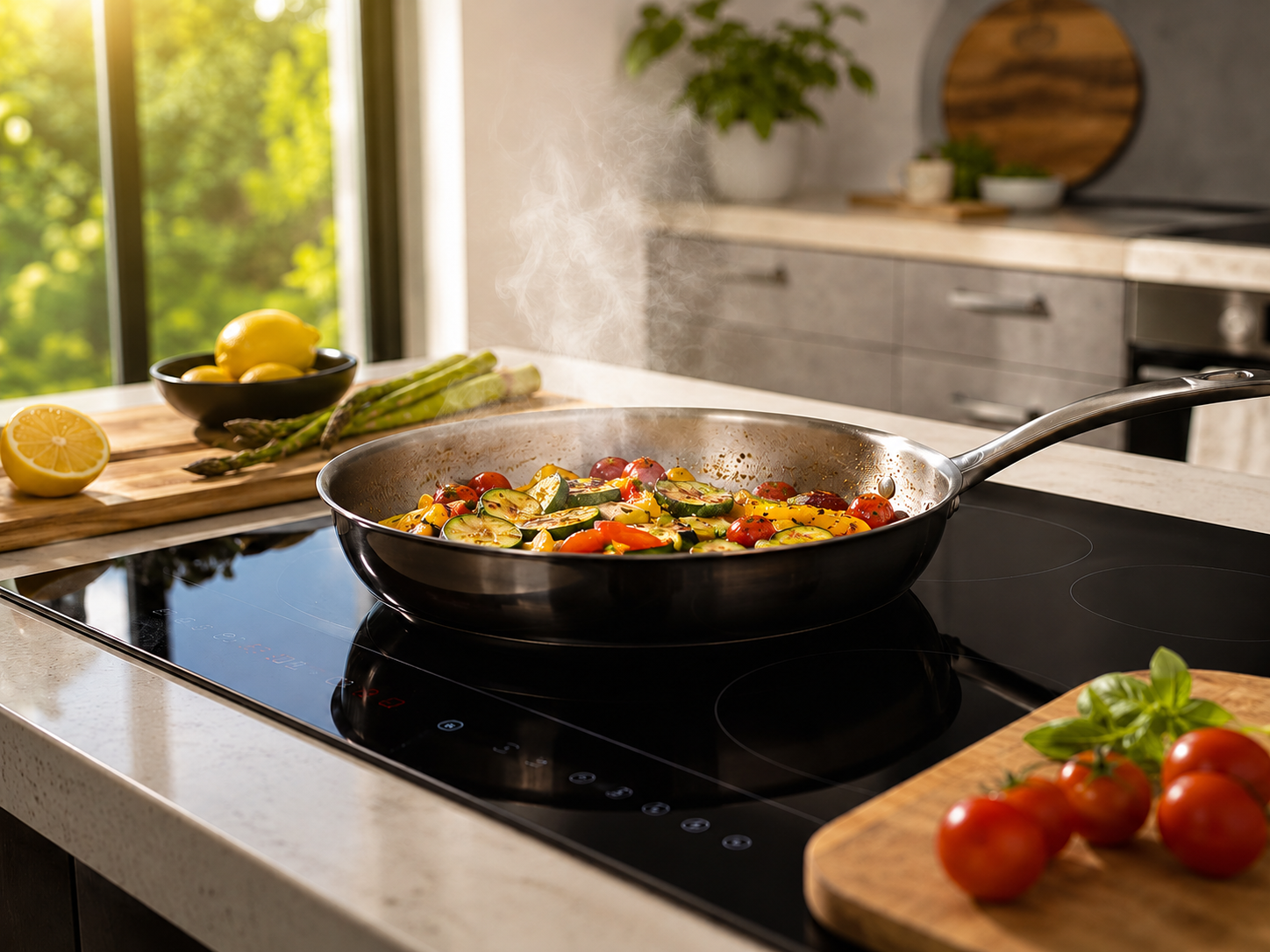
Why Summer Is the Best Time to Switch to Induction Cooking
Most people who eventually switch to induction cooking do it during a kitchen renovation, when replacing a broken appliance, or when moving into a new home — timing driven by circumstance rather than intention. Summer rarely comes up as a reason to make the switch, which is a missed opportunity, because summer is arguably the most compelling argument for induction cooking that exists and the season when the difference between induction and gas or electric cooking is most immediately and consistently felt. The case for induction cooking in summer isn’t primarily about cooking performance — though that case is strong on its own terms. It’s about what happens to your home’s comfort, your cooling costs, your indoor air quality, and your overall relationship with cooking when the ambient temperature is already fighting you before you’ve turned on a single burner. In summer, every heat source in your kitchen becomes more consequential than it is in October. The inefficiency of gas cooking that you tolerate comfortably in winter becomes a real quality-of-life issue in August. The kitchen you’ve been cooking in all year feels different when the outdoor temperature is 95°F and your range is adding combustion heat to an already-challenged cooling environment. Understanding what induction cooking actually does differently — not just in cooking performance terms but in thermal, efficiency, and air quality terms — makes the summer argument for switching much clearer than the general “induction is better” conversation that often stays abstract. What Induction Cooking Actually Is Before the summer-specific arguments, a clear explanation of what induction cooking does differently from gas and traditional electric is useful context for anyone who hasn’t lived with it. The Electromagnetic Mechanism: Induction cooktops use electromagnetic fields to heat cookware directly rather than heating a surface or producing a flame that then heats cookware. An induction element generates a rapidly alternating magnetic field that induces electrical currents in magnetic cookware placed on the surface. These currents encounter resistance within the cookware’s metal, and that resistance generates heat — directly in the pan, not in the cooktop surface or the air between the cooktop and the pan. What This Means Practically: The cooktop surface itself doesn’t get hot from the cooking process. Only the cookware heats. If you place your hand on the cooktop surface beside an active pan, the surface is warm from contact with the hot pan but not from the element itself. This is the fundamental thermal difference that drives most of induction’s summer advantages. Efficiency Numbers: Induction converts approximately 85-90% of consumed electrical energy into cooking heat in the pan. Traditional electric coil and ceramic cooktops convert roughly 65-70%. Gas converts approximately 40%. The energy that doesn’t become cooking heat in gas and electric alternatives becomes ambient heat in your kitchen — the waste heat that you feel standing at the stove and that your air conditioner works to remove. The Summer Heat Argument: The Numbers Are Compelling The efficiency difference between cooking fuel types has implications for indoor comfort that are usually abstract but become concrete in summer. Gas Cooking’s Heat Load in Summer: A gas burner at full output producing 15,000 BTU delivers roughly 6,000 BTU to the cooking pan and releases approximately 9,000 BTU into the kitchen as waste heat. Running five burners simultaneously at moderate output for a 30-minute cooking session can release tens of thousands of BTUs into your kitchen air — a heat load your air conditioning system then has to work to remove. In winter, this heat goes toward warming a home that needs warming. In summer, it’s purely waste that the cooling system compensates for at cost. Electric Cooktop Improvement, Incomplete: Traditional electric cooktops improve on gas’s thermal efficiency — approximately 65-70% versus gas’s 40% — but still generate meaningful waste heat through the heating element’s radiant output into the kitchen environment above and around the element rather than solely into the cookware. Induction’s Narrow Thermal Footprint: Because induction generates heat directly in the cookware rather than in an element or through combustion, the waste heat that escapes into the kitchen is dramatically lower. The main heat source in the kitchen during induction cooking is the hot cookware and the food itself — not the cooktop, not combustion byproducts, not a glowing element. When you finish cooking and remove the pan, the cooktop surface cools quickly without continuing to radiate heat into the kitchen. The Air Conditioning Implication: Every BTU of heat generated in your kitchen that the air conditioning system removes costs money in electricity consumption and mechanical wear on the cooling system. Reducing the kitchen’s heat load — which induction cooking does more significantly than any other cooking method change — directly reduces cooling costs during the months when air conditioning runs continuously. For households in hot climates running air conditioning from May through September, the cumulative energy savings from reduced kitchen heat load over a summer season are meaningful. The Perceived Comfort Difference: Beyond the measurable energy implications, cooking on induction in summer simply feels different than cooking on gas. Standing at an induction cooktop during a 30-minute cooking session, you’re not experiencing the radiant heat from combustion flames and hot elements that gas and electric cooking produce. The cooking is happening in the pan. The kitchen stays cooler. This isn’t subtle — people who switch to induction during summer consistently comment on how much more comfortable the cooking experience is before they start discussing cooking performance. Air Quality: The Summer-Specific Concern Summer’s indoor air quality implications of gas cooking have received increasing research attention, and the summer context makes the findings particularly relevant. Gas Combustion and Indoor Air: Gas combustion produces nitrogen dioxide, carbon monoxide, and formaldehyde inside homes during cooking. Research published in peer-reviewed journals over the past several years has documented indoor nitrogen dioxide levels during gas cooking that regularly exceed EPA outdoor air quality standards in kitchen environments. These concentrations are highest during cooking and dissipate over time with ventilation, but accumulate throughout