
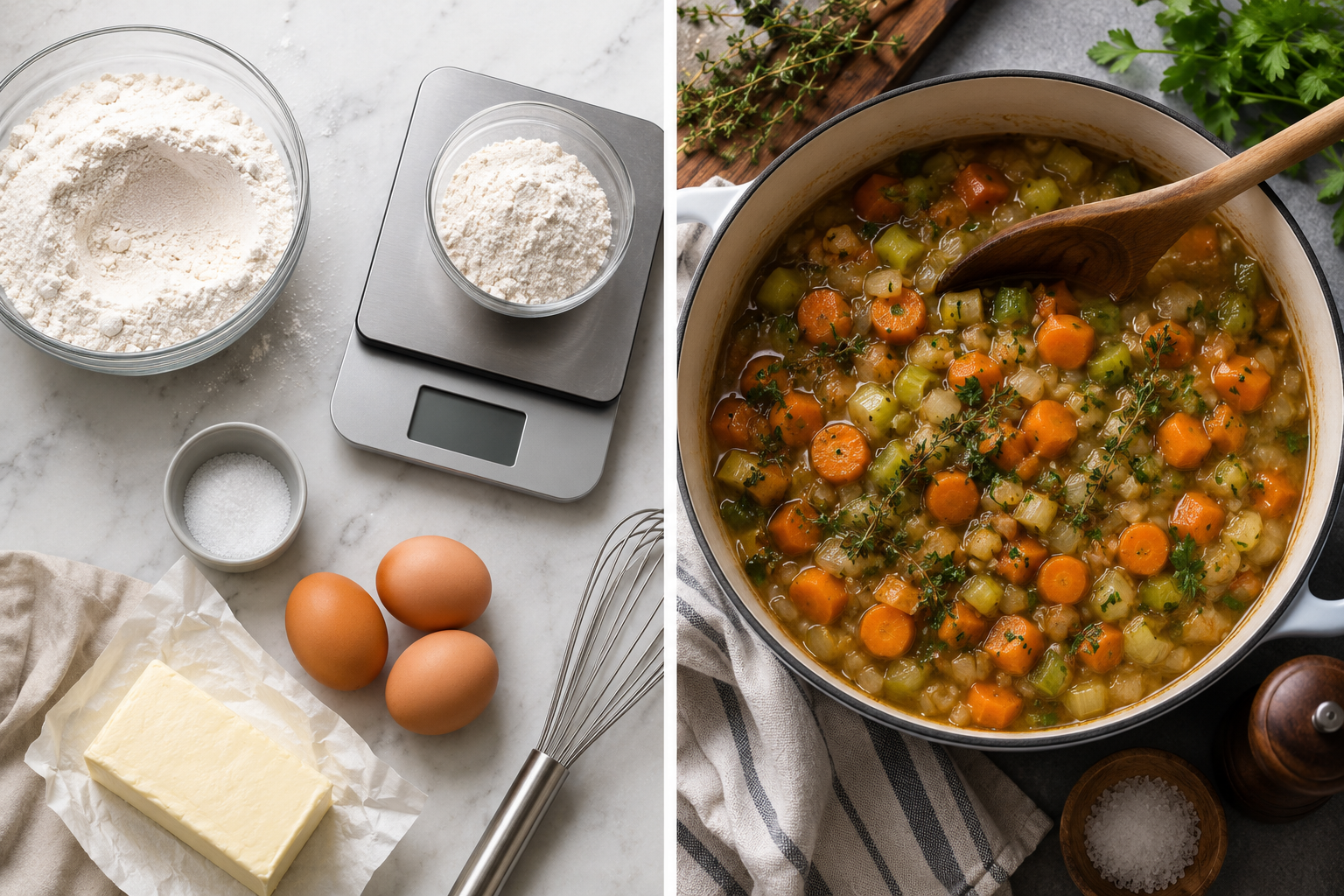
The Hidden Logic Behind Why Some Recipes Demand Exact Measurements and Others Don’t
Anyone who cooks regularly has noticed the split. Some recipes specify precise gram measurements down to the decimal, insist on exact oven temperatures, and warn against any substitution. Others read more like loose suggestions, a handful of this, a splash of that, cook until it looks right. This isn’t inconsistency in recipe writing or laziness on the part of certain cookbook authors. It reflects a real and consistent underlying logic about which foods tolerate variation and which don’t, rooted in the actual chemistry and physics happening during cooking. Understanding this distinction does something practically useful: it tells you when to follow a recipe exactly and when you have genuine room to improvise, adjust to taste, or substitute based on what you have available. Cooks who understand this distinction develop confidence to deviate appropriately rather than either rigidly following every recipe out of fear or carelessly improvising dishes that actually required precision. Why Baking Demands What Cooking Doesn’t The baking-versus-cooking distinction is the most commonly cited version of this principle, and understanding why it holds up reveals the deeper logic at work. Chemical Reactions With Narrow Windows: Baking relies on specific chemical reactions, gluten development, starch gelatinization, protein coagulation, the Maillard reaction, leavening agent activation, that occur within relatively narrow ranges of ingredient ratios, temperatures, and timing. Baking soda reacts with acid in a roughly stoichiometric relationship; too little acid leaves residual baking soda creating a soapy, metallic taste, while too much creates excess unreacted acid affecting flavor and the leavening’s effectiveness. These reactions don’t have wide tolerance ranges where “close enough” produces equivalent results. The Absence of Real-Time Correction: Once bread dough goes into the oven, you can’t add more flour if it turns out too wet, or remove gluten if it was overdeveloped. The cooking process is largely sealed off from intervention once it begins. Stovetop cooking, by contrast, allows continuous tasting, adjusting, and correcting throughout the process, adding salt if it’s bland, reducing liquid if it’s too thin, extending cooking time if something isn’t done. This real-time correction capability is what makes precision less critical in cooking generally: you’re not locked into your initial measurements because you can adjust as you go. Structure Versus Flavor: Baking is fundamentally about creating structure, the proteins and starches that hold a cake’s crumb together, the gluten network that gives bread its chew, the precise fat-to-flour ratio that determines whether pastry is flaky or tough. Structure-building reactions have specific requirements. Cooking savory dishes is primarily about flavor development, which tolerates much more variation because flavor exists on a spectrum of “good” rather than a binary of “structurally sound or structurally failed.” Why Professional Bakers Weigh and Home Cooks Often Don’t: Professional bakers use weight measurements rather than volume measurements specifically because flour density varies significantly based on how it’s scooped, packed, or sifted, a cup of flour can weigh anywhere from 120 to 150 grams depending on technique, a 20% variance that matters enormously for baking’s narrow tolerance windows but matters far less for a soup or stir-fry where that flour might be a thickening agent with more forgiving requirements. The Emulsion and Custard Exception Beyond baking generally, certain savory and dessert preparations require similar precision because they rely on the same kind of narrow-window chemistry, even though they’re not technically “baked goods.” Why Emulsions Are Unforgiving: Mayonnaise, hollandaise, and vinaigrettes that require true emulsification depend on a precise process of slowly incorporating fat into a liquid base while an emulsifying agent, egg yolk lecithin, mustard’s compounds, stabilizes the mixture. Add the fat too quickly and the emulsion breaks, separating into its component oil and liquid rather than forming the stable suspension that defines the dish. This isn’t a matter of taste preference being slightly off; it’s a binary outcome where the emulsion either holds or it doesn’t. Custard’s Temperature Sensitivity: Custards, crème anglaise, crème brûlée, pastry cream, rely on egg proteins coagulating at specific temperatures to thicken the mixture. Below the right temperature, the custard remains thin and never sets properly. Above it, by even a relatively small margin, the proteins overcoagulate and the custard curdles, separating into a grainy, broken texture that can’t be recovered. This narrow temperature window, often just a 10-15°F range between undercooked and curdled, demands the kind of precision that a simmered soup simply doesn’t require. Candy Making’s Stage System: Sugar candy making relies on precise sugar concentration, measured through temperature, that determines the final texture, soft ball, firm ball, hard crack, and other named stages each correspond to specific temperature ranges that produce dramatically different textures in the finished candy. A few degrees’ difference moves the result from one named stage to an entirely different one, with correspondingly different and non-adjustable outcomes. Why These Examples Matter Beyond Themselves: Understanding why emulsions, custards, and candy demand precision reinforces the underlying principle, it’s not about whether a dish is “fancy” or “simple,” but whether it depends on a specific chemical transformation with a narrow tolerance window. A simple vinaigrette without true emulsification (just shaking oil and vinegar together, which separates again quickly) tolerates huge variation in ratios because you’re not relying on a stable chemical transformation, you’re just combining flavors that will be tasted together regardless of precise proportion. Where Real Forgiveness Lives Understanding which dishes are forgiving helps you develop the confidence to deviate from recipes in situations where deviation genuinely doesn’t risk the outcome. Braises and Stews: Long, slow cooking methods that break down tough proteins and meld flavors over extended time are remarkably forgiving of ingredient substitution, ratio variation, and timing flexibility. The collagen breakdown that makes a braise tender happens across a wide temperature and time range, slightly more or less liquid, slightly different vegetable ratios, an extra 20 minutes of cooking time, none of these meaningfully derail the outcome the way a baking substitution might. This is why braise recipes often read more like guidelines than precise formulas. Soups: Soup recipes tolerate substantial ingredient substitution and ratio adjustment because the dish’s