

turbo true european convection

What Is Cosmo Appliances and Who Makes Them?

If you’ve been researching kitchen appliances recently, you’ve probably come across Cosmo Appliances and found yourself asking a reasonable question: who exactly is behind this brand, and where does it actually fit in the appliance market? The kitchen appliance space is crowded with brands operating at wildly different price points and quality levels, and Cosmo’s positioning, premium-looking stainless steel appliances with pro-style aesthetics at mid-range prices, can make it hard to place without some context. This is a company worth understanding before you buy, and the story behind it explains both what Cosmo is genuinely good at and how it delivers the cooking performance and design quality its customers are looking for. The Brand Origin: Who’s Behind Cosmo Cosmo Appliances was founded with a straightforward belief: that serious cooking equipment shouldn’t require a luxury budget to access. The brand was built around a simple idea: households that cook regularly and care about their kitchens deserve high-performing options beyond standard market offerings—without paying premium prices. That belief shapes every product decision Cosmo makes. Burner quality, oven engineering, construction materials, filtration systems, each reflects a deliberate choice about what the product needs to be rather than what it needs to look like. The goal isn’t to impress in a showroom. It’s to perform in a real kitchen used by real people every day. Cosmo is headquartered in Chino, California, with a team focused on developing appliances that deliver on their promises across years of daily use. The products are designed for people who take cooking seriously, not as a hobby requiring professional credentials, but as a daily part of life that deserves equipment worth using. What “Pro-Style” Actually Means and How Cosmo Delivers It “Pro-style” is a term that gets applied loosely across the appliance industry, sometimes to products that genuinely deliver professional cooking performance, and sometimes to products that are primarily imitating the aesthetic of serious cooking equipment without delivering any of its underlying substance. Understanding what the term actually means in Cosmo’s context helps you evaluate what you’re getting rather than just reading a marketing label. The term originally described appliances built with direct influence from professional cooking environments, commercial-grade burner technology, heavy-duty construction materials, larger cooking capacities, and performance specifications designed to handle demanding, high-volume cooking use. These characteristics define what serious cooking equipment looks and feels like, and they’re the standard against which any pro-style claim should be measured. Cosmo’s pro-style positioning reflects genuine product decisions rather than aesthetic choices alone. Several specific details make this concrete. Italian-Made Gas Burners: Multiple Cosmo gas ranges and cooktops feature Italian-made burners sourced from manufacturers with long histories supplying quality residential and commercial cooking equipment. Italian gas burner manufacturing has a well-established reputation for precision and performance in the cooking appliance industry. This sourcing decision reflects a commitment to burner quality that goes beyond simply specifying high BTU numbers on a spec sheet. The difference shows up in flame consistency, low-end simmer stability, and the kind of cooking control that becomes apparent through regular daily use. Turbo True European Convection: Cosmo’s oven lineup includes Turbo True European Convection systems, a specific engineering approach where a dedicated circular heating element surrounds the convection fan rather than simply adding a fan to an existing oven cavity. This distinction matters because the circular element heats air as the fan circulates it, producing more uniform temperature distribution throughout the oven from front to back and corner to corner. The result is more consistent baking and roasting results across all rack positions, an improvement that becomes particularly relevant for multi-rack baking, larger roasts, and any technique where temperature consistency affects the outcome. Construction Quality That Holds Up: Cosmo uses 18 and 20-gauge stainless steel construction across its range hood lineup, 430-grade stainless steel finishes across multiple product categories, and heavy-duty cast iron grates on gas ranges and cooktops. These aren’t interchangeable specifications, thicker gauge steel resists denting and damage during daily use, 430-grade stainless maintains its appearance through the cleaning and handling that kitchen appliances experience continuously, and cast iron grates provide the thermal mass and durability that serious stovetop cooking demands. These material choices reflect how long Cosmo expects its products to perform rather than how good they look at first glance. ARC-FLOW Permanent Filters: Cosmo’s range hoods feature ARC-FLOW permanent stainless steel baffle filters that capture grease through a multi-stage design rather than relying on disposable mesh alternatives that require regular replacement. These filters clean in the dishwasher and have unlimited service life, a design decision that reduces ongoing maintenance cost while delivering consistently effective filtration throughout the hood’s lifespan. Across the product lineup, these specific details add up to a coherent picture of what pro-style means in Cosmo’s context, not aesthetic imitation, but meaningful engineering and component decisions that affect how the products cook, how they hold up, and how they serve the people using them. How Cosmo Sits in the Market The kitchen appliance market operates across meaningfully different tiers, and knowing where a brand sits within that landscape helps you understand what you’re actually buying and whether it matches what you’re looking for. At the entry level, appliances are engineered primarily around price, minimum viable components, basic functionality, and construction that works adequately when new but tends to show its limitations over time through performance and durability. These products serve a purpose for certain situations, but they aren’t built with serious cooking in mind. At the other end of the market sits ultra-premium equipment carrying price tags that reflect extraordinary engineering alongside significant brand investment. These appliances represent genuine excellence, but they’re priced in a way that makes them inaccessible for most households regardless of how seriously those households take their kitchens. Cosmo occupies the space between these two ends deliberately. It’s the tier where serious cooking performance becomes accessible, where Italian-made burners, genuine convection engineering, quality stainless construction, and thoughtfully designed product suites are available to households that cook regularly and care about the result, without requiring an exceptional
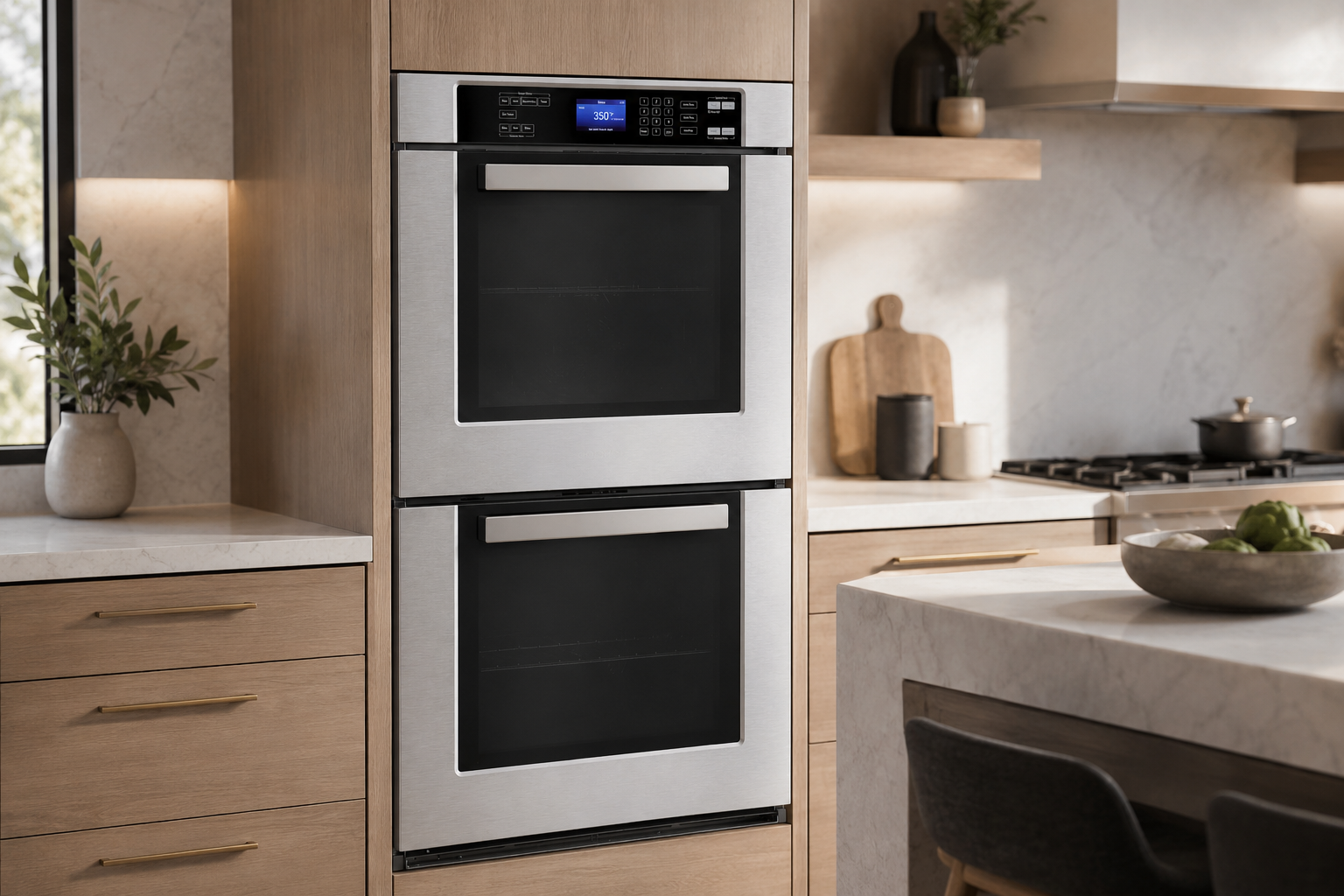
The COS-30EDWC Double Wall Oven: Two 5.0 Cu. Ft. Cavities with Turbo True European Convection

Wall ovens change the way a kitchen functions. Separating the oven from the cooktop creates independent cooking zones that improve workflow, allow more ergonomic oven access, and open up layout possibilities that traditional ranges can’t provide. The COS-30EDWC takes this further by stacking two full 5.0 cubic foot ovens into a single 30-inch built-in unit, giving you 10 cubic feet of total oven capacity within the footprint a single wall oven would otherwise occupy. Both cavities include Turbo True European Convection with a fan-assisted circular heating element, self-cleaning functions, soft touch controls with LED displays, interior lighting, and a temperature probe for precise internal food monitoring. The brushed stainless steel exterior pairs with distinctive blue porcelain interiors that make the interior cavity easy to monitor and simple to clean. What makes this oven genuinely useful for households that cook seriously is the simultaneous independent operation of two full-sized cavities. Running a roast in one oven at 325°F while baking at 375°F in the other isn’t a compromise — both cavities maintain their set temperatures independently, run their own timers, and operate entirely separately. Holiday cooking, batch baking, and multi-course entertaining all become significantly more manageable when two complete ovens are available at once rather than sequencing dishes through a single cavity. Why Two Ovens In One Unit Makes Practical Sense The logic behind double wall ovens becomes clear quickly once you’ve spent time managing a busy kitchen with only one oven available. Simultaneous Independent Cooking: Single ovens force compromises when recipes require different temperatures. You either cook sequentially, letting something cool while the oven adjusts, or you pick a middle temperature that’s ideal for neither dish. Two independent cavities eliminate this entirely. Both ovens maintain precise independent temperatures, letting you cook dishes on their own terms without adjustments or timing gymnastics. Footprint Efficiency: The COS-30EDWC fits two complete 5.0 cu. ft. ovens into a 30-inch wide built-in installation. Buying two separate single wall ovens would require two separate cabinet cutouts and considerably more wall space. The stacked configuration delivers double the capacity within the same lateral footprint, making it an efficient solution for kitchens where wall space is limited. Ergonomic Oven Access: Built-in wall ovens install at heights that put oven interiors at or near counter level, eliminating the bending required to access floor-level range ovens. The COS-30EDWC’s upper cavity typically aligns with counter height, making loading and checking food straightforward. The lower cavity sits below counter level but remains more accessible than a range oven that’s nearly at floor height. Holiday and Entertaining Capacity: Thanksgiving, Christmas, and large dinner party cooking routinely expose the single-oven limitation. Needing to coordinate multiple dishes through one oven creates logistical challenges that affect timing, food temperature, and host stress levels. Two complete ovens running simultaneously handle these high-demand situations without compromise. Separation of Functions: Having two ovens lets you dedicate one to long, slow cooking while keeping the other available for shorter tasks. A pork shoulder braising at 275°F for six hours doesn’t need to monopolize your only oven, preventing any other baking or roasting for that entire period. The second cavity remains available throughout. Turbo True European Convection Explained The Turbo True European Convection system in both cavities represents meaningfully different technology from standard convection, and understanding why matters for evaluating what this oven actually delivers. What Standard Convection Does: Basic convection ovens add a fan to circulate air around food. This circulation reduces hot spots and speeds cooking compared to conventional radiant heat alone. The fan creates movement that prevents the stagnant air layers that cause uneven baking in traditional ovens. What True European Convection Adds: True European Convection, sometimes called third element convection, adds a dedicated circular heating element surrounding the fan at the back of the oven cavity. This element heats air as the fan circulates it rather than just moving air that’s being heated by the oven’s main elements. The result is more consistent temperature distribution throughout the entire cavity, from front to back and corner to corner. Turbo Operation: The Turbo designation indicates higher fan speeds that increase air circulation intensity beyond standard convection. Greater airflow means faster heat transfer to food surfaces, improving browning and reducing cooking times more significantly than standard convection. Turbo convection particularly benefits items that need surface browning alongside thorough internal cooking. Practical Baking Benefits: Even temperature distribution means multiple sheet pans bake consistently without requiring mid-bake rotation. Cookies on the top rack brown at the same rate as those on the bottom rack. Cakes bake evenly without domed tops from hot centers. This consistency is particularly valuable in a 5.0 cu. ft. cavity where larger batches and multiple rack positions are regularly in use. Roasting Advantages: Convection roasting circulates hot air around all exposed surfaces simultaneously, developing browning on more of the exterior than conventional radiant heat achieves. Chicken skin crisps more thoroughly, roast vegetables caramelize more evenly, and large cuts develop better exterior crust while maintaining internal moisture. Temperature Adjustment: Convection cooking typically requires reducing recipe temperatures by 25°F or shortening cooking times by 20-25% compared to conventional oven recipes. The Turbo European Convection system accelerates this effect further, so recipes developed for conventional ovens need attention to timing when converted to Turbo operation. Seven Oven Functions and When to Use Each Both cavities offer seven oven functions covering a range of cooking applications beyond simple baking and roasting. Bake: Standard bake mode uses both top and bottom heating elements without fan assistance for conventional radiant heat cooking. This mode suits recipes developed for traditional ovens and techniques where air circulation would be disruptive — delicate soufflés, custards, and cheesecakes that benefit from gentle, even heat rather than active air movement. Convection Bake: Activates the fan and circular heating element for even temperature distribution throughout the cavity. This is the everyday workhorse function for most baking and roasting tasks, delivering faster and more consistent results than standard bake for most foods. Convection Roast: Similar to convection bake but optimized