
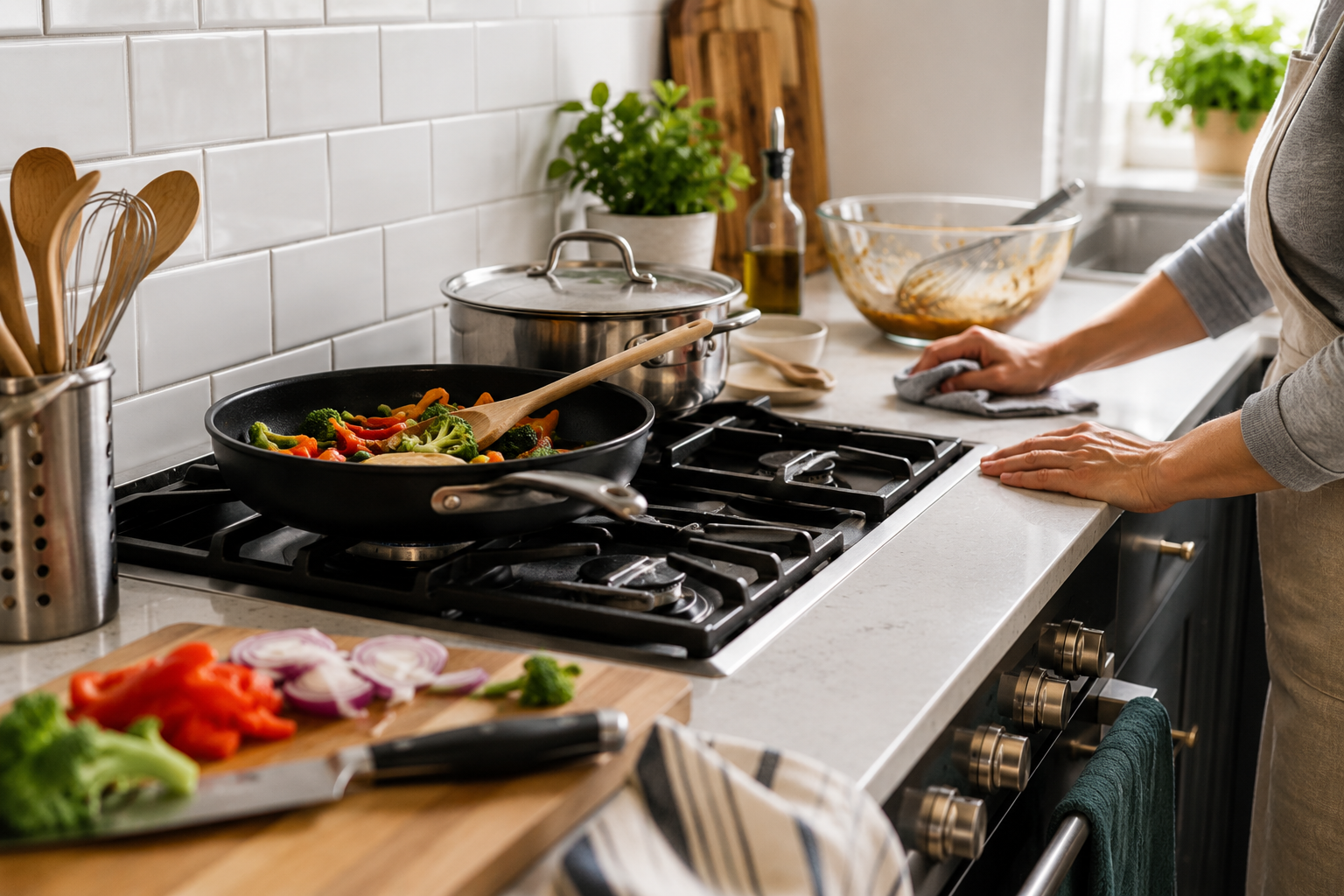
How to Actually Keep a Kitchen Clean While You’re Cooking
Most kitchen cleaning advice focuses on what happens after cooking — the post-meal scrub, the weekly deep clean, the seasonal reorganization. This is useful, but it addresses the symptom rather than the cause. The reason kitchens get genuinely difficult to clean is rarely that people don’t clean them afterward. It’s that cooking itself generates mess faster than any post-session cleaning can efficiently address, and certain habits during cooking either contain that mess or let it compound into something that takes far longer to deal with than it needed to. Cooking clean — the habit of managing mess during the cooking process rather than purely after it — is one of the more underrated skills in practical kitchen management. It’s not about perfectionism or anxiety about a dirty kitchen. It’s about the relationship between active mess generation and active mess management, and understanding which interventions during cooking make the cleanup afterward genuinely easier rather than just displacing effort. Professional kitchens operate on this principle out of necessity. A restaurant that waits until after service to address the mess generated during service would be non-functional within a week. The systems they use to stay clean during operation translate directly into home kitchens with some adjustment for scale and context. Why Kitchens Get Out of Control During Cooking Understanding the mechanics of kitchen mess accumulation helps you identify where to intervene rather than just trying harder to keep everything tidy. Mess Compounds Nonlinearly: A small amount of mess at the beginning of a cooking session doesn’t stay small. Grease splattered on a stovetop in the first five minutes of cooking gets heated repeatedly by subsequent burner use, eventually baking onto the surface and becoming significantly harder to remove than it would have been if wiped immediately. Flour on a counter gets pressed into the surface by subsequent prep work, then moistened by water, then dried again into something that requires actual scrubbing. Mess that gets addressed quickly is easy. The same mess left until cooking is complete is harder. Left until the next morning, it’s genuinely difficult. Surfaces Interact: Mess generated on one surface migrates to others through normal kitchen activity. Wet hands touch cabinet doors. Splattered oil moves from the stovetop to the counter to cutting boards as items are transferred between surfaces. The spoon that stirred the sauce gets set down and leaves a ring. These interactions spread mess faster than it’s generated at any single point, which is why kitchens that seem manageable at the start of cooking look chaotic thirty minutes in. Mental Load of Visible Mess: Beyond the physical accumulation, visible kitchen mess during cooking creates cognitive load that affects cooking performance. Studies on cluttered environments consistently show reduced focus and increased stress in people working in visually disordered spaces. A clean or cleaner workspace during cooking actually supports better cooking outcomes — you notice when things are burning, you find tools quickly, you move efficiently rather than navigating around accumulating debris. The Parallel Processing Problem: Cooking requires attention across multiple simultaneous tasks — timing multiple dishes, monitoring heat levels, following recipe steps, managing ingredients. Adding cleaning as another parallel task competes for the same cognitive resources. The key is making cleaning habitual enough that it doesn’t require active attention, which means establishing specific reflexes rather than making conscious decisions about when to clean. Setting Up for Clean Cooking Before You Start The conditions you establish before cooking begins determine how manageable the cleanup process is throughout. Clear Counter Surfaces Completely: Start with as much clear counter space as possible. This sounds obvious but rarely happens in practice — counters accumulate everyday items that don’t belong there and don’t get moved before cooking starts. A full counter has no space for prep debris, finished components, or tools, so everything piles onto whatever space remains. A cleared counter gives mess somewhere to go other than on top of other things. Establish a Debris Zone: Designate one specific area of counter for cooking debris — vegetable trimmings, packaging, empty cans, used paper towels. This could be a bowl, a section of counter, or a cutting board positioned near the trash. Funneling debris to one location prevents it from distributing across the entire kitchen and makes disposal a single action rather than a surface-by-surface collection effort. Position the Trash Strategically: Where your trash can sits during cooking affects how much debris ends up on counters rather than in it. The trash should be within arm’s reach of your primary prep zone without requiring you to cross the kitchen to dispose of anything. Pulling the trash can out from under a cabinet or repositioning it before cooking starts makes disposal effortless rather than requiring a deliberate trip. Set Up a Dish Station: Place a large bowl or container near the sink before cooking starts. Every dish, utensil, and piece of equipment you finish using goes directly into this container rather than onto the counter. This prevents finished tools from spreading across surfaces while also making post-cooking dish management a single collection rather than hunting for items across the kitchen. Lay Down a Splatter Mat or Towel: For cooking tasks that will generate significant mess — rolling out dough, working with oily ingredients, anything involving substantial liquid — lay a clean kitchen towel or silicone mat under the work area. The mat catches debris that would otherwise reach the counter surface, and cleanup means picking up and disposing of the mat rather than scrubbing the counter. The Habits That Actually Make Cooking Cleaner Specific cooking behaviors, repeated consistently, prevent the vast majority of mess accumulation rather than just managing it after the fact. Wipe As You Go, Not After You’re Done: The single most impactful clean-cooking habit is wiping surfaces during natural pauses in the cooking process rather than waiting until the end. While something simmers for five minutes, wipe down the stovetop, counter, and any surfaces you’ve used. The mess at this point is fresh and takes seconds to address. The