
Food Safety at Summer Parties | What Heat Actually Does to Your Buffet
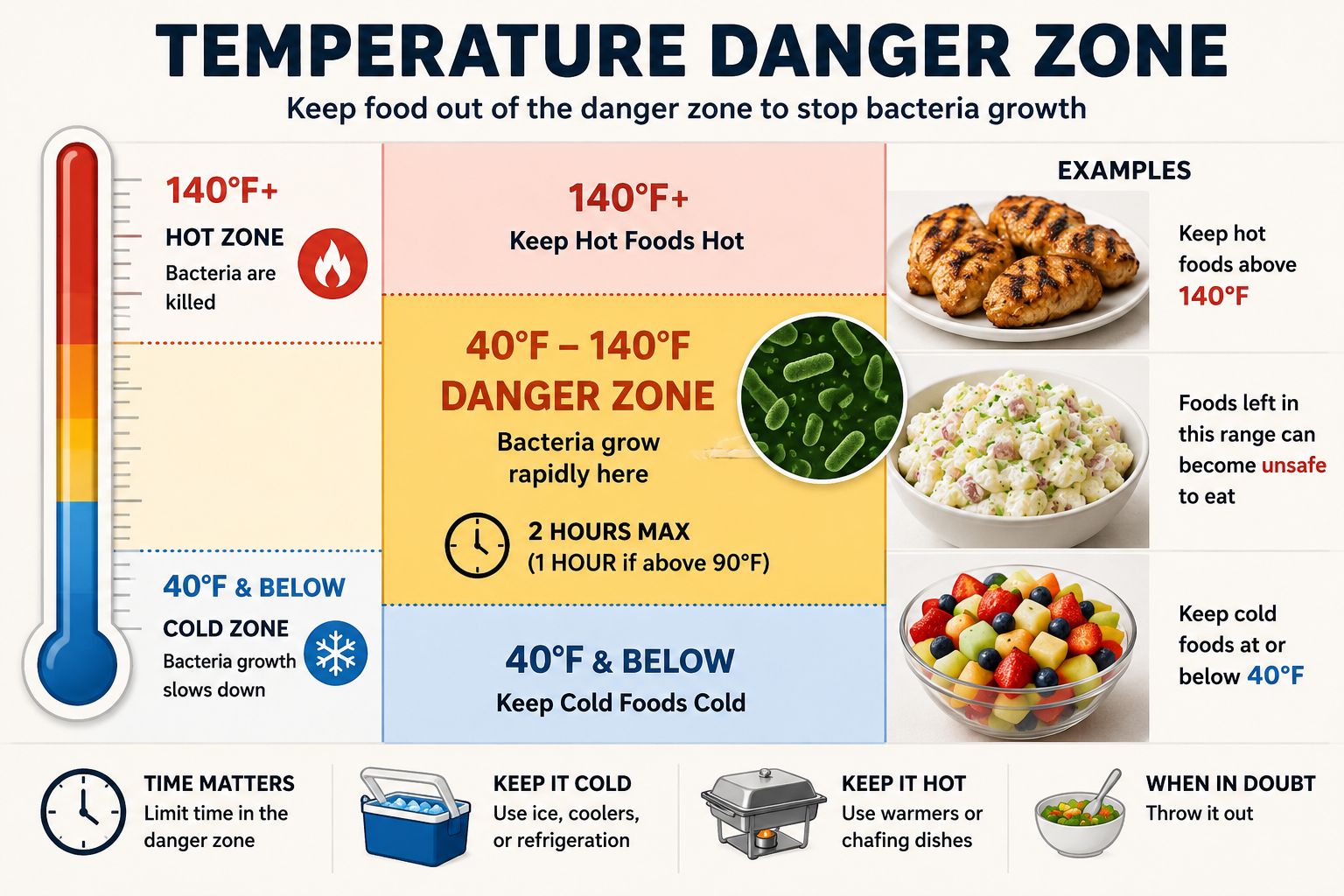
Food Safety at Summer Parties: What the Heat Actually Does to Your Buffet There’s a specific set of conditions that summer outdoor parties create for food safety that indoor entertaining simply doesn’t replicate. Ambient temperatures of 85-95°F, direct sunlight beating down on serving dishes, food sitting out for hours while guests graze casually, and the social dynamics of a party where nobody wants to be the person who announces that the potato salad has been sitting out too long — all of these combine into a situation where foodborne illness risk is meaningfully higher than most hosts realize or want to acknowledge. The statistics behind summer food poisoning are not reassuring. The CDC estimates that roughly 48 million Americans experience foodborne illness each year, with cases spiking significantly during summer months when warm outdoor temperatures create ideal conditions for bacterial growth. The connection between summer parties and foodborne illness isn’t coincidental — it’s a predictable consequence of serving temperature-sensitive food in environments where maintaining safe temperatures is genuinely difficult. Understanding what actually happens to food at different temperatures, why the two-hour rule exists and what it’s based on, and which foods carry the most risk under outdoor summer conditions gives you the practical knowledge to host parties where everyone goes home feeling good rather than experiencing the delayed consequences of something that sat in the sun forty-five minutes too long. The Temperature Danger Zone: What It Is and Why It Matters The phrase “danger zone” gets used frequently in food safety contexts without much explanation of what’s actually happening in the food during that temperature range, which makes the guidance feel abstract rather than grounded in something real. What the Danger Zone Is: The temperature range between 40°F and 140°F is where bacteria that cause foodborne illness grow most rapidly. Below 40°F, bacterial growth slows dramatically — cold temperatures don’t kill bacteria, they just make reproduction extremely slow. Above 140°F, most bacteria responsible for foodborne illness die off — the higher the temperature, the faster the kill rate. Between these two points, bacterial populations can double every 20 minutes under ideal conditions. What Doubling Every 20 Minutes Means in Practice: Start with 100 bacteria — an amount invisible and harmless. After 20 minutes in the danger zone: 200. After 40 minutes: 400. After 1 hour: 800. After 2 hours: approximately 6,400. After 4 hours: more than 400,000. The number at which many bacterial pathogens can cause illness in a healthy adult is somewhere in the thousands to tens of thousands range, depending on the specific organism. This is why the two-hour rule exists — it’s not an arbitrary conservative guideline, it’s a reflection of the bacterial growth curve that makes food genuinely dangerous past this window at room temperature. Summer Outdoor Temperature Acceleration: The two-hour rule is calculated for room temperature environments — roughly 70°F indoors. Outdoors in summer, ambient temperatures of 85-95°F are common, and direct sunlight can raise the surface temperature of serving dishes and food significantly above ambient air temperature. At 90°F ambient, the two-hour window compresses to approximately one hour. At temperatures above 90°F, the FDA and USDA recommend discarding perishable food after just one hour outdoors. This is the detail most summer party hosts don’t know and that makes outdoor summer entertaining significantly higher risk than typical room-temperature indoor serving. What High Heat Does to Different Food Categories Not all party foods carry equal risk in summer heat, and understanding which categories are most vulnerable helps you make targeted decisions about what needs the most protection rather than applying uniform anxiety to everything on the table. High Risk: Protein-Based Dishes Protein-rich foods — particularly those containing eggs, dairy, meat, and fish — provide ideal growth environments for the bacteria most commonly responsible for foodborne illness: Salmonella, Staphylococcus aureus, Listeria, and E. coli. Egg-Based Dishes: Potato salad, egg salad, macaroni salad with mayonnaise, deviled eggs, and similar preparations are among the highest-risk summer party foods. The combination of protein from eggs, fat from mayonnaise, and starchy carbohydrates from potatoes or pasta creates a nutrient-dense environment that supports rapid bacterial growth. The commercial mayonnaise itself — which contains vinegar and is quite acidic — is not the risk factor that most people assume. Eggs, potato, and any other protein additions in these salads are where the risk lives. Myth Correction: Many people believe that mayonnaise causes these salads to spoil quickly, when actually commercial mayonnaise’s acidity is a mild preservative. The problem is everything mixed with the mayonnaise, not the mayonnaise itself. However, this distinction doesn’t meaningfully change the food safety calculus — potato salad in the sun for three hours is dangerous regardless of what’s causing the danger. Cooked Meats: Grilled chicken, pulled pork, sliced brisket, and similar proteins that are cooked and then held for serving represent significant risk when they drop below 140°F and enter the danger zone. The challenge with cooked meats at outdoor parties is that they often start at serving temperature and cool through the danger zone gradually over the course of the party. Chafing dishes and covered serving vessels help maintain temperature, but without active heat sources, cooked meats cool to dangerous temperatures faster than hosts typically account for. Dips Containing Dairy or Protein: Queso dip, buffalo chicken dip, cream cheese-based dips, and similar preparations need active temperature maintenance. These are frequently served in the same bowl or slow cooker insert from the moment guests arrive until the party ends — a window that can easily exceed two to three hours at outdoor temperatures. Moderate Risk: Dairy-Based Items Dairy products — cheese boards, sour cream, cream cheese, whipped cream — carry moderate risk that varies significantly based on moisture content and preparation form. Cheese: Hard cheeses like aged cheddar, parmesan, and similar low-moisture varieties are considerably more stable at room temperature than soft cheeses. A properly aged hard cheese can sit at room temperature for 2-3 hours without significant safety concern. Soft cheeses — brie, camembert, fresh mozzarella, ricotta,