
Products

The COS-DIC366 Gas Cooktop: 36-Inch Drop-In with Six Italian-Made Sealed Burners

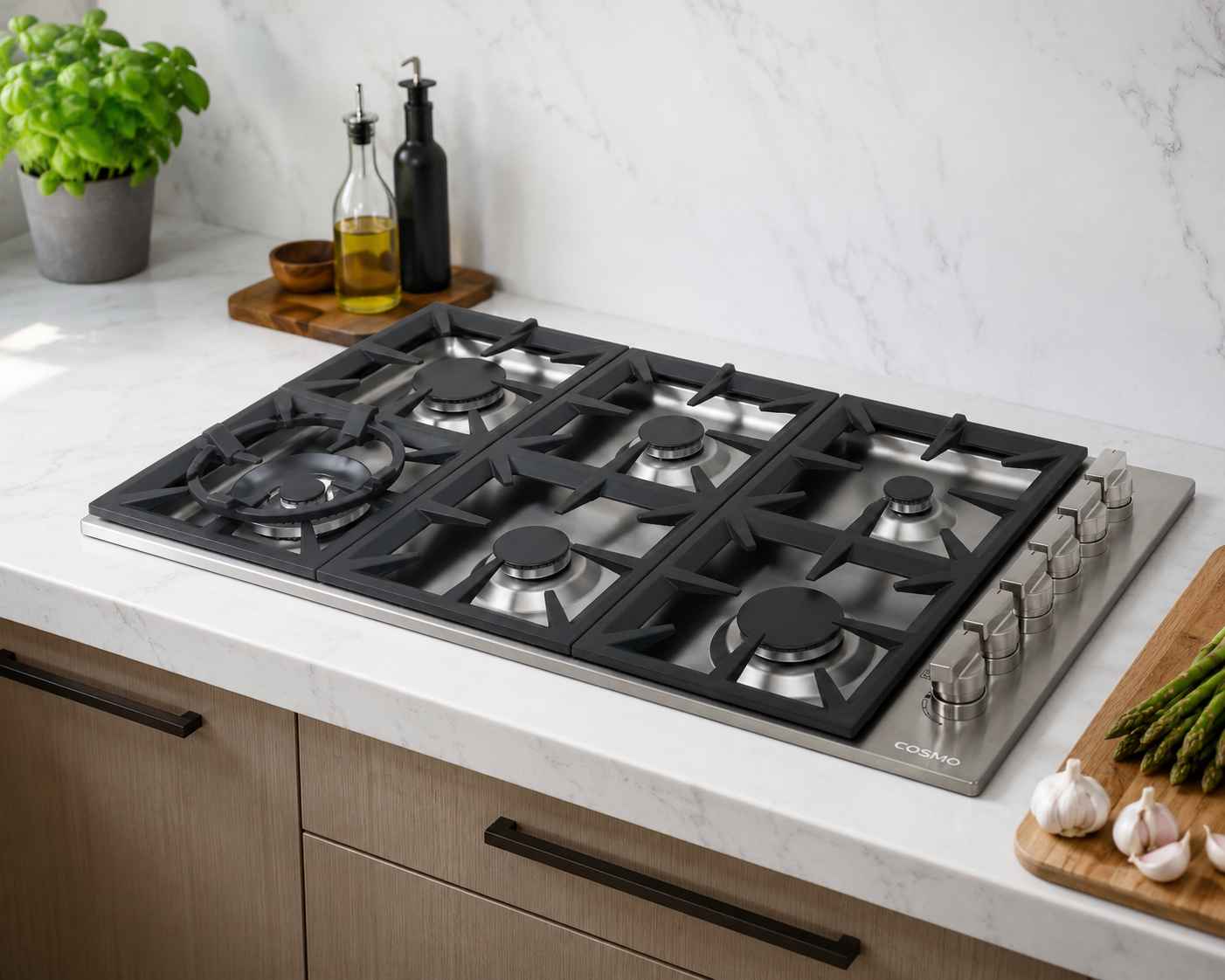
Drop-in gas cooktops that pair serious burner quality with a clean design approach are harder to find than the market’s volume of options suggests. The COS-DIC366 positions itself through a specific combination: six sealed Italian-made gas burners across a 36-inch stainless steel surface, with controls mounted on the side rather than the front, and cast iron grates spanning the full cooktop width. The side control placement is the detail that defines this cooktop’s aesthetic, the surface reads as an almost uninterrupted field of grates and burners, without the control knob band across the front that most cooktops use. This matters particularly for kitchen island installations where the cooktop is viewed from multiple angles simultaneously, and for modern kitchen designs where a cleaner surface line above the countertop is a genuine design priority. The Italian-made burner specification reflects the same sourcing decision found in several Cosmo ranges and the DIC304, a commitment to burner quality through manufacturing heritage rather than just specification numbers. Six burners across 36 inches provides the simultaneous cooking capacity that serious meal preparation demands without the 48-inch footprint of the largest configurations, fitting standard 36-inch countertop openings and pairing naturally with 36-inch range hoods. LP conversion capability makes the cooktop available to homes using liquid propane rather than natural gas, and the metal constructed knobs and stainless steel surface complete a build that prioritizes durability alongside the design clarity that the side-control approach achieves. The Side Control Distinction Most drop-in cooktops position all control knobs across the front edge, creating a consistent product language that’s familiar and functional. The COS-DIC366’s side-mounted controls represent a deliberate departure that produces specific aesthetic and practical outcomes worth understanding. Surface Continuity: Moving controls to the side allows the cooktop’s main surface to present as an uninterrupted plane of grates and burners from front to back. Viewing the cooktop from above, the angle most visible during cooking and most prominent in kitchen photography, the absence of a front control band creates a cleaner, more considered appearance than front-control designs achieve. For kitchen design where countertop aesthetics are a genuine priority, this difference is meaningful. Island Installation Advantage: Kitchen island cooktops are viewed from all four sides, from the front, from the sides, and across the surface during cooking. Standard front-mounted controls work ergonomically when the cook faces the front, but they interrupt the sight line from other angles. Side controls allow anyone approaching the island from the front to see an unbroken surface before reaching the controls on the side, creating a more intentional appearance from all viewing angles simultaneously. Reach and Operation: Side controls require reaching slightly to the side rather than straight forward to adjust burners. For most cooking situations this is a non-issue and becomes entirely natural within the first week of cooking on the unit. The adjustment in reach habit is minor and quickly becomes automatic, while the visual benefit of the cleaner surface persists throughout ownership. Design Versatility: The side-control configuration suits both contemporary and transitional kitchen designs where visual continuity across countertop surfaces is valued. It works particularly well when the cooktop’s stainless surface is meant to integrate with adjacent countertop materials, granite, quartz, or marble, without the control band creating a visual break at the front edge. Italian-Made Sealed Burners The six burners in the COS-DIC366 carry the Italian-made designation that appears across Cosmo’s premium gas cooktop and range offerings — a specification with practical implications for cooking performance that go beyond the brand origin. Manufacturing Precision: Italian gas burner production, particularly for the residential and commercial cooking appliance market, has developed through decades of precision engineering focused specifically on flame consistency, low-end stability, and reliable ignition across thousands of use cycles. The manufacturing tolerances in Italian-made burners typically exceed those of mass-market alternatives, producing more consistent flame patterns and more reliable performance throughout the burner’s operational life. Flame Quality Across the Range: The cooking difference that Italian burner quality produces is most noticeable at the extremes of the operating range — at minimum output where stable, even low flames are required for delicate simmering, and at maximum output where consistent, even flame distribution across the full burner crown matters for high-heat cooking. Both extremes benefit from the tighter manufacturing tolerances that quality Italian burner production delivers compared to less precisely made alternatives. Six-Burner Configuration: Distributing six Italian-made burners across 36 inches provides a burner arrangement that covers the full range of simultaneous cooking needs — high-heat tasks on the power burners, medium-heat general cooking on mid-range burners, and gentle simmering on the lower-output positions. Having six zones available means no waiting for burners, no juggling between tasks, and no compromise on heat level for any given dish while other components cook simultaneously. Sealed Construction: All six burners use sealed design, preventing cooking spills from reaching internal burner components. The sealed surface keeps mess on the stainless steel cooktop surface where wiping it up is straightforward, rather than allowing liquids to reach internal gas ports and components where they cause corrosion and clogging over time. For a six-burner cooktop where multiple spills during active meal preparation are the norm, sealed construction’s maintenance advantage compounds significantly over the cooktop’s lifespan. Cast Iron Grates The heavy-duty cast iron grates spanning the COS-DIC366’s full 36-inch surface provide the structural and thermal foundation that serious gas cooktop cooking requires. Continuous Grate Surface: A single connected grate system across all six burners allows sliding heavy cookware between positions without lifting — a practical advantage that accumulates into genuine daily convenience for anyone using large stockpots, heavy cast iron pans, or oversized cookware that would be awkward to lift and reposition. Moving a full pasta pot from the high-heat boiling position to a lower-heat holding position requires no lifting, reducing spill risk and physical strain. Thermal Mass and Stability: Cast iron’s substantial thermal mass absorbs heat from burner flames and distributes it more evenly to cookware bases than lighter grate materials manage. This thermal buffer moderates the temperature fluctuations that

The COS-2PKG-800 Outdoor Grill and Cabinet Package: Build Your Fourth of July Setup Around It

Most backyard cooking setups are assembled piecemeal — a grill here, a side table there, a propane tank sitting visibly on the patio because there’s nowhere designated to put it. The result works functionally but looks improvised in a way that doesn’t match the effort that goes into the cooking itself. The COS-2PKG-800 solves this as a single decision: the COS-BGGN325K 32-inch propane gas grill paired with the COS-GCN323SS stainless steel grill cabinet, designed to work together as a complete outdoor cooking station. Part of the Cosmo Newport Collection — the lineup positioned at the premium end of the outdoor cooking range — this package brings together serious burner technology with the storage and mobility infrastructure that makes managing a full-scale holiday cookout genuinely organized. Four main burners including both conventional and infrared configurations, a motorized rotisserie for whole cuts, LED-lit knobs for evening grilling, interior halogen lighting, a built-in thermometer, 304-grade stainless steel construction throughout, and a cabinet with two drawers, dedicated propane storage, and four casters with lockable brakes. For the Fourth of July specifically — a day that runs from midday through fireworks, demands volume cooking across multiple daylight and evening sessions, and benefits from a setup that looks as intentional as it performs — this combination handles the full scope of the event rather than just part of it. The Newport Collection and What It Signals Newport Collection positioning within the Cosmo lineup reflects a specific set of priorities: technology additions that serve real cooking purposes, construction quality that handles outdoor exposure over years of use, and design refinement that brings outdoor cooking stations closer to the standard set by indoor kitchen appliances. The Newport Collection’s design approach treats outdoor cooking equipment with the same seriousness as indoor kitchen appliances — premium 304-grade stainless steel rather than painted alternatives, LED indicator lighting that serves a practical nighttime cooking purpose rather than purely aesthetic function, and engineering details like the motorized rotisserie and infrared rear burner that address specific cooking needs rather than just adding to a feature count. For buyers building an outdoor kitchen or serious patio cooking setup, the Newport Collection represents the tier where premium outdoor cooking actually begins. For the Fourth of July, this positioning matters practically. A holiday that starts at noon and ends well after dark, hosts more guests than any typical weekend gathering, and requires the grill to perform at its best for hours without issues is exactly the context where cutting corners on equipment quality reveals itself most inconveniently. Four Main Burners with Infrared Technology The COS-BGGN325K’s burner configuration is more sophisticated than a simple BTU total suggests, and understanding the different burner types and their outputs explains how this grill handles the range of cooking tasks a Fourth of July spread demands. Three 12,000 BTU Conventional Burners: These are the workhorses of the cooking surface — the burners that handle the continuous volume of burgers, chicken pieces, hot dogs, corn, and everything else that cycles through a holiday grill throughout the day. At 12,000 BTU each, they provide strong, consistent heat for high-heat searing and thorough cooking across the conventional grill zones. Three burners across 32 inches gives you a full conventional cooking surface with independent zone control — high heat on one end, medium on the middle, lower on the far end — that allows managing multiple items at different stages simultaneously. 10,000 BTU Infrared Burner: The infrared burner operates through radiant heat rather than the convective flame of a conventional burner. Infrared heat transfers more directly to food surfaces, producing faster and more intense searing with less heat lost to surrounding air. For searing steaks or any protein where a hard, fast crust is the goal before finishing at lower heat, the infrared burner delivers a level of surface browning intensity that conventional burners at similar BTU output don’t match. On a holiday where you might be serving steaks or thick-cut burgers to guests who specifically want them seared properly, this burner matters. 13,500 BTU Infrared Rear Rotisserie Burner: The rear-mounted infrared burner works in conjunction with the motorized rotisserie, heating from behind while the rotisserie rotates food through the heat zone. Infrared positioning for rotisserie is specifically valuable because it produces even radiant heat across the full circumference of rotating food — every rotation brings a new surface into proximity with the infrared source. This produces more consistent exterior browning and more even cooking than conventional rear burners, which heat unevenly relative to rotating food’s varying surface exposure. Motorized Rotisserie Kit For the Fourth of July specifically, the motorized rotisserie is the grill feature most likely to produce a showstopper centerpiece that distinguishes the event from a standard cookout. What Rotisserie Cooking Does: Rotisserie cooking works through the continuous rotation of food through a heat zone, basting the food in its own rendered fat and juices with every revolution. This self-basting effect produces results that stationary grilling can’t replicate — a whole chicken that’s juicy and evenly browned on every surface, a roast that develops consistent exterior caramelization all the way around without dry patches from uneven heat exposure. The rotation prevents the side closest to the heat from overcooking while the far side stays undercooked, producing an even result that requires no intervention once the rotisserie is running. Fourth of July Applications: Whole chickens are the classic rotisserie presentation — visually impressive, deeply flavorful, and capable of feeding four to six people per bird. A whole rotisserie chicken on a Fourth of July spread creates exactly the kind of centerpiece that guests remember. Bone-in leg of lamb, pork shoulder, whole turkey breast, and large rib roasts all benefit similarly from rotisserie treatment. For a holiday crowd, running the rotisserie from mid-afternoon produces food ready for a prime dinner window while requiring minimal active attention — the motorized rotation handles itself while you manage the conventional burners for faster-cooking items. Motorized vs. Manual: The motorized designation matters because rotisserie cooking is fundamentally a low-attention

The C51EIX Compact Wall Oven: 24-Inch with Turbo True Convection and Triple Layer Glass

Not every kitchen has the space, or the need, for a 30-inch wall oven. Smaller kitchens, secondary cooking stations, condos, and households that don’t require the largest available oven capacity are better served by a more compact footprint that still delivers genuine convection performance rather than a stripped-down version of larger models. The C51EIX fills exactly this space: a 24-inch built-in single wall oven with 2.5 cubic feet of capacity, eight oven functions, Turbo True Convection, and triple layer glass construction, controlled through a straightforward combination of knobs and push buttons rather than an all-touchscreen interface. What distinguishes the C51EIX within Cosmo’s oven lineup is the combination of genuine convection technology and safety-focused construction in a compact size class where these features aren’t always standard. The same fan-assisted circular heating element that distributes heat evenly in larger ovens is present here at the 24-inch scale. Triple layer glass on the door provides better insulation and a cooler exterior surface during operation than single or double-pane alternatives. An auto-off safety feature adds a layer of protection relevant to any household, but particularly valuable in kitchens where the oven might be used by less experienced cooks or where the unit operates somewhat out of the way of regular kitchen traffic and attention. Why 24-Inch Wall Ovens Serve a Real Need Wall oven buying guides default to discussing 27-inch and 30-inch models because they’re the most common sizes in larger kitchens, but the 24-inch category addresses genuine constraints that a meaningful number of kitchens face. Compact Kitchen Footprints: Condos, smaller homes, and kitchens with limited cabinet runs often can’t accommodate a 30-inch wall oven cutout without sacrificing other essential storage or workspace. The C51EIX’s 24-inch width fits into a smaller cabinet allocation, making built-in oven installation achievable in kitchens where the larger size simply wouldn’t fit without compromising the rest of the layout. Secondary Cooking Stations: Households building a butler’s pantry, an outdoor kitchen extension, a basement kitchenette, or a secondary prep area benefit from a smaller, dedicated oven that doesn’t require the capacity of a primary household oven. The C51EIX provides genuine baking and roasting capability for these secondary spaces without the footprint commitment of a full-size oven. Two-Oven Configurations Without the Double Oven Commitment: Some households want the flexibility of two ovens — one for everyday use and one for additional capacity during entertaining — without installing a full double wall oven unit. Pairing a primary 30-inch oven with a separate 24-inch C51EIX in another part of the kitchen achieves this flexibility through two independent appliances rather than a single stacked unit, which can work better in kitchens where the cabinetry layout doesn’t accommodate a double oven cutout in one location. Right-Sized Capacity: Not every household needs 5+ cubic feet of oven space. Smaller households, those who cook primarily for one or two people, or anyone whose oven use skews toward smaller dishes rather than large roasts or sheet pans benefits from a 2.5 cubic foot cavity that’s proportional to actual usage rather than oversized for the household’s typical needs. Turbo True Convection at the 24-Inch Scale The C51EIX brings genuine convection technology into the compact oven category, a meaningful distinction from basic ovens at this size that sometimes omit true convection in favor of simpler, less expensive heating systems. What Turbo True Convection Means: Unlike basic convection that simply adds a fan to circulate existing oven heat, Turbo True Convection includes a dedicated circular heating element positioned around the fan. This element heats air directly as the fan circulates it, rather than relying solely on the oven’s main heating elements to warm air that the fan then moves around. The result is more uniform temperature distribution throughout the cavity — front to back, top to bottom — than fan-only convection systems achieve. Why This Matters in a Smaller Cavity: It might seem like convection matters less in a smaller oven cavity since there’s less distance for heat to travel and less opportunity for temperature variation. In practice, smaller cavities can actually show more pronounced hot and cold spots without proper convection because food items often occupy a larger percentage of the available airflow path, creating more significant disruption to heat circulation than the same items would in a larger cavity. Genuine convection technology compensates for this more effectively than basic fan circulation alone. Practical Baking Improvements: Even at 2.5 cubic feet, the C51EIX’s convection system improves results for baked goods that benefit from consistent heat — cookies that brown evenly without rotation, small roasts that cook through without overdone exteriors, and multi-item baking where you’re using the available rack space efficiently despite the more limited cavity size. Faster Cooking Through Efficient Heat Transfer: Convection’s active air movement transfers heat to food more efficiently than static radiant heat, typically reducing cooking times by 20-25% or allowing lower temperatures for equivalent results. This efficiency matters in any oven size but contributes meaningfully to the C51EIX’s practical usability for everyday cooking tasks where time matters. Eight Oven Functions in a Compact Package The C51EIX includes eight distinct oven functions, providing the same breadth of cooking methods found in considerably larger and more expensive ovens, scaled appropriately to the 2.5 cubic foot cavity. Bake: Conventional radiant heat cooking through bottom and top elements, used for recipes developed with traditional ovens in mind. This is the baseline function for most baked goods and remains unaffected by the oven’s compact size in terms of results. Convection Bake: Fan-assisted baking with the Turbo True system active, providing the even heat distribution benefits described above. The everyday function for most cooking tasks where consistent results across the cavity matter. Convection Roast: Optimized element and fan combination for developing surface browning on smaller roasts, vegetables, and proteins sized appropriately for the 2.5 cubic foot cavity. Whole chickens, smaller roasts, and sheet pan vegetable preparations all benefit from this mode’s emphasis on exterior browning alongside thorough cooking. Broil: Top element at maximum intensity for direct overhead heat — finishing

The COS-RFFV183RS French Door Refrigerator: 30-Inch with 17.5 Cu. Ft. Capacity

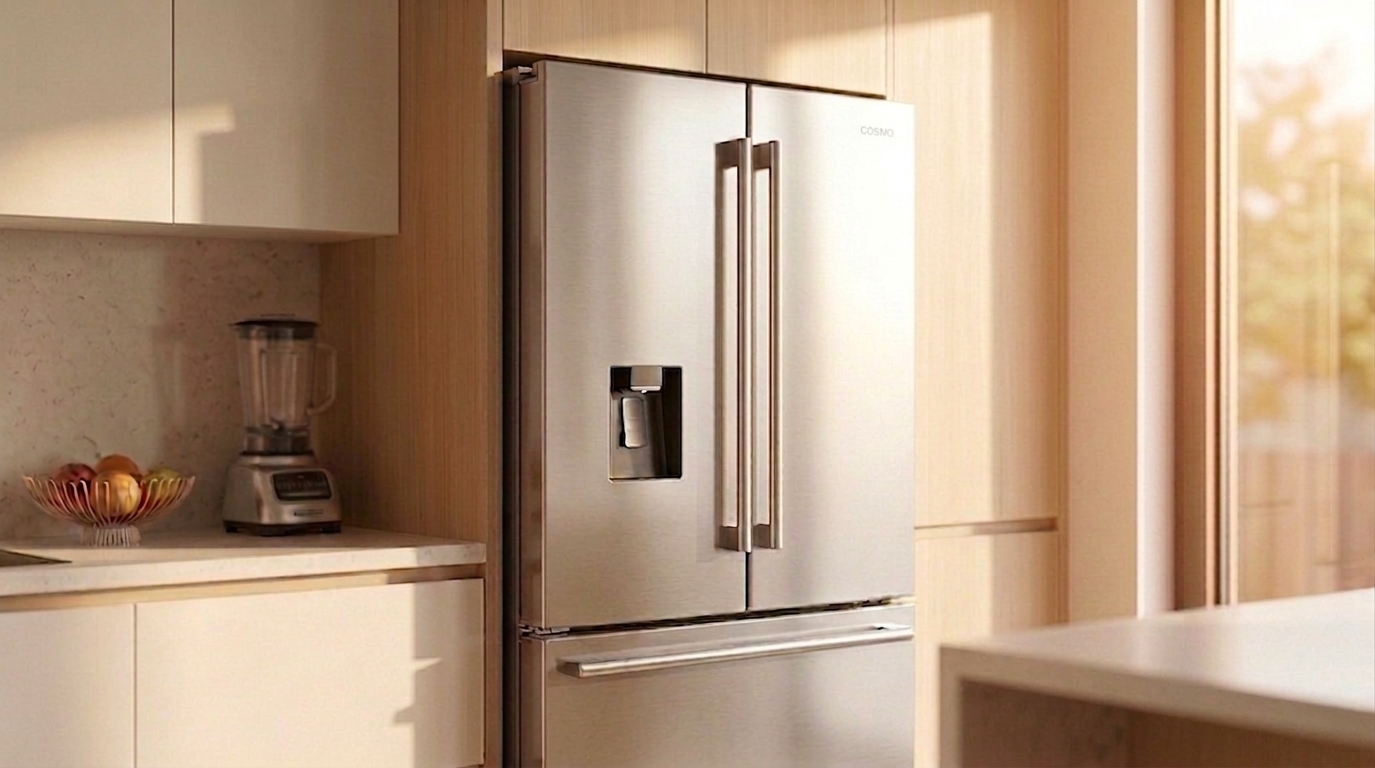
Not every kitchen has room for a 36-inch refrigerator, and not every household needs 22-25 cubic feet of cold storage to feel adequately equipped. The COS-RFFV183RS addresses the segment of the market that the larger French door refrigerators overlook, a genuine 30-inch width that fits standard kitchen openings without requiring cabinet modification, paired with 17.5 cubic feet of capacity that comfortably serves smaller households, secondary kitchens, condos, and any space where a full-size 36-inch refrigerator simply won’t fit. What makes this more than a scaled-down version of a larger refrigerator is that it retains the same core feature set that makes French door refrigerators desirable in the first place. Electronic temperature controls manage refrigerator and freezer zones precisely. Adjustable shelves let you reconfigure the interior as storage needs change. LED lighting illuminates the cavity efficiently. A built-in ice maker eliminates manual tray filling. A controllable alarm setting alerts you if doors are left ajar. The French door design itself provides the same ergonomic and access advantages found in larger models, narrower door swing for tight kitchens, eye-level access to the full refrigerator section, and a bottom freezer that keeps everyday items within easy reach. Why 30-Inch Width Matters for a Meaningful Segment of Buyers Refrigerator width is one of the most consequential measurements in kitchen design, dictating not just whether a unit physically fits but how much surrounding cabinetry needs to accommodate it. Standard Kitchen Openings: Many kitchens — particularly those in condos, smaller homes, older construction, and secondary residences — were built around 30 to 33-inch refrigerator openings rather than the 36-inch standard that larger French door models require. Installing a 36-inch refrigerator into a 30-inch opening means cabinet demolition and rebuilding, an expense and disruption that many buyers want to avoid. The COS-RFFV183RS fits these existing openings directly, making replacement straightforward without renovation. Apartment and Condo Applications: Multi-family housing units consistently use smaller kitchen footprints than single-family homes, and refrigerator openings in these spaces are sized accordingly. A 30-inch French door option gives buyers in these spaces access to French door styling and functionality that was previously only available in widths too large for their kitchens, without forcing a compromise to a side-by-side or top-freezer configuration. Secondary Kitchens: Guest houses, in-law suites, finished basements, and vacation properties often need full refrigeration without requiring the capacity of a primary household refrigerator. The COS-RFFV183RS provides genuine French door functionality at a size and capacity appropriate for these secondary spaces, where a 22+ cubic foot refrigerator would be excessive for the household size using that space. Households of One or Two: Single-person and two-person households frequently find that larger refrigerators leave substantial unused space, particularly in the refrigerator section where food spoilage risk increases the longer items sit unused. A right-sized 17.5 cubic foot refrigerator matches storage capacity to actual consumption patterns more accurately, potentially reducing the food waste that comes from storage space exceeding realistic grocery rotation. Proportional Kitchen Design: In smaller kitchens generally, a 36-inch refrigerator can visually dominate the space in ways that feel disproportionate to the room’s overall scale. A 30-inch refrigerator maintains better visual balance in compact kitchens, avoiding the oversized appliance feeling that occurs when refrigerator width exceeds what the surrounding kitchen proportions suggest. French Door Design at This Scale The French door configuration delivers the same functional advantages in the 30-inch COS-RFFV183RS that it provides in larger models, with some specific considerations relevant to the smaller footprint. Narrower Door Swing: Each door opens to roughly half the width of a full-width single door, requiring less clearance space in front of the refrigerator than traditional single-door designs. This matters particularly in smaller kitchens where floor space is already constrained — the reduced door swing radius means the refrigerator doesn’t require as much open floor area to operate, an advantage that compounds in compact kitchen layouts. Eye-Level Refrigerator Access: Positioning the refrigerator section at the top, accessible through both French doors, keeps the most frequently accessed storage at eye level rather than requiring bending to reach lower shelves. This ergonomic benefit applies regardless of refrigerator size, but it’s particularly valuable in smaller kitchens where users may not have alternative storage solutions to compensate for awkward refrigerator ergonomics. Bottom Freezer Placement: The freezer section sits below the refrigerator, accessed through a pull-out drawer or door depending on the specific configuration. Bottom freezer designs keep the more frequently used refrigerator section at the more convenient height, while freezer items — generally accessed less often during a typical day — sit in the lower position. Single Combined Cavity Efficiency: At 17.5 cubic feet total, the COS-RFFV183RS divides this capacity between refrigerator and freezer sections in proportions designed for typical household usage patterns, where refrigerated items significantly outnumber frozen items in daily consumption. This allocation makes the available capacity work harder for typical grocery and meal planning patterns rather than allocating space evenly between sections regardless of actual usage. Electronic Temperature Controls Precise temperature management matters as much in a 17.5 cubic foot refrigerator as it does in larger models, and the COS-RFFV183RS delivers this through the same electronic control approach found across Cosmo’s refrigerator lineup. Digital Precision: Electronic controls allow setting exact target temperatures rather than the vague positioning that mechanical dial thermostats provide. This precision matters for food safety — maintaining the refrigerator section within the 37-40°F range that proper food preservation requires, and the freezer at 0°F for safe long-term frozen storage. Independent Zone Management: Refrigerator and freezer sections maintain their target temperatures independently, preventing the compromise where adjusting one section’s cooling inadvertently affects the other. This independence ensures both zones operate at their respective optimal temperatures regardless of how much you’re using either section on a given day. Consistency Through Door Openings: Electronic controls respond more quickly to temperature fluctuations from door openings than older mechanical systems, helping maintain narrower temperature ranges even as doors open and close throughout daily use. This responsiveness matters proportionally more in smaller refrigerators, where the same volume of warm

The COS-63175 Wall Mount Range Hood: 30-Inch Pyramid Design with ARC-FLOW Permanent Filters

The classic pyramid chimney silhouette is the defining shape of the 631 Series, a tapered stainless steel body that narrows from the wide filter section at the bottom to the vertical chimney stack above. It’s a form that reads immediately as a kitchen focal point without the glass canopy or decorative elements that the 668A Series uses to achieve a similar visual effect. The COS-63175 delivers this look in a 30-inch wall mount configuration with push button controls, two front LED lights, two ARC-FLOW permanent stainless steel filters, a backdraft damper, and noise levels as low as 45 dB, built from 20-gauge 430-grade stainless steel throughout. The 631 Series covers six models across 30-inch and 36-inch widths, with push button and soft touch control variants in both stainless steel and matte black finishes. The COS-63175 is the 30-inch push button stainless model, the foundational configuration that the rest of the series builds from. For kitchens without upper cabinets above the range, or for any layout where the hood will be a visible architectural presence rather than a hidden utility, the pyramid chimney form of the 631 Series creates a kitchen focal point that performs as well as it looks. Why The Pyramid Chimney Design Works The pyramid chimney is the most recognizable silhouette in residential kitchen ventilation, and the 631 Series executes it in a way that suits a wide range of kitchen styles without demanding a specific aesthetic direction. Visual Weight and Proportion: The pyramid form tapers upward from a wide base to a narrow chimney, creating visual weight at the cooktop level where ventilation capture happens and elegance above where the chimney extends toward the ceiling. This proportional relationship works naturally in kitchen spaces where the range sits as a visual anchor, the hood completes the composition rather than competing with it. Stainless Steel Finish: The brushed stainless steel finish coordinates with ranges, cooktops, and other kitchen appliances regardless of brand or series. Stainless steel’s neutrality is one of its core advantages in kitchen design, it neither blends into cabinetry like panel-ready appliances nor fights with surrounding finishes the way colored or decorative hoods can. The 631 Series’ all-stainless construction maintains this versatility across different kitchen color schemes and cabinet finishes. Matte Black Availability: The addition of COS-63175S-BK and COS-63190S-BK matte black variants expands the series for kitchens where black appliances and hardware create a design direction that stainless steel doesn’t coordinate with. Matte black has established itself as a lasting kitchen design choice rather than a trend, appearing across faucets, cabinet hardware, ranges, and refrigerators in contemporary kitchens. Having the pyramid chimney form available in matte black makes the 631 Series applicable to these kitchens without requiring a different product category. Chimney Stack Height: The vertical chimney stack connecting the hood body to the ceiling creates height and structure that wall mount hoods provide and under-cabinet hoods cannot. In kitchens with 9-foot or higher ceilings, this vertical element draws the eye upward and gives the cooking zone a sense of architectural scale. The chimney routes ductwork internally, keeping the wall behind the hood clean rather than requiring exposed ductwork visible from the kitchen. Scale in Kitchens: The 30-inch COS-63175 fits kitchens with 30-inch ranges or cooktops proportionally, providing appropriate visual balance between the hood and the cooking surface below. A hood significantly wider than the cooktop looks disproportionate; one too narrow fails to capture all cooking byproducts from outer burners. The matched sizing of the COS-63175 to standard 30-inch cooking equipment creates the proportional relationship that kitchen design favors. ARC-FLOW Permanent Filter System The two ARC-FLOW permanent stainless steel filters in the COS-63175 deliver the filtration performance that makes wall mount hood ownership practical rather than expensive to maintain. Baffle Construction for Effective Capture: ARC-FLOW filters use a baffle design where stainless steel layers are arranged to create a changing-direction path for air passing through. Grease-laden air hits these baffles repeatedly, causing grease particles to condense and collect on the metal surfaces while cleaner air continues through to the ductwork. This multi-stage capture is more thorough than simple mesh screens and maintains effectiveness through repeated cleaning cycles without performance degradation. Two Filters for 30-Inch Coverage: The two filters position side by side to cover the full 30-inch hood width, ensuring complete filtration across the entire capture area. No section of the cooking surface below goes unfiltered, both filters together provide continuous coverage from edge to edge of the hood. Dishwasher Cleaning: Remove filters by releasing their retention clips and place them directly in the dishwasher. A normal wash cycle with standard detergent dissolves accumulated grease thoroughly, restoring filter performance without scrubbing or soaking. This cleaning method is fast and effective, removing the barrier that makes some homeowners avoid filter maintenance until performance degrades noticeably. Unlimited Service Life: Stainless steel baffles don’t degrade from cleaning cycles the way aluminum mesh or activated charcoal filters do. The same filters that came with the hood perform identically after years of use and regular washing. No replacement schedule, no recurring filter costs, no performance loss from cumulative cleaning, just periodic dishwasher cleaning and reinstallation. Long-Term Cost Advantage: Replacement filters for hoods using disposable aluminum or charcoal filters cost $15-40 each, recommended every 3-6 months. Over the typical 10-15 year lifespan of a quality range hood, this represents $300-800 in filter replacement costs that permanent ARC-FLOW filters eliminate entirely beyond the negligible cost of dishwasher detergent during cleaning sessions. Three Fan Speeds and Push Button Controls The COS-63175’s push button control interface manages three fan speeds covering the full range of ventilation needs from background maintenance to heavy-duty extraction. Low Speed: Background ventilation during light cooking, warming dishes, gentle simmering, general stovetop use that generates minimal smoke and steam. Low speed runs at the hood’s quietest operating level, maintaining adequate air exchange without the noise increase of higher speeds. Running low speed consistently during any stovetop use removes accumulated background cooking odors and prevents gradual grease buildup on nearby surfaces even

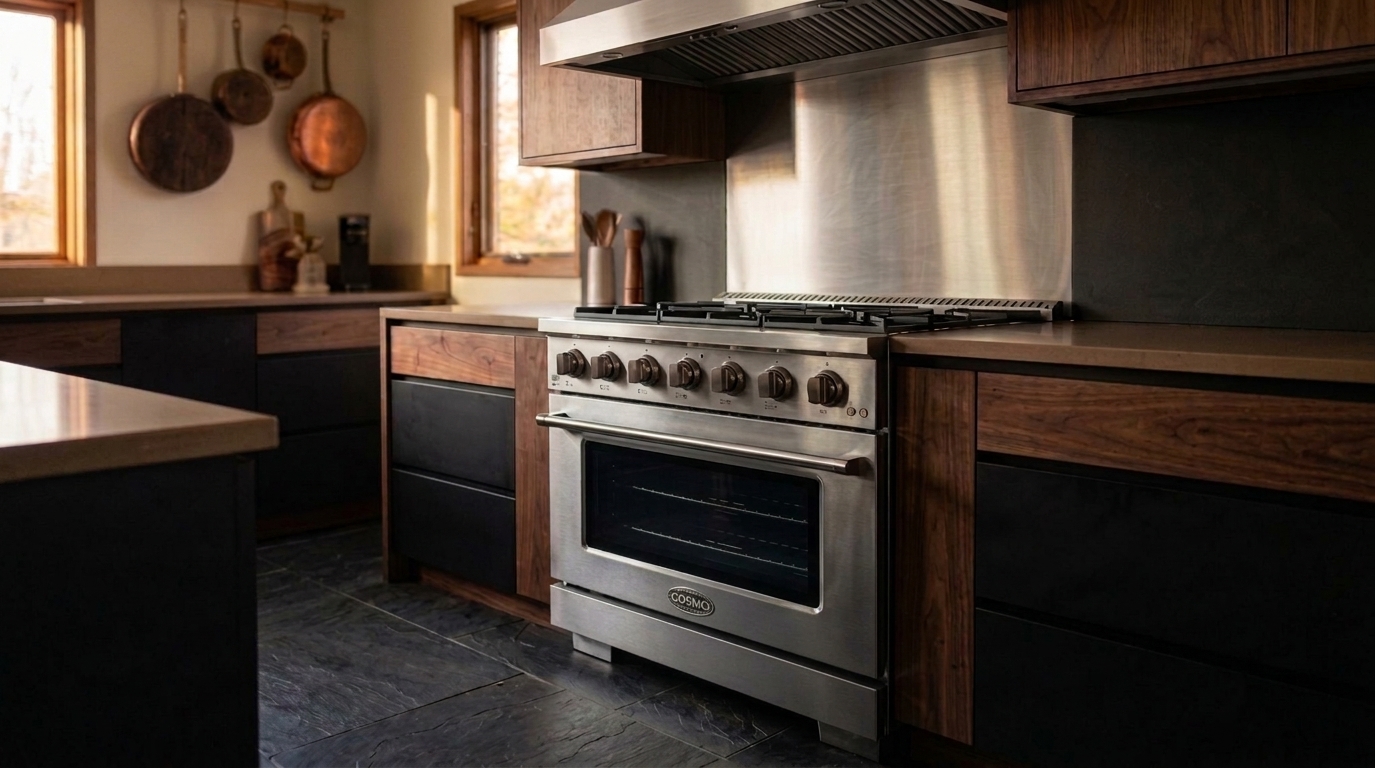
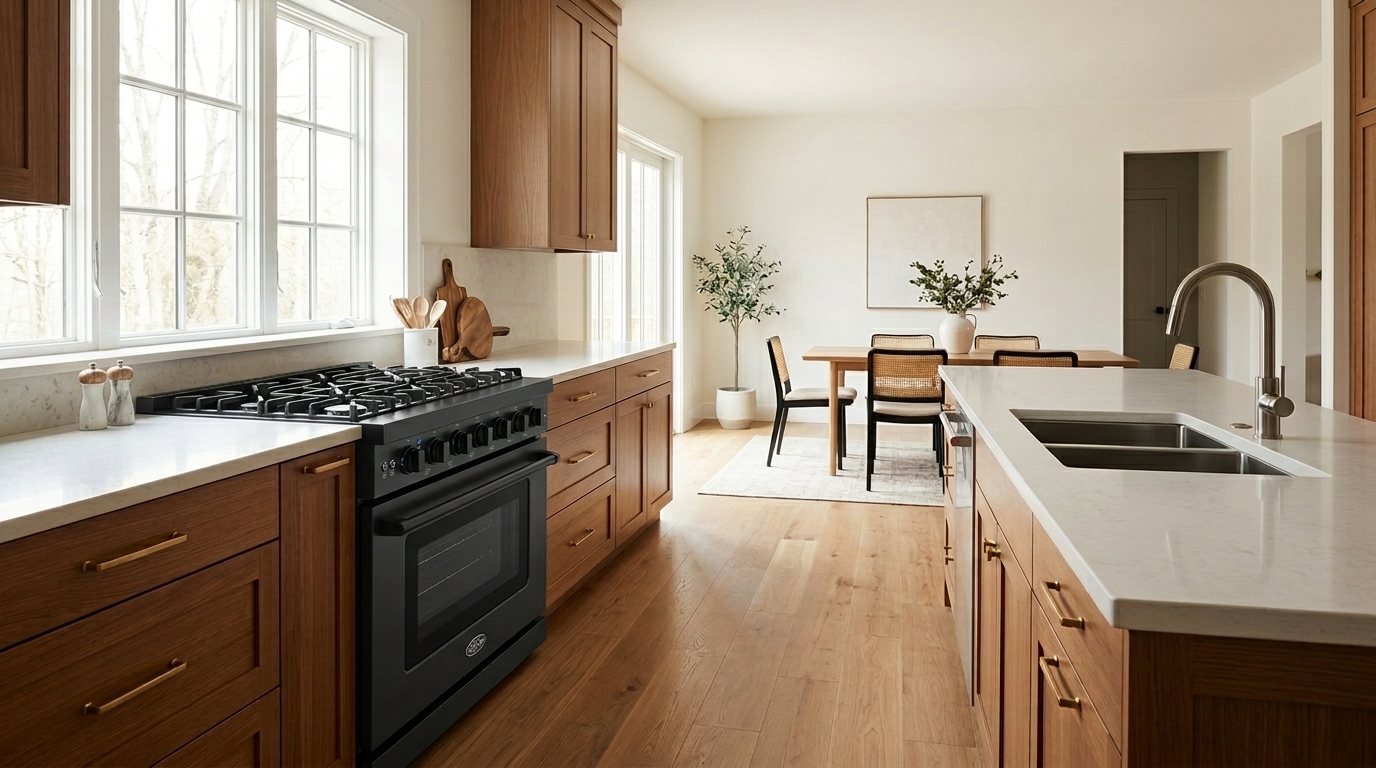
The COS-GRC305KTD Gas Range: 30-Inch with 6.1 Cu. Ft. Air Fry Oven and Self-Clean

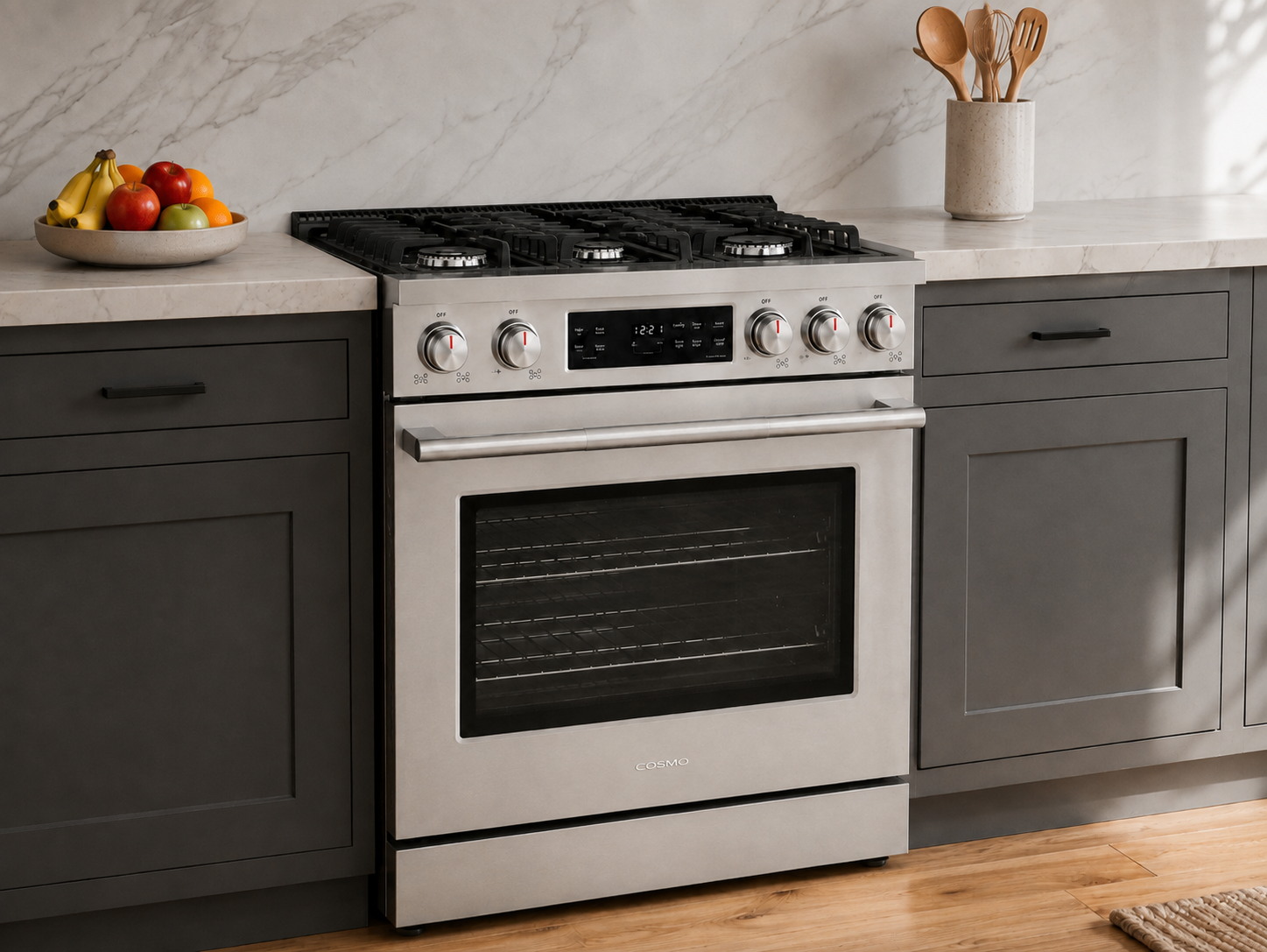
Most ranges are bought for their cooktop and treated as though the oven is just along for the ride. The COS-GRC305KTD from Cosmo’s KTD Series inverts this assumption, the oven is the headline. At 6.1 cubic feet it’s one of the largest single oven cavities available in a 30-inch range, and it includes a built-in air fry function that handles what countertop air fryers do, but in a 6.1 cubic foot space rather than a 5-quart basket. The five sealed gas burners handle everything the stovetop needs, including high-heat cooking with cast iron grates providing the stability and heat distribution that serious cooking demands. Eight oven functions, self-cleaning, a digital display with clock and timer, a lower storage drawer, and LP convertibility round out a range that covers serious ground for everyday cooking without requiring a premium kitchen budget to access it. The KTD Series targets households that cook regularly across a range of methods, weeknight dinners on the stovetop, weekend baking in the oven, and air-fried foods that have become a regular part of how a lot of people cook now. Having a dedicated countertop air fryer alongside a full range solves the problem, but it costs counter space and creates another appliance to maintain. Building air fry directly into the oven cavity is a more practical solution that keeps the counter clear while expanding what the oven can do beyond conventional cooking functions. Why 6.1 Cubic Feet Changes What the Oven Can Handle Oven capacity is one of those specifications that sounds straightforward but reveals its importance only when you’re trying to cook something that doesn’t fit. Scale Context: Standard 30-inch ranges typically offer oven cavities in the 4.8-5.4 cubic foot range. The COS-GRC305KTD’s 6.1 cubic feet sits meaningfully above this, roughly 15-25% more usable space than typical competitors in the same width class. In practical terms, this difference shows up when you’re fitting a 20-pound turkey with clearance around it for hot air circulation, when you’re running two full sheet pans simultaneously without stacking them too close together, or when you want to roast a large prime rib alongside a pan of vegetables without compromise. Multi-Rack Cooking: The larger cavity creates more vertical space between rack positions, which matters significantly when baking multiple items simultaneously. Racks too close together restrict heat circulation and produce uneven browning, particularly a problem for baked goods. The 6.1 cubic foot cavity allows generous spacing between racks while still accommodating multiple levels of cooking, making the oven genuinely functional as a multi-rack cooking environment rather than technically capable but practically frustrating. Air Fry Capacity Advantage: The built-in air fry function benefits from the large cavity more than any other oven mode. Countertop air fryers work through a small basket that limits batch size, a family of four often needs multiple batches to air fry enough chicken wings or fries for everyone. The 6.1 cubic foot oven air fries in the full cavity space with multiple racks available, handling quantities that would require three or four countertop air fryer batches in a single run. Entertaining Scale: Holiday cooking, dinner parties, and large family meals consistently exceed what standard oven cavities can accommodate comfortably. The 6.1 cubic foot cavity handles the scale that these occasions require, not as an occasional luxury but as a reliable cooking environment for the events that matter most. Air Fry Function Explained Built-in oven air fry represents a meaningful evolution from the first ovens to offer this feature, and understanding what it actually does helps set realistic expectations for results. How Oven Air Fry Works: Air fry mode runs the convection fan at higher speeds than standard convection, circulating heated air more aggressively around food surfaces. This intense circulation removes surface moisture rapidly, creating the dry-heat environment that produces crispy exterior textures without submersion frying. The combination of high-speed airflow and consistent oven temperatures cooks food through while developing the surface texture that makes air-fried food satisfying. Why Results Differ from Countertop Air Fryers: Countertop air fryers concentrate airflow in a very small space around a basket, creating extremely intense localized heat. Oven air fry works across a larger volume, producing results that are very good but slightly less aggressive in surface crisping than dedicated compact units. The tradeoff is batch size, oven air fry handles significantly more food at once and doesn’t require the constant shaking and monitoring that basket-style air fryers need to cook evenly. Foods That Work Well: Air fry mode in the COS-GRC305KTD handles chicken wings and pieces, frozen foods typically prepared in a conventional oven, french fries and vegetables, fish fillets, and anything where crispy exterior texture with less oil than deep frying is the goal. The larger cavity allows using air fry racks that position food away from the oven floor, maximizing airflow contact with all surfaces simultaneously. Foods Less Suited: Very small items that would fall through oven rack gaps, anything requiring the basket-shaking process that countertop units accommodate easily, and extremely delicate items that can’t handle the aggressive airflow don’t translate as well from basket air fryers to oven air fry mode. For most practical air-frying tasks, however, the oven function performs excellently. Counter Space Benefit: For households that air fry regularly, keeping a dedicated countertop air fryer on the counter means either permanent counter occupation or storing it between uses. The built-in function eliminates this entirely, no countertop appliance, no storage challenge, and no switching between appliances during cooking sessions that involve both oven and air fry. Eight Oven Functions The eight oven functions in the COS-GRC305KTD cover the full range of cooking methods that home kitchens require, from the most basic baking to the specialized functions that make this range distinctive. Bake: Standard radiant baking using bottom and top elements for conventional oven cooking. Recipes developed for traditional ovens work in this mode without timing or temperature adjustments. Most baked goods, cakes, cookies, breads, use this as their baseline function. Convection Bake: Fan-assisted baking distributes heated air throughout

The COS-12MWDSS Microwave Drawer: 24-Inch Built-In with Touch Controls and 11 Power Levels

Countertop microwaves occupy space that most kitchens can’t afford to surrender. They sit on counter surfaces that could be used for food prep, take up real estate near outlets, and create the cluttered appearance that carefully designed kitchens spend significant effort avoiding. Over-the-range microwaves solve the counter space problem but create different ones — they position the microwave uncomfortably high, require reaching over a hot range, and make checking or stirring food genuinely awkward. The COS-12MWDSS takes a different approach entirely, integrating below the counter inside standard cabinetry where it operates as a drawer rather than a door-swing appliance. This 24-inch microwave drawer installs into base cabinetry at counter height or slightly below, opening by sliding outward rather than swinging a door. The top-loading access that results keeps the control panel at counter level and positions the microwave cavity within easy reach without bending or overhead reaching. At 1.2 cubic feet capacity with 1000 watts of power across 11 levels, the COS-12MWDSS handles the full range of microwave tasks — reheating, defrosting, and the four automatic cooking presets for melt, soften, popcorn, and beverage — from a built-in position that preserves counter space entirely. The child lock function prevents accidental operation, and the stainless steel finish integrates with surrounding cabinetry in the same way a dishwasher or built-in oven does: cleanly and without drawing unnecessary attention. Why Microwave Drawer Design Changes Kitchen Ergonomics The drawer format isn’t just an aesthetic variation on standard microwave design. It addresses real ergonomic problems that both countertop and over-the-range microwaves create. Top-Loading Access: When the drawer slides open, the microwave cavity faces upward rather than toward you. You place food in from above and retrieve it from above — the same natural motion as opening a kitchen drawer to retrieve something. This access angle is inherently more comfortable for most people than reaching into a front-loading microwave at counter height, and dramatically better than reaching up into an over-the-range unit positioned above a hot cooking surface. Reduced Spill Risk: Retrieving hot liquids, soups, or sauces from a front-loading microwave requires pulling the container toward you horizontally, then angling it downward to set it on the counter. Hot liquids spill during this motion regularly. From a drawer microwave, you lift containers straight up from the cavity to the counter surface immediately beside it — a shorter, more controlled movement that reduces spill incidents meaningfully. Height Flexibility: Because the drawer installs into base cabinetry, the microwave cavity sits at a height determined by cabinet configuration rather than fixed by countertop or wall placement. This makes drawer microwaves naturally accessible for a wider range of users than either countertop models positioned on high surfaces or over-the-range models that challenge shorter adults and are awkward for anyone. Counter Space Preservation: The most direct benefit is simply that the counter stays clear. Kitchen work surfaces are finite, and every appliance that occupies counter space reduces available prep area. A built-in microwave drawer reclaims this space permanently rather than requiring temporary relocation during meal prep. Visual Integration: Installed in cabinetry, the COS-12MWDSS becomes part of the kitchen’s built-in architecture rather than a standalone appliance competing with it. The stainless drawer front reads as cabinetry hardware rather than a separate appliance, particularly when surrounding cabinets use stainless or metallic hardware. The result is a kitchen that looks considered and intentional rather than assembled from independent pieces. 1000 Watts and 11 Power Levels The combination of 1000-watt output and 11 discrete power levels provides the cooking range and precision that daily microwave use requires across very different food types and tasks. 1000-Watt Output: 1000 watts is the standard power output for full-size countertop microwaves — not a compromise for the drawer form factor. This output level heats food at the speeds people expect from microwaves, reheating leftovers within the same timeframes, defrosting proteins efficiently, and cooking microwave-specific preparations without extended wait times. Why 11 Levels Matter: Many basic microwaves offer 10 power levels, with the gap between them being 10% each. The COS-12MWDSS provides 11 levels, giving you finer gradations between settings that matter most for delicate cooking tasks. The difference between level 3 and level 4 at 10-level resolution is 10% of full power. At 11-level resolution, the gradations are approximately 9% — a small difference on paper that becomes more meaningful when you’re melting chocolate or softening butter where precision at low power levels affects results noticeably. High Power for Speed: Levels 8-11 deliver 70-100% of maximum power, handling reheating tasks where speed matters more than precision. Day-old leftovers, cold beverages, and foods that need straightforward reheating rather than careful gentle heating operate at these levels efficiently. Mid-Range for Even Heating: Levels 4-7 cover the range where even heating without overcooking matters most. Dense foods like casseroles, stuffed items, and anything with multiple components at different temperatures benefit from mid-range power that allows heat to distribute more evenly through the food before surfaces overheat. Low Power for Delicate Tasks: Levels 1-3 handle the tasks that separate a capable microwave from a basic one — softening butter without melting it, warming chocolate to melting point without seizing it, defrosting delicate proteins without cooking the exterior. These settings run at under 30% of full power, cycling energy on and off to maintain the gentle, controlled heating these applications require. Four Automatic Cooking Presets The four automatic presets cover tasks that appear in daily kitchen use often enough to justify dedicated programming, each calibrated to produce better results than manual time-and-power estimation. Melt: The melt preset handles butter, chocolate, and other ingredients that require controlled low-power heating to liquefy without overcooking. The program cycles power and adjusts timing to bring these ingredients to liquid state consistently across different quantities. Manually melting butter or chocolate in a microwave is a common source of overcooked results when people run full power for estimated times — the preset removes this guesswork. Soften: Distinct from melting, softening brings ingredients to pliable, workable consistency without liquefying them.

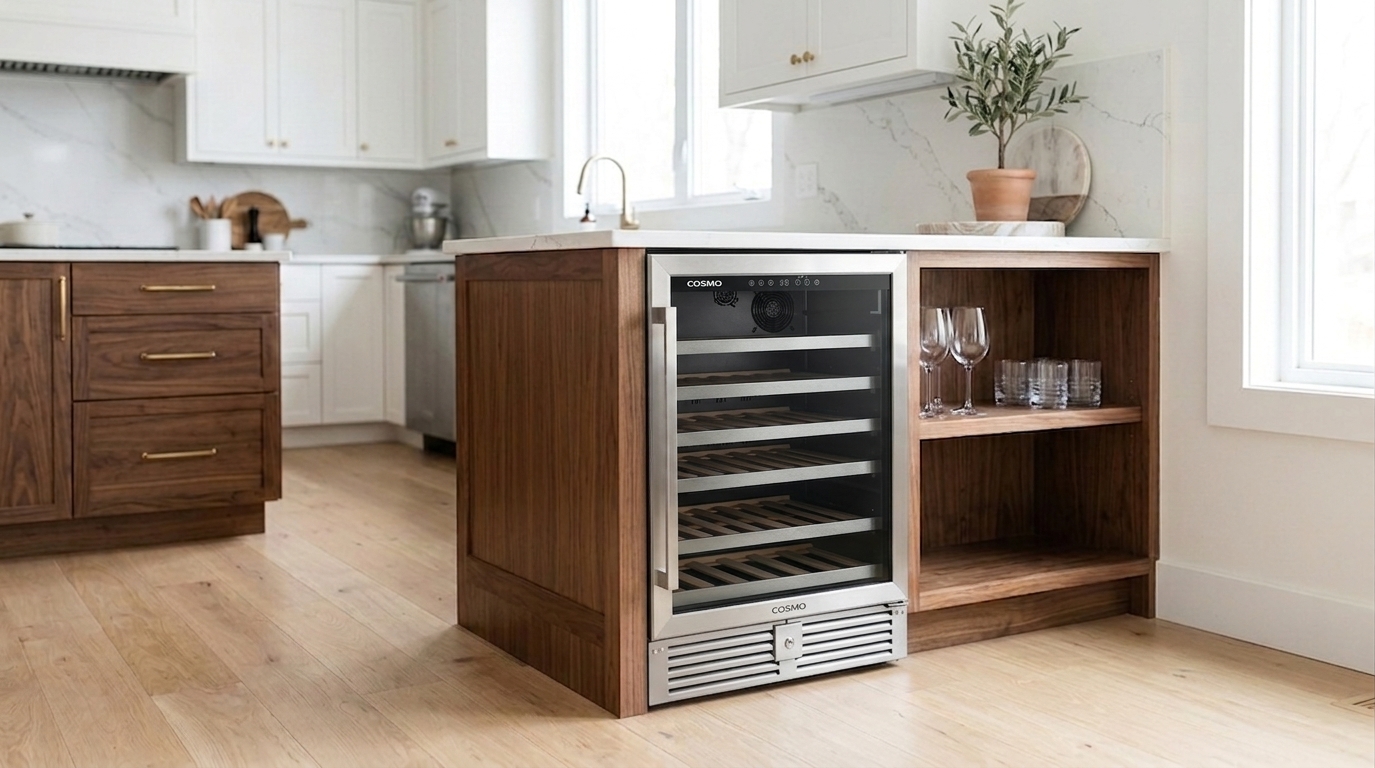
The COS-24BIWCS Wine Cooler: 52-Bottle Built-In or Freestanding with Advanced Fan Cooling

Wine stored at the wrong temperature loses what makes it worth buying in the first place. The tannins in reds soften properly only within a narrow temperature range. Whites lose their crispness when stored too warm. Both deteriorate when temperatures fluctuate constantly, which is exactly what happens in a standard kitchen refrigerator running at 35-38°F with a compressor cycling on and off all day. The COS-24BIWCS addresses this directly with a dedicated wine cooling system maintaining consistent temperatures specifically suited to wine storage and serving, across a 52-bottle capacity that handles serious collections without monopolizing kitchen space. This wine cooler works either built into cabinetry or freestanding depending on your kitchen configuration, giving it placement flexibility that dedicated wine appliances often lack. Electronic temperature controls with digital touch operation provide precise temperature management, telescopic beechwood shelves slide fully out for easy bottle access, LED lighting illuminates the interior without generating the heat that incandescent bulbs produce, and a door lock security feature protects the collection from unintended access. The insulated 3-layer glass door maintains interior temperatures while making the entire collection visible without opening the unit. Available in stainless steel or matte black finish, the COS-24BIWCS integrates into contemporary kitchen designs that treat wine storage as a considered design element rather than an afterthought. Why Dedicated Wine Storage Matters Understanding what separates purpose-built wine storage from general refrigeration helps explain why serious wine collections benefit from dedicated coolers rather than standard kitchen appliances. Temperature Stability: Standard refrigerators cycle compressors on and off frequently to maintain food-safe temperatures, creating constant minor temperature fluctuations throughout the day. Wine is sensitive to these fluctuations in ways that food simply isn’t. Repeated warming and cooling causes wine to expand and contract inside bottles, eventually degrading corks and accelerating oxidation. Wine coolers use systems designed specifically for stable, consistent temperatures that minimize this cycling. Correct Temperature Range: Kitchen refrigerators run at 35-38°F, correct for food safety but too cold for wine storage. Reds ideally store between 55-65°F depending on variety. Whites store best between 45-55°F. Sparkling wines prefer 40-50°F. These ranges differ from food refrigeration temperatures in ways that genuinely affect wine development and serving quality. Humidity Considerations: Proper wine storage maintains moderate humidity levels that keep corks from drying and shrinking. Standard refrigerators dehumidify air aggressively to prevent food spoilage, often dropping humidity to levels that dry corks over extended storage periods. Dried corks eventually allow air contact that ruins wine, particularly for bottles stored longer than a few months. Vibration Effects: Refrigerator compressors generate vibration that disturbs wine sediment and accelerates chemical reactions that degrade wine over time. This matters most for wines stored for years rather than weeks, but even moderate-term storage benefits from the reduced vibration that wine-specific cooling systems produce. Light Protection: Standard UV light accelerates chemical degradation in wine, which is why quality bottles use dark glass. The COS-24BIWCS’s tinted 3-layer glass door filters UV while still allowing the collection to be viewed, protecting bottles from light exposure that standard glass-door refrigerators can’t prevent. Advanced Fan Cooling System The fan-based cooling system in the COS-24BIWCS represents a deliberate design choice over thermoelectric alternatives, with meaningful performance implications for storage capacity and temperature consistency. How Fan Cooling Works: The advanced fan cooling system circulates refrigerated air throughout the interior using a compressor-based system designed for the specific temperature ranges wine requires. A fan distributes this cooled air evenly, preventing temperature stratification where upper shelves run warmer than lower shelves. Even distribution across all 52 bottle positions means every bottle in the collection stores at consistent temperatures regardless of shelf position. Temperature Range Capability: Fan cooling systems maintain temperatures across a wider range than thermoelectric alternatives and perform reliably regardless of ambient room temperature. Thermoelectric coolers work adequately in climate-controlled rooms but struggle to maintain target temperatures when room temperatures rise in summer or vary seasonally. Fan systems maintain consistent performance across varying conditions. Capacity and Consistency: For collections of this size, 52 bottles, fan cooling provides the consistent air distribution necessary to maintain uniform temperatures across multiple shelves. Thermoelectric systems that work adequately for 12-bottle countertop coolers lose temperature consistency across larger capacities where air circulation becomes critical. Noise Considerations: Fan cooling systems produce slightly more noise than thermoelectric alternatives due to compressor and fan operation. The system operates at background levels appropriate for living spaces, but buyers should understand that any compressor-based cooling produces some operational sound. Proper installation in cabinetry or against walls reduces resonance that amplifies perceived noise. Energy Efficiency: Modern fan cooling systems operate efficiently while maintaining consistent temperatures that thermoelectric systems sometimes struggle to achieve without running continuously at higher power draws. The efficiency advantage becomes more meaningful in warmer environments where thermoelectric systems work harder against ambient temperature. 52-Bottle Capacity and Shelf Configuration Understanding how 52 bottles actually fit and what the telescopic shelf system offers helps you assess whether this capacity and configuration suits your collection and usage patterns. Bottle Count Reality: The 52-bottle rating assumes standard 750ml Bordeaux-style bottles stored horizontally on the shelves. Burgundy-style bottles with their wider shoulders fit fewer per shelf. Champagne and sparkling wine bottles are larger and reduce total capacity. Mixed collections with varied bottle shapes typically hold somewhat fewer than the rated capacity. Understanding this helps set realistic expectations rather than discovering the limitation after purchase. Telescopic Sliding Rails: Each shelf extends fully on telescopic rails, allowing complete access to bottles at the back without removing those in front. This seemingly simple feature makes a significant practical difference in daily use. Standard fixed shelves require removing multiple bottles to reach one stored behind them — acceptable occasionally but frustrating in regular use. Telescopic rails mean the bottle you want is always accessible without disruption. Beechwood Shelf Material: Beechwood shelves are a traditional choice for wine storage that combines aesthetic appeal with practical function. The wood surface holds bottles without rolling while absorbing minor vibrations. Beechwood’s appearance integrates naturally with wine cellar aesthetics that glass or

The COS-CTGV305SS Gas Cooktop: 30-Inch Drop-In with 22,000 BTU Power Burner

Drop-in gas cooktops give kitchens the cooking control of gas without the bulk of a full range, and the COS-CTGV305SS from Cosmo’s Vista Collection delivers that in a 30-inch stainless steel package built around five sealed burners covering a genuinely wide output range. At the top end, a 22,000 BTU power burner handles tasks that demand serious heat — bringing large stockpots to a boil quickly, maintaining the sustained high temperature that proper searing requires, and producing the wok cooking conditions that lower-output burners simply can’t achieve. At the other end, a 3,400 BTU burner holds gentle simmers without cycling or fluctuating. The full five-burner spread — 22,000, 10,000, 6,000, 6,000, and 3,400 BTU — gives cooks a range of heat zones that covers everything from delicate sauce work to high-heat cooking, all running simultaneously if needed. Beyond the burner output, the COS-CTGV305SS earns its place in the Vista Collection through practical construction choices that hold up through daily use. Heavy-duty cast iron grates support cookware across the continuous cooking surface, front-mounted metal knobs provide precise heat control without reaching over hot pans, and auto ignition lights burners reliably without matches or external lighters. The included wok grate attachment adds high-heat cooking flexibility beyond what flat grates alone allow. ETL certification confirms compliance with North American safety standards, and the stainless steel surface keeps cleanup manageable after heavy cooking sessions. Why The BTU Range Matters As Much As The Peak Output The 22,000 BTU power burner gets the most attention on any high-output cooktop spec sheet, and it deserves it — but the full spread of burner outputs across all five positions tells the more complete story about what this cooktop can actually do. 22,000 BTU Power Burner: This is the top-end burner that handles tasks requiring genuine high heat output. Bringing a large pot of water to boil for pasta goes faster here than on standard 15,000 BTU burners. Searing proteins at high temperature develops the crust that lower heat never achieves before the interior overcooks. Stir-frying in a wok requires sustained high temperatures that maintain cooking momentum as cold ingredients hit the pan. At 22,000 BTU, this burner delivers heat that residential cooking rarely has reliable access to. 10,000 BTU Mid-Range Burner: The second burner in the lineup handles the broad middle ground of everyday cooking — sautéing vegetables, browning ground meat, cooking eggs in butter without scorching them, managing the active simmer that braises and soups require. This range covers the majority of stovetop work that doesn’t demand either the power burner’s intensity or the low burner’s gentleness. 6,000 BTU Burners (×2): Two burners at this output give the cooktop versatile mid-low heat positions for tasks like warming sauces without reducing them further, cooking rice without scorching the bottom, and keeping completed dishes warm while other components finish. Having two burners at this output means you can run two moderate-heat tasks simultaneously without competing for the same zone. 3,400 BTU Simmer Burner: The lowest-output burner holds temperatures that higher-output burners struggle to maintain stably. Melting chocolate without seizing it, holding a béchamel at the bare simmer that prevents scorching, keeping hollandaise warm without breaking it — these tasks need genuinely low, steady heat that gas cooktops can provide at this BTU level. The 3,400 BTU burner makes these techniques reliable rather than anxious. Total Output Distribution: The five-burner spread means you can run completely different heat levels simultaneously across the entire cooktop without any burner forced to operate outside its ideal range. The right burner for the right task, all at once. Sealed Burner Design and Why It Matters Every burner on the COS-CTGV305SS uses sealed construction that addresses the practical maintenance issues that open burner designs create in everyday kitchen use. Spill Containment: Sealed burners form a raised seal around each burner base that keeps cooking spills on the cooktop surface rather than allowing liquids to flow down into the burner cavity. When a pot boils over or oil splatters during a sear, the mess stays on the stainless steel surface where wiping it up is straightforward. Open burner designs let these spills reach internal components where they’re genuinely difficult to clean and eventually cause corrosion and clogging. Consistent Flame Patterns: Sealed burners maintain precise flame distribution because spills and residue can’t reach internal gas ports and alter flame patterns over time. Open burners develop uneven flames as cooking debris accumulates inside the burner ring, eventually requiring disassembly to restore proper performance. Sealed burners maintain their flame characteristics as long as the burner cap stays clean. Surface Cleaning: After the cooktop cools, cleaning sealed burners means wiping the stainless steel surface and cleaning the removable burner caps and grates — nothing more. There’s no burner box underneath to disassemble, no drip pans to soak, and no hidden residue building up where you can’t reach it. This straightforward maintenance keeps the cooktop looking clean without the labor that open burner designs demand. Longevity: Preventing spills from reaching internal components protects igniters, gas valves, and other components from the corrosion and damage that kitchen liquids cause over time. Sealed burners extend the functional lifespan of these components substantially compared to open burner designs where every boilover potentially reaches sensitive parts. Auto Ignition System Electronic auto ignition handles burner lighting reliably without pilot lights that consume gas continuously or manual lighters that add a step to every cooking session. How It Operates: Push and turn any control knob to the ignition position and the electronic system generates the spark that lights the gas immediately. The 3-prong power cord connects to standard 120V household power, providing electricity for the ignition system. No external lighters, no matches, no standing pilots burning gas when no burners are in use. Reliability Advantage: Electronic ignition systems fire consistently across the wide range of kitchen conditions that cooking creates — high humidity from steam, temperature variations, and the general chaos of active cooking. The system lights burners reliably regardless of these conditions, which matters

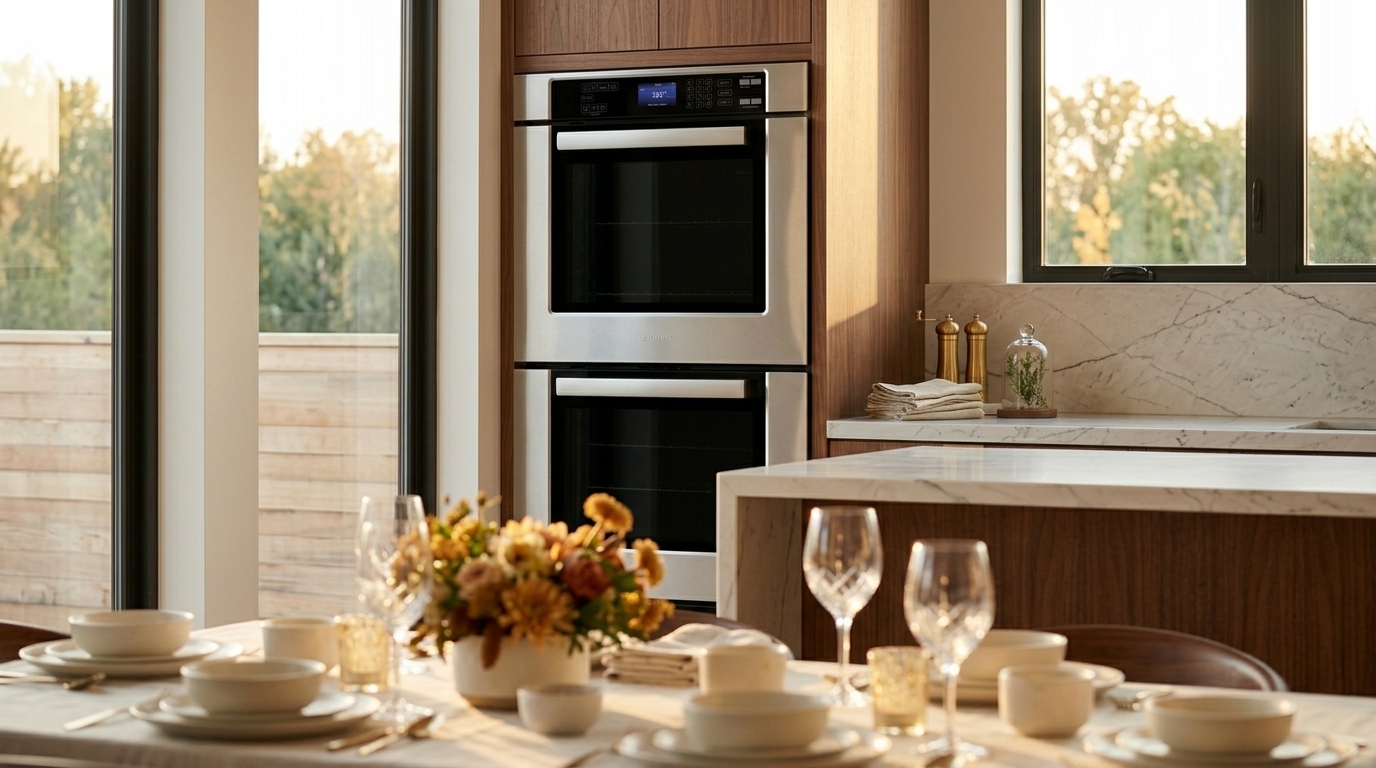
The COS-30EDWC Double Wall Oven: Two 5.0 Cu. Ft. Cavities with Turbo True European Convection

Wall ovens change the way a kitchen functions. Separating the oven from the cooktop creates independent cooking zones that improve workflow, allow more ergonomic oven access, and open up layout possibilities that traditional ranges can’t provide. The COS-30EDWC takes this further by stacking two full 5.0 cubic foot ovens into a single 30-inch built-in unit, giving you 10 cubic feet of total oven capacity within the footprint a single wall oven would otherwise occupy. Both cavities include Turbo True European Convection with a fan-assisted circular heating element, self-cleaning functions, soft touch controls with LED displays, interior lighting, and a temperature probe for precise internal food monitoring. The brushed stainless steel exterior pairs with distinctive blue porcelain interiors that make the interior cavity easy to monitor and simple to clean. What makes this oven genuinely useful for households that cook seriously is the simultaneous independent operation of two full-sized cavities. Running a roast in one oven at 325°F while baking at 375°F in the other isn’t a compromise — both cavities maintain their set temperatures independently, run their own timers, and operate entirely separately. Holiday cooking, batch baking, and multi-course entertaining all become significantly more manageable when two complete ovens are available at once rather than sequencing dishes through a single cavity. Why Two Ovens In One Unit Makes Practical Sense The logic behind double wall ovens becomes clear quickly once you’ve spent time managing a busy kitchen with only one oven available. Simultaneous Independent Cooking: Single ovens force compromises when recipes require different temperatures. You either cook sequentially, letting something cool while the oven adjusts, or you pick a middle temperature that’s ideal for neither dish. Two independent cavities eliminate this entirely. Both ovens maintain precise independent temperatures, letting you cook dishes on their own terms without adjustments or timing gymnastics. Footprint Efficiency: The COS-30EDWC fits two complete 5.0 cu. ft. ovens into a 30-inch wide built-in installation. Buying two separate single wall ovens would require two separate cabinet cutouts and considerably more wall space. The stacked configuration delivers double the capacity within the same lateral footprint, making it an efficient solution for kitchens where wall space is limited. Ergonomic Oven Access: Built-in wall ovens install at heights that put oven interiors at or near counter level, eliminating the bending required to access floor-level range ovens. The COS-30EDWC’s upper cavity typically aligns with counter height, making loading and checking food straightforward. The lower cavity sits below counter level but remains more accessible than a range oven that’s nearly at floor height. Holiday and Entertaining Capacity: Thanksgiving, Christmas, and large dinner party cooking routinely expose the single-oven limitation. Needing to coordinate multiple dishes through one oven creates logistical challenges that affect timing, food temperature, and host stress levels. Two complete ovens running simultaneously handle these high-demand situations without compromise. Separation of Functions: Having two ovens lets you dedicate one to long, slow cooking while keeping the other available for shorter tasks. A pork shoulder braising at 275°F for six hours doesn’t need to monopolize your only oven, preventing any other baking or roasting for that entire period. The second cavity remains available throughout. Turbo True European Convection Explained The Turbo True European Convection system in both cavities represents meaningfully different technology from standard convection, and understanding why matters for evaluating what this oven actually delivers. What Standard Convection Does: Basic convection ovens add a fan to circulate air around food. This circulation reduces hot spots and speeds cooking compared to conventional radiant heat alone. The fan creates movement that prevents the stagnant air layers that cause uneven baking in traditional ovens. What True European Convection Adds: True European Convection, sometimes called third element convection, adds a dedicated circular heating element surrounding the fan at the back of the oven cavity. This element heats air as the fan circulates it rather than just moving air that’s being heated by the oven’s main elements. The result is more consistent temperature distribution throughout the entire cavity, from front to back and corner to corner. Turbo Operation: The Turbo designation indicates higher fan speeds that increase air circulation intensity beyond standard convection. Greater airflow means faster heat transfer to food surfaces, improving browning and reducing cooking times more significantly than standard convection. Turbo convection particularly benefits items that need surface browning alongside thorough internal cooking. Practical Baking Benefits: Even temperature distribution means multiple sheet pans bake consistently without requiring mid-bake rotation. Cookies on the top rack brown at the same rate as those on the bottom rack. Cakes bake evenly without domed tops from hot centers. This consistency is particularly valuable in a 5.0 cu. ft. cavity where larger batches and multiple rack positions are regularly in use. Roasting Advantages: Convection roasting circulates hot air around all exposed surfaces simultaneously, developing browning on more of the exterior than conventional radiant heat achieves. Chicken skin crisps more thoroughly, roast vegetables caramelize more evenly, and large cuts develop better exterior crust while maintaining internal moisture. Temperature Adjustment: Convection cooking typically requires reducing recipe temperatures by 25°F or shortening cooking times by 20-25% compared to conventional oven recipes. The Turbo European Convection system accelerates this effect further, so recipes developed for conventional ovens need attention to timing when converted to Turbo operation. Seven Oven Functions and When to Use Each Both cavities offer seven oven functions covering a range of cooking applications beyond simple baking and roasting. Bake: Standard bake mode uses both top and bottom heating elements without fan assistance for conventional radiant heat cooking. This mode suits recipes developed for traditional ovens and techniques where air circulation would be disruptive — delicate soufflés, custards, and cheesecakes that benefit from gentle, even heat rather than active air movement. Convection Bake: Activates the fan and circular heating element for even temperature distribution throughout the cavity. This is the everyday workhorse function for most baking and roasting tasks, delivering faster and more consistent results than standard bake for most foods. Convection Roast: Similar to convection bake but optimized