
When to Repair vs. Replace Kitchen Appliances: Making Smart Decisions About Your Kitchen Equipment
Kitchen appliances eventually fail. Range burners stop lighting, dishwashers start leaking, refrigerators quit cooling, and ovens heat inconsistently. When appliances malfunction, you face a decision: pay for repairs or replace the unit entirely. This choice affects your budget immediately and influences kitchen functionality for years. The decision isn’t always obvious because repair costs, appliance age, energy efficiency changes, and replacement prices all factor into what makes financial sense. Understanding when repair makes sense versus when replacement is smarter helps you avoid wasting money on fixing appliances that will fail again soon while also preventing unnecessary replacement of equipment that could serve reliably for years more with simple fixes.
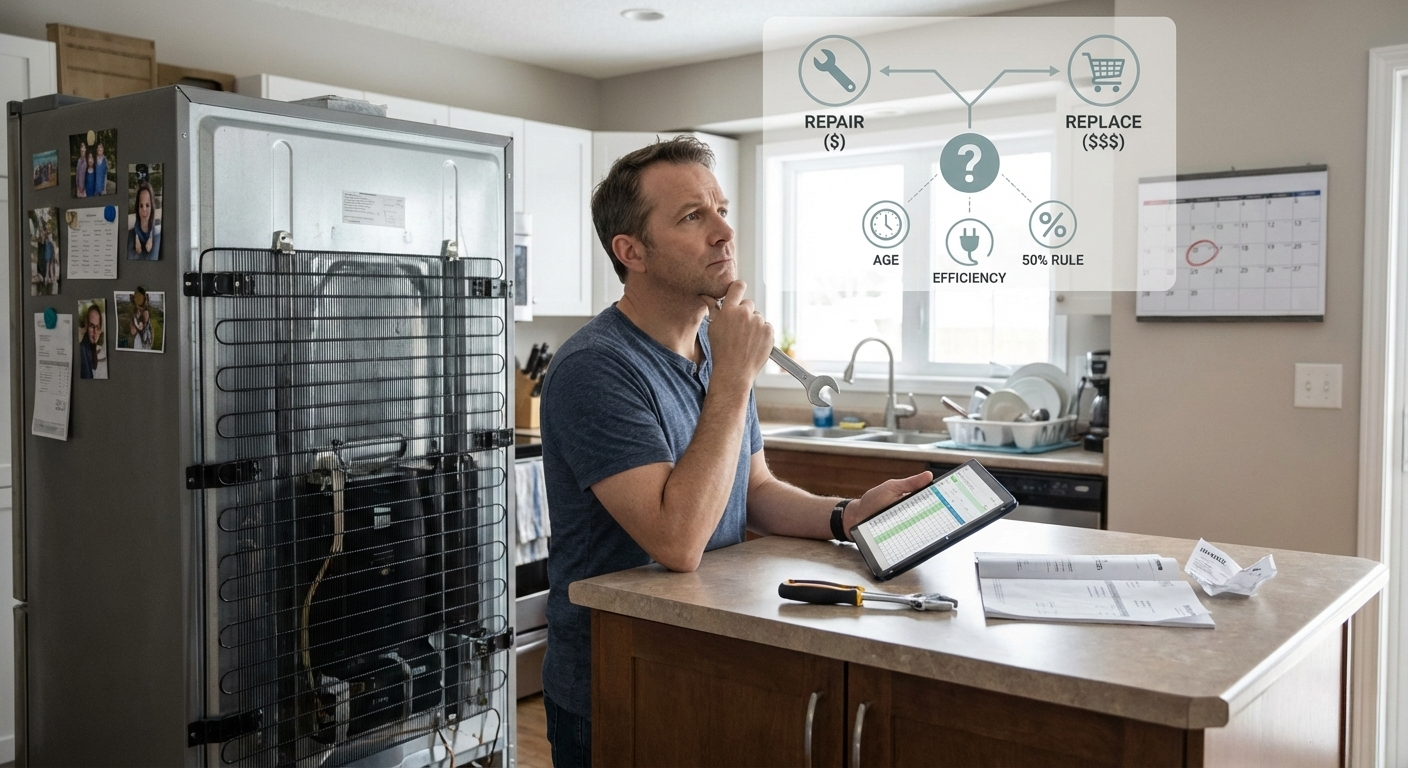
The repair-versus-replace decision requires evaluating several factors simultaneously rather than applying simple rules. Appliance age matters, but a ten-year-old refrigerator might justify repair while a seven-year-old dishwasher doesn’t, depending on what’s broken and repair costs. The specific failure type influences the decision – some problems signal imminent complete failure while others are isolated issues. Repair cost as a percentage of replacement cost provides useful guidance, but this ratio alone doesn’t account for how much longer the appliance will function after repair. Energy efficiency improvements in newer models sometimes justify replacement even when repairs are relatively inexpensive. Making smart decisions requires understanding these factors and how they interact rather than following rigid formulas.
The 50% Rule and Its Limitations
The commonly cited 50% rule suggests replacing appliances when repair costs exceed half the replacement price. While this guideline provides a starting point, it oversimplifies complex decisions.
The rule captures important economic reality – spending 60% of replacement cost to repair an aging appliance rarely makes sense when you could get a new unit with warranty for just 40% more. This principle is sound for straightforward cases.
However, the rule ignores appliance age and remaining useful life. A two-year-old refrigerator might justify a repair costing 60% of replacement because you’re likely getting 10+ more years. That same repair cost on a 12-year-old refrigerator makes less sense because you’re probably getting only a few more years before another major component fails.
The calculation also depends on accurate replacement cost assessment. Cheap replacement options might suggest not repairing, but if you’d actually buy a higher-quality replacement, the 50% threshold changes significantly. Compare repair costs to what you’d actually spend on replacement, not the cheapest available option.
Energy efficiency improvements complicate the calculation further. An expensive repair on an old, inefficient refrigerator might cost less upfront than replacement but more over time through higher electricity bills. The 50% rule doesn’t account for operating cost differences.
Warranty coverage on repairs versus new appliances matters. A $400 repair might come with a 90-day parts warranty, while a $900 replacement includes a full warranty. The replacement provides more protection for the additional cost.
Use the 50% rule as initial screening rather than definitive answer. If repair costs are under 30% of replacement, repair usually makes sense. Over 70%, replacement is typically smarter. Between 30-70%, other factors become decisive.
Age and Expected Remaining Life
Appliance age fundamentally affects repair decisions because it indicates how much useful life remains even after successful repairs.
Typical appliance lifespans provide context for age-based decisions. Refrigerators average 10-15 years, dishwashers 8-12 years, ranges 13-15 years, microwaves 8-10 years. These averages help gauge whether an appliance is early, middle, or late in its expected service life.
Early-life repairs (within first 3-5 years) usually justify fixing unless the problem indicates fundamental design flaws. You’re repairing an appliance that should provide many more years of service. Manufacturing defects sometimes appear early, but most appliances work reliably through early years if they survive initial break-in.
Mid-life repairs require more careful evaluation. An eight-year-old dishwasher might have 4-6 years of remaining life if repaired successfully, making repair reasonable for moderate costs. The appliance has proven reliable enough to reach middle age, suggesting decent quality.
Late-life repairs on appliances approaching or exceeding typical lifespan rarely make sense unless costs are minimal. A 14-year-old refrigerator, even if repaired successfully, likely faces other component failures soon. You’re putting money into an appliance nearing the end regardless of this specific repair.
Multiple previous repairs accelerate the replacement decision timeline. An appliance requiring its third significant repair in two years is telling you something about its overall condition. Each repair buys less time before the next failure.
The age consideration interacts with repair cost. A $300 repair on a three-year-old appliance is smarter than the same repair on a twelve-year-old unit, even though the repair cost is identical.
Nature and Severity of the Problem
What specifically has failed significantly influences whether repair makes sense because some problems indicate broader deterioration.
Compressor failure in refrigerators represents major mechanical breakdown. While compressors can be replaced, this failure often signals that the appliance has experienced conditions or manufacturing issues that will cause other components to fail. Compressor replacement costs are high and remaining life expectancy after repair is uncertain.
Control board failures are increasingly common in modern appliances with extensive electronics. These repairs can be expensive, but if the mechanical components remain sound, successful control board replacement often provides years more service. The appliance’s mechanical parts are what determine longevity – electronics are just the brain controlling them.
Leaking issues in dishwashers and washing machines vary in seriousness. Small seal failures are straightforward fixes with good prognosis. Tub cracks or major structural leaks indicate problems that may not be economically repairable and suggest replacing rather than attempting major reconstruction.
Burner ignition problems on gas ranges are typically simple, inexpensive fixes. These failures don’t indicate broader deterioration – often just dirty igniters or simple component wear. Repairing makes sense at almost any appliance age.
Oven heating element failures are straightforward replacements on electric ranges. These are wear items expected to fail occasionally. Replace elements without considering broader appliance replacement unless other problems exist concurrently.
Door seal failures and hinge problems are minor repairs that rarely justify replacement. These components wear from use but don’t indicate appliance core deterioration.
Multiple simultaneous problems suggest systemic issues rather than isolated component failure. When three things break at once, you’re likely seeing cascading failure from core deterioration. Replacement becomes smarter than addressing problems individually.
Energy Efficiency Considerations
Modern appliances use substantially less energy than models from 10-15 years ago, creating situations where replacement makes financial sense even when repairs are relatively affordable.
Refrigerator efficiency improvements have been dramatic. A refrigerator from 2010 uses roughly twice the electricity of current ENERGY STAR models. Over a refrigerator’s 12-year expected life, this difference represents hundreds of dollars in electricity costs.
The efficiency calculation requires math. If a new efficient refrigerator saves $100 annually in electricity versus your current unit, that’s $1,200 in savings over 12 years. A $400 repair on the old unit means you’re choosing $400 now but spending $1,200 more in electricity over the appliance’s remaining life versus replacing with an efficient model.
Dishwasher water and energy use has improved significantly. Newer models use 3-4 gallons per cycle versus 6-10 gallons in older units. Combined with better energy efficiency for water heating, the savings add up, though less dramatically than refrigerators.
Range and oven efficiency improvements are modest. Gas ranges haven’t changed much in efficiency – combustion efficiency is similar across decades. Electric ranges show some improvement but not enough to justify replacement based solely on energy savings.
The efficiency argument applies mainly when you’re already considering replacement. Don’t replace a functioning appliance just for efficiency gains unless it’s extremely old and inefficient. But when repair costs approach 50% of replacement cost, factor efficiency improvements into the total cost of ownership calculation.
Calculate payback period for efficiency improvements. If the efficiency savings would take 15 years to equal the price premium of replacement over repair, but the appliance will likely last only 8 more years, efficiency doesn’t justify replacement. If payback is 5 years on an appliance expected to last 10 more, efficiency strengthens the replacement argument.
Repair Cost Breakdown and Second Opinions
Understanding what you’re paying for in appliance repairs helps evaluate whether quoted costs are reasonable and whether repair makes sense.
Service call or diagnostic fees (typically $75-150) apply whether you repair or not. This cost is sunk once the technician diagnoses the problem. Don’t let this fee pressure you into repairing if replacement makes more sense – you’ve paid for information about what’s wrong.
Parts costs vary enormously between appliances and components. Simple parts like igniters or heating elements cost $50-150. Control boards run $150-400. Major components like compressors cost $300-600 for parts alone. Understanding whether high repair costs come from expensive parts or excessive labor helps evaluate fairness.
Labor costs depend on repair complexity and local market rates. Simple repairs take 30-60 minutes while complex ones require several hours. Expect $100-200 per hour for skilled appliance repair labor. If quoted labor seems excessive for the work involved, get a second opinion.
Warranty coverage on repairs typically includes 90 days to one year on parts and labor. This limited warranty means another failure shortly after repair might require paying again. New appliances include multi-year warranties providing better protection.
Second opinions make sense for expensive repairs ($400+) on older appliances. Different technicians may diagnose different problems or quote different costs. The $100-150 cost of a second diagnostic call is worthwhile when facing $800 repair decisions.
Manufacturer-authorized service versus independent repair shops trade off expertise for cost. Authorized service knows the appliances well but charges more. Independent shops cost less but may lack specific expertise. For complex repairs, authorized service may be worth the premium. For simple fixes, independent shops work fine.
When Replacement Clearly Makes Sense
Some situations point strongly toward replacement rather than repair regardless of specific cost calculations.
Repeated failures within short timeframes indicate fundamental unreliability. An appliance requiring its third repair in 18 months won’t suddenly become reliable after the fourth fix. Cut your losses and replace.
Discontinued parts availability makes repair impossible regardless of willingness to pay. Appliances over 15 years old sometimes face parts unavailability that forces replacement.
Major structural failures like cracked tubs or damaged frames rarely justify repair economics. These repairs are expensive, reduce appliance reliability, and leave you with a fundamentally compromised unit.
Safety issues including gas leaks, electrical problems causing shocks, or fire risks require immediate replacement. Don’t repair appliances showing dangerous failure modes – the liability and safety risks outweigh any cost savings.
Multiple simultaneous major component failures suggest systemic breakdown. When the compressor fails and the control board dies in the same month, the appliance is telling you it’s done.
Aesthetic obsolescence sometimes justifies replacement even when repair is economically defensible. If you’re planning kitchen updates and the appliance doesn’t match your new design, factor the inevitable replacement into current timing rather than repairing now and replacing in a year anyway.
When Repair Makes Clear Sense
Certain situations favor repair over replacement regardless of the 50% rule or other considerations.
Simple, inexpensive fixes under $200 almost always make sense unless the appliance is already at the very end of expected lifespan. The low cost and low risk make repair obvious.
Recent purchases still under warranty should always be repaired. You’ve paid for warranty protection – use it. Even out-of-warranty repairs on 1-3 year old appliances usually make sense because you’re fixing new equipment with most of its life ahead.
Minor component failures that don’t indicate broader problems justify repair at any reasonable cost. Replacing a door seal, heating element, or igniter addresses isolated wear without suggesting systemic issues.
Sentimental value or unusual requirements sometimes justify repairs that don’t make strict economic sense. An inherited appliance or one with specific dimensions fitting a tight space might be worth repairing even when replacement would usually make more sense.
Quality appliances built to last deserve repair consideration that cheaper units don’t. A high-end range or refrigerator from a reliability-focused manufacturer might justify a more expensive repair than a budget appliance would.
Making Your Decision
When facing the repair-versus-replace choice, work through a structured decision process rather than reacting emotionally or accepting the first quote.
Get clear diagnosis and repair cost estimate including parts and labor. Understand exactly what’s wrong and what fixing it requires.
Research replacement cost for comparable appliances. Don’t compare repair costs to the cheapest replacement available if you’d actually buy mid-range or better.
Calculate the repair cost as percentage of replacement cost. Under 30% favors repair, over 70% favors replacement, and 30-70% requires deeper analysis.
Consider appliance age and expected remaining life. Early life strongly favors repair, late life strongly favors replacement.
Evaluate whether the failure indicates isolated problem or systemic deterioration. Simple component wear favors repair while multiple failures suggest replacement.
Factor energy efficiency if the appliance is old and inefficient. Calculate actual savings over expected remaining life.
Check for rebates, sales, or promotions on replacement appliances. Sometimes manufacturer incentives change the economics significantly.
Consider timing and urgency. If you can wait for sales or research thoroughly, you might make a better decision than when facing immediate need.
Trust your instinct about the appliance’s overall condition. If it’s been reliable until this single issue, repair probably makes sense. If it’s been problematic for years, this failure might be the final indication to replace.
The repair-versus-replace decision for kitchen appliances requires balancing multiple factors rather than following simple rules. Appliance age, repair cost relative to replacement, the nature of the failure, energy efficiency considerations, and your specific circumstances all matter. By understanding these factors and working through structured analysis rather than reacting emotionally, you can make decisions that serve your budget and kitchen needs effectively. Sometimes a $400 repair is smart spending that provides years more service. Other times, it’s throwing good money at a dying appliance. The difference lies in careful evaluation of your specific situation.