
Bringing Tableside Flambé Home: What Your Range Actually Needs to Pull It Off Safely
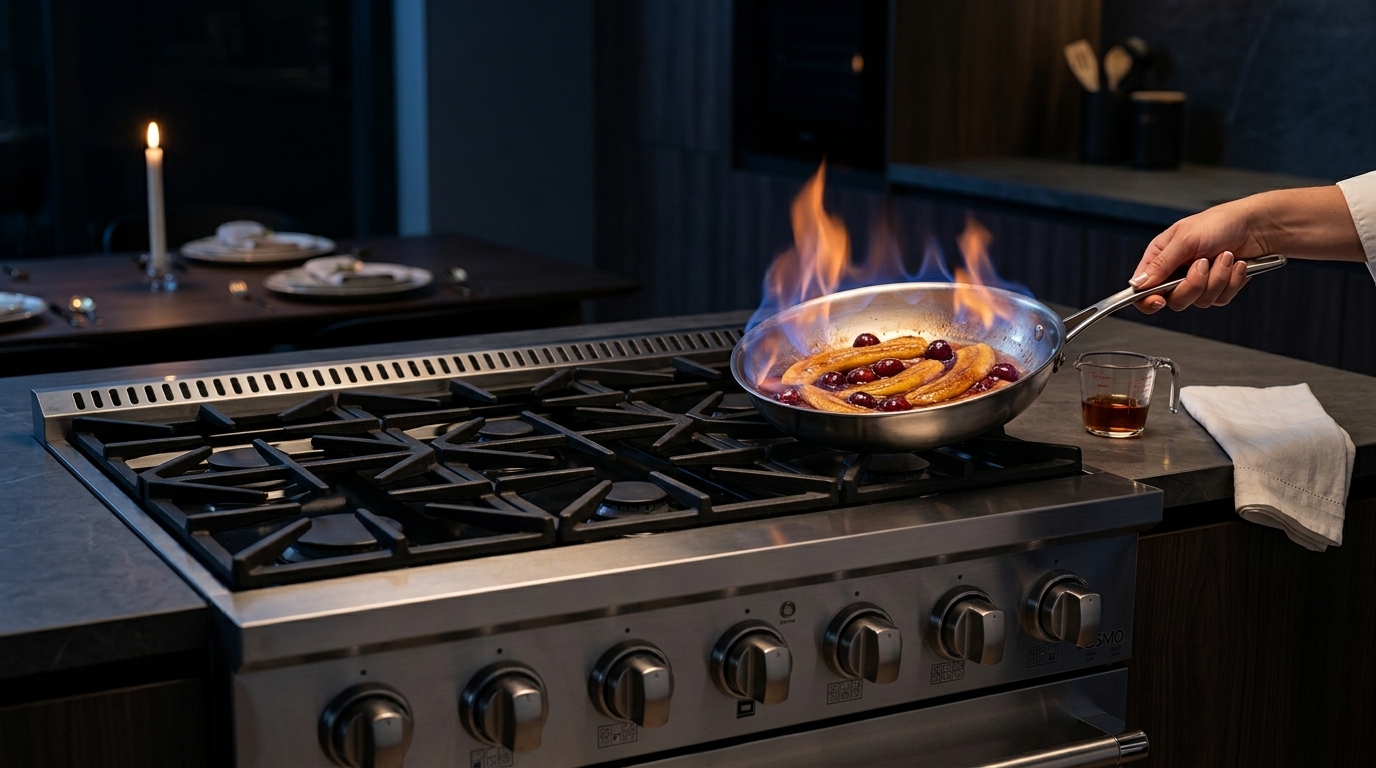
There is a specific kind of theater a flambé brings to a table, the room going quiet for a second as a server tips a pan and a controlled sheet of blue-orange flame rolls across a cherries jubilee or a pan of bananas foster. It reads as a restaurant trick, the kind of thing that belongs to someone with a captain’s cart and a fire extinguisher within arm’s reach, not a Tuesday dinner at home. That reputation is mostly undeserved. Flambéing is a fairly simple technique once the mechanics are understood, and the real barrier for most home cooks is not skill. It is a stovetop that was never built to give a cook the fast, precise control that lighting alcohol on fire actually requires.
What Flambé Is Actually Doing
Strip away the showmanship and flambéing is a fairly ordinary chemical event. A splash of high-proof alcohol, usually a fruit brandy, rum, or a liqueur, goes into a hot pan already holding fruit, a sauce, or a piece of meat, and the alcohol vapor rising off the pan ignites, burning off quickly while leaving behind a deeper, more concentrated flavor than the alcohol could contribute unburned. The flame itself lasts only fifteen to thirty seconds before the alcohol content burns away and the fire extinguishes on its own. Nothing about that description involves danger by design. The danger shows up when the pan is too hot before the alcohol goes in, when the alcohol is poured straight from the bottle instead of measured out, or when a cook is working over a burner that cannot be adjusted or shut off the instant something goes sideways.
That last point is the one most home flambé guides skip past, and it is the one that actually determines whether the technique goes well. A recipe can tell a cook to remove the pan from heat before adding alcohol, to measure the pour in advance, and to keep a lid within reach. None of that advice does much good if the burner underneath the pan cannot respond as quickly as the cook needs it to.
Why the Stove Matters More Than the Recipe
Every serious flambé guide converges on the same handful of rules, and nearly all of them come back to timing. Alcohol should be measured into a cup rather than poured from the bottle, so a flame traveling up the alcohol stream never has a bottle to travel back to. The pan itself should come off direct heat, or the burner should be turned down, in the moment before the alcohol is added, since a pan that is too hot can ignite the alcohol vapor before a cook is ready for it. A long lighter or match, rather than a stovetop’s own flame, is the safer ignition source on an electric or induction surface, and even on gas, pulling the pan slightly away from the burner before adding alcohol keeps the vapor from catching prematurely. Loose sleeves get rolled up, hair gets tied back, and anything flammable gets cleared from the space above and around the pan before the alcohol ever comes out of the bottle.
Every one of those steps assumes a cook who can move the pan, adjust the flame, or kill the heat entirely within a second or two of deciding to. That is where a home range with sluggish, imprecise burner control becomes the actual liability in the process, not the alcohol itself. A burner that takes several seconds to drop from high to low, or a single all-purpose burner asked to handle a hard reduction and then a delicate flambé finish without missing a beat, turns a fifteen-second technique into a much longer window where something can go wrong. The alcohol keeps cooking off while a cook waits for the heat to actually respond, and a pan sauce that should have stayed exactly where it needed to be either scorches or never develops the reduction a flambé dish depends on.
Where the COS-GRP366 Fits
Cosmo’s COS-GRP366, a 36-inch professional-style gas range with six sealed Italian-made burners, is built around exactly the kind of range and responsiveness a flambé technique actually needs. Its burner lineup runs from a 20,000 BTU high-output burner down through a 15,000 BTU burner, a 12,000 BTU burner, two 9,000 BTU burners, and a 6,000 BTU burner, which matters for a flambé dish in a way that is easy to overlook. The dish rarely starts as a flambé. It starts as a sauté or a reduction that needs real heat, a pan of bananas caramelizing in butter and sugar or a reduction of pan juices building toward the finish, and only in the final moment does the cook need to pull that same burner down to a controlled, moderate flame before the alcohol goes in. A range with a wide spread of burner outputs, rather than six burners tuned to nearly the same range, gives a cook that kind of headroom on a single burner instead of needing to shuffle a hot pan across the cooktop at the exact moment precision matters most.
Metal control knobs on the COS-GRP366 respond instantly to a twist in either direction, a meaningful difference from a touch panel that has to register a tap and confirm a setting change before the burner actually responds, a lag that matters far more during a fifteen-second flambé than it does during an ordinary sauté. The range’s auto re-ignition system, which continuously monitors each burner’s flame and automatically relights it if a draft or a spill causes it to blow out, adds a layer of protection specific to open-flame cooking, catching a flame that might otherwise go dark without a cook noticing right away.
The range’s 5.4 cubic foot convection oven, with its 22,000 BTU bake burner and even, fan-assisted heat distribution, rounds out the rest of a dinner built around a flambéed finish, whether that means keeping a tray of accompaniments warm or finishing the dish that came before the showpiece dessert. Heavy-duty cast iron grates keep a pan stable during the moment a cook is tilting or swirling it, an oven cavity cooling ventilation system and cool-to-touch handle round out the range’s built-in safety features, and the whole cooktop is finished in corrosion-resistant 304-grade stainless steel that stands up to the kind of splashes and spills a working flambé pan tends to produce.
A Few Practical Notes Before Lighting Anything
A handful of habits separate a flambé that goes smoothly from one that does not. High-proof alcohol, generally above 80 proof, ignites reliably where a lower-proof wine or beer often will not, so the bottle matters as much as the technique. Warming the alcohol slightly in a small separate pan before adding it to the main pan helps it ignite more readily, since cold alcohol poured into a hot pan can sometimes fail to catch on the first attempt, leaving a cook holding a lit match over a pan that has not lit yet, which is its own small hazard worth avoiding. Turning off the range hood before igniting anything keeps the exhaust fan from pulling the flame upward toward a cook’s face or sleeve, and clearing the space above the stove of anything hanging, a paper towel roll, a dish towel, a low cabinet, matters as much as anything done at the pan itself. And a lid, sized to fully cover the pan, belongs within arm’s reach every time, not because the flame is expected to need smothering but because a cook who has one ready never has to improvise if it does.
A Technique Worth Bringing Home
Flambéing has stayed a restaurant trick for longer than it needed to, mostly because home cooks assumed the danger lived in the alcohol itself rather than in a kitchen not equipped to control heat quickly enough. Once that assumption is corrected, the technique is approachable enough for a weeknight: a measured pour, a pan pulled back from direct heat at the right moment, and a burner that actually listens when a cook turns it down. A range like the COS-GRP366, with a real spread of burner output, instant knob response, and a flame-monitoring system built for exactly this kind of open cooking, gives a home cook the same control a captain’s cart depends on, minus the reservation and the audience, unless a few dinner guests happen to be watching from the table.