
Soup Season Started Early This Year, and It Has a New Accent
American soup season used to keep a fairly strict calendar. It held off until the first cold snap of autumn, then showed up all at once as tomato soup or chicken noodle. That schedule has loosened. Food-trend analysts tracking consumer demand have noted that soup cravings are turning up weeks ahead of the cold weather, and the shift shows up in more than timing. The soup itself is changing: lighter, more deliberately flavored, and far more likely to draw on Indian, Japanese, and broader Asian kitchens than on the canned-soup classics that defined the category for decades.
On this last Friday of September, it is worth looking at what American households are putting in the pot, and what that pot leaves behind afterward.
What the Numbers Say About Today’s Soup
Tastewise, a food-intelligence company that analyzes consumer and menu data, published a soup trend report this year with several findings worth noting. Soup used as a meal replacement, rather than as a starter or a side, is up 18 percent year over year. Broth-based formats are growing roughly twice as fast as cream-based ones. Single-serve formats are up 15 percent, and soup content tied to health and recovery is up 24 percent. Taken together, they describe a category that has moved from comfort food that happens to be warm to a repeatable weeknight meal that happens to be comforting.
The flavor breakdown is the more interesting half of the story. In Tastewise’s analysis of global flavor references in soup, Indian profiles account for 21 percent, Japanese for 20 percent, and broader Asian flavors for another 15 percent. Italian and American profiles each sit below 10 percent. That is a notable reversal for a country whose soup identity was built on chicken noodle, clam chowder, and minestrone. The report’s own reading is that global flavors are succeeding not as novelty but as intensity: concentrated umami, layered aromatics, and depth that a household can taste from the first spoonful. Think miso and ginger, curried lentils, coconut broth with lemongrass, or a long-simmered pot of chicken with garlic, turmeric, and fish sauce.
Broader fall-food coverage points the same way, with comfort foods being reimagined through global flavors rather than replaced by them. Soup is one of the easiest formats for that, because a pot of broth forgives a lot and rewards a cook who builds flavor in layers.
Why Home Cooks Are Getting Into It
A pot of soup is one of the few dishes that becomes more useful the longer it sits. It cooks largely unattended, scales up easily, and holds in the refrigerator for days. The USDA’s food safety guidance recommends refrigerating leftovers within two hours of cooking, using them within three to four days, and reheating to 165 degrees Fahrenheit. For a household cooking on Sunday and eating through Thursday, that is a comfortable window, and broth-forward soups suit the way many people say they want to eat now: light on cream, easy to load with vegetables, simple to boost with shredded chicken, beans, or tofu.
What a Soup Habit Does to Your Kitchen
The part that rarely gets written about is what soup season does to the sink. A single pot of soup can involve a stockpot or Dutch oven, a cutting board that has handled onions, garlic, and raw chicken, a blender or immersion blender if the recipe calls for puréeing, a ladle, a strainer, a handful of measuring spoons, and a stack of bowls. Then come the storage containers, since the whole point of a big batch is to portion it out. A household making soup two or three times a week can generate a heavier and stickier cleanup load than almost any other style of cooking, and the aromatics that make a global-inspired broth so appealing, garlic, curry, ginger, and fish sauce, are exactly the ones that linger in a dishwasher and in plastic.
That changes what a household needs from its dishwasher: room for a bulky, irregular load, a cycle that can handle starchy, greasy residue, resistance to lingering odors, and quiet enough to run after dinner. Sanitizing helps too, since cutting boards and ladles that have touched raw poultry deserve a proper wash.
Cleanup Power for a Season of Big Pots
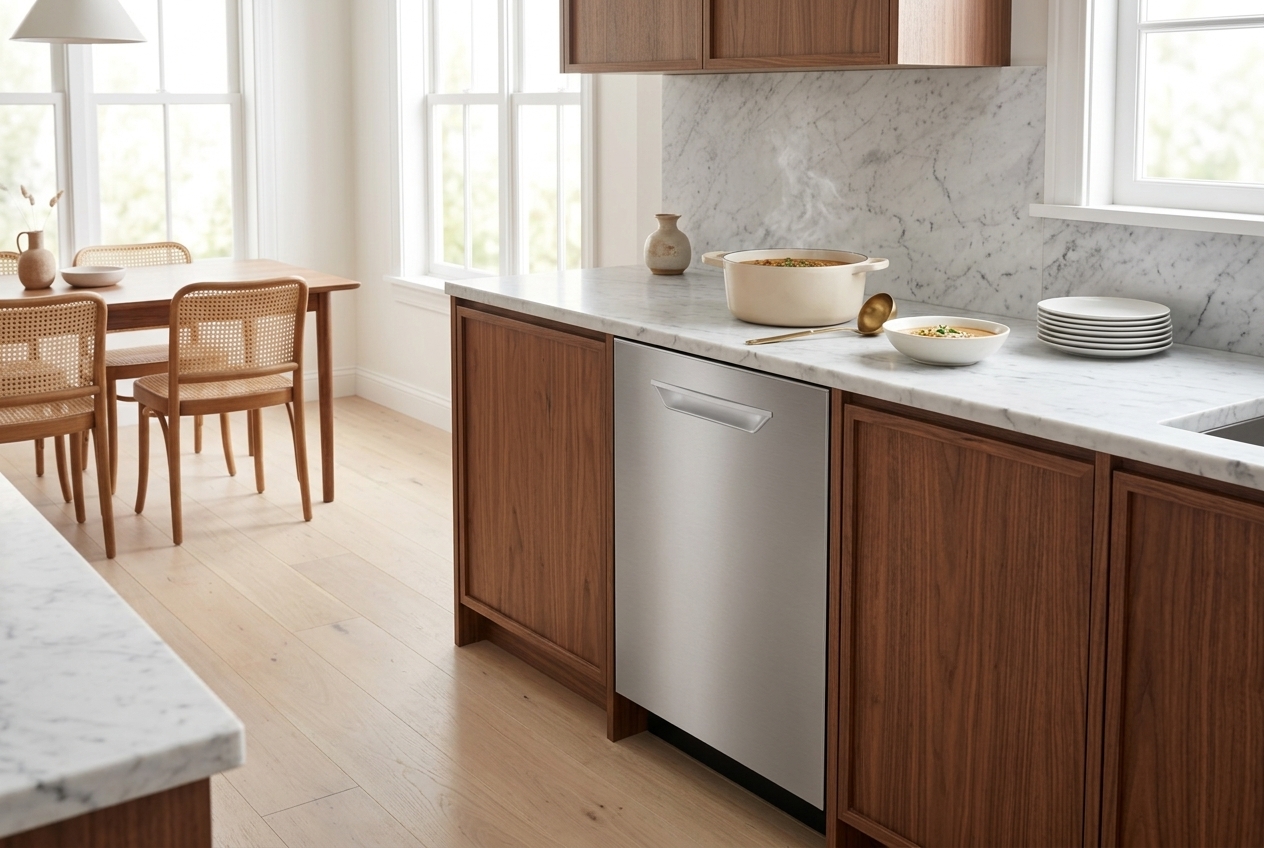
Picture Sunday night after a batch of coconut curry lentil soup: a stockpot lid, a ladle, a blender jar, a cutting board, six bowls, and a row of storage containers waiting to be scrubbed. Cosmo’s COS-DWV24TTR, a 24-inch top control built-in dishwasher from the Vista Collection, is made for that kind of evening. It holds 16 place settings across three racks, plus a silverware basket, enough for a family’s bowls and spoons and the cookware that produced them. For a household making soup several nights a week, that capacity keeps a stack of dishes from sitting on the counter overnight.
Its four cycles, Normal Wash, Auto, Heavy, and Express, cover the range of a soup week. Heavy is the setting for the day after a thick lentil stew or a chowder has left residue on a pot lid or a blender jar. Auto adjusts to how soiled a mixed load is, Normal handles an ordinary evening, and Express is useful when the bowls from a quick weeknight lunch need turning around. A Rapid Heated Dry function helps dishes finish drying so containers are ready to fill again, which suits a household that portions a new batch of soup each weekend.
The details that matter most in soup season are the ones about cleanliness and smell. The COS-DWV24TTR features advanced sanitize technology rated for 99.99 percent bacteria reduction, a useful option for cutting boards, ladles, and anything else that has come into contact with raw chicken or meat. An odor-resistant tub helps keep the interior fresh between loads, which counts for a lot when the last cycle had a pot that held a garlic-and-curry broth. It runs at 48 decibels, which Cosmo compares to light rain, quiet enough to run after dinner in a kitchen that opens onto the living room.
A few design choices add to daily convenience. The controls sit on a hidden soft-touch panel with an LED display along the top of the door, a recessed handle keeps the profile flat, and the fingerprint-resistant stainless steel finish shrugs off the handprints of a busy cooking week. An anti-leak detection system and child safety lock add peace of mind, and the unit is Energy Star certified and UL listed, measuring 33.7 by 23.9 by 24.8 inches for a standard 24-inch cutout, with a one-year warranty.
Practical Notes for a Season of Soup
Cool it fast. Dividing a big pot into shallow containers helps soup cool quickly and get into the refrigerator inside the two-hour window. Label each container with the date so the three-to-four-day clock is easy to follow.
Build flavor before adding liquid. Toasting whole spices, browning aromatics until they turn sweet, and cooking a spoonful of tomato paste, miso, or curry paste in the oil before adding broth add depth that simmering alone will not. Season near the end, since broths reduce as they cook, and finish with lime juice or rice vinegar to brighten the pot.
Scrape, do not rinse. The ENERGY STAR program advises scraping food off dishes rather than pre-rinsing, noting that rinsing increases total water and energy use, and it recommends running full loads. A soup week tends to produce full loads on its own.
Hand-wash the oversized pot if it will not fit. A very large stockpot can take up more room than a load can spare, so wash that one by hand and let the machine handle everything else.
A Pot Worth Coming Home To
Soup turns a handful of ingredients into something warm and dependable at the end of a long day, and this year American cooks are making it earlier, more often, and with far more range. The cooking is the enjoyable part. For the cleanup, a dishwasher like the COS-DWV24TTR brings the space, cycles, and sanitizing power that a season of big pots calls for.