
Stocking the Wine Cooler Before Holiday Dinner Season Fills the Calendar
Thanksgiving falls on November 26 this year. Hanukkah begins at sundown on December 4 and runs through December 12, Christmas lands on a Friday, and New Year’s Eve follows a week later. Between the first turkey and the last toast there are only about five weeks, and for any household that hosts, nearly every one of them has something on the calendar. The wine for all of those gatherings usually gets bought the same way: in a rush, in a crowded store, a few days before each event, with whatever is left on the shelf.
Mid-October is a better moment to deal with it. The shelves are full, the stores are quiet, and there is still time to work out how much a season of hosting requires and where it will all live until it is poured. This guide covers the math, the storage problem, and a simple schedule for filling a wine cooler early.
The Holiday Calendar Is Shorter Than It Looks
From Thanksgiving to New Year’s Day is just over five weeks, and the gatherings inside it tend to stack up rather than spread out. A household might host Thanksgiving dinner, a December open house, a holiday dinner for family, and a New Year’s Eve party, with smaller drop-ins and gifts of wine in between. Each one is manageable on its own. Together they create a surge in demand that arrives at exactly the moment the stores are busiest and the refrigerator is already carrying its heaviest load of the year.
That timing is the real argument for stocking early. Buying one dinner at a time means making fresh decisions under pressure, with less choice and little room to compare. Buying for the whole season in October and November turns it into a single, calm project and leaves the last week before each event free for everything that cannot be done in advance.
Start With the Math, Not the Shopping List
The first number worth knowing is the pour. A standard 750-milliliter bottle holds five 5-ounce glasses, and some guests will prefer pours of 6 or 7 ounces. Hosting guidance generally suggests planning on about one bottle for every dinner guest at a longer meal, with a four-hour gathering working out to at least four glasses per person, which is close to a full bottle each. That sounds generous until it meets a real table. Ten guests lingering through a long Thanksgiving afternoon is roughly ten bottles, before anyone opens something for the cook.
The mix matters as much as the count. A workable split for a sit-down dinner is a sparkling wine for arrival and toasts, a crisp white for the first courses, and one or two reds that can handle richer dishes. A few extra bottles of the most versatile choices, rather than one bottle of many different ones, protect a host from running short of the wine everyone is actually drinking.
Then add up the season. Three gatherings of eight to ten people comes to roughly two dozen bottles or more, a quantity that does not fit on a spare refrigerator shelf and does not belong in a pantry corner either.
Why the Refrigerator Is the Wrong Place to Hold Them
Wine rewards a steady environment, and a kitchen refrigerator does not provide one. Storage guidance from wine specialists puts the ideal holding temperature at about 55 degrees Fahrenheit, with humidity around 70 percent to keep corks from drying out, and stresses that stability matters as much as the number itself. Swings in temperature, exposure to UV light, and vibration all work against bottles that sit for weeks rather than days. A refrigerator runs far colder than 55 degrees, cycles on and off throughout the day, and exposes everything inside to light every time the door opens.
During the holidays there is a second problem, which is simple space. The refrigerator is the bottleneck of the season, asked to hold a thawing turkey, prepared sides, pies, and a week of ordinary groceries at once. Two dozen bottles competing for that space means either giving up room the food needs or leaving the wine on a counter or pantry shelf, where it warms and cools with the kitchen. A dedicated cooler removes the conflict and keeps the refrigerator free for food.
Where the COS-24BIWCS-BK Fits
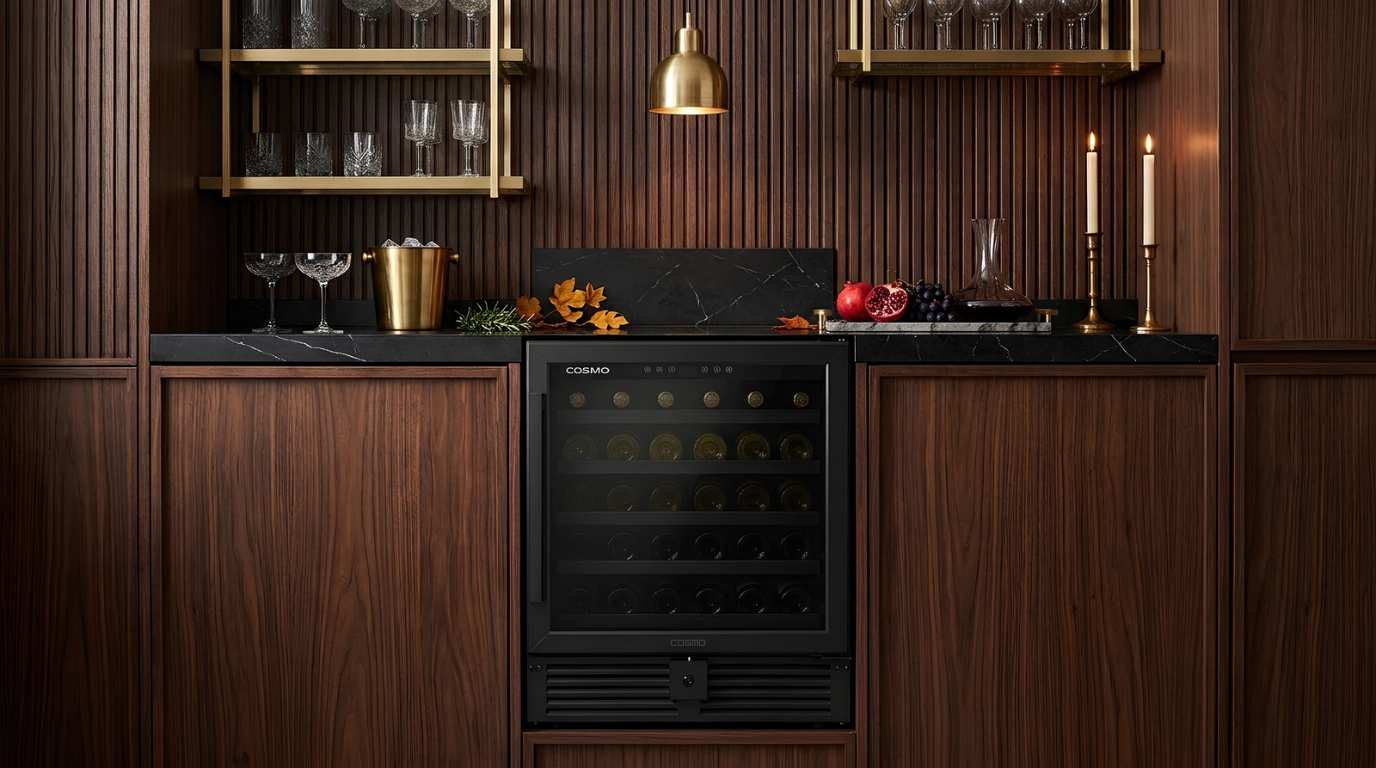
Cosmo’s COS-24BIWCS-BK is a 24-inch wine cooler from the brand’s Lumin Collection, finished in matte black. It holds up to 52 bottles across a 145-liter interior, which is enough room to stock a full season of hosting in one place rather than managing it across shelves and cabinets. Its single-zone compressor system and advanced fan cooling hold a steady temperature anywhere from 41 to 68 degrees Fahrenheit, a range wide enough to cover everything from sparkling wine to full-bodied reds, and an insulated three-layer glass door blocks the light that damages wine over time.
Smaller details make it practical during a season of heavy use. Six beechwood shelves on telescopic sliding rails let a host pull a shelf out to read a label or choose a bottle without disturbing the rest, which matters when guests are in the kitchen and a bottle is needed quickly. A digital touchpad controls the temperature precisely, LED lighting keeps the collection visible, and a door lock adds security for a household with children or a steady flow of guests. The unit is ETL listed and runs on standard 115-volt power.
At 34 inches tall, 23.4 inches wide, and 22.75 inches deep, it installs either as a built-in unit under a counter or freestanding, so it can sit in an island end cap, a run of lower cabinets, or a corner of a dining room. The matte black finish reads as a deliberate design choice in a darker kitchen and stays understated in a lighter one.
Setting the Temperature and Staging the Bottles
Because the cooler is single-zone, it works best as a holding space rather than a serving station, and the temperature setting follows from that. Setting it near the middle of its range, close to the 55 degrees recommended for storage, keeps every bottle in good condition for weeks and sits within a few degrees of where many wines are served. Serving guidance from Coravin puts sparkling wine at 40 to 45 degrees, whites and rosés at 45 to 55, light reds at 55 to 60, and full-bodied reds at 60 to 65.
That leaves a small amount of staging on the day of each event, and it is easy to handle. Sparkling wine and whites can move to the refrigerator earlier in the day, or finish in an ice bucket for 10 to 20 minutes, which is the guidance for bottles stored warmer than the serving range. Reds that have been held at storage temperature need only a short time out of the cooler to reach their range. Planning that sequence ahead is far easier than chilling a dozen bottles in a crowded refrigerator an hour before guests arrive.
A Stocking Schedule Between Now and Thanksgiving
Working backward from the holiday keeps the project small. A simple schedule might look like this:
- October 19: List every gathering from Thanksgiving through New Year’s Eve, estimate guest counts, and total the bottles needed.
- October 26: Buy the reds and whites, in multiples of the bottles most likely to be popular.
- November 2: Add sparkling wine for toasts, and set aside bottles to give as gifts.
- November 9: Confirm the cooler is clean, level, and holding its set temperature, and arrange bottles by type on the shelves.
- November 16: Fill any gaps, and buy mixers, non-alcoholic options, and anything else needed for the beverage table.
- November 23: Move whites and sparkling wine to the refrigerator for Thursday, and set out glassware.
The point is not precision. It is to settle the decisions that cost the most under pressure while there is still time to make them well.
A Calmer Season Starts in October
Holiday hosting is judged by how a household handles the moment guests arrive, and a host who has already counted the bottles, chosen the wines, and given them a proper place to rest has far less to manage at that point. Wine is one of the few parts of a holiday meal that can be fully prepared weeks in advance, and treating it that way frees attention for the parts that cannot.
A dedicated cooler like the COS-24BIWCS-BK gives that advance work a home: room for a full season of bottles, a steady temperature, and a refrigerator left free for the food. Five weeks of gatherings is a long stretch of calendar, but it is a manageable one for a household that starts stocking in October.