
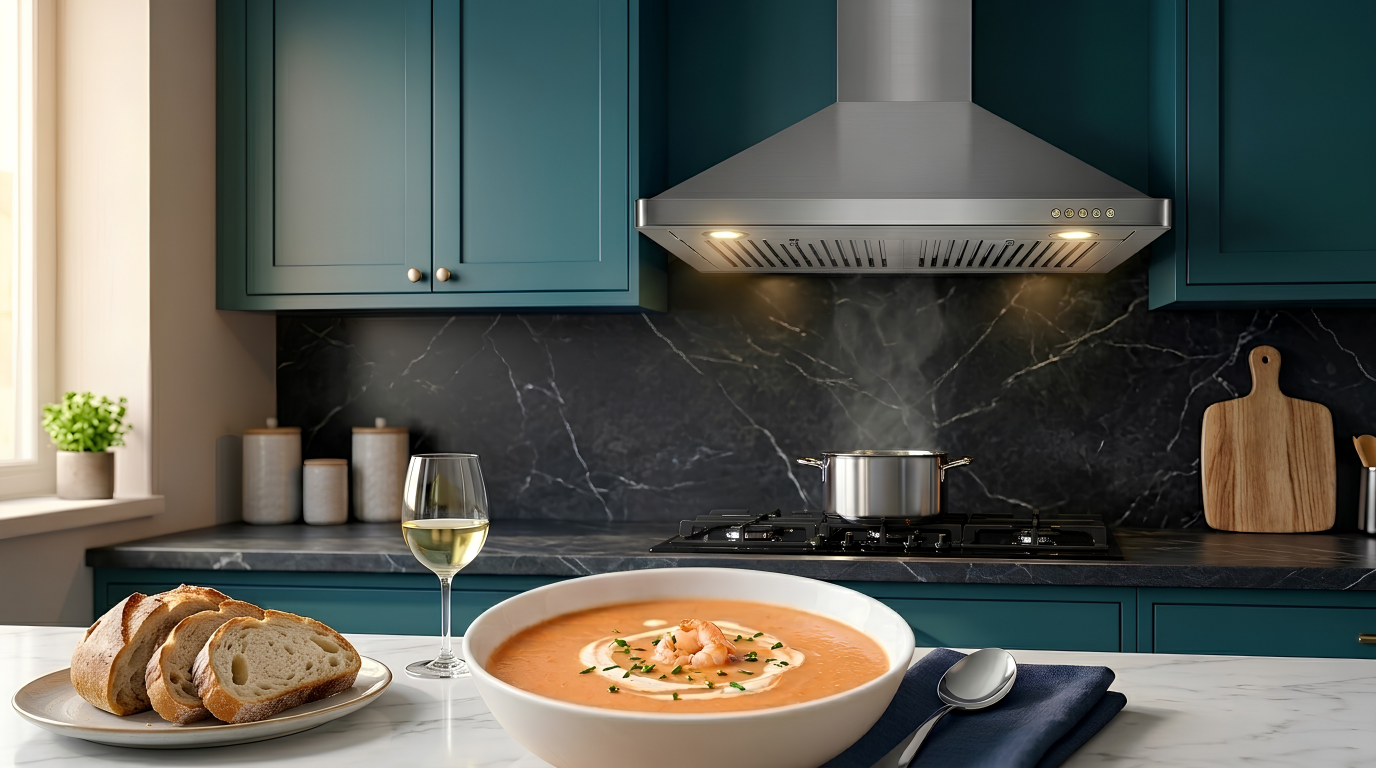
Seafood Bisque Day and the Smell That Outlasts the Meal: What Your Range Hood Is Actually Doing
Every October 19, National Seafood Bisque Day invites home cooks to take on one of the most elegant soups in the French repertoire. A true bisque is a slow, layered project. Shells are sautéed until fragrant, deglazed with wine or cognac, simmered with aromatics, strained, and finished with cream. In the classic method, the soup is thickened with a fine purée of crustacean shells, which is where much of its depth comes from. The result is rich, velvety, and unmistakably of the sea.
It is also a dish that refuses to leave when dinner ends. Hours after the last spoonful, the scent of shellfish, butter, and brandy can still be found in the dining room, the hallway, and sometimes the bedroom. That lingering presence is not a sign that the recipe was too ambitious. It is a question about how air moves through your kitchen, and how much of the work your range hood is genuinely doing.
Why a Bisque Is a Demanding Test of Ventilation
Few dishes ask more of a kitchen’s air handling than a bisque. Shells and aromatics are sautéed in hot butter or oil, which sends fine droplets of grease into the air. Wine or cognac is added and reduced, releasing alcohol vapor and concentrated aroma. A stock simmers for the better part of an hour, steadily pushing steam and volatile compounds from the shellfish into the room. Finally, cream is added and the soup is held at a gentle heat, which keeps the process going long after the loudest part of the cooking is over.
Shellfish deserve particular mention. Crab, shrimp, and lobster shells release sulfur compounds and amines that are pleasant in a simmering pot and far less welcome on a living room sofa. Those molecules travel on steam and on microscopic grease particles. When they are not captured, they settle onto cabinet faces, window treatments, upholstery, and walls, then release again slowly. That slow release is why a kitchen can smell of last night’s dinner even after every dish has been washed.
What Your Range Hood Is Actually Doing
A range hood has three jobs, and it helps to separate them, because most homeowners credit it with only one.
The first job is capture. A hood creates a zone of moving air above the cooktop that pulls rising steam, smoke, heat, and grease up and away from the cooking surface before it can spread. Capture is a matter of airflow and coverage. Airflow is measured in cubic feet per minute, or CFM, and coverage depends on how wide and deep the hood is relative to the burners beneath it. A hood that is narrower than the cooktop, or mounted too high, will let part of the plume escape around its edges no matter how powerful the motor is.
The second job is filtration. Grease filters sit just inside the hood and catch airborne fat before it reaches the fan and the duct. This protects the motor and keeps a sticky film from building up inside the system. The Cosmo COS-63175, a 30 inch wall mount range hood from the 631 Series and one of the brand’s most recent hood introductions, uses two permanent stainless steel ARC FLOW filters to capture grease and cooking odors. They are dishwasher washable, so they are cleaned and reused rather than replaced.
The third job is removal, and this is where odor is truly won or lost. A ducted hood carries the captured air outside the home entirely. A recirculating hood, which is installed without a duct, passes the air through a carbon filter and returns it to the room. Carbon can adsorb a good share of odor molecules, but it does not remove moisture or heat, and its capacity fades as it saturates.
Ducted or Recirculating: Why It Matters for Seafood
For a dish like bisque, the difference between ducted and recirculating operation is not subtle. Much of the odor load in seafood cooking is carried as vapor, so the removal step decides whether the aroma stays in the house. A ducted hood exhausts those compounds outdoors. A recirculating setup relies on carbon to hold them, which works well for occasional cooking but demands discipline about replacing the carbon filter on schedule.
The COS-63175 comes standard for ducted use and can be converted to recirculating operation with an optional carbon filter kit, sold separately. If your kitchen layout allows a duct to the exterior, that route is generally the stronger choice for heavily scented cooking. If it does not, a recirculating hood with fresh carbon is a legitimate solution, provided you treat the filter as a consumable and not a lifetime part.
Duct design matters as well. A short, straight run with as few elbows as possible lets the fan move air with less resistance and less noise. Cosmo rates the COS-63175 as low as 45 dB on its lowest fan speed, and notes that figures like this are reached under optimal conditions with rigid ducting, which is sold separately. In practice, the installation can be as important as the hood itself.
Habits That Help Your Hood Do More
Even a well-chosen hood performs better when it is used with intention. A few habits make a noticeable difference on bisque day and every day.
Start the fan before the pan heats. Capture is far easier than recovery. If the hood is switched on only after the kitchen already smells of shellfish, it is chasing a plume that has already spread.
Use the back burners when you can. Hoods draw most effectively from the rear of the cooktop, so the pot that produces the most vapor belongs there.
Keep the fan running after the cooking ends. The aroma outlasts the meal partly because the pot, the cooktop, and the air above them are still warm and still releasing it. Leaving the fan on for ten to fifteen minutes after you turn off the heat clears the residual cloud, and a lower speed keeps the noise modest.
Manage the shells and the lid. Simmer the stock with the lid ajar rather than fully open, and move spent shells into a sealed bag as soon as they are strained. Shells left in an open bin become an odor source of their own, no matter how well the hood is performing.
Clean the filters on a schedule. A filter saturated with grease restricts airflow and can become a source of stale odor. A monthly check suits most households, with more frequent cleaning for kitchens that sear, fry, or simmer stocks often.
Let fresh air in. Modern homes are built tight. A hood that exhausts air outdoors needs air to replace it, and a kitchen starved of that makeup air will see its hood underperform. Opening a window slightly while the fan is running, or asking an installer about a dedicated makeup air solution for higher output hoods, keeps the system working as designed.
Matching the Hood to the Way You Cook
If you are the kind of cook who attempts a bisque, a paella, or a weekend of braising, the hood deserves the same attention as the range beneath it. Airflow is the starting point, and the Cosmo COS-63175 is a practical example. It offers three fan speeds, so you can run a low setting for a long simmer and step up when the shells hit the pan. Push button controls handle the fan and the two front LED lights, which put light directly on the pots. The brushed stainless steel body includes a backdraft damper, and the telescoping chimney suits standard ceilings. For kitchens that want more capacity, Cosmo’s under cabinet models reach 500 CFM.
Size the hood to the cooktop, not the cabinet opening. Look for a hood at least as wide as the surface it serves. Cosmo advises placing the bottom edge of the COS-63175 24 to 30 inches above the cooktop, so follow the installation manual and measure your ceiling before you order. Confirm the duct size and route as well, since the exhaust opening on that hood is six inches. Remember too that higher CFM is not automatically better.
The Bottom Line
The aroma of a bisque cooking is part of the pleasure. What should not follow you into tomorrow is the smell that hangs on in the curtains and the couch. That outcome is not inevitable. It depends on a hood that captures well, filters cleanly, and removes air effectively, and on a few habits that let it do its job.
This Seafood Bisque Day, make the soup, light the burners, and switch the hood on first. Explore the Cosmo range hood collection to find the model that fits your cooktop, your ducting, and the way you cook.