
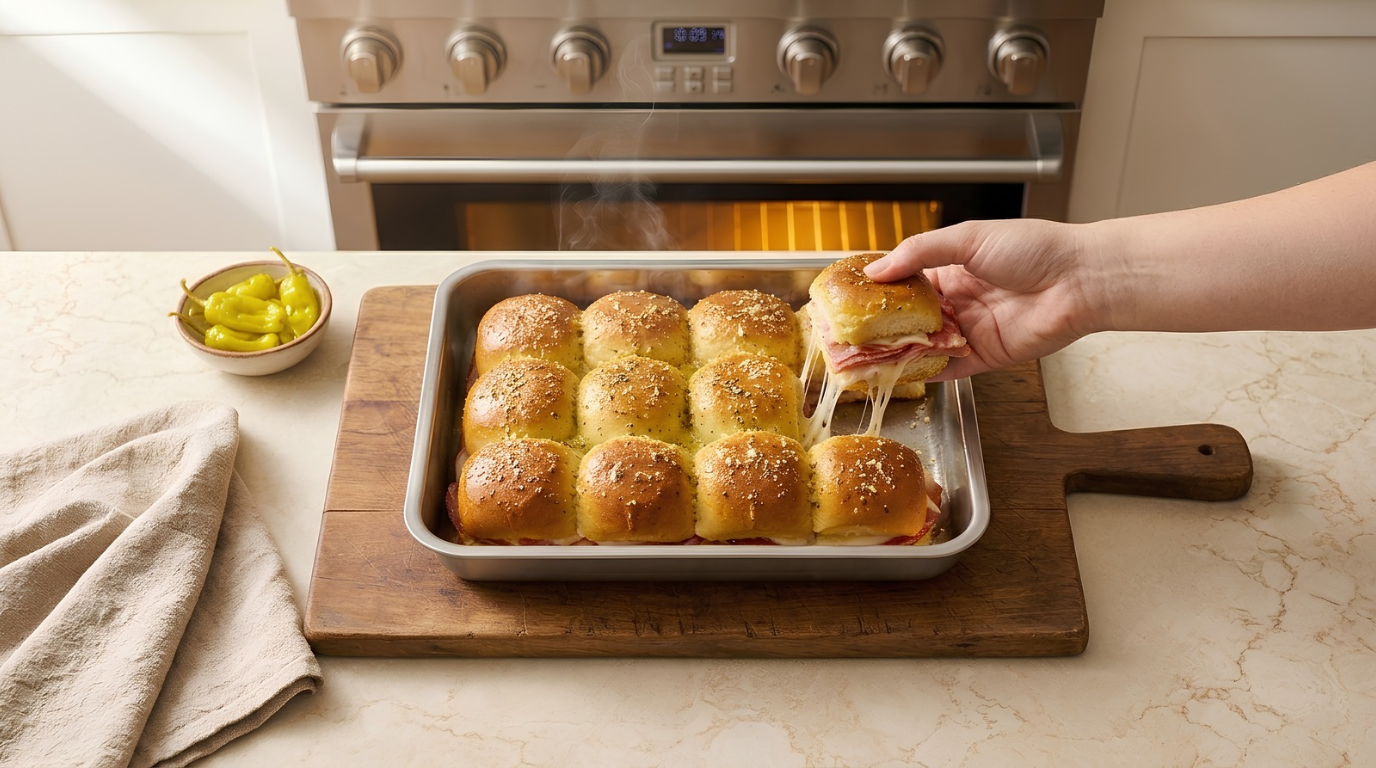
National Sandwich Day: Bake a Dozen Sliders at Once and Skip the Assembly Line
A sandwich lunch for a crowd carries a hidden cost. Each sandwich takes about a minute to build, which sounds trivial until twelve people are waiting and the cook is still working on the fourth. The bread dries out, the fillings drift toward room temperature, and the person assembling lunch never sits down to eat it. Sliders solve the problem by changing the unit of work. Instead of building twelve sandwiches, the cook builds one large sandwich on a single pan, bakes it, and cuts it into twelve portions at the table.
National Sandwich Day arrives every November 3, a natural reason to try that approach. This post covers the holiday’s history, a complete recipe for a dozen Italian style sliders, three alternate fillings, and a plan for baking the pan in Cosmo’s Haven Collection range, the COS-ERC365KBD.
The Earl, the Cards, and the Bread
National Sandwich Day falls on the birthday of John Montagu, the fourth Earl of Sandwich, who was born on November 3, 1718. The popular account holds that during a long evening of cards in the eighteenth century, the Earl asked for meat tucked between two slices of bread so he could keep playing without leaving the table. Other players began ordering what the Earl was having, and the name stuck. Historians note that the story is difficult to document, and some suggest he was more likely eating at his desk while tending to official business. Either way, the idea behind the dish has proven durable: a complete meal that can be eaten with one hand.
Sliders carry that idea one step further. The word once meant small hamburgers but now describes almost any small sandwich on a soft roll. The baked version, made as a connected slab, has become a fixture of game days, potlucks, and holiday tables. It suits the holiday because it rewards the same instinct that produced the original sandwich: make the meal easy to hold, easy to share, and easy to keep serving.
Why a Baked Pan Beats the Assembly Line
The advantages are practical. Assembly happens once, on one pan, using a full package of rolls kept intact. The cook slices the slab in half horizontally and layers the filling across the entire bottom in a few minutes. Heat does the rest. Baking warms every roll at the same time, melts the cheese into the meat, and lets a seasoned butter glaze soak into the tops, a result a skillet cannot match for twelve portions.
The finished pan also holds well. Because the rolls touch one another, they insulate each other, and the center stays warm far longer than a platter of individual sandwiches would. One package of twelve soft dinner rolls, about a pound of deli meat, and eight slices of cheese feed six to eight adults, and the quantities scale by adding a second pan.
Ingredients
Makes 12 sliders and serves six to eight.
- 1 package (12 count) soft dinner rolls, kept connected as one slab
- 1/2 pound sliced deli ham
- 1/4 pound sliced Genoa salami
- 1/4 pound sliced capicola
- 8 slices provolone cheese
- 1/3 cup mayonnaise
- 2 tablespoons Dijon mustard
- 1/4 cup chopped pepperoncini
- 6 tablespoons unsalted butter
- 2 cloves garlic, minced
- 1 teaspoon Italian seasoning
- 2 tablespoons grated Parmesan
Instructions
- Heat the oven. Move a rack to the center and heat the oven to 350 degrees on Bake, or 325 degrees on Convection Bake. Lightly grease a nine by thirteen inch baking dish.
- Cut the rolls. Without separating them, use a long serrated knife to slice the entire slab in half horizontally. Set the bottom half in the dish and keep the top half nearby.
- Spread the base. Stir the mayonnaise and mustard together and spread it across the cut side of the bottom layer and the underside of the top layer.
- Layer the filling. Cover the bottom layer with half of the provolone, fold the ham, salami, and capicola across it in even layers, scatter the pepperoncini over the meat, and finish with the remaining cheese. Cheese above and below the meat seals the layers together as it melts.
- Replace the top. Set the top slab in place and press down gently.
- Make the glaze. Melt the butter in a small saucepan over low heat. Stir in the garlic, Italian seasoning, and Parmesan for thirty seconds, then brush or spoon the mixture over the tops of the rolls, letting it run into the seams.
- Bake covered. Cover the dish with foil and bake for 15 minutes, until the cheese begins to melt.
- Finish uncovered. Remove the foil and bake 5 to 8 minutes more, until the tops are golden and the center is hot. Check the middle with a thermometer for 165 degrees, which matters most for guests at higher risk, such as older adults and pregnant guests.
- Rest and cut. Let the pan stand for five minutes, then cut along the seams and serve warm.
Three More Fillings, Same Method
The glaze, bake times, and pan stay the same for every variation.
Roast beef and cheddar. Layer thinly sliced roast beef with sharp cheddar and a few rings of red onion, and stir a tablespoon of prepared horseradish into the mayonnaise. Warm beef broth in a small bowl makes a good dipping sauce.
Turkey and apple. Use sliced turkey, white cheddar, and thin apple slices, and replace the mustard with honey mustard. The apple adds a crisp, sweet contrast to the savory glaze.
Chicken parmesan. Spread a thin layer of marinara across the bottom rolls, add sliced rotisserie chicken and mozzarella, and use the same garlic butter on top. Sweet rolls balance the salty fillings well, but potato rolls work if a less sweet bread is preferred.
Baking the Whole Pan in the Cosmo COS-ERC365KBD
The COS-ERC365KBD is a 36 inch electric range from Cosmo’s Haven Collection, and its oven is the feature that matters most for this recipe. The 6 cubic foot convection oven comes with two racks and six rack positions, so two nine by thirteen inch pans can bake at once, one on each rack, which turns a dozen sliders into two dozen without changing the method. The oven offers both Bake and Convection Bake, and the convection fan circulates heat for even browning, which is why the recipe lists a lower setting of 325 degrees for Convection Bake. When baking two pans, swap their positions after the foil comes off so both tops color evenly.
The five burner ceramic glass cooktop handles the glaze. Melting six tablespoons of butter calls for one of the smaller elements on a low setting, and the smooth surface wipes clean if a drip of garlic butter lands on it. The hot surface indicator stays lit until the cooktop has cooled, a useful reminder while the sliders finish in the oven.
After baking, the Warm function holds the pan at serving temperature while guests arrive. Confirm that the center stays at 140 degrees or above, and refrigerate leftovers within two hours. Keeping the pan covered with foil for the first stretch of baking also protects the porcelain oven interior from glaze spatter, which makes cleanup easier.
Make Ahead and Timing
Complete the first five steps up to a day ahead, leave the glaze off, cover the dish tightly, and refrigerate it. Brush on the glaze just before baking, and allow about ten extra minutes covered for a pan that starts cold.
On the day, the schedule is short. The oven heats while the sliders are assembled, the bake takes about 25 minutes, and the rest adds five more, so a pan started at 5:00 is on the table shortly after 5:45. Store leftovers in an airtight container for up to four days, and reheat them covered at 325 degrees for about ten minutes, until hot throughout.
Building the Rest of the Table
Sliders pair best with sides that are cool, crisp, or bright. A green salad with a sharp vinaigrette cuts through the richness of the cheese and meat, and a pot of tomato soup left at a low simmer on the cooktop gives guests something warm to dip into on a cold November evening.
A Better Way to Honor a Practical Meal
The sandwich has lasted for more than two centuries because it solves a simple problem well: it feeds people quickly and without fuss. A pan of baked sliders keeps that spirit and removes the one weakness of serving sandwiches to a group, the long wait while one person builds them. Assemble the pan, put it in the oven, and sit down with everyone else. That is a fitting way to spend National Sandwich Day.