
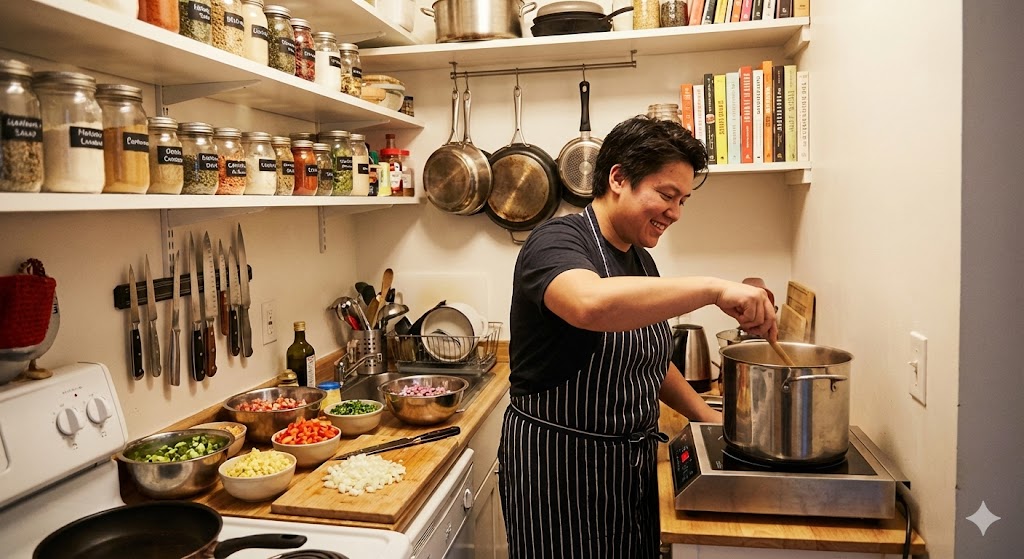
Cooking in Small Kitchens: Strategies for Making Limited Space Work
Small kitchens present real challenges that affect daily cooking more than most design issues. Limited counter space means nowhere to set ingredients while prepping. Minimal cabinet storage forces choosing between cookware and food storage. Compact appliances or missing equipment entirely restricts cooking techniques. Single cooks manage, but small kitchens become genuinely difficult when multiple people need to work simultaneously or when preparing complex meals requiring multiple active cooking processes. The constraints are real, not just inconvenient, and they fundamentally shape what you can cook and how efficiently you can work.
However, small kitchen limitations don’t prevent good cooking if you adapt your approach to the space rather than fighting against it. Strategic equipment choices, workflow organization, prep timing, and cooking method selection all accommodate space constraints while maintaining cooking capability. The goal isn’t making a small kitchen function like a large one – that’s impossible. Instead, you develop cooking strategies that work within the space you have, accepting some limitations while maximizing what’s actually achievable. Many excellent cooks work in tiny kitchens successfully because they’ve learned to work with their constraints rather than against them.
Honest Assessment of Your Actual Cooking Patterns
Small kitchen organization starts with understanding what you actually cook rather than what you imagine cooking someday.
Most people cook 7-10 dishes regularly that constitute 80% of their home cooking. These core recipes drive your equipment needs more than occasional ambitious projects. If you make pasta dishes, stir-fries, and sheet pan dinners weekly but roast whole chickens twice a year, your space allocation should reflect that reality.
Equipment you haven’t used in six months probably doesn’t earn its storage space. Small kitchens can’t accommodate “someday” items. That bread machine gathering dust, the fondue set from a wedding gift, the juicer you used twice – these take space from tools you actually use. Be ruthless about removing equipment that doesn’t serve current cooking patterns.
Cooking frequency affects space allocation. Daily coffee drinkers justify countertop coffee makers. Occasional coffee drinkers don’t. If you bake weekly, stand mixers earn their space. Monthly baking doesn’t justify permanent counter real estate for large appliances.
The honesty assessment requires distinguishing between aspirational cooking and actual behavior. You might want to be someone who makes fresh pasta weekly, but if you haven’t done it in two years, that pasta roller doesn’t deserve storage space. Build your kitchen around who you are, not who you wish to be.
Family size and cooking scale determine equipment sizing. Single people and couples don’t need 12-quart stockpots or full-size food processors. Smaller versions of these tools work fine and consume less storage space.
Special dietary needs or restrictions create legitimate equipment requirements that override general minimalism. If you’re gluten-free and make your own bread regularly, those baking tools earn their space. But don’t keep specialty equipment for diets you’re not actually following.
Strategic Equipment Selection and Multi-Use Tools
Equipment choices matter enormously in small kitchens because every item must justify its space through frequent use or unique capability.
One excellent large skillet (10-12 inch) handles more cooking tasks than multiple smaller pans. You can make small portions in a large pan, but you can’t make large portions in a small pan. The large skillet serves as everyday pan, sauté vessel, shallow braising pot, and even oven-to-table serving dish.
Dutch ovens provide exceptional versatility – stovetop cooking, oven braising, bread baking, soup making, and even frying in one pot. A 5-6 quart Dutch oven handles most tasks that would otherwise require multiple specialized pots. This single piece of cookware eliminates need for separate stockpots, braising dishes, and casseroles for many cooks.
Sheet pans serve multiple roles beyond baking cookies. Roasting vegetables, cooking proteins, making complete sheet pan dinners, holding prepped ingredients during cooking, and catching drips under other cooking vessels all use the same basic sheet pan. Two sheet pans (one half-size, one quarter-size) provide enormous utility without consuming much storage space.
Immersion blenders eliminate need for countertop blenders for many tasks. They blend soups directly in the pot, make smoothies in tall containers, and store in a drawer. Full-size blenders are bulky and single-purpose by comparison.
Instant-read thermometers replace multiple specialized tools. Instead of timers and guessing, temperature-based cooking ensures proper doneness for meats, baking, candy making, and oil frying. One small thermometer handles all these tasks.
Avoid single-use gadgets ruthlessly. Garlic presses, avocado slicers, strawberry hullers, egg separators, and similar specialized tools all perform tasks a knife handles. Each gadget consumes storage space for something you use occasionally at best.
Quality over quantity applies especially in small kitchens. One excellent chef’s knife used for everything beats a block of mediocre knives you never use. The good knife earns its space through daily use and capability. The knife block just takes up counter space.
Vertical Storage and Space Maximization
Small kitchens require using all available space, not just obvious cabinet and counter areas.
Wall-mounted magnetic knife strips get knives off counters and out of drawers while keeping them accessible. The vertical wall space holds 5-8 knives in the area a decorative plate would occupy.
Hanging pot racks suspended from ceilings or mounted on walls store cookware vertically above counters. This solution works only if you actually use the cookware regularly – hanging pots you rarely touch just creates visual clutter. But for frequently-used pans, vertical hanging beats cabinet storage.
Inside cabinet doors offer unused space for mounting racks, hooks, or organizers. Pot lids, measuring cups, small utensils, and cleaning supplies all store on door-mounted organizers, freeing drawer and shelf space.
Shelf risers effectively double cabinet space by creating two levels where one existed. Plates, bowls, and canned goods all benefit from riser systems that let you stack items without creating unstable towers.
Under-shelf baskets hang from existing shelves to create storage below them. These work well for lightweight items like coffee filters, tea bags, or small containers that would otherwise consume entire shelf space.
Drawer dividers and organizers prevent utensil drawers from becoming jumbled messes where nothing is findable. Organized drawers hold more usable items than chaotic ones because you can actually access everything.
Narrow rolling carts fit in gaps between appliances or next to refrigerators, providing mobile storage and additional workspace. Roll them out when needed, tuck them away when not in use.
Prep Work Timing and Mise en Place Adaptation
Traditional mise en place – having all ingredients prepped before cooking starts – doesn’t work well in small kitchens without counter space for multiple prep bowls.
Sequential prepping matches small kitchen realities better than complete advance prep. Prep the first ingredients, start them cooking, then prep the next items while the first ones cook. This approach uses cooking time for continued prep rather than requiring all prep to finish before cooking begins.
One large bowl or plate can hold multiple prepped ingredients when you don’t have space for individual containers. Pile everything on one plate with ingredients separated by small barriers or positioned in different areas. This compromise between complete mise en place and no prep works in constrained spaces.
Immediate waste disposal during prep keeps limited counter space clear. Have trash bowl or garbage right at your prep station so scraps don’t accumulate on the already-limited work surface.
Cutting directly over pots or bowls eliminates need for cutting board space when appropriate. Chopping onions directly into the pot they’re going into saves the intermediate step of cutting on a board then transferring. This doesn’t work for all prep, but it helps when possible.
Using pot lids, plates, or sheet pans as temporary ingredient holders during cooking provides surfaces when you don’t have counter space. Everything doesn’t need a dedicated bowl – sometimes a plate sitting on the stove works fine.
The adapted mise en place for small kitchens involves having ingredients ready in the most space-efficient way possible, not in the traditional each-ingredient-in-its-own-container approach that requires extensive counter space.
Cooking Method Selection Based on Equipment Constraints
Small kitchens often lack full-size ovens, multiple burners, or specialized cooking equipment, requiring cooking method adaptation.
One-pot meals eliminate the multiple-pan juggling that small kitchens and limited burner space make difficult. Soups, stews, braised dishes, pasta dishes cooked in one vessel, and rice bowls all create complete meals with minimal equipment.
Sheet pan dinners maximize oven efficiency when you have oven access. Complete proteins and vegetables roast together on one pan, requiring minimal active cooking and no stovetop space.
Sequential cooking on limited burners means cooking ingredients in batches using the same pan. Brown meat first, remove it, cook vegetables in the same pan, then combine at the end. This approach creates complex dishes with only one or two burners.
Microwave utilization beyond reheating provides cooking capability when burner and oven space are limited. Steaming vegetables, cooking grains, making mug cakes, and even cooking eggs all work in microwaves, freeing other equipment for items that truly require them.
Pressure cookers and slow cookers offer set-and-forget cooking that doesn’t require monitoring or active burner space. These appliances cook complete meals while consuming only counter or shelf space plus one electrical outlet.
Cold and no-cook meals during busy times reduce cooking equipment demands entirely. Salads, sandwiches, cheese and charcuterie, and grain bowls with pre-cooked components all provide good meals without extensive cooking.
Outdoor cooking when possible (grills, portable burners) extends cooking capacity beyond the constrained indoor kitchen. This seasonal solution works when weather permits.
Cleaning as You Go in Tight Spaces
Small kitchens become unworkable quickly when dirty dishes and cookware accumulate because there’s no space to set anything down.
Immediate cleaning of finished cookware opens up that equipment for reuse and clears limited space. As soon as a pan finishes its cooking task, wash it if you might need it again or need the drying rack space. Waiting until the end to clean means working around piles of dirty items.
Running dishwashers mid-cooking when you run out of clean items keeps usable dishes available. Small kitchens often lack extensive dish collections, so having clean dishes mid-cooking matters more than in kitchens with 40 plates and bowls.
Using the same pan for multiple cooking steps reduces total dishes. Cook bacon, remove it, cook eggs in the bacon fat, then wipe the pan and move to the next task. Sequential pan use means cleaning one pan instead of three.
Keeping sink clear as primary workspace matters in kitchens where the sink area is the only continuous counter space. Dirty dishes piled in the sink eliminate your workspace, so immediate dish washing or at least moving them to a dish rack preserves functionality.
Two-bowl sink systems or large dishpans allow separating clean and dirty items when counter space for dish racks doesn’t exist. One side holds dirty dishes, the other provides washing space or clean dish drying.
Grocery Shopping and Food Storage Adaptation
Small kitchens typically mean small refrigerators and limited pantry space, affecting shopping patterns and storage.
More frequent, smaller shopping trips suit small kitchens better than bulk purchasing. You don’t have storage space for three-week supplies, so shopping twice weekly for immediate needs works better than monthly costco runs.
Prioritizing fresh ingredients over extensive pantry stocks makes sense when cabinet space is limited. Fresh vegetables and proteins bought for immediate use don’t require long-term storage space that small kitchens lack.
Vertical pantry organization with risers, turntables, and stacking containers maximizes limited cabinet space. Efficient organization means you can actually see and access what you have rather than buying duplicates of items buried in back.
Decanting dry goods into uniform square or rectangular containers uses space more efficiently than keeping items in original packaging. Round containers waste space, bulky packaging consumes more room than necessary, and uniform containers stack cleanly.
Using refrigerator and freezer space strategically for prep items and leftovers matters when you have limited cabinet pantry. Some items store fine in the fridge that could theoretically live in cabinets, freeing cabinet space for things that must stay dry.
Avoiding duplicates and backup supplies keeps inventory minimal. You don’t need three bottles of olive oil or four containers of cumin when you barely have storage space. Buy one, use it, replace it.
Accepting Limitations and Working Within Them
Small kitchen reality includes genuine limitations that no organizational system or cooking hack overcomes completely.
Some cooking projects genuinely don’t work in small spaces. Making ravioli for 12 people requires workspace, equipment, and storage that small kitchens simply don’t have. Accept that certain ambitious cooking projects need to wait for different circumstances rather than fighting your kitchen.
Cooking for large groups in small kitchens requires different strategies than cooking the same food in large kitchens. Make-ahead dishes, cold items, and outsourcing some components all help when your kitchen can’t handle producing everything fresh simultaneously.
Multiple cooks in small kitchens create genuine conflicts that only scheduling solves. Two people can’t both actively prep in a 40-square-foot kitchen simultaneously. Sequential cooking or division of labor where one person preps while the other cleans works better than trying to share constrained space.
The limitation acceptance means developing cooking approaches that match your space rather than constantly feeling frustrated that your kitchen doesn’t work like larger ones. This isn’t settling or giving up – it’s practical adaptation to reality.
Making Peace with Small Kitchen Cooking
Small kitchens impose real constraints on cooking, but they don’t prevent good food or enjoyable cooking if you adapt your approach to match the space.
Strategic equipment choices focused on multi-use items and actual cooking patterns maximize utility while minimizing storage demands. Vertical storage and organizational systems extract maximum capability from limited space. Adapted prep timing and cooking methods work with spatial constraints rather than against them. Cleaning as you go maintains functionality in tight spaces.
The key lies in accepting your kitchen’s limitations while maximizing what’s actually achievable within them. You won’t cook exactly like someone with a large kitchen cooks, but you can cook well using methods suited to small spaces. Many excellent home cooks work in tiny kitchens successfully because they’ve learned to work with their constraints rather than constantly fighting against them. Small kitchens require more thoughtful planning and stricter organization than large ones, but they’re fully capable of producing great food when you approach them on their own terms.