
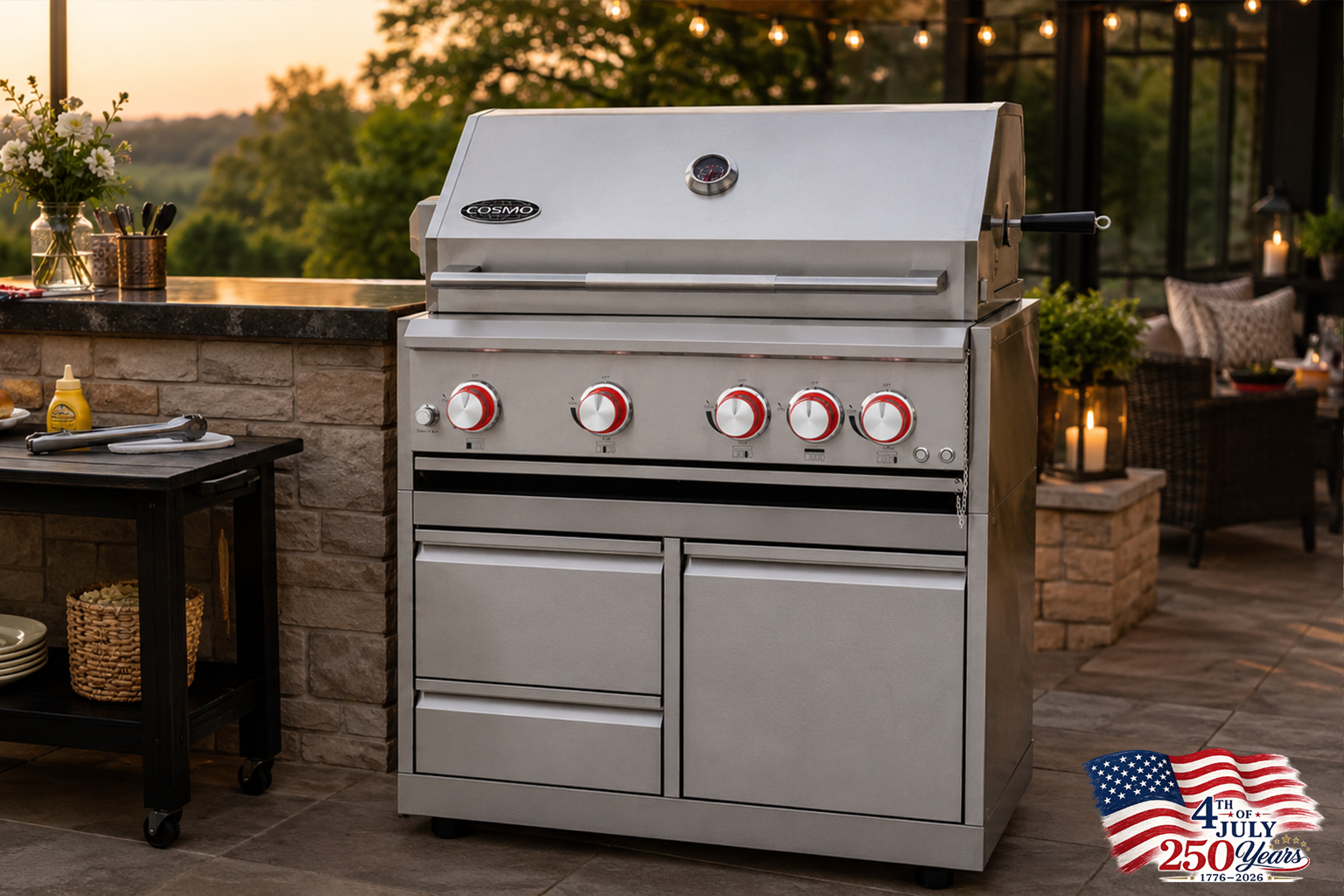
The COS-2PKG-800 Outdoor Grill and Cabinet Package: Build Your Fourth of July Setup Around It
Most backyard cooking setups are assembled piecemeal — a grill here, a side table there, a propane tank sitting visibly on the patio because there’s nowhere designated to put it. The result works functionally but looks improvised in a way that doesn’t match the effort that goes into the cooking itself. The COS-2PKG-800 solves this as a single decision: the COS-BGGN325K 32-inch propane gas grill paired with the COS-GCN323SS stainless steel grill cabinet, designed to work together as a complete outdoor cooking station.
Part of the Cosmo Newport Collection — the lineup positioned at the premium end of the outdoor cooking range — this package brings together serious burner technology with the storage and mobility infrastructure that makes managing a full-scale holiday cookout genuinely organized. Four main burners including both conventional and infrared configurations, a motorized rotisserie for whole cuts, LED-lit knobs for evening grilling, interior halogen lighting, a built-in thermometer, 304-grade stainless steel construction throughout, and a cabinet with two drawers, dedicated propane storage, and four casters with lockable brakes. For the Fourth of July specifically — a day that runs from midday through fireworks, demands volume cooking across multiple daylight and evening sessions, and benefits from a setup that looks as intentional as it performs — this combination handles the full scope of the event rather than just part of it.
The Newport Collection and What It Signals
Newport Collection positioning within the Cosmo lineup reflects a specific set of priorities: technology additions that serve real cooking purposes, construction quality that handles outdoor exposure over years of use, and design refinement that brings outdoor cooking stations closer to the standard set by indoor kitchen appliances.
The Newport Collection’s design approach treats outdoor cooking equipment with the same seriousness as indoor kitchen appliances — premium 304-grade stainless steel rather than painted alternatives, LED indicator lighting that serves a practical nighttime cooking purpose rather than purely aesthetic function, and engineering details like the motorized rotisserie and infrared rear burner that address specific cooking needs rather than just adding to a feature count. For buyers building an outdoor kitchen or serious patio cooking setup, the Newport Collection represents the tier where premium outdoor cooking actually begins.
For the Fourth of July, this positioning matters practically. A holiday that starts at noon and ends well after dark, hosts more guests than any typical weekend gathering, and requires the grill to perform at its best for hours without issues is exactly the context where cutting corners on equipment quality reveals itself most inconveniently.
Four Main Burners with Infrared Technology
The COS-BGGN325K’s burner configuration is more sophisticated than a simple BTU total suggests, and understanding the different burner types and their outputs explains how this grill handles the range of cooking tasks a Fourth of July spread demands.
Three 12,000 BTU Conventional Burners: These are the workhorses of the cooking surface — the burners that handle the continuous volume of burgers, chicken pieces, hot dogs, corn, and everything else that cycles through a holiday grill throughout the day. At 12,000 BTU each, they provide strong, consistent heat for high-heat searing and thorough cooking across the conventional grill zones. Three burners across 32 inches gives you a full conventional cooking surface with independent zone control — high heat on one end, medium on the middle, lower on the far end — that allows managing multiple items at different stages simultaneously.
10,000 BTU Infrared Burner: The infrared burner operates through radiant heat rather than the convective flame of a conventional burner. Infrared heat transfers more directly to food surfaces, producing faster and more intense searing with less heat lost to surrounding air. For searing steaks or any protein where a hard, fast crust is the goal before finishing at lower heat, the infrared burner delivers a level of surface browning intensity that conventional burners at similar BTU output don’t match. On a holiday where you might be serving steaks or thick-cut burgers to guests who specifically want them seared properly, this burner matters.
13,500 BTU Infrared Rear Rotisserie Burner: The rear-mounted infrared burner works in conjunction with the motorized rotisserie, heating from behind while the rotisserie rotates food through the heat zone. Infrared positioning for rotisserie is specifically valuable because it produces even radiant heat across the full circumference of rotating food — every rotation brings a new surface into proximity with the infrared source. This produces more consistent exterior browning and more even cooking than conventional rear burners, which heat unevenly relative to rotating food’s varying surface exposure.
Motorized Rotisserie Kit
For the Fourth of July specifically, the motorized rotisserie is the grill feature most likely to produce a showstopper centerpiece that distinguishes the event from a standard cookout.
What Rotisserie Cooking Does: Rotisserie cooking works through the continuous rotation of food through a heat zone, basting the food in its own rendered fat and juices with every revolution. This self-basting effect produces results that stationary grilling can’t replicate — a whole chicken that’s juicy and evenly browned on every surface, a roast that develops consistent exterior caramelization all the way around without dry patches from uneven heat exposure. The rotation prevents the side closest to the heat from overcooking while the far side stays undercooked, producing an even result that requires no intervention once the rotisserie is running.
Fourth of July Applications: Whole chickens are the classic rotisserie presentation — visually impressive, deeply flavorful, and capable of feeding four to six people per bird. A whole rotisserie chicken on a Fourth of July spread creates exactly the kind of centerpiece that guests remember. Bone-in leg of lamb, pork shoulder, whole turkey breast, and large rib roasts all benefit similarly from rotisserie treatment. For a holiday crowd, running the rotisserie from mid-afternoon produces food ready for a prime dinner window while requiring minimal active attention — the motorized rotation handles itself while you manage the conventional burners for faster-cooking items.
Motorized vs. Manual: The motorized designation matters because rotisserie cooking is fundamentally a low-attention technique — you load the spit, start the rotation, set the rear infrared burner, and walk away to manage guests and other cooking tasks. A manual rotisserie requires periodic turning that defeats the primary benefit. The motorized kit maintains continuous, consistent rotation throughout the full cooking session without monitoring.
The Infrared Rear Burner Pairing: The rear infrared burner’s positioning creates an ideal rotisserie heat environment because the food rotates through the infrared zone continuously. Every surface spends equal time in proximity to the infrared source throughout the cooking session, resulting in even browning and consistent cooking that front-mounted or bottom-mounted heat sources don’t achieve as reliably for rotating food.
LED Knob Indicator Lights
The Fourth of July runs through the evening and often past dark, and the LED indicator lights on the grill knobs address a specific nighttime cooking challenge directly.
The Nighttime Grilling Problem: Once ambient light drops, identifying which burners are on, which are off, and what level each is running at becomes genuinely difficult without dedicated lighting. Traditional grill knobs in the dark require leaning close and squinting at markings that aren’t illuminated, or using a phone flashlight to see what you’re adjusting — awkward when you’re managing multiple burners and holding a spatula.
LED Indicators in Practice: Each knob’s LED illumination makes burner status immediately visible from a comfortable standing distance. On an evening where the grill is running through fireworks viewing — keeping things warm, cooking a final round of food — the lit knobs allow confident grill management without fighting against darkness. For guests who interact with the grill, the visible indicators also prevent accidental operation changes from someone bumping controls without knowing what position they were in.
Interior Halogen Lighting
The interior halogen light illuminates the cooking surface from within the grill hood, creating visibility for monitoring food in the same way a range hood light illuminates a stovetop — except the operating environment is a high-heat grill rather than a kitchen cooktop.
Practical Evening Use: Once natural light drops during the extended evening phase of a Fourth of July gathering, monitoring food on an unlit grill requires opening the hood repeatedly to check doneness — disrupting the cooking environment each time. The interior halogen light allows checking food status through the grill’s window without opening the hood, preserving the cooking temperature and letting you assess progress visually from a convenient position.
Monitoring Rotisserie Progress: Interior lighting is particularly useful when monitoring rotisserie cooking, where you want to assess browning progress without interrupting rotation by opening the hood. The light makes the rotating food’s exterior color visible from outside, letting you judge whether it’s browning appropriately without touching the cooking process.
Built-In Hood Thermometer
A built-in thermometer on the hood provides ambient temperature readings inside the grill that guide heat management throughout the cooking session.
Managing Cooking Environment: The hood thermometer shows the air temperature inside the closed grill, which guides decisions about heat level adjustments, when to open the hood to release excess heat, and whether the grill has reached target temperature after preheating. For indirect cooking or rotisserie work where maintaining a consistent ambient temperature over extended periods matters, the hood thermometer provides continuous reference without requiring opening the hood to check.
Holiday Volume Awareness: During a long cooking day where the grill cycles through many consecutive cooking sessions, the hood thermometer helps identify when the grill is running unusually hot from accumulated heat versus a fresh preheat session. This awareness guides adjustments that prevent accidentally overcooking food from a grill running 50°F hotter than you expected from the last session’s residual heat.
COS-GCN323SS Grill Cabinet: The Infrastructure Side of the Package
The grill cabinet is what transforms the COS-BGGN325K from a good grill into a complete outdoor cooking station. Its contributions to a Fourth of July setup are organizational and operational rather than cooking-performance related, but they matter significantly for managing a high-volume holiday cooking day.
304-Grade Stainless Steel Construction: The cabinet uses the same 304-grade stainless steel as the grill itself — a specification that matters for outdoor equipment expected to endure year-round weather exposure. 304-grade stainless contains a higher chromium and nickel content than 430-grade alternatives, providing superior resistance to rust, corrosion, and surface oxidation from rain, humidity, and salt air in coastal environments. This construction quality extends the cabinet’s useful life significantly over painted steel or lower-grade stainless alternatives that pit and rust within a few years of outdoor exposure.
Two Storage Drawers: The drawers provide dedicated, organized storage for grilling tools, utensils, heat-resistant gloves, thermometers, tongs, and anything else needed at the grill station throughout the cooking day. On a Fourth of July where you might be managing spatulas, a meat thermometer, basting brushes, a rotisserie basting tool, tongs for multiple protein types, and miscellaneous other equipment, having it organized within arm’s reach of the grill rather than scattered across a separate table or making trips inside significantly improves the cooking workflow.
Dedicated Propane Tank Storage: A dedicated propane compartment with secure tank mount eliminates the common scenario where a propane tank sits visibly beside the grill with no designated home — something that looks disorganized and can be a tripping hazard in a busy patio environment during a gathering. The enclosed compartment conceals the tank within the cabinet’s stainless steel exterior while keeping it ventilated for safe propane storage and accessible for tank connection and disconnection.
Four Casters with Lockable Brakes: Smooth-rolling casters allow repositioning the entire grill and cabinet unit — adjusting position relative to wind direction, moving to access the area behind for cleaning, or repositioning relative to where guests are gathered throughout the day. Two lockable brakes secure the unit in position during active cooking, preventing unwanted movement when leaning on the cabinet or working at the grill surface. For a day involving many people moving around the cooking area, a stable, locked grill station is a meaningful safety feature.
LP Configuration and Natural Gas Convertibility
The package ships configured for liquid propane — the standard outdoor grill configuration that requires no permanent gas line installation and makes the grill usable in any location where a propane tank can be positioned.
Propane Logistics for the Fourth: For a holiday requiring extended cooking, verify propane supply well in advance. A full 20-pound propane tank provides approximately 18-20 hours of moderate cooking — typically adequate for a full holiday event. Running high-heat burners simultaneously and extended rotisserie operation will consume fuel faster than moderate cooking. Having a backup tank available or confirming tank fullness several days before the event prevents the scenario of running out of fuel mid-event when exchange locations are at their busiest.
Natural Gas Conversion Option: The optional natural gas conversion kit (sold separately) allows connecting to a permanent natural gas line for households with exterior gas line access. Natural gas conversion eliminates propane tank management entirely — no monitoring fuel levels, no tank exchanges, no concern about running out mid-event. For permanently installed outdoor kitchen setups where running a gas line to the patio is feasible, natural gas conversion is worth considering as it simplifies long-term operation considerably.
Building the Fourth of July Setup Around This Package
The COS-2PKG-800’s combination of conventional and infrared burners, motorized rotisserie, and organized cabinet infrastructure creates specific opportunities for structuring a Fourth of July cookout better than a standard grill setup allows.
Early Afternoon Rotisserie Start: Load the rotisserie with whole chickens, a leg of lamb, or a large roast in the early afternoon, set the rear infrared burner, and let the motorized rotation run while you focus on setup, guest arrival, and managing the conventional burners for faster-cooking early items. The rotisserie produces its centerpiece result largely independently while you direct attention elsewhere.
Conventional Burners for Volume Cooking: The three 12,000 BTU conventional burners handle the high-volume rounds of burgers, hot dogs, corn, and chicken pieces that a large Fourth of July crowd requires. Independent zone control allows one burner running hot for active searing, another at medium for cooking through, and a third at lower heat for holding finished items warm while the next round comes off.
Infrared Burner for Steak Service: If your menu includes steaks — which benefit most from the infrared burner’s intense direct heat — save that burner zone for the steak service window, running the conventional burners for everything else throughout the day and transitioning to the infrared zone when steaks go on.
Evening Extension: The LED knob lights and interior halogen lighting make the grill fully operational into the evening without lighting infrastructure additions. Keep the grill running through the fireworks viewing period for anyone wanting food through the evening rather than having to shut down when light drops.
304-Grade Stainless Throughout
Both the grill and cabinet share 304-grade stainless steel construction, which is worth understanding in context of outdoor appliance material choices.
Why Grade Matters Outdoors: Outdoor cooking equipment faces exposure that indoor appliances don’t — rain, humidity, temperature cycling, UV exposure, and in many regions salt air from proximity to coastal water. 304-grade stainless steel’s higher alloy content provides meaningful corrosion resistance advantage over painted steel and 430-grade stainless in these conditions. The construction investment pays back over years of service life rather than showing rust, pitting, and surface degradation within a few seasons that lower-grade materials eventually develop.
Appearance Maintenance: Stainless steel maintains its appearance longest with regular wiping after use and periodic treatment with stainless steel cleaner that removes surface oxidation and provides protective coating. After each holiday cooking session, a simple wipe-down of exterior surfaces while still slightly warm removes grease splatter before it bakes on, dramatically reducing the cleaning effort required for any subsequent deep clean.
The COS-2PKG-800 package makes the Fourth of July a different kind of event than a grill-only setup produces — not just because of what it cooks, but because of how it organizes the entire outdoor cooking station into a complete system with designated places for everything needed throughout a full day of cooking. The rotisserie centerpiece, the infrared searing capability, the LED-lit evening operation, and the cabinet’s organizational infrastructure all serve a holiday that runs longer, hosts more people, and demands more from outdoor cooking equipment than any typical weekend gathering. Getting the right setup before the Fourth means spending the holiday actually enjoying it rather than working around its limitations.