
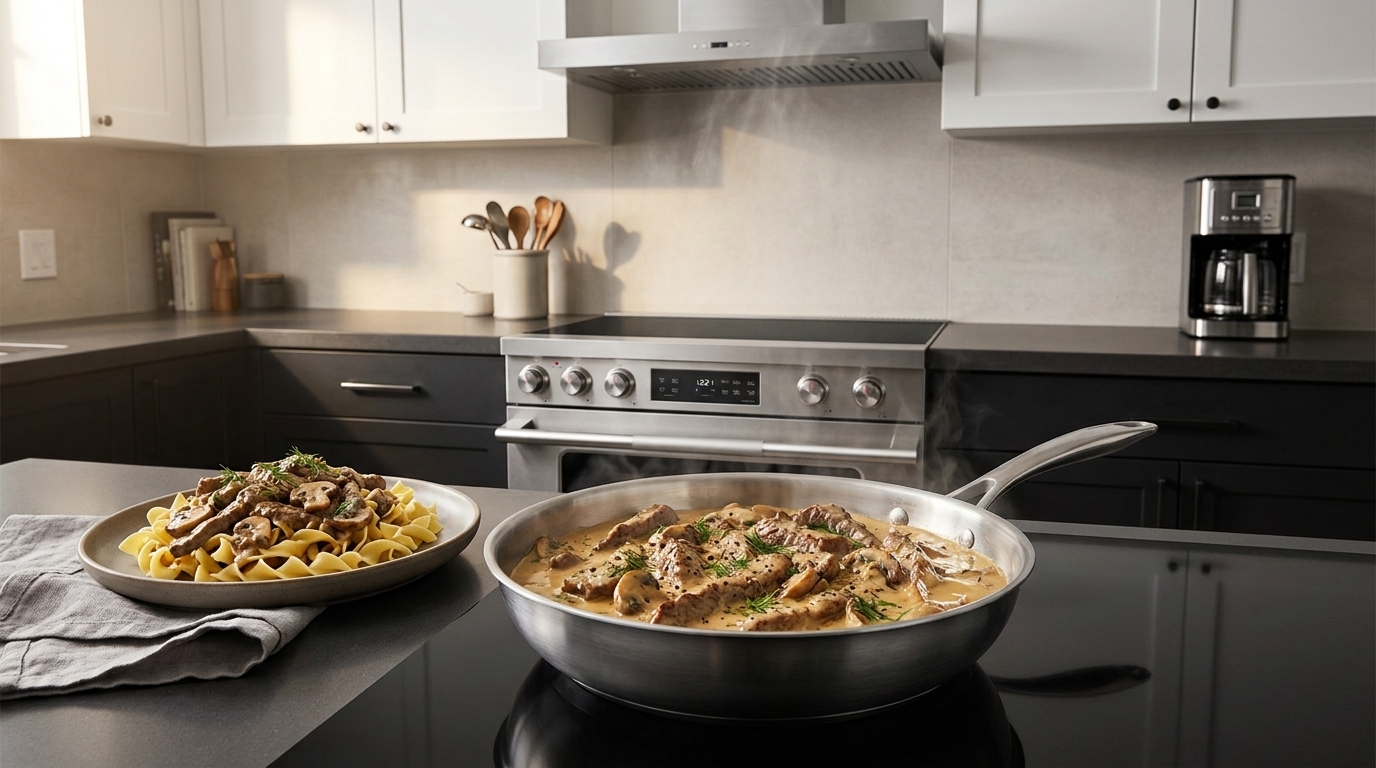
National Beef Stroganoff Day: The Dish That Lives or Dies on What Happens After the Sour Cream Goes In
Most food holidays celebrate something a home cook already makes without thinking twice about it. National Beef Stroganoff Day, observed on September 21st, is a little different. Stroganoff is a dish nearly every American household recognizes by name, tender beef and mushrooms in a rich, tangy cream sauce over egg noodles, but one that fewer households actually make from scratch than the recipe’s popularity would suggest. Part of that gap comes down to a single, easy-to-miss detail in the technique: stroganoff’s sauce is built on sour cream, and sour cream does not behave the same way heavy cream or a basic pan sauce does once it hits real heat. Get that one step wrong, and a dish built around silky, tangy richness turns grainy and broken. Get it right, and stroganoff earns every bit of the reputation that has kept it on American dinner tables for more than a century.
A Russian Import With an American Second Life
Beef stroganoff traces back to 19th-century Russia, most commonly credited to the kitchens associated with the Stroganov family, though the exact origin story has always been more folklore than documented fact. The dish that reached America by the mid-20th century, strips of beef sautéed with onions and mushrooms, finished in a sour cream sauce, was already a departure from the earlier Russian versions, which sometimes used a mustard-forward sauce rather than the cream-based one that eventually became standard. What stuck, and what turned stroganoff into a fixture of mid-century American cookbooks, was the combination of an approachable ingredient list with a genuinely elegant result. It read as special-occasion food while using cuts of beef and pantry staples most households already had on hand, which is exactly why it became a Cold War-era dinner party favorite and, not long after, a weeknight regular served over egg noodles instead of rice.
That dual identity, humble ingredients producing a dish that tastes considerably more refined than its grocery list suggests, is still the best argument for making stroganoff at home rather than ordering something similar at a restaurant. Good beef stroganoff is not an expensive dish. It is a technique-dependent one, and the technique is almost entirely about heat management rather than any hard-to-source ingredient or complicated multi-day process.
Where Most Home Versions Go Wrong
Ask any experienced home cook why their stroganoff came out grainy or thin instead of silky, and the answer nearly always traces back to the same mistake: the sour cream went into a pan that was too hot, or it sat over heat too long after being stirred in. Sour cream is a cultured dairy product with a relatively low tolerance for high heat. Push it past a gentle simmer, and the proteins that give it that smooth, tangy body start to separate, curdling into small white flecks suspended in a thin, broken liquid instead of melting seamlessly into the pan sauce. Once that happens, there is no fixing it. The dish is still edible, but it has lost the texture that makes stroganoff worth making in the first place.
This is why so many stroganoff recipes read like a warning label by the time they get to the final step: remove the pan from heat, or reduce to the lowest possible setting, before the sour cream goes in, and never let the sauce come back to a boil afterward. That instruction is easy to write and considerably harder to execute on a standard stovetop, where the gap between a gentle simmer and a rolling boil on a single burner setting can be narrower than most home cooks expect, especially on a gas burner where visual flame height does not always correlate cleanly to the actual heat reaching the pan. A cook distracted for even a minute, stirring noodles or plating a side dish, can come back to a sauce that has quietly slipped past the point of no return.
Precise, Instant Heat Changes the Outcome
This is exactly the kind of failure point that a genuinely responsive cooktop is built to eliminate, and it is the strongest practical argument for cooking stroganoff on induction rather than gas or a standard electric coil. Cosmo’s COS-RIS365SS, a 36-inch freestanding induction range, gives a home cook direct, immediate control over the exact moment the sauce needs to drop from an active simmer to a bare, sauce-holding warmth. Because induction heats a pan by generating a magnetic field directly in the cookware itself rather than heating the air and the burner surface first, adjusting the dial changes the temperature at the food almost instantly, without the lag of a gas flame slowly settling to a new height or an electric coil taking a minute or two to cool from its previous setting. For a sauce with a narrow safe zone like stroganoff’s, that responsiveness is the difference between a sauce that stays exactly where it needs to be and one that overshoots by the time a cook notices and reacts.
The range’s burner lineup backs up that precision with real range, not just fine control at the low end. Its five induction elements include one 2,500-watt burner and two 1,600-watt burners alongside two 1,200-watt units, enough output to properly sear beef strips over high, dry heat before the sauce stage ever begins, a step that matters as much to the finished dish as the sour cream technique does. Beef that goes into a crowded, lukewarm pan steams instead of browning, and stroganoff without a real sear on the beef loses much of the savory depth that makes the finished sauce worth building around. Getting both ends of that range, a hard sear early and a controlled, gentle finish later, out of the same burner without swapping pans or waiting on a cooktop to catch up is a genuine advantage for a dish built entirely around two very different heat requirements happening ten minutes apart.
The range’s 6.1 cubic foot convection oven and included storage drawer round out a kitchen setup built for a full stroganoff dinner rather than just the stovetop component, room to keep a tray of roasted vegetables or garlic bread warming in the oven while the sauce comes together on the cooktop, without needing a second appliance or a warming drawer improvised out of a low oven setting.
Building the Dish, Step by Step
A well-made stroganoff starts with the right cut of beef, sirloin or tenderloin sliced thin against the grain, patted dry before it ever touches the pan since excess surface moisture is the main thing standing between a real sear and a gray, steamed piece of meat. That beef gets seared quickly in batches over high heat, removed, and set aside while the same pan builds the rest of the dish, sliced mushrooms and diced onion sautéed in the leftover fat until they release their own liquid and begin to brown, followed by garlic, a spoonful of flour or a splash of brandy to deglaze the pan, and beef broth simmered down into a base with real body.
Once that base has reduced to a proper sauce consistency, the pan comes off direct high heat, dropping to the low, steady warmth an induction burner can hit and hold without drifting. The sour cream goes in off the heat or over the gentlest possible simmer, stirred until it fully incorporates into a smooth, cohesive sauce, and the seared beef returns to the pan just long enough to warm back through, not long enough to overcook a second time. Served over wide egg noodles, with a scattering of fresh parsley or dill, stroganoff comes together in well under an hour once the technique is dialed in, considerably faster than its dinner-party reputation suggests.
A Dish Worth Getting Exactly Right
National Beef Stroganoff Day is a fitting occasion for a dish that has always rewarded precision more than complexity. Nothing about stroganoff demands hard-to-find ingredients or an advanced skill set, but it does demand a kitchen that can move cleanly between a hard sear and a sauce that needs to sit just below a simmer without wandering past it. That is the exact gap a range like the Cosmo COS-RIS365SS closes, direct, instant control at both ends of a single burner’s range, so the dish that has quietly held its place on American dinner tables for a century finally gets made the way it was always meant to be, silky sauce and all.