
First Day of Fall: What a Real Kitchen Refresh Looks Like Going Into Roasting Season
Tonight at 8:05 p.m. Eastern, the sun crosses the celestial equator and fall officially begins. Meteorologists already counted September 1st as the first day of the season, but the astronomical calendar is the one most households instinctively mark, and it carries a certain weight. The evenings are shorter, the first cool mornings have arrived, and somewhere in the back of a lot of minds, a Sunday roast has quietly moved from “someday” to “soon.”
That shift is worth pausing on, because it is also when the phrase “kitchen refresh” starts showing up everywhere, usually attached to paint swatches, new hardware, and a rotating cast of gourd-themed decor. There is nothing wrong with any of that. But a refresh that only changes how a kitchen looks misses the more useful question, which is what the kitchen is about to be asked to do. From now until the holidays, the answer is almost always the same: work the oven harder than it has been worked in months.
The Kitchen Is About to Change Jobs
Summer cooking runs on speed. The grill handles the main course, the stovetop handles a quick sear or a pot of corn, and the oven mostly sits idle, since nobody wants to add heat to a kitchen already fighting a humid afternoon. Fall reverses that arrangement almost overnight. Roasting is the defining technique of the season, and it is a demanding one: high, sustained heat, long stretches with the door closed, pans that are heavy, hot, and awkward to move, and a fair amount of rendered fat and smoke that the summer kitchen never had to deal with.
Thanksgiving falls on November 26th this year, roughly nine weeks from now, and that number matters more than it seems. Nine weeks is enough time to fix nearly anything about a kitchen’s readiness, and not nearly enough time to discover a problem the week of the holiday. The households that cook that meal calmly are almost always the ones that spent September finding out what their oven actually does, rather than what the dial says it does.
Start With the Oven, Not the Throw Pillows
A real refresh has an order of operations, and the oven sits at the top of it. The first task takes about twenty minutes and costs less than a sandwich: place an inexpensive oven thermometer on the center rack, set the oven to 350 degrees, wait for it to cycle a few times, and compare the two readings. A gap of a few degrees is normal. A gap of twenty-five is the reason last year’s roast chicken had pale skin and dry breast meat, and it is far better to learn that in September than in November.
Cleaning comes next, and it is worth doing before the season starts rather than during it. Roasting leaves a residue that summer baking does not, a thin film of rendered fat and caramelized drippings that bakes on harder with every session. Removing the racks, running the oven’s cleaning cycle, and wiping down the door glass now means the first big roast of the season goes into a clean cavity instead of smoking off last winter’s leftovers. The same logic applies overhead. Range hood filters that have gone all summer without a serious workout tend to be coated in grease that has been quietly building up since spring, and a hood that cannot pull smoke from a 425-degree roast is a hood that will trigger a smoke detector at the worst possible moment.
Pans, Space, and the Unglamorous Details
The second half of the checklist is less about the appliance and more about everything around it. Rimmed sheet pans warp over time, and a pan that rocks on the rack roasts vegetables unevenly and pools fat in one corner. A heavy roasting pan or a large cast iron skillet is worth having a designated home for, ideally somewhere reachable without unstacking half a cabinet. A reliable instant-read thermometer earns its place before any large cut of meat goes in, since color and cooking time are only approximations of doneness.
Counter space deserves an honest audit too. Roasting season is prep-heavy: peeling and cutting squash, trimming Brussels sprouts, breaking down a whole chicken. A counter buried under summer’s small appliances and the stray pile of mail leaves nowhere to work. Clearing it now, and putting the ice cream maker and the outdoor serving trays into longer-term storage, is a refresh in the truest sense, because it returns the room to the function it needs to serve for the next few months.
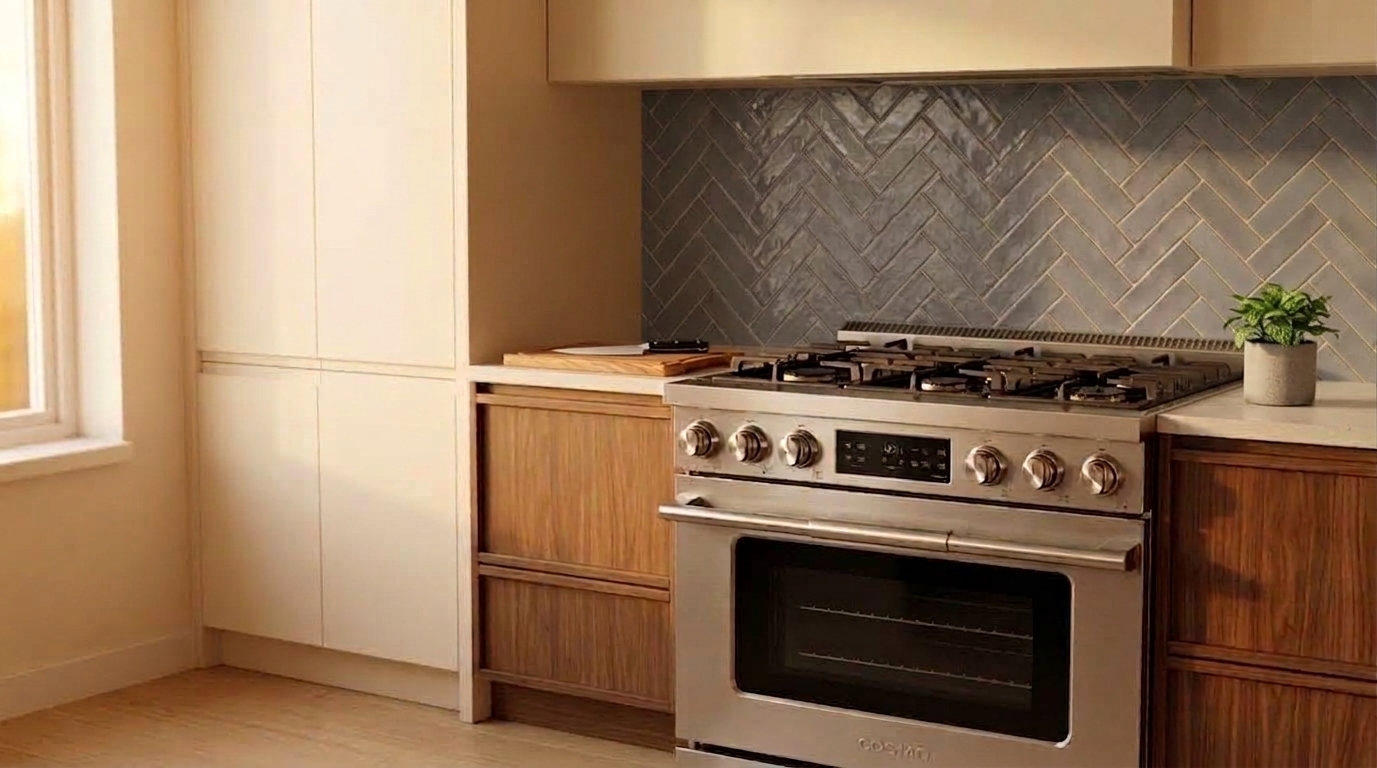
For households considering a new range as part of this reset, Cosmo’s COS-RGS366SS, a 36-inch gas range from the Stellar Collection, is built around the demands of exactly this kind of cooking. Its 6.1 cubic foot convection oven has a fan to circulate hot air through the cavity, which matters for roasting because it reduces the hot spots that leave one side of a pan browned and the other pale. Two racks with six positioning levels give a cook room to set a roasting pan low and a tray of vegetables above it, and the oven’s 18,500 BTU bake burner and 13,500 BTU broil burner provide the sustained high heat that a good roast depends on and a final blast of top-down heat to finish crisp skin or a caramelized crust.
The cooktop matters as much as the oven in a fall kitchen, since most roasts begin on the stove. Six burners on heavy-duty cast iron grates range from a 22,000 BTU high-output burner, strong enough to sear a chuck roast or brown a pork shoulder in a heavy skillet before it moves to the oven, down to a 3,500 BTU simmer burner, gentle enough to hold a pan gravy or a pot of cider without scorching. The oven’s air fry function, which comes with a dedicated tray, is a practical companion to roasting as well, useful for re-crisping roasted potatoes or finishing a batch of wings without heating a second appliance.
The practical details are the kind that count once the season is in full swing. A storage drawer keeps roasting pans and sheet pans close to where they are used. Digital touch controls with a clock and timer handle the oven, while front-mounted metal knobs handle the burners, and delay start and keep warm settings help when a dinner has to hold for an hour. A steam clean function loosens baked-on residue with heat and moisture, a sensible feature for a range that will spend the next three months turning out drippings. An oven cavity cooling ventilation system, overheating protection, and a cool-to-touch handle round out the safety features, all in a brushed stainless steel finish that fits comfortably alongside just about any cabinetry.
A Few Roasting Notes Worth Keeping Handy
Whatever range is in the kitchen, a handful of roasting habits carry across every oven and every recipe. Vegetables roast best at 400 to 450 degrees on a pan with enough room between pieces for hot air to reach every surface, since a crowded pan steams rather than browns. Cutting root vegetables to a similar size keeps a tray from finishing unevenly, and a light coating of oil, applied to the vegetables rather than the pan, promotes even caramelization.
For meat, doneness is a matter of temperature, not time. The USDA’s safe minimum is 165 degrees for whole poultry and 145 degrees, followed by a three-minute rest, for beef, pork, and lamb roasts, and a thermometer is the only reliable way to know when a roast has arrived. Resting the meat after it comes out, generally 15 to 20 minutes for a larger cut, lets the juices redistribute and makes carving considerably cleaner. When using a convection setting, many recipes suggest lowering the temperature by about 25 degrees or checking for doneness earlier than the written time, since moving air cooks more quickly than still air.
The Season Starts Tonight
A kitchen refresh, at its best, is less about making a room look new and more about making it ready. Verifying the oven, cleaning what roasting will soon dirty, clearing the counter, and making sure the equipment can handle a season of sustained, high-heat cooking does more for a fall kitchen than any decorative change can. The decor can come afterward, and it will look better in a kitchen that works. For anyone planning to upgrade the centerpiece of that kitchen before the holidays, a range like the COS-RGS366SS offers the convection oven, the burner range, and the practical details that roasting season asks for, with nine weeks still left to get comfortable with it before the table is full.