
Leftovers Done Right and What Your Microwave Can Do Beyond Reheating
The Second Meal Nobody Plans For
Every kitchen runs on two kinds of cooking. There is the cooking a household plans, shops for, and talks about, and there is the quieter second shift that happens the next day, when a container comes out of the fridge and goes into the microwave with very little thought. That second shift is where a surprising amount of good food gets ruined. The chicken that was juicy on Sunday turns stringy on Monday, the rice goes hard at the edges and stays cold in the middle, and the pasta comes out with a sauce that has quietly separated into oil and something else.
October makes the problem more noticeable. Soup season is already underway, braises and casseroles are back in rotation, and the stretch between now and the end of the year is built around big-batch cooking meant to be eaten more than once. A household that cooks one large pot on Sunday is really cooking three or four meals, and how well those later meals turn out depends almost entirely on what happens in the two or three minutes it takes to reheat them.
Why Leftovers Go Wrong in the First Place
Most reheating failures come from the same habit: treating the microwave as an on-off switch instead of a heat source with a dial. A microwave heats food by agitating the water molecules inside it, which means it reaches the wettest, thinnest, outermost parts of a dish first. Run it at full power for four straight minutes and the edges overcook and dry out long before the dense center catches up. That is how a single plate ends up both scorched and cold.
Density and moisture matter as much as time. A mound of mashed potatoes, a thick slice of lasagna, and a stack of chicken thighs all hold cold at their core, while a thin layer of rice or a few spoonfuls of sauce heat almost instantly. When those items share a plate and a single high-power setting, something is always going to lose. The fix is not a better container or a longer timer. It is a slightly more deliberate routine.
Leftovers Done Right, One Step at a Time
Start with power, not time. Dropping to medium, somewhere around 50 to 70 percent, gives heat time to move inward from the edges instead of cooking the outside while the middle waits. It adds a minute or so, and it is the single change that makes the biggest difference for dense dishes like casseroles, meatloaf, and anything with cheese on top.
Arrange the plate before it goes in. Spreading food into an even layer, or pushing it into a ring with an open center, removes the thick cold spot that microwaves struggle to reach. Thicker pieces belong toward the outside edge, where they get more energy, and delicate items toward the middle.
Add a little moisture back. Rice, grains, and pasta lose water in the fridge, and a spoonful of water or broth sprinkled over the top before reheating turns into steam that plumps them back up. Covering the dish with a microwave-safe lid or a damp paper towel keeps that steam where it belongs instead of letting it escape and leaving the surface dry.
Stir or flip halfway through. Reheating in shorter intervals, with a stir for saucy dishes and a flip for solid pieces, evens out the hot and cold zones that no cavity design fully eliminates.
Let it rest before eating. A minute of standing time lets heat keep spreading through the food after the cycle ends, which is often what finishes off a stubborn cold center. For food safety, leftovers should reach 165°F all the way through, and a quick check with an instant-read thermometer on thicker items like chicken or casseroles takes the guesswork out of it.
And know when the microwave is not the right tool. Anything that was crisp the first time, fried chicken, pizza crust, roasted potatoes, anything breaded, will come back soft no matter how carefully it is handled. Those are better revived in an oven or air fryer, while soups, stews, curries, grains, pasta, and saucy braises are exactly what the microwave does best.
What Your Microwave Can Do Beyond Reheating
Once a household starts using power levels deliberately, the microwave stops looking like a leftovers box and starts looking like what it actually is: a precise, low-mess heat source that handles a long list of small prep jobs faster than the stove.
Softening butter is the most common one. A stick straight from the fridge can be brought to spreadable, bakeable softness in short bursts at low power, without the melted puddle that full power produces. Melting chocolate works the same way, with short intervals at reduced power and a stir between each giving a smooth, glossy result without a double boiler.
Citrus gives up noticeably more juice after 10 to 15 seconds in the microwave, since the gentle warmth loosens the flesh before squeezing. A few seconds also makes garlic cloves easier to peel, as the skins pull away from the heat.
Fresh herbs that are about to wilt can be dried instead of tossed. Spread between two paper towels and heated in short bursts, parsley, oregano, rosemary, and thyme dry out in a few minutes and hold their color better than they do air-drying over a week.
Nuts, seeds, and breadcrumbs toast surprisingly well in a single layer on a plate, stirred every minute, and they come out evenly browned without the risk of a forgotten skillet on the burner. Stale bread or tortillas wrapped in a damp towel soften back to pliable in seconds.
Even cleanup falls within the microwave’s range. A bowl of water with lemon slices or a splash of vinegar, heated until it steams, loosens splatters inside the cavity so they wipe away easily, and it takes care of lingering food odors at the same time.
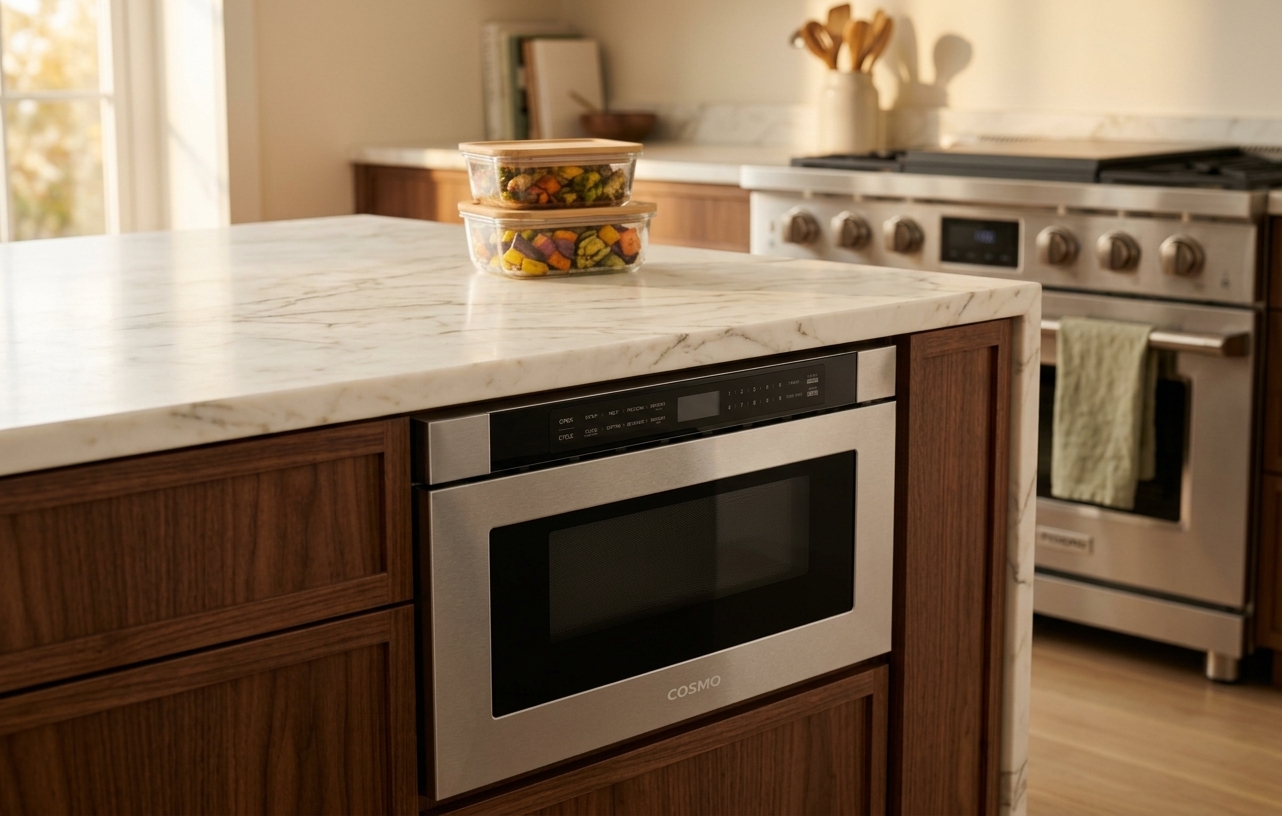
Cosmo’s COS-12MWDSS-NH, a 24-inch built-in microwave drawer from the Haven Collection, is built around exactly the kind of deliberate, everyday use that makes leftovers and small prep jobs turn out well. Its 11 power levels and 1,000 watts of output give a household the range to actually follow the medium-power approach instead of defaulting to high for everything, and its 1.2-cubic-foot capacity has room for a full dinner plate or a wide dish spread out in the even layer that reheats best.
The drawer’s automatic presets line up directly with the jobs that go beyond reheating. Dedicated melt and soften settings take the trial and error out of butter and chocolate, while popcorn and beverage presets cover the other quick everyday tasks. Weight and timed defrost options, paired with an included defrosting rack, make it easier to thaw a frozen batch of soup or a portion of last month’s chili evenly, which is where a lot of weeknight leftover meals actually begin.
The drawer format matters, too. Because it installs directly into cabinetry below the counter, the microwave comes off the countertop entirely and stops competing for prep space. Food loads from the top rather than being lifted in and out at eye level, which makes stirring halfway through or checking a hot bowl of stew far more comfortable, and the drawer opens and closes at the touch of a button on the control panel. A child lock rounds out a design built for a busy family kitchen, and the brushed stainless steel finish sits cleanly alongside a modern range and hood.
A Few Habits Worth Keeping
Portion leftovers before they go into the fridge. Shallow, single-serving containers cool faster, store more safely, and reheat more evenly than one large, deep container that has to be warmed all at once.
Label and date what goes in. Most cooked leftovers are best eaten within three to four days, and a strip of tape on the lid keeps a forgotten container from becoming a guessing game.
Reheat only what will be eaten. Warming and chilling the same dish over and over degrades its texture each time and is not recommended from a food safety standpoint.
Keep the cavity clean. Splatters left behind absorb energy on the next cycle and make the microwave work less efficiently, so a quick steam clean once a week is time well spent.
A Microwave Worth Using Well
The microwave has spent decades being treated as the least serious appliance in the kitchen, a box for coffee that went cold and yesterday’s pasta. Used with a little more intention, it becomes one of the most useful. It rescues leftovers instead of punishing them, and it quietly takes on a dozen small prep tasks that would otherwise tie up a burner or a pan.
A built-in drawer like the COS-12MWDSS-NH is made for exactly that kind of everyday use, with precise power control, presets for the jobs that come up most, and a design that keeps the countertop clear so the second meal of the week gets the same care as the first.