
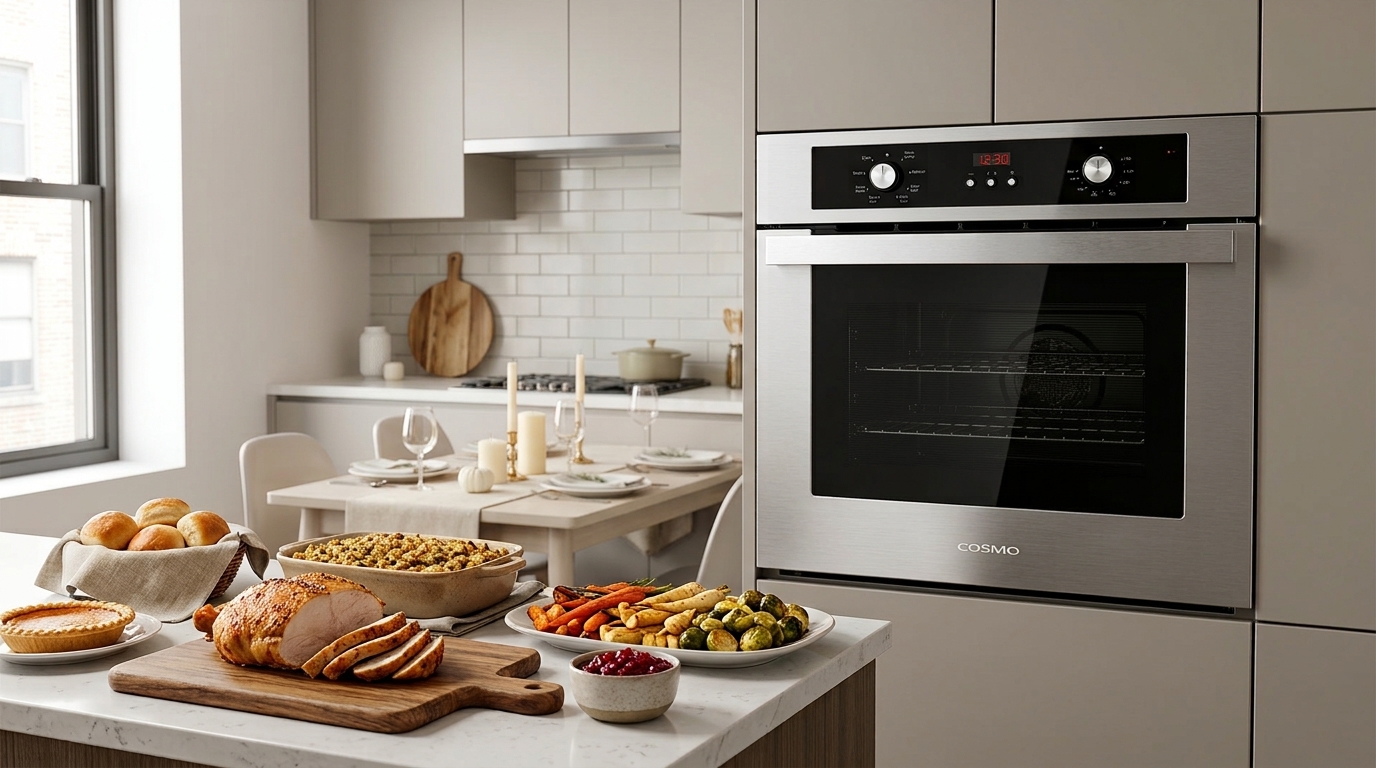
Hosting Thanksgiving in a 24-Inch Kitchen: How Ten People Eat From an Apartment Oven
Every November, hosts in apartments and condos do the same quiet calculation. The guest list has crept up to ten, the dining table needs a borrowed leaf, and the kitchen offers one cooktop and an oven that is twenty-four inches wide. The traditional Thanksgiving menu was designed for a house with a double oven, a long counter, and a second refrigerator in the garage. Feeding ten people from a compact kitchen is entirely possible, but it asks for a different method, one built around planning rather than square footage.
Start With the Math, Not the Menu
The USDA suggests planning on about a pound of turkey per person, which puts a party of ten at roughly ten to fifteen pounds of bird once you account for bones and a few leftovers. In a full-size kitchen, that is a shopping decision. In a compact one, it is a scheduling problem, because that bird will claim the only oven for the better part of an afternoon while stuffing, sweet potatoes, rolls, and a green bean casserole all wait their turn.
The most useful exercise a small-kitchen host can do is count oven hours instead of dishes. Write down every item on the menu, the temperature it needs, and how long it needs it. Then look for collisions. A turkey at 325 degrees, a casserole at 350, and rolls at 375 cannot share a cavity at the same moment, and in a compact oven they cannot share the racks either. Once the collisions are visible, the solution is usually to move work out of the oven, earlier in the week, or onto another appliance.
Build the Menu Around the Oven You Have
The biggest single change a compact kitchen can make is the shape of the turkey. A whole bird roasted upright is tall, slow, and awkward to maneuver in a small cavity. A spatchcocked turkey, with the backbone removed and the bird pressed flat, sits low on the rack, roasts more evenly, and typically finishes in a fraction of the time a whole bird needs. Another option is to roast two bone-in turkey breasts, which fit more easily and are simple to carve for a crowd. Either approach frees up hours of oven time without giving up the centerpiece.
Stuffing is the next place to save space. Cooked inside the bird, it forces the whole turkey to stay in the oven until the stuffing reaches a safe temperature. Baked as a dressing in a casserole dish, it can be assembled on Wednesday and baked on Thursday while the turkey rests. Cranberry sauce can be made days ahead and served cold. Pies, including pumpkin, should be baked the day before and refrigerated, which removes the heaviest dessert from the oven schedule entirely. Mashed potatoes can hold in a slow cooker, and gravy belongs on the stovetop.
One practical check before the week begins: measure. Set your roasting pan and baking dishes inside the oven and confirm they clear the walls and door with the racks where you plan to use them. A casserole dish that does not fit is far easier to fix on Monday than on Thursday.
Where the Cosmo C51EIX Fits
For condo owners, remodelers, and anyone building a guest house or accessory dwelling unit, the oven itself is part of the equation, and a compact wall oven is designed with exactly this kind of kitchen in mind. Cosmo’s recently introduced C51EIX is a 24-inch built-in single wall oven with 2.5 cubic feet of capacity. Because the 24-inch width needs a smaller cutout than a 27 or 30-inch oven, it fits into cabinetry that a larger oven would never clear, and it requires 240V service like most electric wall ovens.
Capacity is modest, and it is worth being honest about that. This is not an oven that will hold a large roasting pan and a sheet pan side by side, which is why the strategy above matters. What it does offer is control, and a holiday schedule depends on control. The C51EIX has eight oven functions: Bake, Convection Bake, Convection Roast, Broil, Convection Broil, Warm, Defrost, and Proof. Several of them map directly onto a Thanksgiving timeline.
Turbo True Convection uses a dedicated circular heating element around the fan, which heats the air as it moves and distributes it more evenly than a fan alone. Cosmo notes that convection cooking can reduce cooking times by roughly 20 to 25 percent, a meaningful figure when every minute of oven time is spoken for. Convection Roast suits the spatchcocked turkey or turkey breasts, while Convection Bake handles dressing, roasted vegetables, and pies on a single rack. Many cooks lower the recipe temperature by 25 degrees when switching to convection, and a probe or instant-read thermometer is the safest way to confirm doneness either way.
The Warm function is especially valuable for a host with one oven. When the turkey comes out to rest, the oven can heat up for the sides, and once those are finished, Warm holds them at serving temperature while you carve and plate. Proof is the quiet advantage for anyone baking rolls. A gentle, steady environment lets dough rise in a drafty apartment kitchen without taking over counter space, and it can be used earlier in the day before the oven is needed for roasting.
The triple layer glass door also helps in a tight space. It lets you check the turkey’s color without opening the door, which matters because every opening of a small cavity drops the temperature and stretches the schedule.
A note for renters: a built-in wall oven is an installation, so it is a decision for owners and remodelers. If you are cooking in a rental, every strategy in this post still applies to the range oven you already have.
A Timeline That Works for Ten
Planning backward from the meal makes a compact oven feel generous. Start with the turkey itself. The USDA recommends thawing in the refrigerator at about twenty-four hours for every four to five pounds, so a fourteen-pound bird needs roughly three days. Buy early and clear the shelf space, because refrigerator room is often the hidden bottleneck in an apartment.
On Tuesday, make the cranberry sauce, prepare any dry brine for the turkey, and shop for fresh ingredients. On Wednesday, bake the pies and refrigerate them, assemble the dressing, wash and trim the vegetables, and prepare the roll dough so it is ready to proof the next day. Wednesday evening is also the time to run the dishwasher and clear counters, so Thursday begins with space rather than clutter.
On Thursday, work in sequence. Proof the rolls in the morning and shape them. Roast the turkey in the early afternoon, planning for dinner at about five o’clock. When the bird reaches 165 degrees in the thickest part of the breast, the innermost part of the thigh, and the thickest part of the wing, per USDA guidance, tent it loosely with foil and let it rest for thirty to forty-five minutes. A rested turkey stays hot, carves more cleanly, and holds its juices. That rest window is when the oven earns its keep: raise the temperature, bake the dressing and vegetables, then bake the rolls last. While they bake, make gravy on the stovetop from the pan drippings and use the Warm setting to hold finished dishes.
Use Every Surface That Is Not the Oven
A compact kitchen succeeds when the oven is not asked to do everything. A slow cooker holds mashed potatoes at serving temperature, and the stovetop handles green beans, gravy, and sauces. Cold dishes are the other lever. A cranberry relish, a salad, or a cheese board asks nothing of the oven at all. Guests are often delighted to be assigned a dish, and the best assignments for a small kitchen arrive finished and at room temperature, such as a salad, bakery rolls, or a pie. Keep an eye on food safety as well. Cold items should stay below 40 degrees and hot items above 140, and leftovers should be refrigerated within two hours of serving. If the refrigerator is full, a clean cooler with ice, kept below 40 degrees, is a legitimate overflow plan.
The Bottom Line
A twenty-four-inch kitchen does not have to mean a smaller Thanksgiving. It means a more deliberate one. Count the oven hours, choose a turkey shape that suits the space, move as many dishes as possible off the oven and onto other days, and rely on a well-timed sequence rather than raw capacity. With a compact oven like the Cosmo C51EIX, convection speeds the work, Proof and Warm manage the margins, and a clear glass door keeps you in control without losing heat. The result is a dinner for ten that arrives hot, on time, and from a kitchen smaller than most hosts expected to need.