
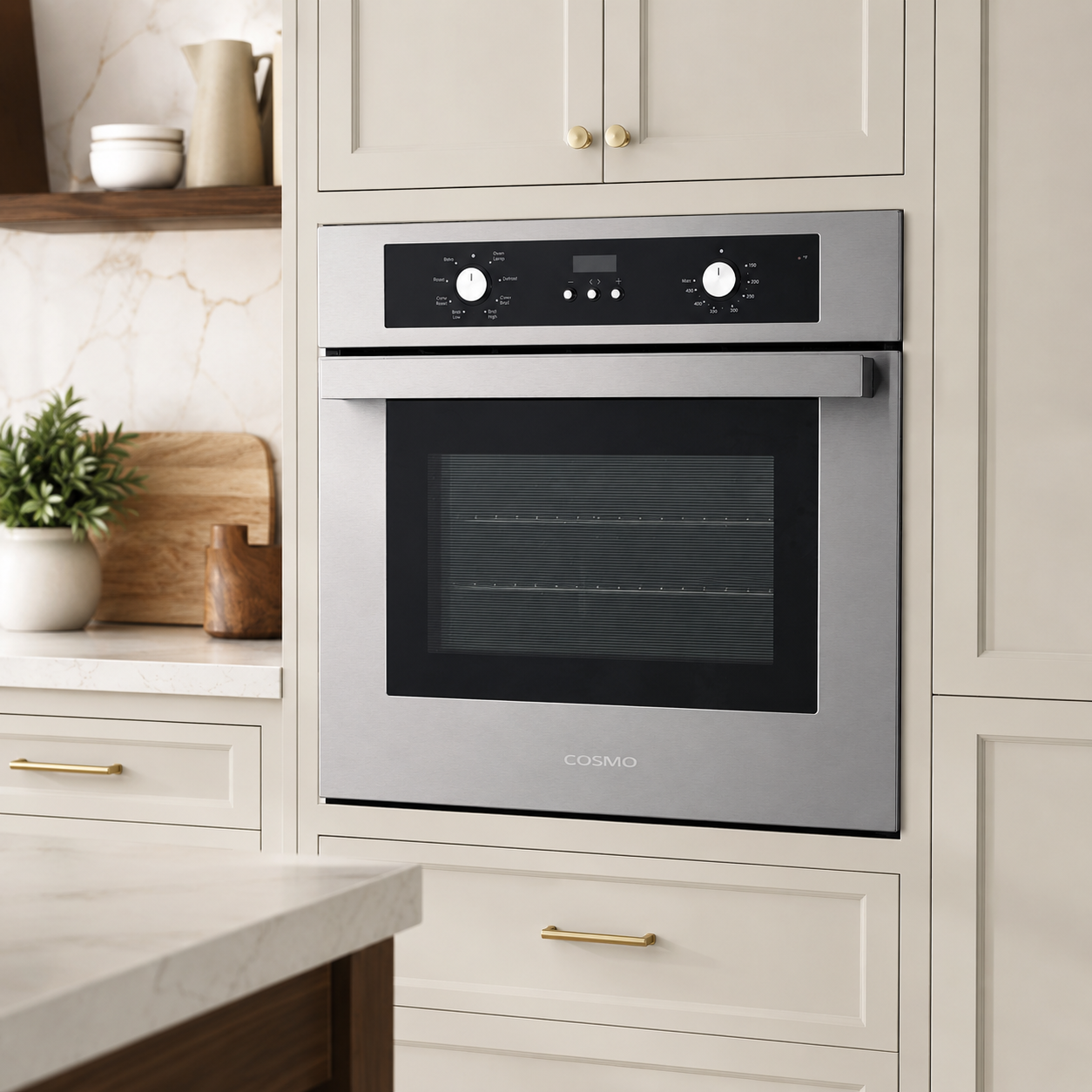
The C51EIX Compact Wall Oven: 24-Inch with Turbo True Convection and Triple Layer Glass
Not every kitchen has the space, or the need, for a 30-inch wall oven. Smaller kitchens, secondary cooking stations, condos, and households that don’t require the largest available oven capacity are better served by a more compact footprint that still delivers genuine convection performance rather than a stripped-down version of larger models. The C51EIX fills exactly this space: a 24-inch built-in single wall oven with 2.5 cubic feet of capacity, eight oven functions, Turbo True Convection, and triple layer glass construction, controlled through a straightforward combination of knobs and push buttons rather than an all-touchscreen interface.
What distinguishes the C51EIX within Cosmo’s oven lineup is the combination of genuine convection technology and safety-focused construction in a compact size class where these features aren’t always standard. The same fan-assisted circular heating element that distributes heat evenly in larger ovens is present here at the 24-inch scale. Triple layer glass on the door provides better insulation and a cooler exterior surface during operation than single or double-pane alternatives. An auto-off safety feature adds a layer of protection relevant to any household, but particularly valuable in kitchens where the oven might be used by less experienced cooks or where the unit operates somewhat out of the way of regular kitchen traffic and attention.
Why 24-Inch Wall Ovens Serve a Real Need
Wall oven buying guides default to discussing 27-inch and 30-inch models because they’re the most common sizes in larger kitchens, but the 24-inch category addresses genuine constraints that a meaningful number of kitchens face.
Compact Kitchen Footprints: Condos, smaller homes, and kitchens with limited cabinet runs often can’t accommodate a 30-inch wall oven cutout without sacrificing other essential storage or workspace. The C51EIX’s 24-inch width fits into a smaller cabinet allocation, making built-in oven installation achievable in kitchens where the larger size simply wouldn’t fit without compromising the rest of the layout.
Secondary Cooking Stations: Households building a butler’s pantry, an outdoor kitchen extension, a basement kitchenette, or a secondary prep area benefit from a smaller, dedicated oven that doesn’t require the capacity of a primary household oven. The C51EIX provides genuine baking and roasting capability for these secondary spaces without the footprint commitment of a full-size oven.
Two-Oven Configurations Without the Double Oven Commitment: Some households want the flexibility of two ovens — one for everyday use and one for additional capacity during entertaining — without installing a full double wall oven unit. Pairing a primary 30-inch oven with a separate 24-inch C51EIX in another part of the kitchen achieves this flexibility through two independent appliances rather than a single stacked unit, which can work better in kitchens where the cabinetry layout doesn’t accommodate a double oven cutout in one location.
Right-Sized Capacity: Not every household needs 5+ cubic feet of oven space. Smaller households, those who cook primarily for one or two people, or anyone whose oven use skews toward smaller dishes rather than large roasts or sheet pans benefits from a 2.5 cubic foot cavity that’s proportional to actual usage rather than oversized for the household’s typical needs.
Turbo True Convection at the 24-Inch Scale
The C51EIX brings genuine convection technology into the compact oven category, a meaningful distinction from basic ovens at this size that sometimes omit true convection in favor of simpler, less expensive heating systems.
What Turbo True Convection Means: Unlike basic convection that simply adds a fan to circulate existing oven heat, Turbo True Convection includes a dedicated circular heating element positioned around the fan. This element heats air directly as the fan circulates it, rather than relying solely on the oven’s main heating elements to warm air that the fan then moves around. The result is more uniform temperature distribution throughout the cavity — front to back, top to bottom — than fan-only convection systems achieve.
Why This Matters in a Smaller Cavity: It might seem like convection matters less in a smaller oven cavity since there’s less distance for heat to travel and less opportunity for temperature variation. In practice, smaller cavities can actually show more pronounced hot and cold spots without proper convection because food items often occupy a larger percentage of the available airflow path, creating more significant disruption to heat circulation than the same items would in a larger cavity. Genuine convection technology compensates for this more effectively than basic fan circulation alone.
Practical Baking Improvements: Even at 2.5 cubic feet, the C51EIX’s convection system improves results for baked goods that benefit from consistent heat — cookies that brown evenly without rotation, small roasts that cook through without overdone exteriors, and multi-item baking where you’re using the available rack space efficiently despite the more limited cavity size.
Faster Cooking Through Efficient Heat Transfer: Convection’s active air movement transfers heat to food more efficiently than static radiant heat, typically reducing cooking times by 20-25% or allowing lower temperatures for equivalent results. This efficiency matters in any oven size but contributes meaningfully to the C51EIX’s practical usability for everyday cooking tasks where time matters.
Eight Oven Functions in a Compact Package
The C51EIX includes eight distinct oven functions, providing the same breadth of cooking methods found in considerably larger and more expensive ovens, scaled appropriately to the 2.5 cubic foot cavity.
Bake: Conventional radiant heat cooking through bottom and top elements, used for recipes developed with traditional ovens in mind. This is the baseline function for most baked goods and remains unaffected by the oven’s compact size in terms of results.
Convection Bake: Fan-assisted baking with the Turbo True system active, providing the even heat distribution benefits described above. The everyday function for most cooking tasks where consistent results across the cavity matter.
Convection Roast: Optimized element and fan combination for developing surface browning on smaller roasts, vegetables, and proteins sized appropriately for the 2.5 cubic foot cavity. Whole chickens, smaller roasts, and sheet pan vegetable preparations all benefit from this mode’s emphasis on exterior browning alongside thorough cooking.
Broil: Top element at maximum intensity for direct overhead heat — finishing dishes, browning cheese toppings, and quick searing tasks that the compact cavity handles just as effectively as larger ovens for appropriately sized dishes.
Convection Broil: Combines broiler intensity with fan circulation for more even browning results across a dish’s surface, useful for finishing multiple smaller items simultaneously where standard broil might brown unevenly.
Warm: Low-temperature holding function that maintains finished dishes at serving temperature without continuing to cook them — practical for staging components during a multi-dish meal even in a smaller secondary oven context.
Defrost: A function not always included at this size class, defrost mode uses controlled low-temperature air circulation to thaw frozen items more evenly and safely than ambient counter thawing, reducing the time and food safety concerns associated with improper defrosting methods.
Proof: Dedicated proofing mode maintains the warm, consistent environment that yeast doughs require for rising — valuable for home bread baking, pizza dough, and other yeasted preparations regardless of the oven’s overall size.
Triple Layer Glass Construction
The door glass construction on the C51EIX uses three layers rather than the single or double pane glass found in more basic ovens, with meaningful implications for both safety and energy efficiency.
Insulation Performance: Each additional glass layer with air gaps between them reduces heat transfer through the door. Triple layer glass keeps more heat contained within the oven cavity, meaning the cooking system works less to maintain set temperatures and the oven recovers temperature more quickly after door openings during cooking.
Exterior Surface Temperature: A cooler door exterior during operation is a genuine safety consideration, particularly relevant for compact ovens that might be installed at heights more accessible to children, or in kitchens where the oven sees frequent traffic near its exterior surfaces during active cooking. Triple layer glass keeps the outermost surface significantly cooler than single-pane alternatives at equivalent internal temperatures.
Energy Efficiency: Better door insulation means less energy lost through the glass during cooking cycles, contributing to lower energy consumption over the oven’s lifetime. This efficiency compounds over years of regular use into measurable energy cost savings.
Visibility Without Compromise: Despite the additional glass layers, the triple layer construction maintains clear visibility into the oven cavity, allowing visual monitoring of food without opening the door and disrupting cooking temperatures — a small but meaningful daily convenience.
Auto-Off Safety Feature
The auto-off safety feature provides an additional layer of protection that’s particularly valuable given the contexts where compact 24-inch ovens often get installed and used.
How It Functions: The auto-off feature monitors oven operation and automatically shuts down the unit after an extended period without active monitoring or adjustment, preventing the scenario where an oven is accidentally left running for hours longer than intended. This isn’t a substitute for attentive cooking practices, but it provides a backstop against the genuinely common situation of a forgotten oven.
Relevance to Compact Oven Use Cases: Secondary kitchen stations, guest spaces, and households where the C51EIX might serve a less frequently monitored role benefit particularly from this safety feature. An oven in a butler’s pantry or basement kitchenette is more likely to be started and then forgotten amid other household activity than a primary kitchen oven that receives constant attention throughout active cooking.
Peace of Mind for Multi-Generational Households: Households where the oven might be used by family members with varying levels of cooking experience or attentiveness — older relatives, younger family members learning to cook, or guests unfamiliar with the kitchen — benefit from the additional protection that automatic shutoff provides against extended unintended operation.
Knob and Push Button Control Interface
The C51EIX uses a combination of knob and push button controls rather than an entirely touchscreen interface, a deliberate choice with specific practical advantages.
Tactile Reliability: Physical knobs and buttons provide immediate tactile feedback and continue functioning reliably through years of kitchen use, including exposure to the heat, moisture, and occasional grease that kitchen environments generate. Unlike touch interfaces that can become less responsive over time or struggle with wet or greasy fingers, physical controls maintain consistent performance.
Straightforward Operation: For a compact, often secondary oven, straightforward physical controls reduce the learning curve for anyone using the unit — family members, guests, or household members who use this oven less frequently than a primary kitchen appliance. The directness of knob and button operation doesn’t require navigating menu systems or touchscreen interfaces to access basic functions.
Temperature Setting Precision: Knob-based temperature selection, when well-designed, provides quick and intuitive temperature setting without requiring multiple button presses or screen navigation to reach a target temperature — a practical advantage for an oven that might see frequent quick-use throughout a cooking session.
Installation Considerations
Installing the C51EIX requires planning specific to its 24-inch compact dimensions, distinct from the larger wall oven installations more commonly discussed.
Cabinet Cutout Requirements: The 24-inch width requires a correspondingly sized cabinet opening — smaller than standard 27 or 30-inch wall oven cutouts. This compact footprint can fit into cabinet spaces that wouldn’t accommodate larger wall ovens, making the C51EIX a practical retrofit option for existing cabinetry not originally designed around a full-size wall oven.
Placement Flexibility: Because of its smaller footprint, the C51EIX offers installation flexibility beyond traditional wall oven locations — built into a kitchen island, positioned in a butler’s pantry, or installed in a secondary food preparation area where a 30-inch oven wouldn’t reasonably fit. This flexibility expands where built-in oven capability can be added to a home.
Electrical Requirements: Like other built-in electric ovens, the C51EIX requires appropriate 240V electrical service. Confirm that the planned installation location has access to this circuit, or budget for the electrical work required to bring it there, particularly if the C51EIX is being installed as a secondary oven in a location without existing major appliance electrical infrastructure.
Ventilation Clearance: The cavity cooling ventilation system that protects surrounding cabinetry from heat damage requires the clearances specified in installation documentation. Following these specifications during cabinet planning protects both the oven’s performance and the surrounding cabinetry’s finish over years of use.
The C51EIX Compared to the C106SIX-PT
Cosmo offers two compact 24-inch wall ovens with closely related specifications, and understanding the distinction helps clarify which suits a given kitchen’s needs.
Control Interface Difference: The C51EIX uses knob and push button controls, while the C106SIX-PT uses soft touch controls with an LED display. Both provide full access to the same eight oven functions and Turbo True Convection performance — the difference is purely in how you interact with the oven’s controls. The C51EIX’s physical controls suit buyers prioritizing tactile reliability and straightforward operation; the C106SIX-PT’s soft touch and LED display suit buyers prioritizing a sleeker, more contemporary control surface aesthetic.
Shared Core Specifications: Both models share identical 2.5 cubic foot capacity, eight oven functions, and Turbo True Convection technology. The C51EIX specifically includes the auto-off safety feature as an explicitly noted specification, providing that additional safety layer alongside its physical control interface.
Choosing Between Them: The decision largely comes down to control interface preference rather than any difference in cooking performance or capacity. Buyers who want the cleanest possible front panel appearance and don’t mind touch-based operation should consider the C106SIX-PT. Buyers who prioritize the long-term reliability and immediate tactile feedback of physical controls, particularly for an oven that might see use by multiple household members with varying technical comfort levels, should lean toward the C51EIX.
The C51EIX makes a genuine case for itself within Cosmo’s oven lineup by delivering real convection technology, a full eight-function cooking range, triple layer glass insulation, and a meaningful safety feature in a 24-inch footprint that fits where larger wall ovens simply can’t. For kitchens with compact dimensions, secondary cooking station applications, or households that want built-in oven capability without committing to a full-size unit, the C51EIX provides genuine cooking performance scaled appropriately rather than a stripped-down compromise.