
How Much Oven, Microwave, and Reheating Capacity You Actually Need for Thanksgiving
A twenty pound turkey can hold a home oven for more than four hours, and that single fact explains most of what goes wrong on Thanksgiving afternoon. The bird is rarely the problem. The trouble is everything else that wants heat at the same moment: the dressing, the rolls, the casserole, the gravy, and the plate someone needs warmed at the last minute.
Thanksgiving falls on Thursday, November 26 this year, which leaves enough time to answer three practical questions before the grocery lists get long. How many oven hours does the menu really need? How much of the work can happen somewhere other than the main oven? And how much reheating will the days after the meal demand? This guide takes them in order.
How Much Oven Time You Need
Start by writing down every dish that will need heat on Thursday, with the temperature it wants and the minutes it needs. Then add up the oven hours. The turkey is the largest entry, and the USDA gives a useful benchmark. With the oven set no lower than 325 degrees, an unstuffed bird of 12 to 14 pounds takes roughly three to three and three quarter hours, and one of 18 to 20 pounds takes about four and a quarter to four and a half hours. Those figures are approximate, so the turkey is done only when a food thermometer reads 165 degrees in the innermost part of the thigh, the innermost part of the wing, and the thickest part of the breast.
The second number matters just as much. The USDA advises letting the turkey stand for about 20 minutes before carving. That rest is the one reliable window of the day when the main oven is empty, and hosts who plan around it can finish the dressing, warm the rolls, and brown a casserole without improvising. Hosts who ignore it tend to discover on Thursday that three dishes need the same oven at 4:30.
The audit usually produces a simple result. If the list shows more than one dish that needs a long stretch of real oven heat, a single cavity is going to be tight. That is the point at which the equipment in the wall starts to matter.
How Much Second Cavity You Need
A host with one oven has three choices: stagger the dishes and accept a long afternoon, move as many as possible to the stovetop and slow cooker, or add a second place to cook. Plenty of households do well with the first two. For anyone replacing an oven before the holidays, the third deserves a look.
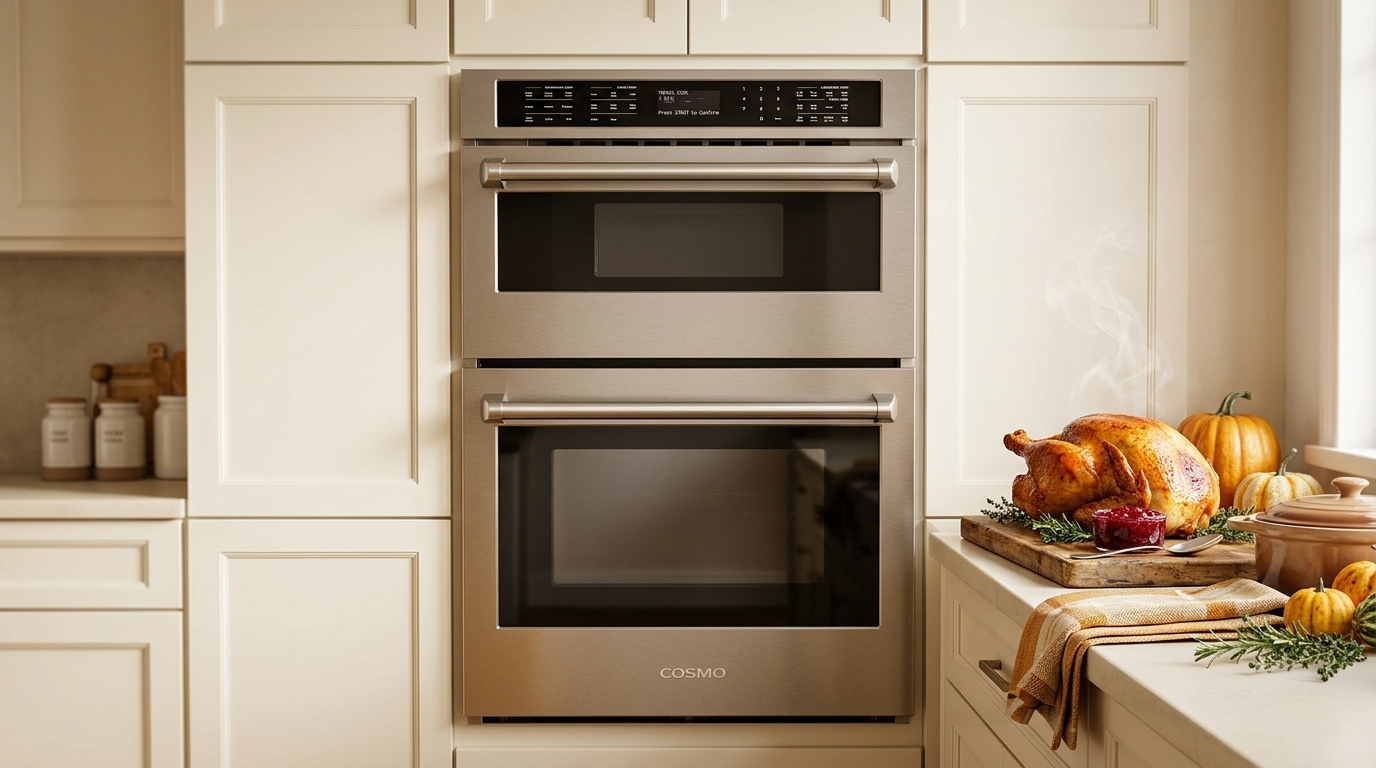
Cosmo’s COS-WOMCR302SS, a Regal Collection wall oven and microwave combination, fits both appliances into one 30 inch opening. The lower oven holds 4.8 cubic feet and offers Bake, Broil, Convection Bake, Convection Roast, Keep Warm, Pizza, and Proof, with gliding racks across six positions. That is the cavity for the turkey. Convection Roast suits the bird, and the built in temperature probe lets a cook watch internal temperature from the control panel instead of opening the door again and again. A probe reads a single point, so it is worth treating as a convenience and still checking all three spots the USDA names before carving.
The upper unit is where this appliance differs from a standard wall oven. It is a 1.6 cubic foot microwave that also carries Turbo True European Convection, which circulates heat with a fan assisted circular element. Both cavities include an Air Fry function, and the upper unit comes with a ceramic tray, a turntable, an oven rack, and an air fry basket. In practice that gives a host a second place to bake or crisp a smaller dish while the turkey roasts below, and it gives the day a microwave that is not sitting on the counter taking up room.
A fair caveat belongs here. At 1.6 cubic feet, the upper cavity is a supporting player, not a second roasting oven, so measure the casserole dish you plan to use against the interior before counting on it. The microwave side adds its own small conveniences. Ten power levels and presets for Melt, Soften, Popcorn, and Beverage handle the quiet jobs of a holiday kitchen, like melting butter for the dressing, softening cream cheese for a pie filling, or warming cider for guests who arrive early.
The lower oven helps with timing as well. Proof gives dinner rolls a steady place to rise, Keep Warm holds finished dishes while the turkey is carved, and the self cleaning cycle takes care of Friday morning. Since hot food should be held at 140 degrees or above, check dishes with a thermometer rather than trusting the setting alone.
How Much Reheating You Need
The meal ends, but the oven work does not. Perishable food should be refrigerated within two hours of cooking, or within one hour when the room is above 90 degrees. Carve the turkey, divide it into shallow covered containers, and plan to eat it within three to four days. That makes Monday, November 30 the last day for refrigerated leftovers, and anything beyond it belongs in the freezer.
Reheating is where a microwave earns its place, and the USDA is specific about the method. Leftovers should reach 165 degrees as measured with a food thermometer. In the microwave, cover the food, arrange it evenly in a dish, add a little liquid if it looks dry, and rotate it partway through. Microwaves leave cold spots, so allow a standing time of at least two minutes unless the manufacturer says otherwise, then check the temperature in several places. Dense foods such as sliced turkey keep cooking after the timer stops, which is one reason a lower power level often works better than full power for a plate of leftovers.
Larger portions are better in the oven. The USDA suggests reheating at no lower than 325 degrees with a splash of broth or water under a cover until the food reaches 165 degrees. A wall oven and microwave combination suits this pattern well, since the upper unit can warm a single plate while the lower oven reheats a pan of dressing or a casserole, and nothing has to wait its turn.
What to Check Before You Install
A replacement three weeks before Thanksgiving is possible, but the details deserve attention now. The COS-WOMCR302SS measures 42.5 inches high, 30 inches wide, and 25.1 inches deep. It runs on 240 volts with a four wire connection, draws 34 amps, and is rated at 6150 watts, so it needs a dedicated circuit and professional installation. The installation guide calls for a cabinet base that can support 243 pounds plus the weight of food, and for at least 23 inches of clearance in front for the open door. Confirm the cutout against the guide before ordering.
Cosmo appliances are sold through authorized dealers, so confirm availability and delivery timing right away. If the wiring or cabinetry needs changes, it may be wiser to install after the holiday and use the planning above to run this Thursday with the oven you already have.
A Countdown to Thursday
- This week, November 5 to 8: Finish the menu, run the oven hour audit, and if you are replacing an oven, confirm the electrical and cabinet requirements with an electrician and a dealer.
- November 9 to 15: Measure your roasting pan and casserole dishes against every cavity, and decide which dishes can be made ahead.
- November 16 to 19: Write a schedule that starts with the turkey’s roasting time and works backward from the moment you want to sit down.
- Wednesday, November 25: Assemble the dressing, bake the pies, and clear refrigerator space for the leftovers to come.
- Thursday, November 26: Roast at no lower than 325 degrees, rest the bird for about 20 minutes, and use that window to finish the sides. Refrigerate leftovers within two hours.
- Monday, November 30: Eat or freeze every remaining leftover.
The Bottom Line
Thanksgiving is a scheduling problem before it is a cooking problem. Count the oven hours, protect the rest window, decide where the second round of dishes will cook, and plan the reheating before the leftovers exist. A combination like the COS-WOMCR302SS gives a household a second cavity and a microwave in one opening, but the real work is the plan, and three weeks is plenty of time to make one.