
A Better Bake Starts Here: Getting to Know Your Oven’s Settings
Most home bakers can recall a tray of cookies that came out pale on top and scorched on the bottom, or a cake that domed, cracked, and sank within the same afternoon. The recipe usually takes the blame. The more likely culprit is a setting that was never chosen on purpose. With holiday baking about to begin, this is a good week to look closely at the dial or touch panel and learn what each mode is actually doing inside the cavity.
An oven is not simply a box that gets hot. Each setting changes which heating elements are running, whether a fan is moving the air, and how aggressively the heat reaches the surface of your food. Once you understand those three variables, you can match the setting to the dish instead of leaving everything on the default and hoping for the best.
Bake: The Dependable Baseline
Standard Bake is the setting most recipes assume. Heat comes from the elements at the top and bottom of the oven, and the air inside stays relatively still. That gentle, steady environment is the reason Bake remains the right choice for delicate batters. Layer cakes, quick breads, custards, cheesecakes, and soufflés all benefit from still air, because moving air can dry the surface, push a crust to set too early, or cause an uneven rise.
If a recipe does not mention a mode at all, assume Bake and use the rack position the recipe suggests. The center rack is the safest default for most baking because it sits farthest from both elements, which gives the food the most balanced exposure. Moving a pan one rack higher will brown the top faster, and moving it one rack lower will deepen the bottom crust, which is a useful trick once you know your oven’s habits.
Convection Bake: Moving Air Changes the Math
Convection Bake adds a fan, and in a true convection design a heating element positioned around that fan, so hot air circulates continuously instead of settling into warm and cool pockets. The practical result is faster, more even browning and the ability to bake on more than one rack at a time. Cookies, scones, biscuits, puff pastry, sheet pan vegetables, and granola are all strong candidates because they want dry heat and crisp edges.
The adjustment most bakers need to remember is that moving air cooks faster. Many recipes suggest lowering the temperature by about 25 degrees, or checking for doneness a few minutes early, when switching from Bake to a convection mode. Cosmo notes that convection cooking can shorten cooking times by roughly 20 to 25 percent, so it pays to start watching the oven sooner than the written time. If a cake or custard comes out with a dried top or a lopsided rise, return to standard Bake for that recipe. Convection is a tool for the right job, not an upgrade for every job.
Convection Roast and Broil: High Heat, Different Jobs
Convection Roast is built for larger cuts and trays of vegetables. It uses the fan alongside the heating elements to brown the outside while the inside cooks through, which is why it suits a chicken, a pork loin, or a pan of potatoes and carrots. Because it favors browning, it is generally less suited to baked goods, although it can rescue a pale pizza or finish a gratin whose top needs color.
Broil uses intense heat from above and is best reserved for short, attended tasks such as melting cheese, caramelizing the sugar on a crème brulee, or giving a casserole a final blush of color. Keep the rack position in mind, since food placed too close to the element can burn in under a minute. Many ovens also offer a convection version of Broil, which moves the air to help food brown more evenly. In either case, follow your manual’s guidance on door position and stay nearby.
The Quiet Settings Worth Using
Two settings tend to be overlooked until someone discovers them and cannot stop using them. Proof holds the oven at a low, steady temperature, which makes it an ideal spot for bread dough, cinnamon rolls, and dinner rolls to rise, especially in a cool kitchen during winter. Warm holds finished dishes at serving temperature, so a pan of rolls or a casserole can wait patiently while the rest of the meal comes together.
Preheating deserves the same attention. A preheat signal tells you the air has reached the set temperature, but the walls and racks may still be catching up. Giving the oven an extra ten minutes after the beep, particularly before baking bread or pizza, helps the cavity hold its heat when the door opens and the cold pan goes in. Placing an inexpensive oven thermometer on the center rack is also worthwhile, because it shows whether the number on the display matches what is happening inside. If you suspect a mismatch, our post on why your oven temperature may not be telling the truth walks through the signs to look for.
Putting the Settings to Work in the COS-30ESWC
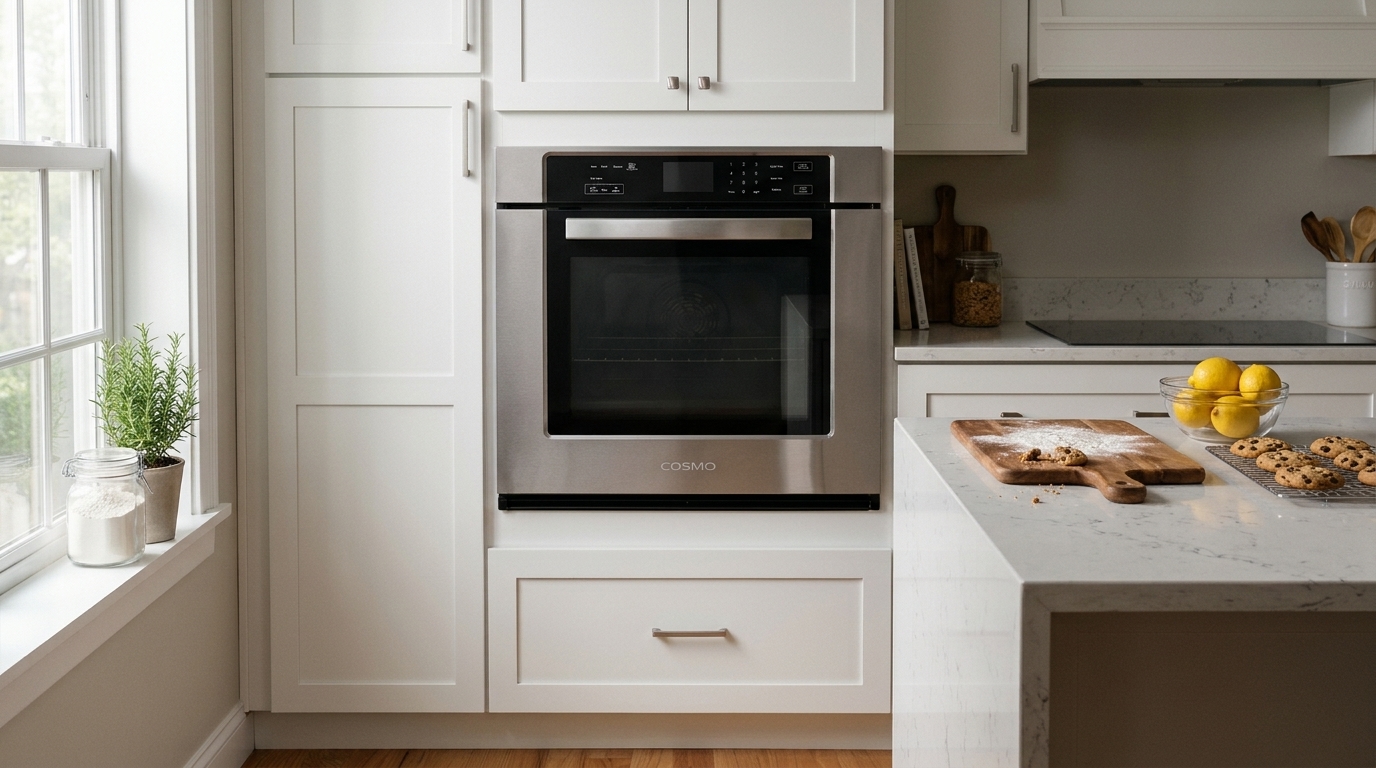
A wide range of modes only helps if the oven performs consistently in each of them. Cosmo’s COS-30ESWC is a 30 inch single electric wall oven with a 5 cubic foot cavity, and it is a useful example of how these settings come together in one appliance. Its Turbo True European Convection system pairs a fan with a circular heating element, which distributes heat evenly through the cavity and helps reduce the hot spots that cause lopsided cookies and unevenly browned pies.
The oven offers seven cooking functions, including dedicated Convection Bake and Convection Roast modes, so the choices described above are available directly from the soft touch digital display. That makes it easy to put a cake on standard Bake in the morning and switch to Convection Bake for a batch of cookies in the afternoon without second guessing which control to use. Because each mode is its own selection, you can build the habit of choosing deliberately for every dish.
The built in temperature probe is especially helpful when the dish is a roast rather than a bake. Instead of opening the door repeatedly to check on a roast, a cook can monitor the internal temperature from the control panel and keep the heat inside the cavity where it belongs. The large window and interior light add to this, letting you watch a loaf rise or a pie crust turn golden without interrupting the bake. The bold blue porcelain interior is a distinctive touch against the brushed stainless steel exterior, and the lighting makes the color of a crust easier to judge. Anyone planning a new installation should confirm the cutout dimensions and electrical requirements in the installation guide before ordering.
A Simple Test to Learn Your Own Oven
The fastest way to understand your settings is to run a controlled experiment. Line a sheet pan with parchment, scoop a dozen cookies of identical size from one batch of dough, and bake half on standard Bake and half on Convection Bake, reducing the temperature by 25 degrees for the convection tray. Bake them on separate occasions on the same rack, and take notes on color, spread, and how long each batch needed.
Repeat the test with a second pan on a different rack to see how much your oven’s top and bottom differ. A few notes written in the margin of a favorite recipe, such as which mode and rack worked best, will save more effort than any single piece of equipment. Within two or three bakes you will know whether your oven runs a little hot at the back, whether the top browns faster than the bottom, and how much a convection mode changes your timing.
The Bottom Line
A better bake rarely requires a new recipe. It starts with choosing a setting for a reason: Bake for delicate batters, Convection Bake for crisp and even results on cookies and pastry, Convection Roast for meats and vegetables, Broil for quick finishing, and Proof or Warm for the moments between. Learn how each one behaves in your oven, keep a thermometer on the rack, and adjust one variable at a time. The more you understand what the oven is doing, the less the results will feel like luck, and the more your baking will feel like something you control.