
Black Friday Appliance Shopping: Measure Twice, Order Once
Every holiday shopping season, a handful of appliance orders go wrong in exactly the same way. The product was excellent, the price felt right, and the order took only a few minutes to place. Then the delivery crew stood in the front hall with a refrigerator that would not clear the doorway, or an installer pulled out a tape measure and found the cutout was an inch too narrow.
Black Friday rewards speed, but a good appliance decision depends on the opposite habit. The solution is to do the slow work first. Spend an hour with a tape measure and a notepad before you open a single browser tab, and when an offer appears you can say yes or no in five minutes with real numbers in hand. The five steps below cover the measurements, utilities, and delivery details that decide whether a purchase fits your home as well as your budget.
Why Fit Matters More on a Sale Day
A sale creates a deadline, and a deadline pushes people to skip the details. That is a poor trade for a large appliance, because a wrong size is rarely a small problem. It can mean cabinet changes, a new electrical circuit, a return that involves freight, or an installation that stalls halfway through a kitchen project. Return terms for large appliances also vary by retailer, so read them before you buy and not after the truck has left.
A price can be compared again next week. A cutout that is the wrong size will still be the wrong size on Monday. Treat every measurement as part of the price.
Step One: Measure the Opening Three Ways
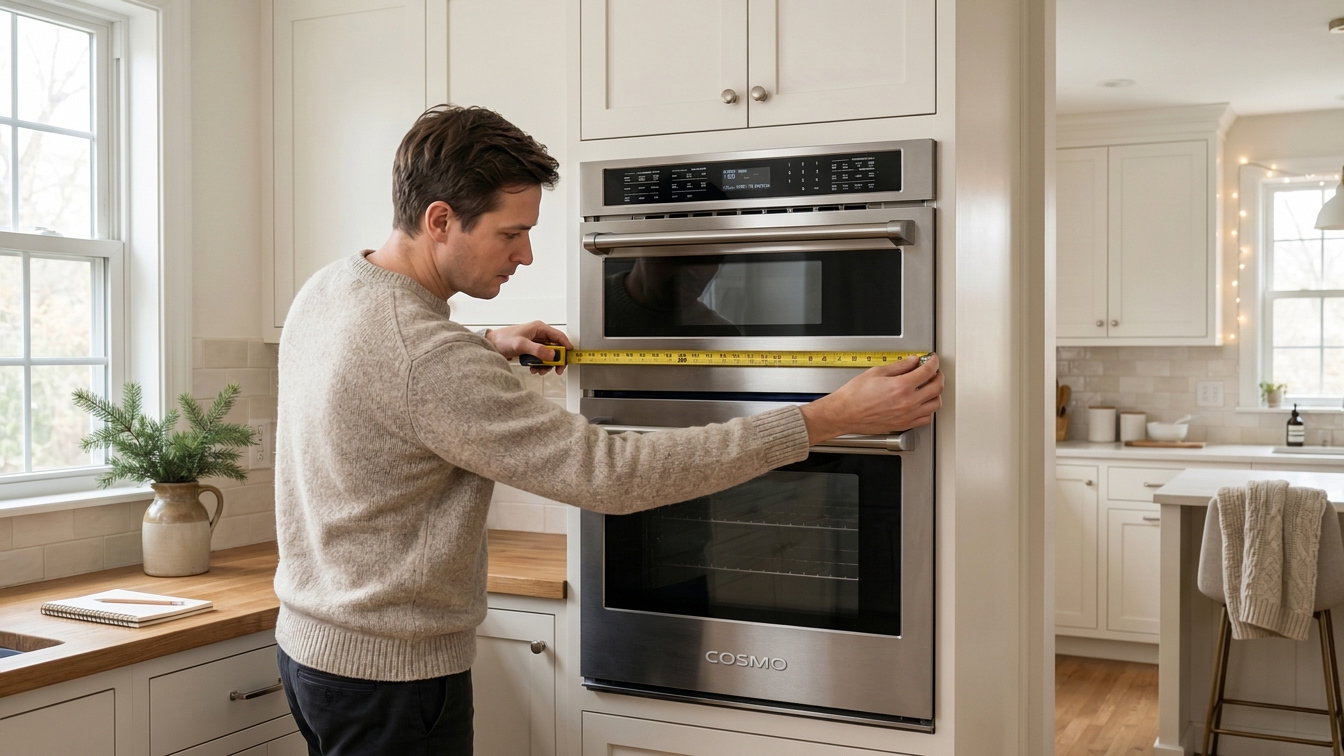
Start with the space where the appliance will live. Measure the width at the front, the middle, and the back, since walls and cabinets are rarely perfectly square, and write down the smallest of the three numbers. Do the same for height, from the floor to the underside of the countertop or cabinet above, and for depth, from the back wall to the front edge of the surrounding cabinets.
Then look for the things that quietly shrink a space. Baseboards, outlet boxes, gas shutoff valves, a countertop overhang, and a drawer pull on a neighboring cabinet can each take away half an inch or more. A strip of painter’s tape on the floor and wall, set to the appliance’s listed dimensions, is the fastest way to see how a new unit will sit in the room before you commit.
Step Two: Measure the Path, Not Just the Spot
An appliance has to travel from the truck to its final position, and the route is often tighter than the destination. Measure every doorway, hallway, stair turn, and tight corner along the way, and note which direction each door swings. Doors can often be lifted off their hinges for delivery day, and a refrigerator’s own doors can sometimes be removed, but find that out ahead of time instead of in the hallway.
Refrigerators deserve extra attention because of their height and depth. Cosmo’s COS-RFFV283RBK, a 27.4 cubic foot counter depth French door model from the Vista Collection, stands about 70.1 inches high, 35.9 inches wide, and 33.6 inches deep and needs a 36 inch cutout. Those numbers are the product itself, so check the installation guide for the extra room needed around it for ventilation and for the doors to open fully. Also remember that the shipping carton is larger than the appliance, which matters for any narrow entry.
Step Three: Match the Cutout to the Spec Sheet
Built in appliances are the least forgiving, because they slide into an opening that already exists. A cutout is not a rough guide. It is a fixed dimension, and the manufacturer’s installation guide lists it exactly.
Two examples show how specific these numbers get. Cosmo’s COS-30IRHP insert hood is built for a 30 inch wide opening that is 11.4 inches high and 11.5 inches deep, so an existing hood shell has to be checked against those figures before anyone orders. Cosmo’s COS-WOMCR302SS wall oven and microwave combination measures 30 inches wide, 42.5 inches high, and 25.1 inches deep, and its installation guide calls for a cabinet base that can support 243 pounds plus the weight of food, along with at least 23 inches of clearance in front for the open door.
Notice that none of these details appears in a sale banner. They live on the product page and in the installation manual, and both are free to read before you buy.
Step Four: Check Power, Fuel, and Venting
Dimensions are only half of the fit. The other half is whether your home can feed the appliance. Look at three things.
Electrical. Many large appliances need a dedicated circuit. The COS-WOMCR302SS, for instance, runs on 240 volts with a four wire connection, draws 34 amps, and is rated at 6150 watts, which means a dedicated circuit and professional installation. Open the panel, or ask an electrician to, and confirm that a circuit of the right size exists and that the outlet or junction box matches the connection the appliance requires.
Fuel. A range comes in gas, electric, and induction versions, and the right one depends on what is already behind the wall. If you are switching fuel types, plan for the new line or circuit as part of the real cost of the purchase. A gas model also needs the correct supply type, so confirm whether your home runs on natural gas or propane.
Venting and water. A ducted range hood needs a clear path outdoors, and the duct size has to match the hood’s opening. The COS-30IRHP, for example, has a 5.9 inch round duct opening. Dishwashers and refrigerators with ice makers need a water line within reach. A quick look under the sink and behind the current unit answers most of these questions.
Step Five: Plan the Delivery, Not Just the Order
An order is not finished until the appliance is installed and working, so read the delivery terms as carefully as the price. Ask what the delivery fee covers, whether the crew will haul away the old appliance, whether installation and hookups are included or separate, and how far out the delivery date really is. If you are renovating or hosting guests soon, a delivery that arrives in six weeks may not serve the plan at all.
Verify the model number as well. On a busy sale weekend, similar listings can differ by finish, size, or fuel type, so match the model number on the listing to the product page on cosmoappliances.com and confirm the specifications there. Cosmo products are sold through authorized dealers, and the earlier guide on where to buy Cosmo appliances explains how that affects returns and warranty service.
When the appliance arrives, inspect it before the crew leaves. Cosmo recommends checking for damage on arrival, photographing anything you find, and contacting the dealer within 48 hours if there is a problem. Keep the receipt, since proof of purchase is needed for warranty service.
A Checklist to Keep in Your Phone
Before you click buy, make sure every line below has an answer you wrote down.
- Opening: Smallest width, height, and depth, measured at several points.
- Path: Every doorway, turn, and stair from the street to the kitchen.
- Cutout: The manufacturer’s exact dimensions, matched to your opening, plus clearances.
- Electrical: Voltage, amperage, and connection type confirmed with your panel or an electrician.
- Fuel and venting: Gas type, duct size, and water line, where they apply.
- Model number: Matched between the listing and cosmoappliances.com.
- Delivery terms: Fees, haul away, installation, and the actual delivery date.
- Return terms: What the retailer will do if the appliance arrives damaged or does not fit.
Keeping a Cool Head on a Hot Sale
Deals arrive on schedule, but this weekend is not the only one, and Cyber Monday on November 30 follows close behind. If a model passes every line of the checklist, a good offer is a pleasant bonus. If it fails one, the offer is not worth the trouble. Confirm any promotion directly with the retailer, since pricing and availability change quickly and vary by seller.
The Bottom Line
The most valuable thing you can bring to Black Friday is not a coupon. It is a short list of verified numbers. Measure the opening, the path, and the utilities, match them to the manufacturer’s installation guide, and read the delivery terms before you pay. Do that, and the order you place will arrive, fit, and work on the first try, which is the only kind of bargain that lasts.