
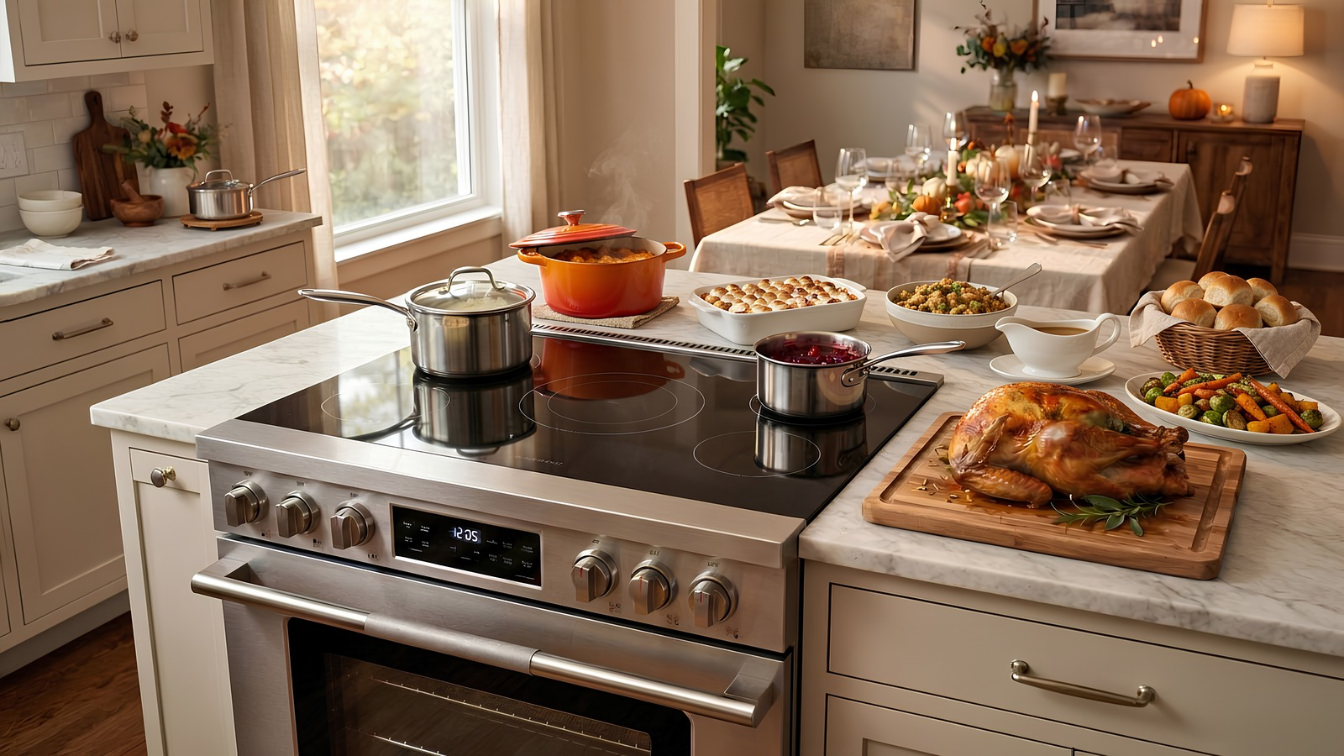
Thanksgiving Day: The Final Hour Before the Doorbell
There is a particular kind of quiet in a kitchen about an hour before the first guests arrive. The heavy cooking is behind you, or very nearly. The counters are crowded but not chaotic, the house smells like butter and sage, and one question hangs over the room: will the next sixty minutes feel like hosting or like firefighting?
Most of that answer is decided right now, on Thursday, November 26, by what you do with this hour. It is tempting to treat it as bonus cooking time, a chance to squeeze in one more task. The better approach is to treat it as a handoff. In this hour the kitchen moves from production mode to holding mode, so that when the doorbell rings the food can wait comfortably and you can walk to the door with both hands free.
Why the Last Hour Goes Wrong
Hosts rarely lose control of Thanksgiving at nine in the morning. They lose it in the final stretch, when every dish wants attention at once.
Three habits cause most of the trouble: starting new tasks instead of finishing old ones, leaving dishes without an assigned place to stay warm, and answering the door in a kitchen that still looks like a work site. The plan below works backward from the doorbell, so treat the times as a template and slide them to match your own schedule.
Sixty Minutes Out: Walk the Counter
Before touching a pan, take two minutes to look at everything. Sort each dish into one of three groups: finished and hot, finished and cold, and still needs heat. That single walk through tells you what needs a holding spot and what can simply sit.
Then pull out the serving dishes and spoons, and put a sticky note in each one naming the food it will carry. It feels fussy until a helpful guest asks where the green beans go and the answer is already written on the bowl.
Finally, give each holding station a clear job. The cooktop holds anything that lives in a pot. The oven holds anything that lives in a dish.
Forty Five Minutes Out: Turn the Cooktop Into a Holding Station
By now the cooktop has been the busiest surface in the house for hours, and the best way to rest it is to lower everything. Mashed potatoes, creamed corn, cranberry sauce, and gravy all hold well at a gentle setting, provided the heat stays steady and a lid keeps the moisture in.
This is where an induction cooktop earns its place. Cosmo’s COS-RIS365SS, a 36 inch induction range from the Stellar Collection, has five burners on a flat ceramic glass surface: one 2,500 watt burner, two 1,600 watt burners, and two 1,200 watt burners. Induction heats the pan directly, so a burner answers quickly when the setting goes down. A pot of potatoes that was boiling a few minutes ago can settle into a quiet hold without the lag a cook might expect from a coil or a flame. Gravy rewards that control more than any other dish. Whisk it smooth, bring it down to low heat, and it waits patiently. A splash of warm stock loosens it again right before serving.
The range also includes a 3,600 watt sync bridge, which joins two burners into one larger heating zone. For the final hour, the roasting pan is where that matters most. Once the turkey moves to a board to rest, the pan and its drippings can go across the bridged zone, so a wide pan heats evenly instead of leaving a cold corner over the gap between two burners. Add stock or wine, scrape up the browned bits, and build the gravy right there in the pan where the flavor already lives.
One caution applies to any induction cooktop. It needs cookware that a magnet will stick to, so test the bottom of your roasting pan with a refrigerator magnet now, before the gravy needs it. Disposable aluminum pans will not work. If the pan fails the test, strain the drippings into a stainless steel or cast iron skillet and carry on from there.
Thirty Minutes Out: Give the Oven a Second Shift
Once the turkey is out and resting under loose foil, the oven is free for the first time all day, and it becomes the second holding station. The COS-RIS365SS has a 6.1 cubic foot convection oven with bake, convection bake, broil, air fry, and keep warm functions, and the last hour can use several of them in sequence.
Start with Convection Bake for anything that has been waiting in the refrigerator. The circulating air warms a casserole or a pan of dressing evenly from edge to center. Next, use Air Fry with the included tray to bring back the crisp edges on roasted vegetables such as Brussels sprouts, which soften the longer they sit. Then switch the oven to Keep Warm and slide the finished dishes in, covered, until it is time to serve.
Keep Warm is a holding setting, not a cooking one, so heat each dish fully first and hold it after. Stack the dishes in the order they will come out, and leave the rolls for last. A warm roll is the small detail that guests remember. If you are still deciding what belongs in the oven at all, Five Weeks Out From Thanksgiving: Decide What Can Leave the Oven walks through that choice in more detail.
Fifteen Minutes Out: Reset the Room
With the food holding, the last quarter hour belongs to the room, and it is the step hosts skip most often. Four quick tasks make the difference between a kitchen that looks finished and one that looks abandoned.
- Clear the dishwasher. Empty it now so it can take the first round of plates later, and load any pots that are done.
- Take out the trash. Put in a fresh liner, since guests will want somewhere to put a bottle cap or a napkin.
- Wipe the counters. Put away finished ingredients and leave out only what is serving or staging.
- Stage the gathering spot. Set out drinks, ice, and a small appetizer in the room where people will actually stand, and clear a landing zone near the door for coats and bags.
Run the range hood on low if the air is heavy with cooking. The goal is for the first guest to walk into a home that feels welcoming rather than into the middle of a project.
Five Minutes Out: One Last Taste
Take a clean spoon and taste the gravy, the potatoes, and the cranberry sauce one more time. Salt and acid fade as dishes hold, and a pinch of salt or a squeeze of lemon can wake up a dish that has been sitting quietly. Stir everything once, put the lids back on, and check that the oven is on Keep Warm and not still set to a baking temperature.
Then stop. The urge to do one more thing is strongest right before the doorbell, and it is the urge to ignore. Whatever is not done can wait until after the greetings, because the plan already gave it a place to wait.
After the Last Plate: The Easy Wipe
Later tonight, when the plates are cleared and the guests are still talking, the cooktop is the quickest surface to restore. The COS-RIS365SS has no grates or burner caps to lift and scrub, only a flush ceramic glass surface. Let the glass cool, since it can hold warmth from hot cookware, and a damp cloth usually handles the splashes from gravy and cranberries in a single pass. The oven has its own shortcut in the steam clean function, which uses heat and moisture to loosen baked on residue while the leftovers are being wrapped.
The Bottom Line
A successful Thanksgiving hour is not a matter of doing more. It is a matter of assigning each dish a place to wait, and making that wait comfortable. Walk the counter, move the cooktop to a gentle hold, give the oven a second shift, reset the room, and take one last taste. A range like the Cosmo COS-RIS365SS, with responsive induction burners, a sync bridge for the roasting pan, and a convection oven that holds as well as it cooks, gives that plan the control it needs.
When the doorbell finally rings, the best thing you can have ready is not another dish. It is a free hand to open the door, a warm kitchen behind you, and a meal that is already waiting its turn. Happy Thanksgiving.