
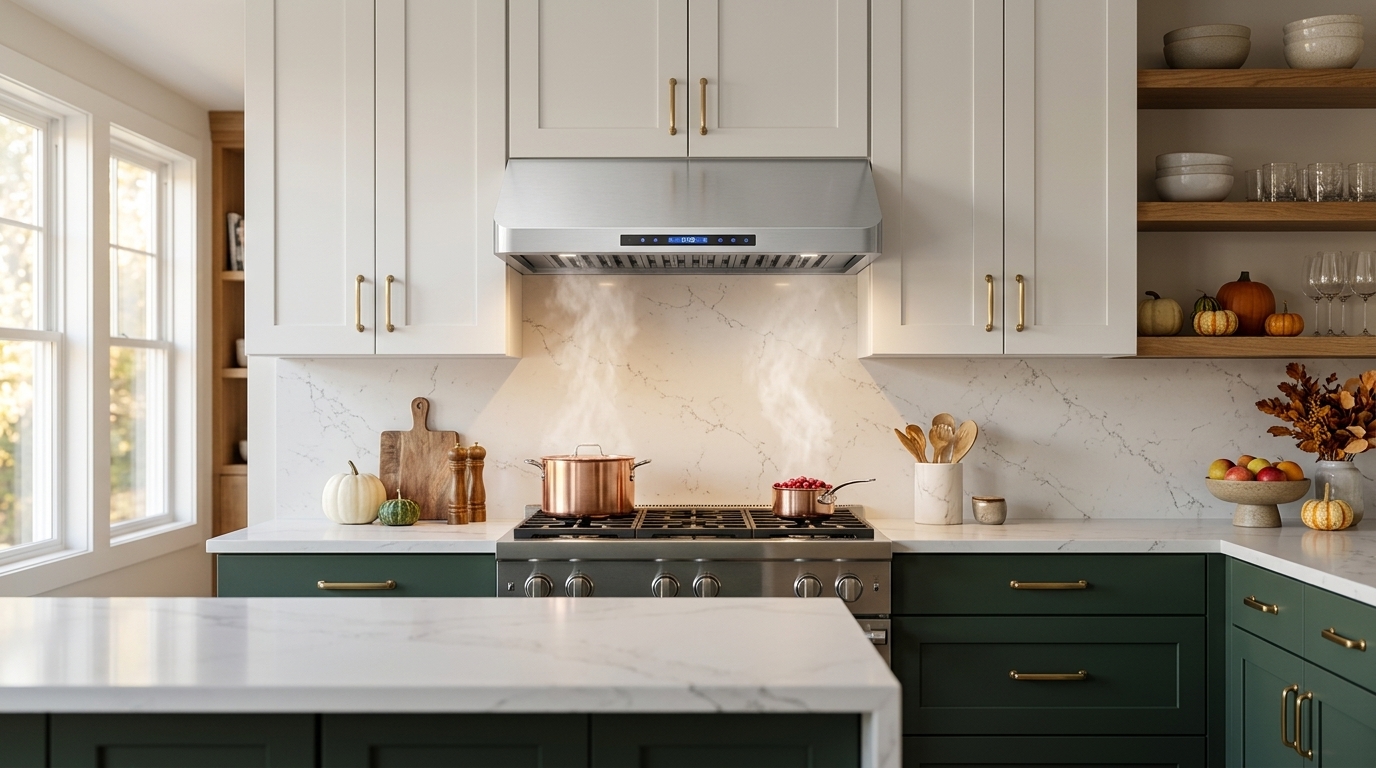
Clear the Air: How to Keep Smoke, Steam and Turkey Smells Under Control on the Biggest Cooking Day
Thanksgiving dinner is judged on the table, but it is experienced in the air. Guests arrive to the smell of roasting turkey, sage, and butter. Several hours later, in a kitchen that has not been ventilated well, the same aromas have turned into a haze at the ceiling, a film of steam on the windows, and a smell that settles into coats and cushions for days. Thursday, November 26 is nine days away, which leaves enough time to get the kitchen ready for the heaviest cooking load of the year.
Why Thanksgiving Is the Hardest Day for Kitchen Air
On an ordinary weeknight, a kitchen handles one or two burners for half an hour. Thanksgiving reverses every part of that equation. Nearly every burner is in use, the oven has been on since morning, and the cooking does not stop for six hours or more.
Three things build up over that stretch. The first is smoke, which comes mostly from fat. Turkey drippings spatter on a hot roasting pan, butter browns a little too far, and onions and celery sauté in a pan that was already hot. The second is steam. Pots of potatoes, a stockpot, cranberries, and a gravy reducing on the back burner all release moisture, and every time the oven door opens to baste the bird, a wave of hot, humid air rolls out. The third is odor, which rides on both of the others. Grease particles and steam carry the smell of roasting meat and sage, and as they cool they settle onto cabinet faces, window glass, curtains, and upholstery, then release the smell slowly. That slow release is why a kitchen can still smell like Thursday on Saturday.
Turn the Fan On Before You Need It
The most useful habit in holiday ventilation costs nothing. Switch the hood on before the first pan gets hot, not after the kitchen already smells of smoke. A hood works by creating a steady current of air above the cooktop, and it captures a rising plume far more easily than it can clear a room that has already filled. On Thanksgiving, that means starting the fan in the morning when the first pot goes on and leaving it at a low speed through the long stretches in between.
Burner choice helps too. Hoods draw most effectively from the back of the cooktop, so the pots that release the most steam belong on the rear burners when the layout allows. Finally, keep the fan running after the last burner is off. The pans, the cooktop, and the air above them stay warm and keep releasing aroma for a while, and several more minutes of airflow clears that residual cloud before it settles.
Check the Hood Before the Holiday
A hood can only move air through filters that are clean and a path that is open, which makes the week before Thanksgiving the right time for a quick inspection. Start with the grease filters. Grease that has built up since last year restricts airflow, and a restricted hood works harder and clears less. Give them time to dry fully before they go back in, so wash them early in the week and not on Thursday morning.
Next, look at the path the air takes. If the hood is ducted, confirm that the exterior damper opens freely and that nothing is blocking the outdoor vent. If the hood recirculates air through a carbon filter instead, check when that filter was last replaced, since carbon saturates over time and a tired filter handles a turkey dinner poorly. Last, think about replacement air. Modern homes are built tight, and a hood that pushes air outdoors needs air to come in from somewhere. Cracking a window while the fan runs on a higher speed helps the hood perform the way it was designed to.
What a Hood Like the Cosmo COS-QS90 Brings to the Day
Cosmo’s COS-QS90 is a 36 inch under cabinet hood from the Q Series, measuring about 35.4 inches wide. Its motor is rated at 500 CFM, and a four speed fan gives a cook more steps to work with than the three speeds common on many hoods. That matters on Thanksgiving, because the load changes through the day. A low speed suits a stockpot at a simmer or cranberries bubbling quietly. A middle speed handles a big pot of boiling potatoes and the steam that comes with it. The top speed is there for the moments that really produce smoke, such as browning aromatics for the dressing, deglazing a roasting pan for gravy, or opening the oven door to baste, when hot air and fat vapor roll out together.
The controls suit a messy kitchen. Soft touch controls and an LCD panel show the fan speed and lighting status at a glance, and the hood also comes with a remote control. Those details sound small until a cook’s hands are covered in butter and flour and the fan needs to move up a speed. A remote that sits on the counter means nobody has to wipe a hand and reach overhead. Two front LED lights put light directly on the pans below.
Noise is a fair concern when guests are standing in an open kitchen. Cosmo lists the COS-QS90 at a maximum of 65 dB, and retailer listings cite levels as low as 40 dB on the lowest speed with rigid ducting under optimal conditions. That points toward running low most of the day and saving louder speeds for short bursts.
Cleanup is built in. The hood uses three ARC FLOW permanent stainless steel baffle filters that are dishwasher safe, so the Friday morning job of washing away a day of grease is a matter of loading a rack. It vents through the top and is set up for ducted use, and it can be converted to ductless operation for kitchens that cannot run a duct outside. For a holiday with this much smoke and steam, a ducted installation is the stronger choice, because it sends odor outdoors instead of passing it through a filter and back into the room.
A Ventilation Timeline for the Week
Treat the hood like any other part of the Thanksgiving plan, with a few tasks scheduled in order.
This week: Wash the filters and let them dry completely, check the duct damper or the carbon filter, and wipe down the underside of the hood and the cabinets beside it, where old grease holds odor. If the oven has spills from earlier roasts, run its cleaning cycle now, because baked on residue smokes at roasting temperatures.
Wednesday, November 25: Prep day is when onions, celery, and aromatics get chopped and often cooked, and when pies and make ahead dishes go into the oven. Run the hood through all of it, so the house is not already carrying a day of cooking smells before Thursday begins.
Thursday, November 26: Turn the hood on low before the oven preheats, step it up for browning and basting, and bring it back down for the long stretches. Keep a window cracked and the lids on the pots.
Friday, November 27: Run the fan for a while after the last dish is washed, wipe down the cabinets and the hood exterior while any grease is still fresh, and put the filters through the dishwasher.
Small Moves Beyond the Hood
A hood does most of the work, and a few habits handle the rest. Keep the oven door closed as much as possible, since each opening releases heat and steam that the hood and the room must then manage. Use a roasting pan with sides high enough to contain spatter, and keep a little liquid in the bottom of the pan so the drippings do not scorch and smoke. And remember that a hood is not a substitute for a working smoke alarm. Leave the alarms in place, and let good ventilation reduce the chances that they go off for the wrong reason.
The Bottom Line
A good Thanksgiving smells like Thanksgiving for an afternoon, not for a week. That outcome comes from a hood that is started early, filters that are clean, a clear path outdoors for the air, and a fan speed matched to the task at hand. A hood such as the Cosmo COS-QS90, with 500 CFM, four speeds, and a remote to adjust them, gives a household room to do all of that without leaving the stove. With nine days to go, the filters are the first thing to wash. Do that, switch the fan on early on Thursday, and let the house smell like the meal for exactly as long as the meal lasts.