
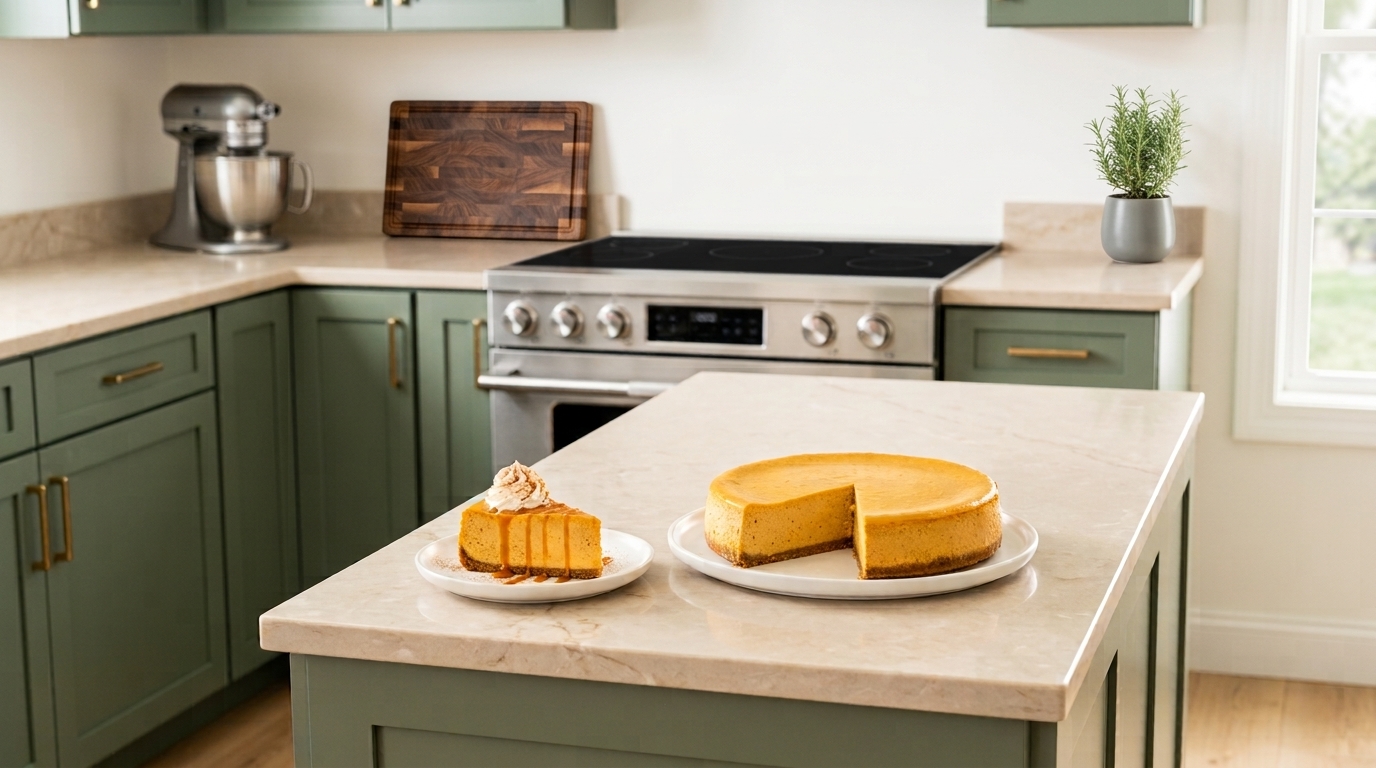
National Pumpkin Cheesecake Day and Why the Top Cracks: What Your Oven Has to Do With It
The crack almost never appears while the cheesecake is in the oven. It shows up an hour later, on the cooling rack, as a thin line that starts near the center and runs toward the edge, and by then the cause is long settled. Most bakers blame the recipe, the pan, or bad luck. The better suspect is the oven, which decides how fast heat reaches a delicate custard and how gently that heat is taken away. Today, October 21, is National Pumpkin Cheesecake Day, an unofficial celebration of one of fall’s most dependable desserts, and a fair moment to look at why so many of them split.
A Dessert With a Long History and a Short Temper
Cheesecake is far older than the pumpkin version most people bake in October. Early versions are traced to ancient Greece, and cream cheese itself dates to 1872. Pairing it with pumpkin is a more recent habit, and a smart one. Puree and warm spices turn a rich filling into something that suits a November table, and the dessert can be baked days ahead, which matters in a season built around hosting.
The trouble is that it is not forgiving. It is a baked custard of cream cheese, eggs, sugar, and puree that has to set without turning tough. The window between underdone and overdone is narrow, and the top is the first place a mistake shows. A crack does not ruin the flavor, but it is a visible record that something about the heat went wrong.
What Actually Happens When the Top Splits
Eggs are what hold a cheesecake together. As the filling heats, the proteins in the eggs link up and form a network that turns liquid batter into a sliceable cake. Bakers call this coagulation. Like any custard, it has a ceiling. Push past it and the network tightens, squeezes out moisture, and loses its stretch. A filling that has lost its stretch cannot flex as the cake puffs in the oven or settles as it cools, so it tears at its weakest point, the surface.
That is why overbaking is the leading cause of cracks, and King Arthur Baking puts numbers on it. The center of a finished cheesecake should read between 150°F and 155°F, since the cake keeps cooking after it leaves the oven. If any part of it reaches 185°F or higher, a cracked top is almost certain. The gap between a perfect center and a ruined one is about thirty degrees, small enough that a few extra minutes or a hot spot in the oven can cross it.
Two other habits feed the same problem. Mixing the batter too vigorously can also cause cracking, and cooling the cake too fast encourages it to shrink before the structure has time to relax. Both are easier to control once the oven itself is under control.
Your Oven Is the Variable Nobody Checks
A recipe says 325°F, and most cooks assume the oven delivers 325°F. Home ovens can run hotter or cooler than the dial says, and a cheesecake in an oven that runs even twenty degrees high will cross the danger line much earlier than the recipe predicts. Baking Bites notes that a cheesecake that cracks or browns unevenly points to an oven that is too hot or has hot spots, and the fix is a lower temperature with a slightly longer bake.
Three inexpensive habits take out most of the guesswork. First, hang an oven thermometer from the center rack and compare it with the display. If the two disagree, bake to the thermometer. Second, give the oven a full preheat before the pan goes in, so the cheesecake meets a steady temperature instead of a climbing one. Third, keep the door closed, because every peek lets heat out and cool air in.
Placement matters too. Set the springform on the center rack, away from the oven walls, so heat reaches every side evenly. A water bath, which means setting the springform inside a roasting pan of hot water, adds another layer of protection. King Arthur calls it the most reliable method because the water insulates the cake and holds back the edges from overbaking. It has a cost, since the springform must be wrapped carefully against leaks and the oven must be roomy enough to hold a roasting pan without crowding.
Where the Cosmo COS-RIS365SS Fits
A good oven for this job holds steady heat, offers a plain baking mode, and leaves room for a roasting pan. Cosmo’s COS-RIS365SS, a 36 inch induction range from the Stellar Collection, is one of the brand’s newest models and fits that description. Its 6.1 cubic foot oven gives a springform and a water bath ample room, and two racks across six positions make it easy to place the cheesecake at true center.
The oven offers Bake, Convection Bake, Broil, Air Fry, Delay Start, and Keep Warm. For a custard, many bakers prefer standard Bake, since circulating air can dry a surface faster. Convection Bake is still useful when a recipe calls for it. Its fan distributes heat evenly and eliminates cold spots, and Cosmo notes that food cooks at a lower temperature than in a standard oven, so a cheesecake baked that way deserves an earlier check against the 150°F to 155°F target.
Smaller details help with the full job. The digital display with a clock and timer keeps the countdown in view, and a large oven window and interior light let the cook judge the jiggle in the center without opening the door. The storage drawer below holds baking pans within reach, and the oven cavity cooling ventilation system and cool to the touch handle make the end of the bake more comfortable. Afterward, the Steam Clean function loosens baked on residue with heat and moisture, which helps when a water bath leaves a few drips behind.
No oven, this one included, removes the need to verify temperature. Even a new range deserves a thermometer on the first few bakes, because learning how a particular oven behaves is what makes it predictable.
A Baking and Cooling Routine That Works
Start with ingredients at room temperature so the batter comes together with minimal mixing, and keep the mixer on low once the eggs go in. Bake at 325°F, the temperature King Arthur describes as typical for cheesecake, with either a full water bath or a pan of hot water on the rack below. Times vary, so trust the thermometer over the clock. The edges should look set while the center few inches still jiggle slightly when the pan is nudged.
When the center reaches the lower end of the 150°F to 155°F range, stop. The cake keeps cooking on its own heat, and that margin is what protects the top. Run a thin knife around the edge of the pan to release the cake from the sides. Then turn off the oven, prop the door open four to five inches, and let the cheesecake cool inside until it reaches room temperature. Only then does it go to the refrigerator, where several hours or a full night finish the set.
That slow cooldown does the most to prevent the late crack that appears on the cooling rack. A cheesecake pulled straight into a cool, drafty kitchen contracts quickly, and the surface pays for it.
If It Cracks Anyway
Some cracks are cosmetic and easy to fix. Once the cheesecake is fully chilled, dip a metal offset spatula in warm water and smooth the surface, and the edges of the crack will slowly draw together. A layer of whipped cream, caramel sauce, or candied pecans covers whatever remains.
It is also worth treating the crack as information. If the cake browned unevenly or puffed high at the edges, suspect the oven temperature or a hot spot. If it looked perfect in the oven and split on the counter, suspect the cooldown. Either answer points to a specific change for the next bake.
Bake One Before the Holiday Rush
Thanksgiving falls on November 26 this year, which leaves about five weeks to practice. Earlier this month, the Cosmo blog laid out a Thanksgiving prep timeline built around dishes that can be made ahead, and a pumpkin cheesecake belongs on that list. It can be baked and chilled well before the holiday, which frees the oven on the big day for the turkey and sides.
National Pumpkin Cheesecake Day is a good excuse to turn a dessert with a reputation for cracking into one that comes out smooth, creamy, and whole. Check the oven, bake low and slow, watch the center, and give the cake time to cool. To learn more about the Cosmo COS-RIS365SS, visit the Cosmo Appliances website.