
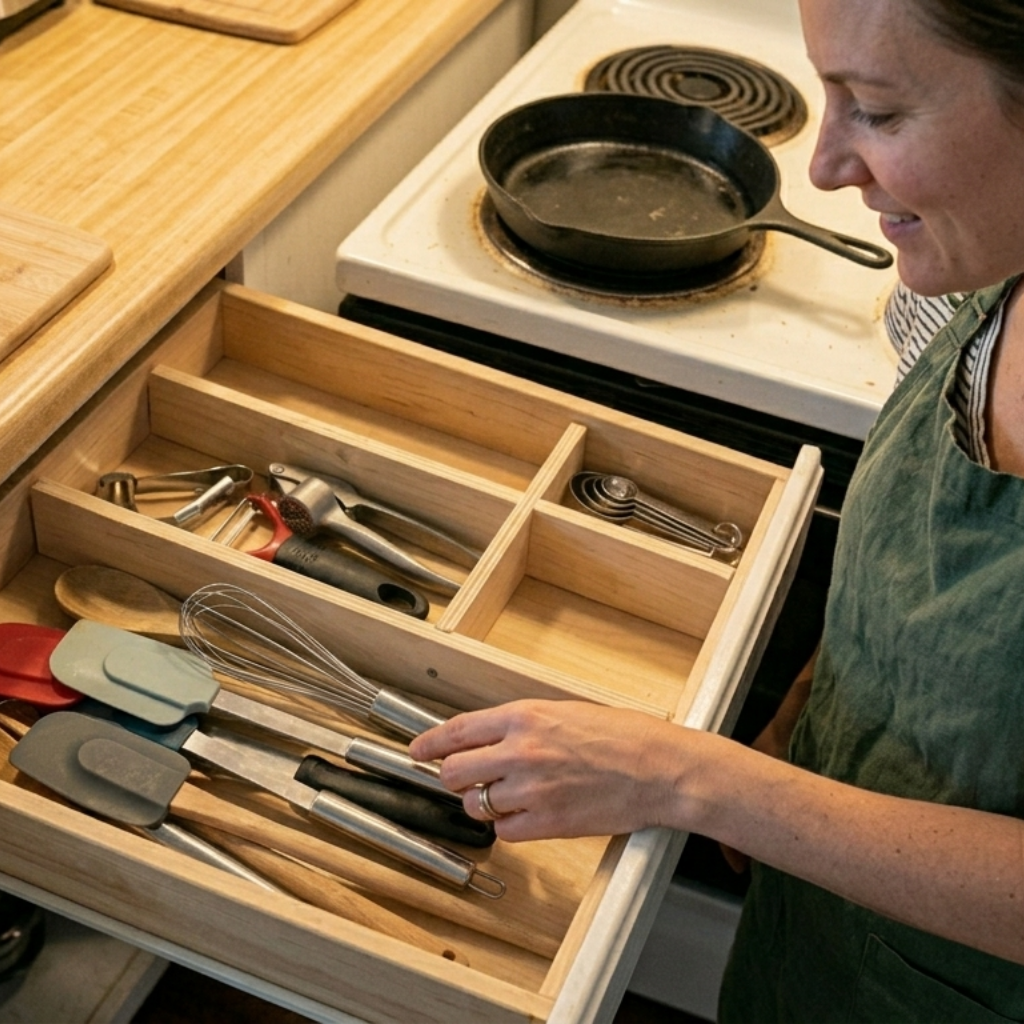
The Drawer Organization That Actually Stays Organized
You organize your kitchen drawers. It looks beautiful for three days. Then you need a whisk in a hurry, toss it back imperfectly, and the whole system collapses within a week.
The problem isn’t your discipline or commitment. The problem is organizing systems designed for photographs, not daily cooking. They require precision placement and careful maintenance that real cooking doesn’t allow.
Drawer organization that actually lasts works with your cooking habits, not against them. It assumes you’ll be rushed, distracted, and unwilling to play Tetris with spatulas while something’s burning on the stove.
Here’s why most drawer organization fails, what actually keeps drawers functional long-term, and how to set up systems that survive real kitchen use.
Perfect Compartments Create Maintenance Hell
Those beautiful drawer organizer systems with precisely-sized slots for every utensil look incredible in before-and-after photos. They fail in actual kitchens because they demand exact placement every time.
Custom-fit organizers require identifying which slot belongs to which tool, orienting the tool correctly, and sliding it into its designated space. This works when you’re organizing slowly and deliberately. It fails when you’re cooking three things simultaneously and need to return a spatula quickly.
The tighter the fit, the more frustrating the system. That perfectly-sized slot for your fish spatula only accepts the spatula at the correct angle. Put it in slightly rotated and it doesn’t fit. Now you’re fumbling with a greasy spatula while your sauce reduces.
Precision systems also break when you add new tools. Buy a second whisk or different-sized spatula and suddenly you’ve got no designated slot. The new item becomes homeless, getting tossed wherever it fits, beginning the drawer’s descent into chaos.
Organization that lasts uses zones, not slots. Group similar items together in loose categories without demanding precise placement. Spatulas go in the spatula zone anywhere, not in individually-assigned slots.
Wide compartments that hold multiple items of the same type accommodate tools at various angles and positions. You’re dropping items into a zone, not threading them into specific slots.
Shallow Organizers For Deep Drawers Guarantee Failure
Standard drawer organizers sit shallow in deep drawers, leaving several inches of unused space below. This invites layering, which destroys organization immediately.
You buy a utensil organizer that’s two inches deep. Your drawer is six inches deep. That four-inch gap below the organizer becomes tempting storage for overflow items.
Initially you resist. Then you acquire a new tool that doesn’t fit in the organizer. “Just temporarily,” you think, sliding it underneath. Then another tool. Then a random kitchen gadget. Within weeks you’ve got a hidden layer of chaos beneath your organized surface.
Deep drawers need either organizers that span full depth or intentional use of vertical space with stackable systems. Half-depth organizers in deep drawers are organizational traps.
If you’ve got deep drawers, use tall organizers or bins that prevent layering. The goal is making layering physically impossible, not relying on your future self to resist temptation.
Alternatively, dedicate deep drawers to large items that actually need the depth: large serving utensils, rolling pins, or bulky kitchen tools. Save shallow drawers for the precision organization that shallow organizers support.
Too Many Categories Mean Nothing Has a Home
Organizing guides tell you to separate whisks, spatulas, spoons, tongs, peelers, zesters, and measuring spoons into individual compartments. This creates so many categories that placing items correctly becomes a puzzle.
Your brain during cooking operates in simplified mode. You’re tracking multiple tasks, monitoring temperatures, and timing various components. Your mental bandwidth for “which compartment does the slotted spoon belong in” is approximately zero.
Too many categories increase friction. Is the slotted spoon a spoon or a spatula? Does the silicone scraper go with spatulas or with whisks? These ambiguous items bounce between categories, creating placement inconsistency.
Successful organization uses three to five broad categories maximum. “Stirring tools,” “measuring tools,” “cutting tools,” and “miscellaneous” works better than ten specific categories requiring constant decision-making.
Broad categories forgive mistakes. Tossing a whisk into the general “stirring tools” zone succeeds even if it lands next to spatulas. Perfect placement isn’t required.
You can subdivide within broad categories using visual separation (different colored bins or simple dividers), but the primary organization should be simple enough that rushing doesn’t break the system.
Measuring Tools Don’t Belong With Cooking Tools
Most drawer organization systems mix measuring cups and spoons with cooking utensils. This creates access conflicts because you use these tools at different times during different tasks.
Measuring happens during prep before cooking starts. You’re standing at your prep area measuring ingredients into bowls. Cooking utensils are used at the stove during active cooking.
Mixing these tools in the same drawer means accessing the drawer from different locations at different times. Your measuring cup drawer should be near your prep area, not your stove.
Separating measuring tools into dedicated drawer near your mixing/prep zone improves workflow. When gathering ingredients, you’re not digging through spatulas to find measuring spoons.
This separation also prevents cross-contamination of organizational systems. Cooking utensils get greasy and sauce-covered; they’re cleaned quickly and returned slightly damp. Measuring tools stay cleaner because they’re used during prep, not cooking.
Dedicate one small drawer or one large drawer section near your primary prep area exclusively to measuring tools. Everything else goes in cooking utensil drawers near the stove.
The Junk Drawer Is Necessary, Not Failure
Every kitchen organization guide promises to eliminate your junk drawer. This is unrealistic and counterproductive. The junk drawer serves an important function.
Kitchens accumulate miscellaneous items: birthday candles, bag clips, corn holders, specialty tools used quarterly. These items need storage but don’t fit into any logical category.
Without a designated miscellaneous drawer, these items infiltrate your organized drawers. The corn holders end up with spatulas. The bag clips migrate to the utensil drawer. Your organization breaks down accommodating items that don’t belong.
A dedicated miscellaneous drawer contains chaos in one location rather than letting it spread. Everything else stays organized because the random stuff has somewhere to go.
The key is intentionality. Designate one specific drawer as your miscellaneous drawer. Everything that doesn’t have an obvious home goes there and only there.
Don’t let the miscellaneous drawer grow into multiple drawers. One junk drawer is functional. Three junk drawers means your organizational system failed.
Purge the miscellaneous drawer twice yearly. Keep items you actually use, discard broken or obsolete items, and acknowledge that some chaos is normal in functional kitchens.
Visible Organization Beats Hidden Organization
Drawer organizers that require opening the drawer fully and looking down into it create extra cognitive load. Systems that show contents at a glance work better.
Shallow drawers naturally show contents when opened. Deep drawers hide contents until you bend down or pull the drawer completely out.
Angled dividers or tiered organizers in deep drawers bring items forward as the drawer opens, making contents visible without extra effort.
Color-coding or visual markers help too. Different colored bins for different categories let you identify zones at a glance rather than reading labels or remembering which section holds what.
The fewer decisions required during placement, the higher compliance rate. “Toss it in the red bin” succeeds more reliably than “third compartment from the left.”
Clear organizers show contents without opening, reducing drawer opening frequency. You can see the whisk through the clear bin before pulling the drawer out.
Adjustable Systems Win Over Fixed Systems
Your kitchen needs change. You acquire new tools, discard old ones, change cooking styles. Fixed organizers can’t adapt.
Modular organizers with movable dividers accommodate changes without requiring complete reorganization. Add a divider when you acquire more of something. Remove a divider when a category shrinks.
Fixed organizers force your tools to fit their configuration. Adjustable organizers configure to fit your tools.
The best systems use simple dividers that can be repositioned as needs change. Avoid elaborate custom-fit systems that only work with specific item counts and sizes.
Bamboo expandable dividers, simple plastic bins in various sizes, or basic drawer dividers that cut to length all provide flexibility without requiring permanent commitment to specific configurations.
As your cooking evolves, your organization should evolve with it. Systems that allow easy reconfiguration survive long-term. Rigid systems get abandoned when they stop matching reality.
The One-Second Rule Determines Long-Term Success
If returning an item to its place takes more than one second of attention during cooking, the system will fail.
One second means: open drawer, toss item into general zone, close drawer. That’s the maximum complexity that survives real cooking situations.
Anything requiring more attention—orienting items correctly, threading them into slots, arranging them neatly—won’t happen consistently when you’re busy cooking.
Test your organization system while distracted. Try putting items away while talking, while checking your phone, while glancing at the stove. If it requires focus, it won’t last.
The easier the placement, the higher the compliance rate. A system with 90% compliance that’s easy beats a perfect system with 30% compliance that’s hard.
What Actually Works Long-Term
Simple systems survive. Complicated systems fail. Here’s what keeps drawers organized through years of daily cooking:
Wide bins or zones holding tool categories rather than specific slots for individual items. Spatulas go in the spatula zone anywhere, not in individually-assigned positions.
Full-depth organizers in deep drawers preventing layering and hiding. If you can layer things, you will layer things.
Three to five broad categories maximum reducing decision-making during hurried placement. “Stirring tools” beats “whisks, spatulas, spoons, ladles” as separate categories.
Designated miscellaneous drawer containing chaos in one location rather than spreading random items throughout organized drawers.
Measuring tools separated into prep-area drawer rather than mixed with cooking utensils accessed from different location.
Adjustable dividers or modular bins adapting to changing tool collections rather than fixed configurations requiring replacement when needs change.
Visual differentiation through color or clear containers making zones obvious at a glance without requiring memory or labels.
One-second placement tests ensuring system works while distracted because cooking creates constant distraction.
Your drawer organization doesn’t fail because you’re messy. It fails because it demands more attention than real cooking allows. Build systems assuming you’ll be rushed, distracted, and unwilling to think about organization while managing three burners simultaneously. Simple zones, adequate space, and minimal categories create organization that actually survives daily kitchen use instead of collapsing the first time you’re in a hurry.