
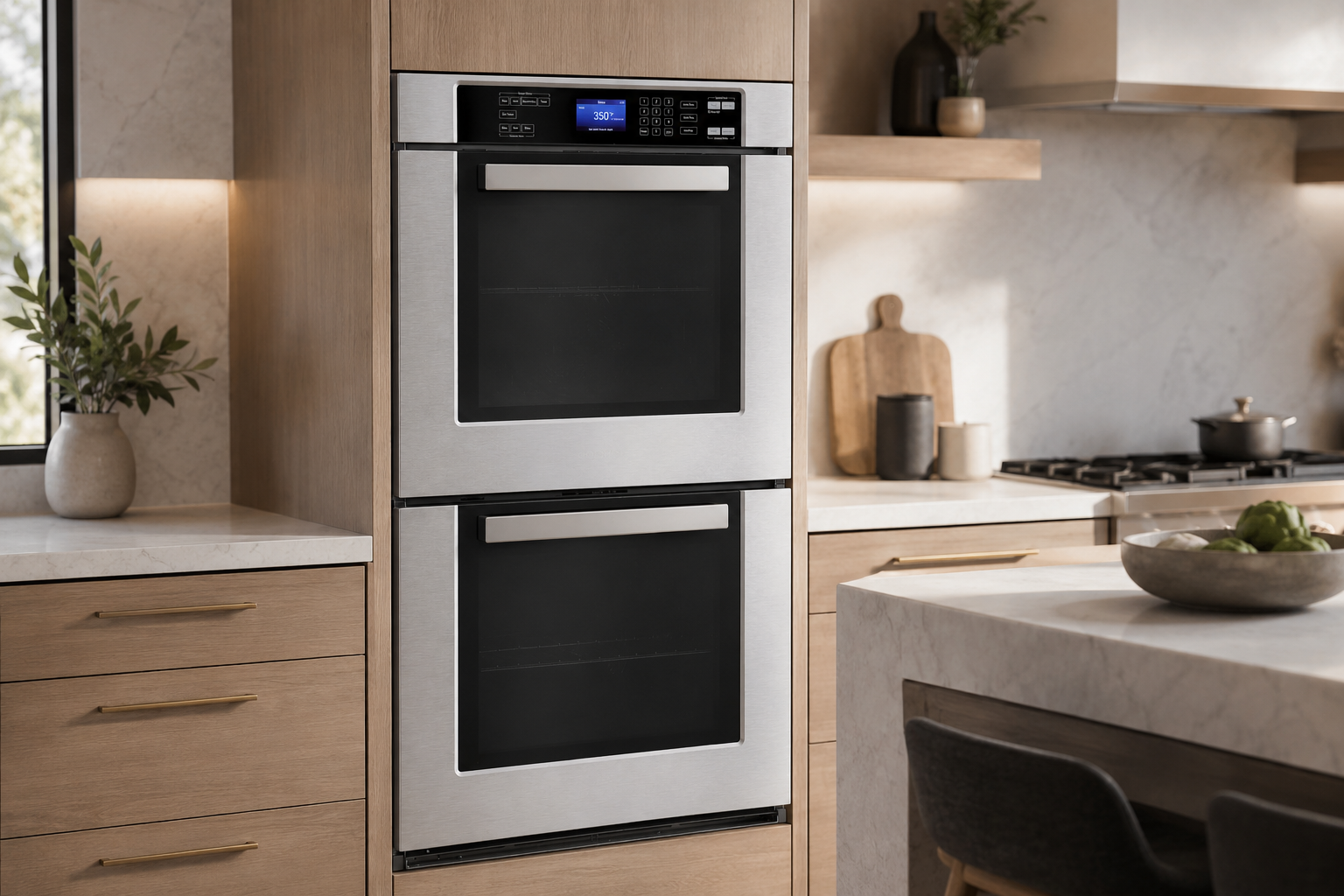
The COS-30EDWC Double Wall Oven: Two 5.0 Cu. Ft. Cavities with Turbo True European Convection
Wall ovens change the way a kitchen functions. Separating the oven from the cooktop creates independent cooking zones that improve workflow, allow more ergonomic oven access, and open up layout possibilities that traditional ranges can’t provide. The COS-30EDWC takes this further by stacking two full 5.0 cubic foot ovens into a single 30-inch built-in unit, giving you 10 cubic feet of total oven capacity within the footprint a single wall oven would otherwise occupy. Both cavities include Turbo True European Convection with a fan-assisted circular heating element, self-cleaning functions, soft touch controls with LED displays, interior lighting, and a temperature probe for precise internal food monitoring. The brushed stainless steel exterior pairs with distinctive blue porcelain interiors that make the interior cavity easy to monitor and simple to clean.
What makes this oven genuinely useful for households that cook seriously is the simultaneous independent operation of two full-sized cavities. Running a roast in one oven at 325°F while baking at 375°F in the other isn’t a compromise — both cavities maintain their set temperatures independently, run their own timers, and operate entirely separately. Holiday cooking, batch baking, and multi-course entertaining all become significantly more manageable when two complete ovens are available at once rather than sequencing dishes through a single cavity.
Why Two Ovens In One Unit Makes Practical Sense
The logic behind double wall ovens becomes clear quickly once you’ve spent time managing a busy kitchen with only one oven available.
Simultaneous Independent Cooking: Single ovens force compromises when recipes require different temperatures. You either cook sequentially, letting something cool while the oven adjusts, or you pick a middle temperature that’s ideal for neither dish. Two independent cavities eliminate this entirely. Both ovens maintain precise independent temperatures, letting you cook dishes on their own terms without adjustments or timing gymnastics.
Footprint Efficiency: The COS-30EDWC fits two complete 5.0 cu. ft. ovens into a 30-inch wide built-in installation. Buying two separate single wall ovens would require two separate cabinet cutouts and considerably more wall space. The stacked configuration delivers double the capacity within the same lateral footprint, making it an efficient solution for kitchens where wall space is limited.
Ergonomic Oven Access: Built-in wall ovens install at heights that put oven interiors at or near counter level, eliminating the bending required to access floor-level range ovens. The COS-30EDWC’s upper cavity typically aligns with counter height, making loading and checking food straightforward. The lower cavity sits below counter level but remains more accessible than a range oven that’s nearly at floor height.
Holiday and Entertaining Capacity: Thanksgiving, Christmas, and large dinner party cooking routinely expose the single-oven limitation. Needing to coordinate multiple dishes through one oven creates logistical challenges that affect timing, food temperature, and host stress levels. Two complete ovens running simultaneously handle these high-demand situations without compromise.
Separation of Functions: Having two ovens lets you dedicate one to long, slow cooking while keeping the other available for shorter tasks. A pork shoulder braising at 275°F for six hours doesn’t need to monopolize your only oven, preventing any other baking or roasting for that entire period. The second cavity remains available throughout.
Turbo True European Convection Explained
The Turbo True European Convection system in both cavities represents meaningfully different technology from standard convection, and understanding why matters for evaluating what this oven actually delivers.
What Standard Convection Does: Basic convection ovens add a fan to circulate air around food. This circulation reduces hot spots and speeds cooking compared to conventional radiant heat alone. The fan creates movement that prevents the stagnant air layers that cause uneven baking in traditional ovens.
What True European Convection Adds: True European Convection, sometimes called third element convection, adds a dedicated circular heating element surrounding the fan at the back of the oven cavity. This element heats air as the fan circulates it rather than just moving air that’s being heated by the oven’s main elements. The result is more consistent temperature distribution throughout the entire cavity, from front to back and corner to corner.
Turbo Operation: The Turbo designation indicates higher fan speeds that increase air circulation intensity beyond standard convection. Greater airflow means faster heat transfer to food surfaces, improving browning and reducing cooking times more significantly than standard convection. Turbo convection particularly benefits items that need surface browning alongside thorough internal cooking.
Practical Baking Benefits: Even temperature distribution means multiple sheet pans bake consistently without requiring mid-bake rotation. Cookies on the top rack brown at the same rate as those on the bottom rack. Cakes bake evenly without domed tops from hot centers. This consistency is particularly valuable in a 5.0 cu. ft. cavity where larger batches and multiple rack positions are regularly in use.
Roasting Advantages: Convection roasting circulates hot air around all exposed surfaces simultaneously, developing browning on more of the exterior than conventional radiant heat achieves. Chicken skin crisps more thoroughly, roast vegetables caramelize more evenly, and large cuts develop better exterior crust while maintaining internal moisture.
Temperature Adjustment: Convection cooking typically requires reducing recipe temperatures by 25°F or shortening cooking times by 20-25% compared to conventional oven recipes. The Turbo European Convection system accelerates this effect further, so recipes developed for conventional ovens need attention to timing when converted to Turbo operation.
Seven Oven Functions and When to Use Each
Both cavities offer seven oven functions covering a range of cooking applications beyond simple baking and roasting.
Bake: Standard bake mode uses both top and bottom heating elements without fan assistance for conventional radiant heat cooking. This mode suits recipes developed for traditional ovens and techniques where air circulation would be disruptive — delicate soufflés, custards, and cheesecakes that benefit from gentle, even heat rather than active air movement.
Convection Bake: Activates the fan and circular heating element for even temperature distribution throughout the cavity. This is the everyday workhorse function for most baking and roasting tasks, delivering faster and more consistent results than standard bake for most foods.
Convection Roast: Similar to convection bake but optimized for meats and vegetables, typically running the fan at higher speeds and using specific element combinations that maximize browning on exterior surfaces. Use this for chickens, roasts, and sheet pan dinners where surface texture matters.
Broil: Top element only at maximum heat for browning surfaces, finishing gratins, caramelizing toppings, and quickly searing food surfaces. The intense overhead heat creates browning without significantly cooking food through, making it useful as a finishing step after other cooking methods.
Convection Broil: Combines top element intensity with fan circulation for faster, more even broiling results. Useful when you need browning that develops more uniformly across an entire dish rather than directly under the broiler element.
Warm: Low-temperature setting maintains cooked food at serving temperatures without continuing to cook it. Using the warm function in one cavity while the other finishes cooking keeps completed dishes ready to serve without the quality loss that comes from holding food in too-hot conditions.
Self-Clean: High-temperature pyrolytic cleaning that burns oven residue to ash. At cleaning temperatures typically above 900°F, organic residue carbonizes completely, leaving only fine ash that wipes out easily after the cycle cools. Both cavities include independent self-clean functions.
Temperature Probe Functionality
The included temperature probe removes guesswork from cooking proteins to precise internal temperatures, a feature that improves results for any cook and is particularly valuable for expensive cuts where overcooking is costly.
How It Works: Insert the probe into the thickest part of the meat avoiding bone contact, plug the other end into the oven’s probe socket, then set the target internal temperature rather than a time. The oven monitors the probe’s reading continuously and adjusts behavior when food reaches the set temperature — either switching to a hold mode or shutting off, depending on programming.
Accuracy Advantage: Even experienced cooks using instant-read thermometers have to estimate doneness timing and check repeatedly. The probe monitors continuously, responding the moment food reaches target temperature regardless of how long that takes. Variations in starting temperature, meat thickness, and oven positioning all affect timing, but the probe accounts for all of these automatically.
Dual Cavity Application: Having a probe available in both cavities means you can monitor proteins in both ovens simultaneously. Roasting a beef tenderloin in the upper cavity while monitoring a pork loin in the lower cavity lets you track both without opening either oven to check manually.
Food Safety Confidence: Cooking poultry and pork to verified internal temperatures eliminates guesswork about food safety. The probe’s continuous monitoring means food reaches target temperature reliably without the over- or under-cooking that visual assessment or timing alone produces.
Blue Porcelain Interior
The distinctive blue porcelain interior finish is worth understanding both aesthetically and practically, as it differs from the black or dark grey interiors common in most ovens.
Visibility Advantage: The bright blue finish reflects interior oven lighting more effectively than dark interiors, making food inside the oven significantly more visible without opening the door. Monitoring browning progress, checking whether liquids are simmering, and assessing doneness through the window all become easier against the reflective blue background.
Cleaning Properties: Porcelain enamel surfaces are non-porous and highly resistant to staining from food residue and grease. The smooth, glass-like surface doesn’t absorb cooking byproducts the way raw metal would, making it easier to wipe down between self-clean cycles for minor spills that don’t warrant a full cleaning session.
Self-Clean Compatibility: The blue porcelain finish withstands the extreme temperatures of self-clean cycles without damage. Porcelain enamel bonded to the oven cavity maintains its integrity through repeated high-temperature cleaning cycles, unlike some specialty coatings that degrade over time with frequent self-cleaning.
Durability: Porcelain enamel is fired at high temperatures during manufacturing, creating a glass-ceramic surface that resists scratches, chips from normal use, and the acidic and alkaline residues that cooking produces. Treated appropriately — avoiding metal scouring pads and harsh abrasive cleaners — the blue interior maintains its appearance for the oven’s entire lifespan.
Self-Cleaning System
Both cavities include independent self-cleaning functions that handle the most tedious aspect of oven ownership automatically, though using them correctly matters for results and safety.
Pyrolytic Cleaning Process: Self-clean cycles heat oven interiors to temperatures between 850-1000°F, far above normal cooking temperatures. At these temperatures, organic residue — baked-on grease, food spills, carbonized drips — burns completely to a light gray ash. After the cavity cools, a quick wipe removes the ash entirely.
Cycle Duration: Self-clean cycles typically run 2-4 hours depending on the soil level selected. Light cleaning cycles for modest residue run shorter. Heavy cleaning for significant buildup runs longer to ensure thorough carbonization of all residue. Plan cycles when the kitchen is well-ventilated and you don’t need oven access for several hours.
Independent Operation: Each cavity runs its self-clean cycle independently, meaning you can clean one oven while using the other normally. This independence eliminates the situation where both ovens are simultaneously unavailable during cleaning cycles, preserving oven access for one cavity throughout the process.
Pre-Clean Preparation: Remove racks, the temperature probe, and any other accessories before running self-clean cycles. The extreme temperatures required for cleaning can discolor oven rack finishes over time, and manufacturers typically recommend hand-cleaning racks separately. Remove large food debris that would produce excessive smoke during burning.
Ventilation During Cleaning: Self-clean cycles produce smoke and odors as food residue burns. Run kitchen ventilation during the entire cleaning cycle and ensure windows can be opened if needed. Households with birds should remove them from the kitchen area, as birds are sensitive to fumes produced during self-clean operation.
Installation Planning and Requirements
Built-in wall oven installation involves more planning than freestanding appliance installation, and understanding requirements before purchasing prevents costly surprises.
Cabinet Cutout Dimensions: The COS-30EDWC requires precise cabinet cutouts according to specification sheet dimensions. Built-in ovens install into cabinetry with tight tolerances — too large a cutout leaves visible gaps while too small prevents installation entirely. Professional cabinet makers or experienced contractors should handle cutout work to ensure accuracy.
Electrical Requirements: Wall ovens operate on 240V service requiring dedicated circuits. Most homes with existing electric ranges have appropriate electrical infrastructure, but older homes may need panel upgrades. Verify electrical capacity before purchasing to avoid delays or additional costs from unexpected electrical work.
Structural Support: Double wall ovens are significantly heavier than single units. Cabinet structures must support the combined weight of the oven and the food it will contain. Standard kitchen cabinetry built to current codes handles this weight adequately, but older or custom cabinetry may need evaluation before installation.
Height Positioning: The installation height choice determines which cavity ends up at the most ergonomic position for your household. Installing the unit so the upper oven interior aligns approximately with counter height puts the most-used cavity at the easiest access point. Lower installations prioritize the lower cavity. Consider your household’s primary cooks and their heights when deciding on installation elevation.
Ventilation Requirements: Wall ovens include cavity cooling ventilation systems that dissipate heat from oven exteriors into the surrounding cabinet space. This ventilation requires adequate airflow around the oven cavity, provided by following manufacturer clearance specifications. Blocking these ventilation pathways causes heat buildup that reduces performance and potentially shortens component lifespan.
Comparing Single vs. Double Wall Oven
The COS-30EDWC exists alongside the single oven COS-30ESWC, and understanding when the double makes sense versus the single helps buyers make appropriate decisions.
Capacity Reality: The COS-30ESWC provides 5.0 cu. ft. of oven space. The COS-30EDWC provides 10.0 cu. ft. across two independent cavities. For households that regularly cook multiple dishes simultaneously or handle large gatherings, this capacity difference is meaningful in daily use rather than just on paper.
Cabinet Space Requirements: Both models fit the same 30-inch wide cabinet space, but the double unit requires more vertical cabinet height to accommodate the stacked configuration. Kitchens with standard wall oven cabinet openings designed for single ovens may need cabinetry modifications to accommodate the taller double unit. Measure available height carefully before ordering.
Cooking Frequency: Households cooking one or two meals daily in a single oven rarely feel constrained enough to justify the double oven premium. Households cooking frequently for larger groups, doing significant holiday entertaining, or regularly managing multiple simultaneous dishes will use both cavities regularly enough to justify the difference.
Budget Considerations: Double wall ovens cost more than comparable single units. The premium buys genuine additional cooking capacity rather than features that might go unused, but it requires honest assessment of whether your cooking patterns will regularly utilize both cavities.
The COS-30EDWC delivers on the central promise of wall ovens — custom kitchen integration with purpose-built oven placement — while doubling available capacity through two complete independent cavities sharing a single 30-inch footprint. With Turbo True European Convection in both ovens, independent self-cleaning, temperature probe monitoring, and the distinctive blue porcelain interior that improves both visibility and maintenance, this double wall oven handles demanding cooking schedules without the sequential cooking compromises that single ovens require. For households that cook seriously and regularly, the independent dual cavity operation changes what’s achievable on busy cooking days more than almost any other kitchen upgrade.