
How to Read a Recipe Like a Cook Instead of a Beginner
Most people read recipes the way they read assembly instructions — sequentially, starting at the top, following each step as they encounter it, and discovering problems only when they’re already in the middle of cooking. This approach works often enough that people don’t realize it’s the source of most cooking frustrations: the sauce that scorches while you’re still chopping the garlic that should have gone in two steps ago, the butter that needs to be at room temperature and isn’t because nobody told you until step four, the dish that requires marinating overnight for a recipe you decided to make at 6pm for dinner at 7pm.
Experienced cooks read recipes differently — not because they’re more disciplined or more talented, but because they’ve learned through enough kitchen failures that the recipe contains information you need before you start cooking, not just while you’re cooking. Reading a recipe like a cook means extracting that information in advance, translating the recipe’s language into actual technique, and understanding what the recipe assumes you already know — because recipes assume quite a lot.
The gap between a beginner’s recipe read and an experienced cook’s recipe read isn’t primarily about skill. It’s about a systematic approach to extracting information that the recipe contains but doesn’t always present in the most useful order. Once you understand this approach, your success rate with new recipes improves immediately, before you’ve learned a single new cooking technique.
Step One: Read the Entire Recipe Before You Do Anything Else
This is the most consistently repeated piece of cooking advice and the most consistently ignored. It sounds obvious. It isn’t practiced. And the consequences of skipping it are responsible for a significant percentage of all home cooking frustrations.
Why You Need the Full Picture First: Recipes are written linearly but cooking is not. A step in the middle of a recipe often has implications for something that needs to happen before you start cooking. A marinade that needs 24 hours. A dough that requires a 2-hour rise. A sauce that needs to reduce for 45 minutes while you simultaneously prepare three other components. A specific type of pan that the recipe assumes you own. Butter that needs to be softened to room temperature — a process that takes 30-60 minutes and can’t be rushed without compromising the recipe.
None of these requirements are secrets — they’re all in the recipe. But if you discover them when you reach the relevant step, you’ve already missed the window to address them properly. Reading the entire recipe first gives you the opportunity to identify every constraint before any of them become problems.
What to Look For in the Full Read: As you read through a recipe for the first time, you’re specifically looking for time commitments that need to start before the cooking session begins, ingredient preparation that takes longer than the recipe’s structure implies, temperature requirements for ingredients that require advance action, equipment requirements you might not have, and steps that produce components needing to be done simultaneously that the recipe’s linear structure doesn’t make obvious.
Step Two: Decode Recipe Language
Recipes are written in a specific vocabulary that has precise meanings professionals understand and beginners often guess at. These guesses are frequently wrong in ways that affect the dish.
“Finely diced” versus “roughly chopped”: These aren’t interchangeable variations on “cut it up.” Size directly affects how quickly an ingredient cooks and how it integrates into the dish. Finely diced onion (⅛ inch) cooks in 3-4 minutes and virtually disappears into a sauce. Roughly chopped onion (¾ inch) takes 8-10 minutes to soften and remains visually present. Using roughly chopped onion in a recipe calling for finely diced produces a dish with different texture, cooking time, and visual appearance than intended.
“Until fragrant”: This means until the ingredient releases its aromatic compounds into the surrounding air — you should actually be able to smell it. For garlic in oil, this is typically 30-60 seconds. For dry spices toasted in a pan, 60-90 seconds. “Until fragrant” is a sensory cue, not a time instruction, and it’s telling you to use your nose rather than your watch.
“Fold” versus “stir” versus “mix”: These three words describe fundamentally different actions. Stirring circulates ingredients uniformly and is used for most general combining. Mixing is more vigorous than stirring and ensures complete combination. Folding is a specific technique for incorporating delicate ingredients — typically whipped cream, beaten egg whites, or similar — without deflating the air that makes them functional. A recipe that says “fold in the egg whites” and receives vigorous stirring instead will produce a flat, dense result where a light one was intended.
“Season to taste”: This phrase assumes you know what the dish should taste like and have calibrated enough to know how much salt, acid, or pepper gets it there. For beginners, “season to taste” often means adding a small amount of salt and calling it done. For experienced cooks, it means tasting repeatedly and adjusting deliberately — salt to bring out flavor, acid (lemon juice or vinegar) to brighten it, pepper for complexity — until the dish tastes the way it should. This step is not optional embellishment. It’s often what separates a good dish from a flat one.
“Rest”: When a recipe tells you to rest a protein, it means let it sit undisturbed for a specified time before cutting. This is not a patience exercise — it’s a functional step. During cooking, muscle fibers contract and push liquid toward the center. Resting allows those fibers to relax and reabsorb the liquid. A rested steak retains its juices when cut. An unrested steak releases them immediately onto the cutting board. The difference is visible and significant.
“Al dente”: An Italian phrase meaning “to the tooth,” describing pasta cooked until it’s tender but retains a slight firmness when bitten through — not raw, not soft. The recipe isn’t being imprecise when it says al dente instead of giving a specific texture description. Al dente is the specific texture and it’s recognizable once you’ve experienced it.
“Deglaze”: Adding liquid to a hot pan that has cooked fond — the browned, flavorful residue stuck to the bottom — to dissolve that fond into the liquid and incorporate it into a sauce. This step creates flavor complexity from material that looks like something to scrub off but is actually the most concentrated flavor in the pan.
Step Three: Understand What the Recipe Assumes You Know
Recipes are written at a specific assumed knowledge level and routinely skip steps that the author considers obvious. Knowing what’s being assumed prevents the gap between what the recipe says and what the recipe means from derailing the dish.
Assumed Temperature: When a recipe says “heat oil in a pan over medium-high heat,” it assumes you know what medium-high heat means on your specific stove, how long it takes your specific pan to reach the right temperature, and what the right temperature looks like. “Oil shimmering in the pan” is a visual cue for heat readiness that recipes sometimes provide and sometimes omit entirely. If the recipe doesn’t specify, oil that shimmers and moves freely when the pan is tilted is at approximately the right temperature for sautéing. Oil that smokes has gone too far.
Assumed Equipment: A recipe that says “blend until smooth” assumes you have a blender or food processor capable of the task. A recipe calling for a specific pan size has chosen that size for a reason — a 12-inch skillet holds more than a 10-inch and affects how quickly liquid reduces, how crowded protein is during searing, and how evenly heat distributes. These aren’t arbitrary specifications.
Assumed Timing: When a recipe provides timing for a step — “cook onions until softened, 5-7 minutes” — the timing is an estimate based on the author’s specific stove, pan, and quantity. Your stove may run hotter or cooler. Your pan may heat differently. The sensory description (“until softened”) is more reliable than the time range and should take precedence when the two diverge. If your onions are softened at 4 minutes, proceed. If they need 9 minutes, give them 9 minutes.
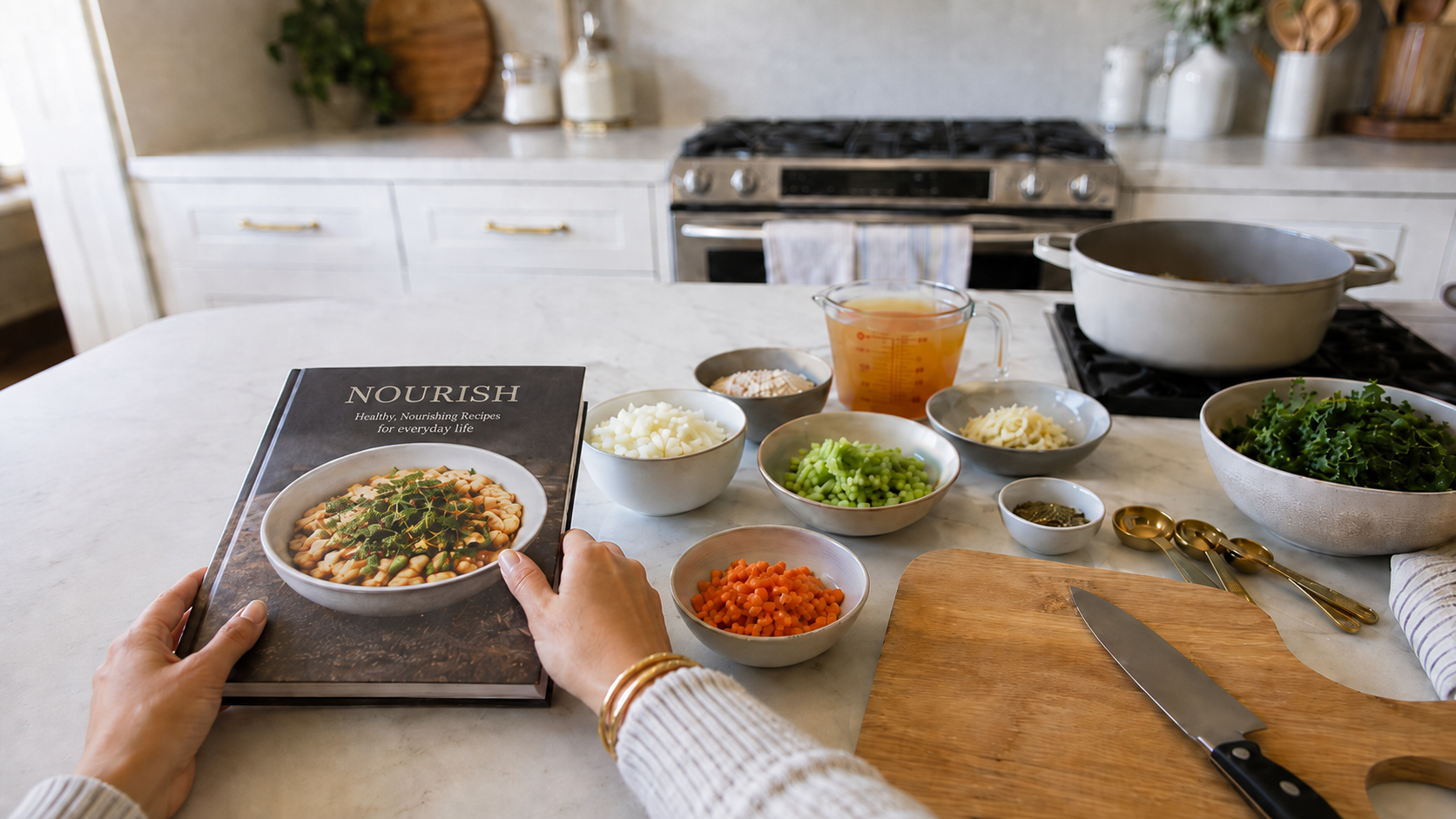
Assumed Mise en Place: Most recipes are written assuming all ingredients are prepped and ready before cooking starts — minced, measured, chopped, and in small bowls waiting to go in. The cooking steps assume you can add the next ingredient immediately because it’s already prepared. A recipe that says “add garlic and cook 30 seconds, then add tomatoes” assumes the garlic is already minced and the tomatoes already diced before you turn on the heat. If you’re mincing the garlic after the onions have been cooking for 5 minutes, the garlic goes in at a different point than intended.
Step Four: Identify the Critical Path
Every recipe has a critical path — the sequence of steps where timing precision matters and where being out of sequence creates problems. Experienced cooks identify this path before starting and plan around it. Beginners discover it step by step, which is why they’re often scrambling.
Longest Lead Time First: The first question to ask when reading any recipe is what needs the most time and whether any of that time needs to start before the rest of the cooking. Braised meats that need 3 hours in the oven need to start 3 hours before dinner, not when you walk into the kitchen hungry. Marinated proteins need their marinade time accounted for in the meal timeline. Chilled desserts need refrigeration time built into the schedule.
Simultaneous Steps: Recipe steps are written sequentially but are often meant to happen simultaneously. “While the pasta cooks, sauté the garlic” means the pasta water should be heating before the garlic preparation begins — not that you start the garlic when the pasta is done. Identifying these parallel steps and executing them simultaneously reduces total cooking time and ensures components are ready at the same time.
Temperature-Sensitive Windows: Some steps have narrow windows where precision matters — caramel that goes from perfect to burnt in 30 seconds, egg-based sauces that curdle above a specific temperature, fish that overcooks in the time it takes to answer a text message. Identifying these windows in advance allows you to give them your full attention when they arrive rather than being distracted by other tasks.
Step Five: Scale Intelligently
Doubling a recipe is not as simple as doubling every ingredient — a common assumption that produces inconsistent results.
What Scales Linearly: Ingredient quantities for most recipes scale reasonably well. Double the chicken, double the vegetables, double the sauce components.
What Doesn’t Scale Linearly: Salt and strongly flavored ingredients often don’t need to double when a recipe doubles. Doubling the salt in a doubled recipe frequently produces an oversalted result because the flavor concentration increases faster than the volume. Start with 1.5x the salt when doubling and adjust from there. The same applies to intensely flavored spices, alcohol, and strongly flavored liquids like fish sauce or soy.
Cooking Time and Equipment: Doubling a recipe doesn’t double the cooking time, but it often requires larger equipment — a bigger pot, a larger pan, or cooking in batches. Doubling a sauté that fits in a 10-inch skillet and trying to do it in the same 10-inch skillet produces steamed, grey meat instead of seared brown meat because the pan is overcrowded and can’t recover temperature. Either use a larger pan or cook in two batches.
Baking Is Different: Doubling baking recipes requires particular caution because baking chemistry involves ratios that don’t always behave linearly at scale. Leavening agents in particular don’t always double — too much baking soda or powder produces a bitter, chemically flavored result. When doubling baked goods, research whether the specific recipe scales reliably before proceeding.
Step Six: Trust Sensory Cues Over Timing
Recipe timing is the part of the recipe most likely to be wrong for your specific situation, and treating it as precise instruction rather than useful estimate is responsible for significant overcooking and undercooking.
Why Recipe Timing Varies: The recipe author cooked on their specific stove with their specific pan at their specific altitude in their specific kitchen temperature. Your stove may run hotter or cooler. Your pan’s heat distribution may differ. Your altitude affects boiling point. Your kitchen temperature affects how quickly proteins come to temperature before cooking. None of these variables match the author’s exactly, so none of the timing will be exactly right.
Sensory Cues Are More Reliable: “Cook until golden brown” is more reliable guidance than “cook 4 minutes per side” because golden brown is golden brown regardless of stove, pan, or altitude. “Until a toothpick inserted in the center comes out clean” is more reliable than “bake 35-40 minutes” because the toothpick test reflects actual doneness rather than estimated time. When recipes provide sensory cues alongside timing, use the sensory cue as the primary indicator and the time as a rough reference frame.
Internal Temperature Is the Most Reliable: For proteins especially, internal temperature measured with a probe thermometer is the most reliable doneness indicator available — more reliable than timing, more reliable than visual assessment, and more reliable than touch tests that take significant experience to interpret accurately. A probe thermometer costs under $15 and removes the guesswork from the most expensive and time-sensitive ingredient in most dinners.
Step Seven: Understand That the Recipe Is a Starting Point
The most significant mental shift between beginner and experienced cook reading of a recipe is understanding what a recipe actually is — a set of instructions that worked for one person in one kitchen under one set of circumstances, offered as a starting point for you to adapt to your kitchen, your ingredients, and your preferences.
Recipes Are Written by People: Recipe authors have preferences, habits, and biases that show up in their recipes. Some undersalt consistently. Some prefer softer vegetables than others. Some write timing for restaurant-quality equipment that exceeds what home kitchens provide. Reading a recipe as absolute authority rather than informed starting point creates rigidity that produces frustration when results don’t match expectations.
Your Ingredients Differ: A recipe developed with peak-summer tomatoes in August will produce different results in January with off-season tomatoes regardless of how precisely you follow the instructions. Adjusting seasoning, acid, and cooking time to account for ingredient quality differences isn’t deviation from the recipe — it’s cooking intelligently with what you actually have.
Taste and Adjust Throughout: The practice of tasting at every stage of cooking — not just at the end — is what allows you to catch and correct problems before they become irreversible. A sauce that tastes flat halfway through can be corrected. The same flat sauce discovered at serving time is harder to fix and the window for correction is gone. Tasting throughout and adjusting continuously is what “cooking to taste” actually means in practice.
Reading a recipe like a cook isn’t a mysterious skill that requires years of kitchen experience to develop. It’s a systematic approach to extracting the information that recipes contain but don’t always present in the most useful order. Read completely before starting. Decode the language precisely. Understand what’s being assumed. Identify the critical path. Trust your senses over the clock. Treat the recipe as a starting point rather than a scripture. These habits, applied consistently from the next recipe you make, change the cooking experience from reactive scrambling into proactive execution — and they make a bigger difference to cooking outcomes than any single technique or piece of equipment you could acquire.