
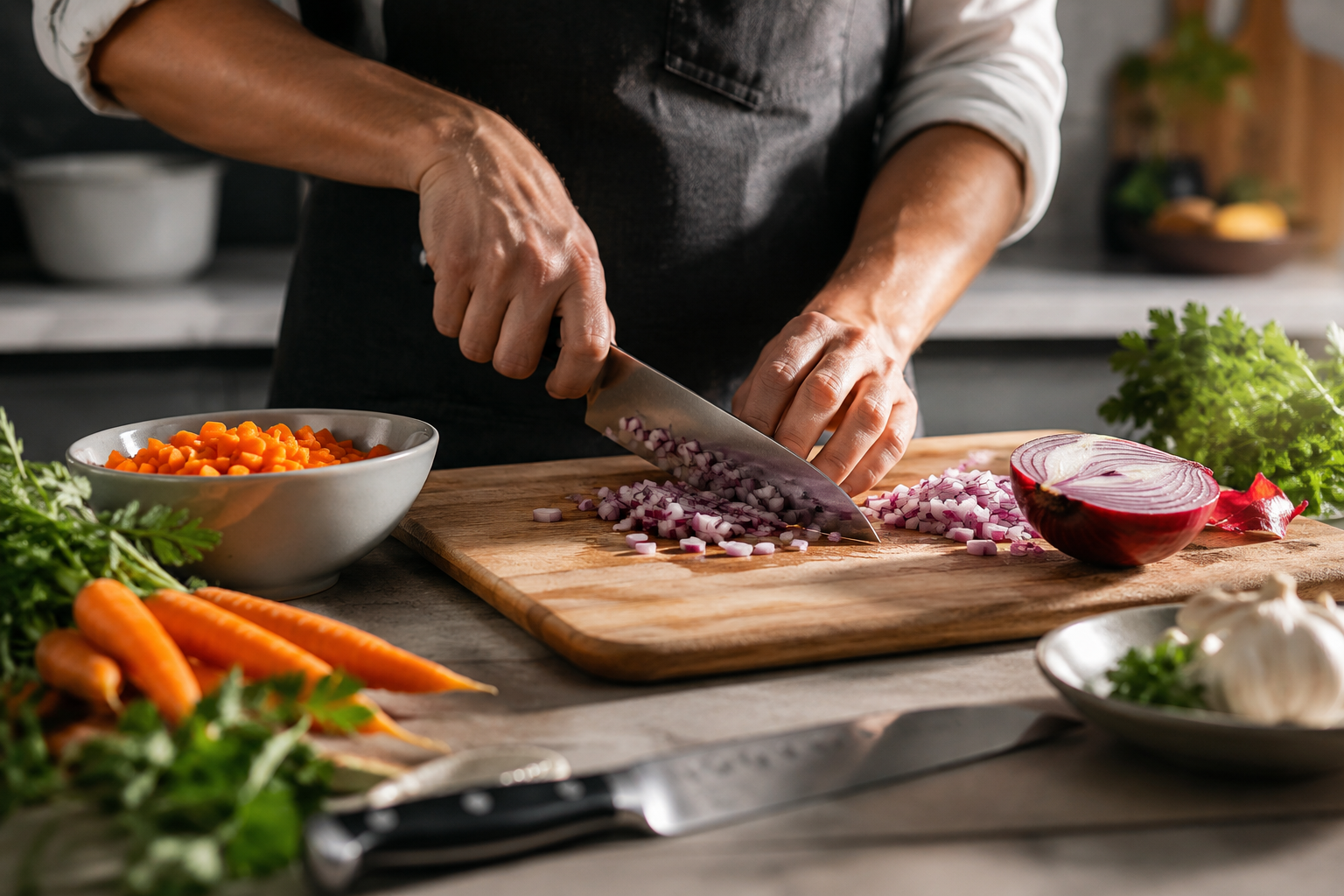
The Knife Skills Gap: Why Most Home Cooks Never Close It and How To Actually Fix That
Knife skills sit in an unusual position in home cooking education. Everyone knows they matter. Cooking shows, culinary schools, and food writers universally emphasize them. Yet the overwhelming majority of home cooks never meaningfully improve their knife skills after the first few years of cooking on their own, no matter how many years or decades they continue cooking. They develop a functional baseline, rough chopping, imprecise slicing, occasional injuries, and stay there permanently, improving at recipes and flavor combinations while the knife technique that underlies all of it stagnates.
This isn’t because knife skills are unusually difficult to learn. It’s because of specific patterns in how home cooks encounter information about knife skills, how they practice them, and what feedback they receive during that practice. Understanding these patterns explains why cooking experience alone doesn’t improve knife skills, and what a different approach looks like for someone who actually wants to close the gap rather than just knowing it exists.
Why Cooking More Doesn’t Automatically Improve Knife Technique
The intuitive assumption is that knife skills improve through accumulated cooking experience, the more you cook, the better your knife work becomes. This is true up to a basic functional threshold and almost entirely false beyond it.
Repetition Without Correction Reinforces Bad Habits: Deliberate practice in any skill domain requires feedback that identifies errors and allows correction. Cooking at home provides neither. When you mince garlic inefficiently for the five hundredth time, no mechanism exists to tell you that you’re doing it inefficiently. The garlic gets minced, the dish gets made, and the inefficient technique gets practiced and reinforced five hundred times rather than improved upon. Repetition without corrective feedback doesn’t build skill, it builds habit, and habits are considerably harder to change than skills that haven’t yet been learned incorrectly.
The Outcome Disconnect: Home cooking provides outcome feedback, did the dish taste good? But not process feedback, was the technique that produced it efficient, safe, and correct? A cook can produce excellent food for twenty years using knife technique that a culinary student would have corrected in their first week. The food’s quality doesn’t reveal the technique’s quality, so the feedback loop that would prompt improvement never activates.
Functional Adequacy as a Ceiling: Most home cooks reach a level of knife competence that feels adequate for their cooking, they can get through recipes without significant difficulty even if they’re working harder and less safely than necessary. This adequacy removes the urgency that drives deliberate improvement. The cook who takes 8 minutes to dice an onion doesn’t feel the inefficiency the way a professional who needs to dice twenty onions does. Comfort with functional adequacy creates a ceiling that experience alone doesn’t push through.
Tool Familiarity Without Technique: Many home cooks develop familiarity with their specific knife and cutting board setup without developing transferable technique. They know how their particular 8-inch chef’s knife behaves, where to grip it for their specific hand size, how much pressure their cutting board requires. This familiarity feels like skill but doesn’t transfer to different knives or environments, and it often accommodates poor technique rather than correcting it.
What Knife Skills Actually Consist Of
Before addressing how to improve, it’s worth being specific about what knife skills actually involve, since most home cooks have a vague understanding that they need work without clarity about what specifically needs improving.
Grip and Control: The most fundamental knife skill is grip, how the hand holds the knife for maximum control during different cuts. The pinch grip, where the thumb and index finger pinch the blade just above the handle with remaining fingers wrapping the handle, provides the most control for most cutting tasks. The vast majority of home cooks use a handle grip where the entire hand wraps the handle, it feels more secure but reduces blade control and increases fatigue during extended cutting. This single technique difference explains a large portion of the speed and precision gap between practiced and unpracticed cutters.
The Guide Hand: The non-knife hand is half of cutting technique and receives almost none of the attention. The guide hand uses the curled-finger position, fingertips curled under so knuckles guide the flat of the blade, to control food position and protect fingers simultaneously. Without this technique, cutting speed is limited by caution about finger proximity to the blade. With it, the knuckle acts as a fence that guides consistent slice thickness while protecting fingers. Most home cooks use flat-finger or pinch-hand positioning that neither guides cuts nor protects as effectively.
Board Contact and Rocking Motion: Efficient chef’s knife technique uses a rocking motion where the knife tip stays in contact with the cutting board as the handle rises and falls, pivoting rather than lifting completely with each cut. Many home cooks lift the entire knife with each stroke, requiring more effort per cut and producing less consistent results. The rocking motion conserves energy, improves consistency, and allows faster cutting once the motion becomes automatic.
Food Preparation Before Cutting: Knife technique starts before the knife touches food. Creating a flat stable surface by halving round vegetables before attempting to slice them, understanding the grain direction in proteins that affects how to cut against it, and knowing when to use different knife types for different tasks, these preparation decisions affect cutting quality before grip and motion even come into play.
Knife Maintenance: A dull knife requires more force per cut, increases fatigue, reduces precision, and paradoxically increases injury risk because more pressure means less control and greater consequence when the knife slips. Knife maintenance, regular honing before each use and periodic sharpening, isn’t separate from knife skill, it’s a prerequisite for practicing knife skill on an appropriate tool. Practicing cutting technique on a dull knife is like practicing piano on an out-of-tune instrument, the mechanics may improve but the feedback is wrong.
The Specific Techniques That Produce The Largest Improvements
Not all knife technique improvements deliver equal returns. A few specific changes produce disproportionate improvements in speed, precision, and safety.
Switching to the Pinch Grip: This single change produces more immediate improvement than any other. The pinch grip moves the control point from the handle to the blade, dramatically increasing the fine-motor control available during cutting. It initially feels insecure to cooks accustomed to handle grips, which is why most people don’t maintain it past the first attempt. Committing to the pinch grip through 2-3 weeks of cooking despite initial discomfort allows the new positioning to become natural, after which the improved control is immediately apparent.
Mastering the Curled Guide Hand: Learning to keep fingertips curled and knuckles forward while cutting is initially slow and awkward because it’s the opposite of the flat-hand position that feels natural. The payoff is the ability to cut quickly without the caution that comes from having fingertips near an unguarded blade. Once the curled hand position is automatic, cutting speed can increase without a corresponding increase in injury risk.
Learning Three Core Cuts Well: Rather than attempting to master the full vocabulary of culinary knife work, julienne, brunoise, chiffonade, tourné, most home cooking is served by three cuts done well. A proper dice (cutting food into consistent cubes through a sequence of slices, planks, and cross-cuts), a proper slice (consistent thickness along a single axis), and a proper mince (fine chopping using the rocking motion with the guide hand adjusting position) cover the vast majority of home recipe requirements. Becoming genuinely good at these three before expanding to specialty cuts produces faster practical improvement than spreading attention across many techniques at once.
Understanding When to Use Different Knives: A chef’s knife is the right tool for most cutting tasks, but using it for everything, including tasks better suited to a paring knife, serrated bread knife, or boning knife, produces harder work and inferior results. Learning which tool suits which task, and building the habit of selecting appropriately rather than defaulting to whatever is closest, immediately improves some cutting results without any change in technique.
Why Video Learning Works Better Than Written Instructions for This Specific Skill
Knife skills are a domain where the medium of instruction matters more than usual.
Three-Dimensional Motion in Two-Dimensional Description: Written descriptions of knife technique, including this article, can convey concepts about grip and motion but can’t show them in a way that allows accurate imitation. The angle of the pinch grip, the exact curvature of the guide hand, the speed and arc of the rocking motion, these are spatial and temporal phenomena that text approximates but can’t fully convey. A reader who understands the pinch grip conceptually from text often holds the knife differently than the text intends because the spatial ambiguity in written description allows multiple interpretations.
Slow Motion Changes What’s Teachable: High-quality knife technique video shot at normal speed is already useful, but slow-motion footage of professional cutting reveals details invisible at normal speed, exactly how the knuckle contacts the blade flat, where the knife tip stays during a rocking cut, how the guide hand reposition happens between cuts. These details are what separate correct technique from approximately-correct technique, and they’re only visible in slow motion.
The Specific Instructors Worth Finding: Not all online knife skill instruction is equal. Look specifically for instructors with culinary school backgrounds or professional kitchen experience who teach the foundational techniques rather than just impressive-looking advanced skills. The most practically useful knife instruction available online comes from culinary educators focused on home cook improvement rather than professional kitchen training or entertainment-oriented cooking content.
The Practice Structure That Actually Builds Skill
Understanding correct technique is necessary but not sufficient. The practice structure that converts understanding into habituated skill requires specific conditions.
Isolated Practice Separate From Cooking: Practicing knife technique during regular cooking embeds the old habits because you’re simultaneously managing heat, timing, and recipe steps that draw attention away from technique. Isolated practice, spending 15 minutes cutting vegetables specifically to practice technique, with no dish being prepared simultaneously, allows full attention on the mechanics rather than splitting it between technique and cooking. Even two or three isolated practice sessions can produce improvements that months of cooking-integrated practice don’t.
Slow Before Fast: Speed in knife work is the output of correct technique at manageable pace repeated until automatic, it’s not practiced directly. Practicing slowly with correct grip, correct guide hand, and correct motion builds the neural pathways that eventually allow faster cutting without conscious attention. Practicing quickly with incorrect technique builds incorrect technique quickly. Deliberately slowing down enough to maintain correct form is the fastest path to genuinely improved speed, counterintuitively.
Video Feedback: Filming yourself cutting, even with a phone propped against something stable, provides the external perspective that reveals discrepancies between how you think your technique looks and how it actually looks. Watching the footage and comparing it to reference video of correct technique shows specifically what to correct rather than requiring you to infer it from internal sensation. This feedback loop is what separates deliberate practice from mere repetition.
Consistent Setup: Knife technique is affected by cutting board height, board stability, and the specific knife being used. Developing technique on a setup that’s inconsistent, cutting board that slides, a knife that’s rarely sharpened, a counter that’s the wrong height, makes the skill harder to build and less transferable. Getting one good knife, keeping it sharp, using a stable cutting board at appropriate counter height, and practicing consistently on that setup creates conditions where technique improvements accumulate predictably.
The Equipment Reality
Knife skill discussions often either overemphasize equipment (blaming bad cuts on the wrong knife) or dismiss it (insisting any knife works fine). The honest position is somewhere between these.
One Good Knife Is Enough: A single quality chef’s knife in the 8-10 inch range handles nearly all home cooking cutting tasks. Knife sets with 14 pieces are primarily marketing, most of those pieces never get used and none of them compensates for poor technique with the primary cutting tool. Buying one genuinely good chef’s knife and maintaining it properly produces better outcomes than buying a full set of mediocre knives, or even a full set of excellent knives that rarely get sharpened.
The Sharpness Threshold: The quality difference between a $50 and a $200 chef’s knife matters less than the sharpness difference between a $200 knife used without maintenance and a $50 knife kept consistently sharp. Sharpness is the prerequisite for practicing technique, cutting on a dull blade develops compensatory techniques (additional force, different angles) that don’t transfer to sharp knife use and make skill development harder. Regular honing and annual or semi-annual professional sharpening, or learning to sharpen on a whetstone, matters more than knife brand or price within the quality middle ground.
Cutting Board Material Affects Technique: Wood and plastic cutting boards are both appropriate surfaces for knife technique practice. Glass, ceramic, and stone cutting boards damage knife edges rapidly, requiring much more frequent sharpening and making consistent practice on a properly sharp knife difficult to maintain. The cutting board material that undermines knife skill development most is the decorative stone board that looks attractive on a counter but destroys edge retention.
Making Improvement Actually Happen
The gap between wanting better knife skills and actually developing them closes through a specific sequence rather than vague resolution to practice more.
The First Week: Get your primary knife professionally sharpened or sharpen it yourself on a whetstone to establish a known baseline edge. Watch three to five hours of quality knife technique video instruction over several sittings, focusing specifically on grip and guide hand position. Don’t try to change your technique during regular cooking yet, just absorb correct technique visually.
The Second and Third Weeks: Set up isolated practice sessions of 15-20 minutes two to three times during each week, separately from meal preparation. Practice the pinch grip and curled guide hand on vegetables that don’t need to go into a specific dish, the practice vegetables get cooked eventually but the cutting is done specifically for technique rather than recipe outcomes. Film these sessions and review the footage.
The Following Month: Begin using the new grip and guide hand during actual cooking, deliberately and slowly even when it feels awkward. Expect this to feel uncomfortable and slower than your old technique for several weeks. The discomfort is the old habit resisting replacement rather than evidence that the new technique is wrong.
Six Weeks Out: At this point, most people who have followed this structure find the new technique is becoming automatic in at least some cutting situations. Speed has not yet returned to the old baseline but is increasing. The pinch grip no longer requires conscious maintenance during familiar cuts. The guide hand curls automatically. This is the point where the new technique is actually taking hold rather than just being understood conceptually.
The knife skills gap is one of the most closable gaps in home cooking, but it requires a different approach than most cooks apply. It closes through deliberate isolated practice with corrective feedback, not through cooking more. It requires specific technique change rather than general attention to cutting. And it rewards commitment through a brief uncomfortable transition period that most cooks never get past because they’ve tried to change technique during regular cooking rather than building it separately first. Getting through that transition is the entire challenge, and the reward on the other side is cooking that is faster, safer, and more enjoyable for every session afterward.