
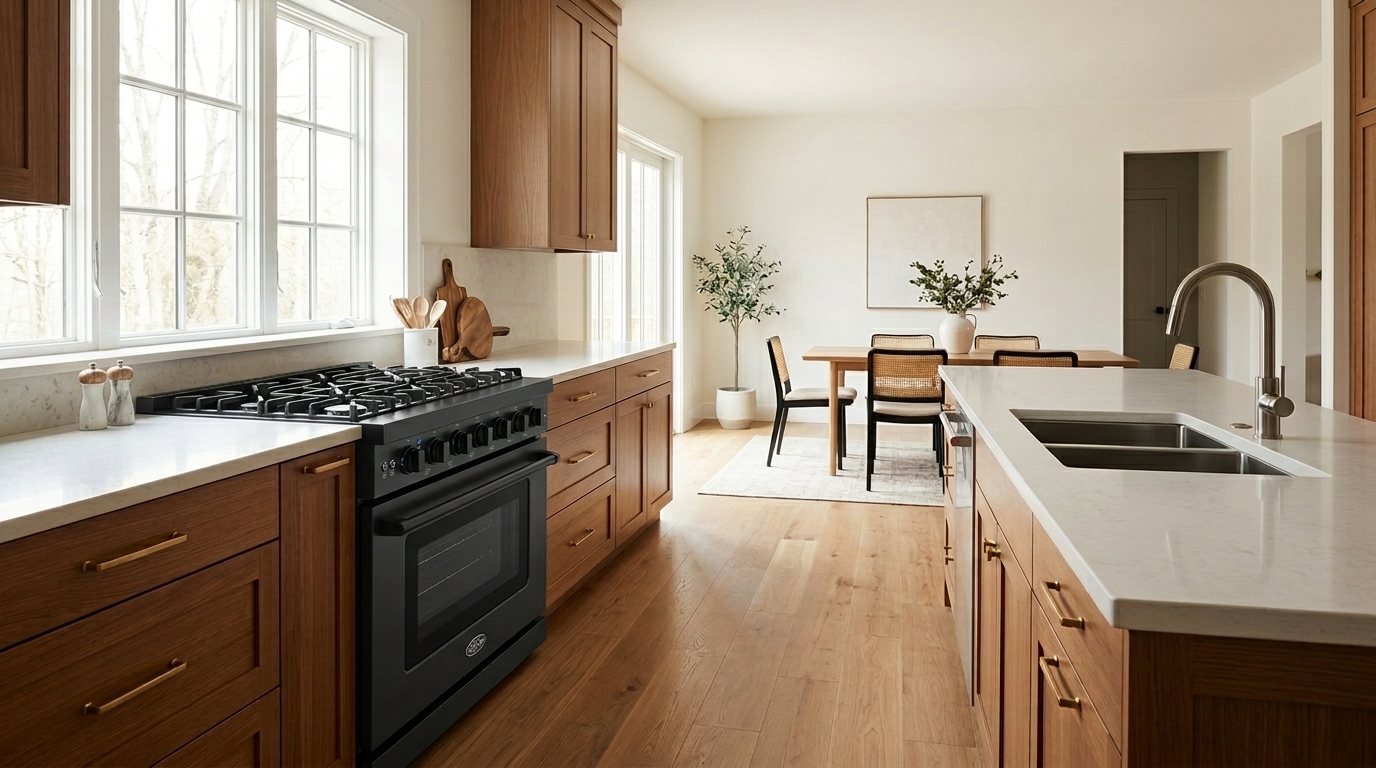
More Than One Right Finish: How Personalization Is Reshaping American Kitchens in 2026
Stainless steel earned its place in the kitchen for good reason. It resists corrosion, shrugs off heat, and wipes clean in a way few materials can match, which is exactly why it remains the performance benchmark against which every other finish gets measured. That has not changed in 2026. What has changed is what sits alongside it. Homeowners are no longer treating finish as a single, universal decision made once and applied to every appliance in the house. Increasingly, they are layering finish choices on top of that performance standard, choosing matte black, warmer whites, or wood-tone cabinetry to make a kitchen feel specifically theirs, and the data behind that shift is hard to ignore.
The Numbers Behind the Shift
According to the 2026 U.S. Houzz Kitchen Trends Study, wood-tone cabinetry has edged out white as the single most popular cabinet finish among renovating homeowners for the first time in years, chosen by 29 percent of respondents compared to white’s 28 percent, a reversal from the previous study. That six-point swing toward wood tones did not happen in isolation. Pinterest’s 2026 trend data shows a similar pattern in search behavior, with warmer, more personal palettes climbing steadily while the cool gray and stark white that defined the 2010s kitchen lose ground. Pantone’s Color of the Year for 2026, Cloud Dancer, tells the same story from a different angle: a soft, chalky white with warmth built in, explicitly positioned as a departure from the clinical whites that have dominated kitchens for a decade.
Put together, the picture is consistent across every major source tracking this space. American kitchens are not abandoning the performance and durability that made stainless steel the standard in the first place. They are asking for that same standard delivered in a wider range of finishes, ones that feel warmer, more personal, and more deliberately chosen.
Why Matte Black Has Staying Power
Of all the finishes gaining ground, matte black has proven to be more than a passing moment. Coating technology has genuinely improved over the past several years, and modern matte black finishes resist scratching and fading in ways earlier versions could not, which matters enormously for an appliance that gets touched, wiped down, and leaned on every day. The practical case is just as strong as the aesthetic one: a matte black cooktop or range front does not show fingerprints or water spots the way polished stainless steel does, which is a real, daily difference for any household with kids, guests, or simply a lot of cooking happening.
Design-wise, matte black pairs naturally with the wood-tone cabinetry gaining ground in the Houzz data, and it works just as well against a soft warm white like Cloud Dancer, giving it more flexibility across kitchen styles than a bolder color trend would offer. That combination of practicality and design flexibility is a large part of why matte black has moved from a niche, ultra-modern choice to a mainstream option that shows up across contractor-grade renovations and high-end builds alike.
A Finish for a Purchase That Outlasts a Paint Color
Appliance finish carries a different weight than a wall color or a throw pillow. A range or a cooktop is a purchase most households live with for a decade or more, which means betting the whole kitchen on a finish that could look dated in five years is a genuine risk. This is part of why Cosmo builds many of its most popular ranges in parallel matte black and stainless steel versions rather than offering matte black as a single, standalone product. The COS-EPGR366-BK, a 36-inch gas range from the Haven Collection, is a clear example of how that plays out in practice. Built with the same 6.0 cu. ft. convection oven, six sealed burners ranging from 9,000 to 18,000 BTU, and heavy-duty cast iron grates as its stainless steel counterpart, the COS-EPGR366-BK swaps in an elegant matte black finish with a matching matte black oven door handle and knobs, along with bright LED knob indicator lights that give the control panel a distinctly modern look after dark. A lower storage drawer and removable backsplash round out a range built for either freestanding or slide-in installation, so the finish decision does not force a compromise on functionality or fit.
Having both finishes built on the same platform matters more than it might seem. It means a homeowner leaning toward wood-tone cabinetry and warmer, more personal finishes is not trading away the durability and heat resistance that stainless steel is known for. The engineering underneath stays the same. Only the finish on top changes.
Choosing a Finish That Will Still Look Right in 2031
A few practical guidelines help when weighing a finish decision meant to last:
Matte black tends to age better than a bold accent color because it functions more like a neutral than a statement, which means it stays compatible with a kitchen even if the cabinetry or countertops change down the line.
Mixing metals intentionally, rather than avoiding it entirely, has become far more accepted; a matte black range with brushed nickel cabinet hardware or a warm brass faucet reads as curated rather than mismatched in most of today’s kitchens.
Consider how a finish performs day to day, not just how it photographs. A matte black cooktop that resists fingerprints and water spots earns its keep in a way a striking but high-maintenance finish sometimes does not.
Whenever possible, choose an appliance line that offers the same features across multiple finishes, so the decision comes down to genuine preference rather than trading capability for color.
A More Personal Kitchen, Built on the Same Standard
This is not a story about one finish replacing another. Stainless steel remains the benchmark for what a kitchen appliance should be able to withstand, and that has not changed. What has changed is how many finishes can now be built to meet that same benchmark. Wood-tone cabinetry, warmer whites, and matte black appliances are all part of the same underlying trend: homeowners in 2026 want a kitchen that feels specific to their household, without giving up the performance a serious range is expected to deliver.
For anyone renovating with that trend in mind, the finish decision no longer has to come at the expense of performance. Take a look at the COS-EPGR366-BK and the rest of Cosmo’s matte black range lineup, built to bring the same power and precision as their stainless steel counterparts to a kitchen finished for exactly how American homes are trending in 2026.