
Bold, Spicier Global Cooking & Why Ventilation Matters More Than Ever
American kitchens are getting louder, hotter, and considerably more adventurous. Across surveys and social platforms alike, the story is the same: home cooks are reaching further beyond familiar recipes, chasing the heat and depth of global cuisines rather than sticking to the mild, predictable dishes that once defined weeknight cooking. More than half of Americans now consider themselves adventurous eaters, and the data on flavor preferences backs that up in striking detail. Over half of Gen Z identifies as a hot sauce connoisseur, intense flavor callouts in food conversations have climbed sharply year over year, and nearly every restaurant menu in the country now features at least one dish built around serious heat. This is not a passing fad confined to restaurants; it is showing up on home stovetops, in weeknight stir-fries, in weekend curry projects, and in the kind of high-heat searing that used to be reserved for professional kitchens.
What often gets left out of that conversation is what this shift actually demands from the kitchen itself. Bolder cooking is not just a matter of stocking a new spice drawer. It changes how a kitchen needs to perform, and nowhere is that more apparent than in ventilation.
A Kitchen Trend Rooted in Real Data
It helps to look past the anecdotal sense that people are cooking differently and look at what the numbers actually say. Food trend researchers tracking 2026 menus and home recipe searches point to a clear and accelerating pattern: American households are not simply eating more takeout from global cuisines, they are attempting to recreate those dishes themselves. Searches for regional spice blends, fermented condiments, and specific chili varieties have grown steadily, and grocery chains have responded by expanding international aisles that were once an afterthought into some of the fastest-growing sections of the store. Home cooks are asking not just for flavor, but for authenticity, seeking out the same techniques and ingredient ratios used in the countries these dishes originate from rather than a simplified, mild approximation.
This authenticity-driven approach naturally pulls in cooking methods that were previously less common in the average American kitchen. Dry-heat searing at very high temperatures, wok-based stir-frying that depends on a screaming-hot pan, and long spice-blooming techniques where whole seeds are toasted directly in oil before the rest of a dish is built around them are all becoming everyday occurrences rather than occasional experiments. Each of these techniques is, by design, meant to push oil and aromatics to the edge of their smoke point, because that is often where the flavor actually develops.
The Flavor Shift Behind the Trend
The numbers describing this movement toward bold flavor are hard to ignore. Global cuisine exploration has become one of the defining food trends heading into 2026, with home cooks seeking out authentic spices and traditional techniques rather than watered-down, Americanized versions of dishes from India, Sichuan China, Thailand, Mexico, and the Caribbean. Flavor profiles are evolving too, with combinations like spicy-sweet-tangy and spicy-sweet-savory gaining traction as cooks look for more complexity rather than heat alone. Even categories that were once considered mild, such as breakfast foods, have seen a significant jump in bold flavor callouts across social media and recipe searches.
This kind of cooking relies on techniques that generate far more smoke, steam, and airborne oil than a typical weeknight meal. High-heat woks, dry-rub searing, char-forward grilling done indoors, and long-simmered curries loaded with toasted spices all release far more into the air than a pot of pasta ever will. A kitchen built around a decade of mild cooking habits is often not equipped to handle that shift, and the ventilation system is usually the first thing to fall behind.
Why Ventilation Becomes the Limiting Factor
Cooking oil that reaches a high enough temperature to sear meat or crisp aromatics vaporizes into microscopic particles that hang in the air long after the pan is turned off. Ground spices, especially the kind used heavily in bold global cooking, such as cumin, dried chilies, and mustard seed, release pungent compounds when they hit hot oil, and those compounds do not simply dissipate on their own. Without a range hood capable of pulling that volume of air out of the kitchen, the smoke and residue settle instead, on cabinetry, on countertops, in fabric, and in the air the household breathes for hours afterward.
This is where CFM, or cubic feet per minute, becomes the single most important number in the kitchen. CFM measures how much air a range hood can move, and it needs to scale with how the stove is actually being used, not just its size. A gentle sauté on a single burner asks very little of a hood. A screaming-hot wok, a dry-rub steak seared in cast iron, or a pot of bubbling curry with the lid off is an entirely different demand, and a hood rated for light-duty cooking will simply be overwhelmed. Under-ventilated kitchens dealing with bold, high-heat cooking tend to show the same signs: a persistent haze near the ceiling, lingering odors the next morning, and a fine film that builds up on cabinet surfaces near the stove faster than it should.
The Health Side of the Equation
There is also a wellness dimension to this conversation that deserves attention alongside the practical one. High-heat cooking, and searing in particular, produces fine airborne particulates, often referred to as PM2.5, along with volatile compounds released from both the oil and the spices themselves. These particles are small enough to travel deep into the lungs, and indoor air quality researchers have increasingly pointed to home cooking, especially frequent high-heat cooking, as a meaningful contributor to indoor air pollution. A kitchen that cooks boldly and often needs a ventilation system that can actually keep pace, not just to protect cabinetry and countertops from grease buildup, but to keep the air genuinely breathable in the hours after a meal is finished. This is one more reason CFM has become such an important spec for households leaning into global, high-heat cooking rather than a technical detail only professionals need to think about.
Ducted Versus Ductless: Why It Still Matters
Bold cooking also puts renewed importance on the distinction between ducted and ductless range hood installations. A ducted hood pulls smoke, grease, and odor completely out of the house through an exterior vent, which is the more effective option for anyone cooking with real intensity on a regular basis. A ductless, or recirculating, hood instead filters the air through a charcoal or carbon filter and releases it back into the kitchen. That approach can work reasonably well for light, occasional cooking, but it struggles considerably more with the volume of smoke and strong aromatics that come from searing meat at high heat or blooming a heavy hand of whole spices in oil. For a household that has genuinely shifted toward bolder, more global cooking, a properly ducted hood with strong CFM is usually the difference between a kitchen that clears out in minutes and one that stays hazy and fragrant long after the stove is off.
Matching the Hood to the Way You Actually Cook
Choosing a range hood used to be mostly about matching the width of the stove underneath it. That still matters, but the more important question for a household embracing bolder cooking is whether the motor and airflow are strong enough for what is actually happening in the pan. A wide, high-CFM hood with a genuinely capable motor gives a kitchen the headroom to handle a hard sear or a fragrant spice bloom without turning the room into a haze.
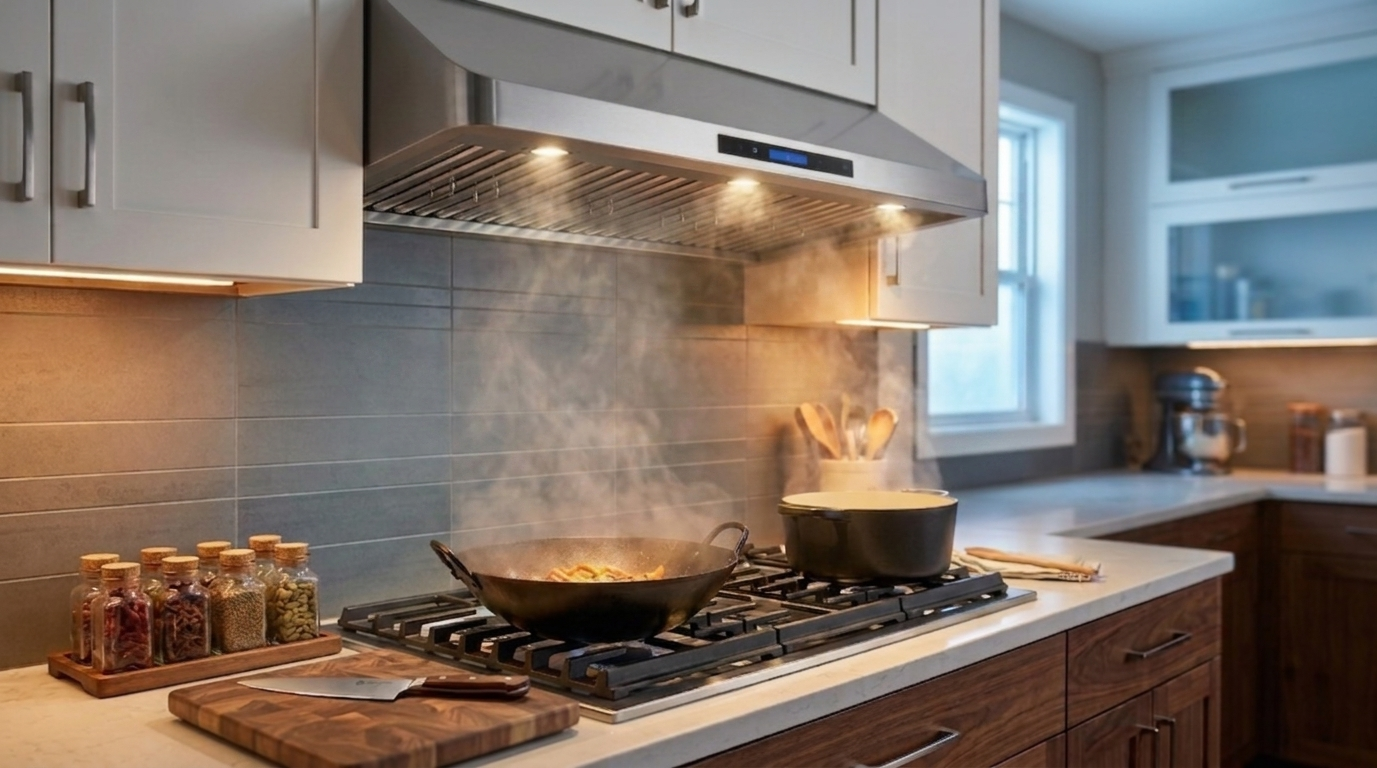
The Cosmo COS-QS48 was built with exactly this kind of demand in mind. This 48-inch under-cabinet range hood is wide enough to sit comfortably over a large range with multiple burners, which matters when bold cooking often means several pans working at once, a wok on one burner and a pan of toasting spices on another. Its dual-motor design produces 500 CFM of suction, giving it the pulling power to keep pace with high-heat searing and heavily spiced dishes rather than simply skimming the surface of the smoke. A sleek touchscreen with a back-lit digital display controls the four-speed fan, so the airflow can be dialed up specifically when a dish calls for it and dialed back down for lighter cooking, and a wireless remote means adjustments do not require stepping away from a hot pan mid-sear. Bright, energy-efficient LED lighting keeps the cooking surface clearly visible even with the exhaust running at full speed, and an auto-shutoff timer takes the guesswork out of remembering to turn the fan off once the kitchen has cleared.
The COS-QS48 is finished in premium brushed stainless steel with seamless corners, built to withstand the higher, more sustained heat that comes with searing and wok cooking without showing wear. Its permanent filters are designed to capture airborne grease without needing constant replacement, which matters considerably more in a kitchen that is cooking with hot oil on a near-daily basis rather than occasionally.
What This Looks Like Across Different Cuisines
The ventilation demands of bold cooking are not identical from one cuisine to the next, and it helps to think through a few concrete examples. Sichuan-style stir-frying relies on a wok held over extremely high, direct heat for a short burst of cooking time, releasing intense smoke almost instantly rather than gradually. Indian and South Asian cooking often begins with tempering whole spices, mustard seed, cumin, dried chilies, in hot oil before anything else goes into the pan, a step that can perfume an entire house within seconds if the exhaust is not already running. Caribbean and Latin American jerk and adobo preparations frequently involve charring spice-rubbed meat directly over high heat, whether on a stovetop grill pan or under a broiler, producing both smoke and airborne fat in quick succession. Each of these techniques is different in execution, but they share the same underlying requirement: a hood that can respond immediately and move a serious volume of air, not one designed around the gentler demands of a simmering sauce.
Beyond the Hood: A Few Habits Worth Adopting
A capable range hood does most of the heavy lifting, but a handful of habits make it even more effective in a kitchen leaning into bold, global flavors.
- Turn the fan on before the pan gets hot, not after the smoke appears, so the airflow is already established when it is needed most.
- Use the higher fan speeds deliberately for high-heat techniques like searing, stir-frying, and blooming spices in oil, rather than leaving the hood on a single low setting regardless of what is cooking.
- Let the fan run for several minutes after cooking finishes, since lingering smoke and odor particles continue to hang in the air even once the burner is off.
- Clean or replace filters on a regular schedule, since a clogged filter reduces airflow no matter how strong the motor rated.
- Crack a nearby window when cooking with particularly intense spices or extremely high heat, giving the exhaust system a little extra help moving air out of the room.
A Kitchen Built for How America Actually Cooks Now
The shift toward bold, spicier, more global cooking is not slowing down, and it is reshaping what a well-equipped kitchen actually needs to look like. A cooktop or range can handle the heat a recipe demands, but it is the range hood quietly working overhead that determines whether that same recipe leaves the kitchen smelling like the dish that was cooked, or lingering with smoke and residue for the rest of the day. As more households season with more confidence and reach further into unfamiliar cuisines, ventilation is no longer a background detail. It is becoming one of the most functional upgrades a kitchen can make, and appliances like the Cosmo COS-QS48 are built specifically for a kitchen that has moved well past mild.