
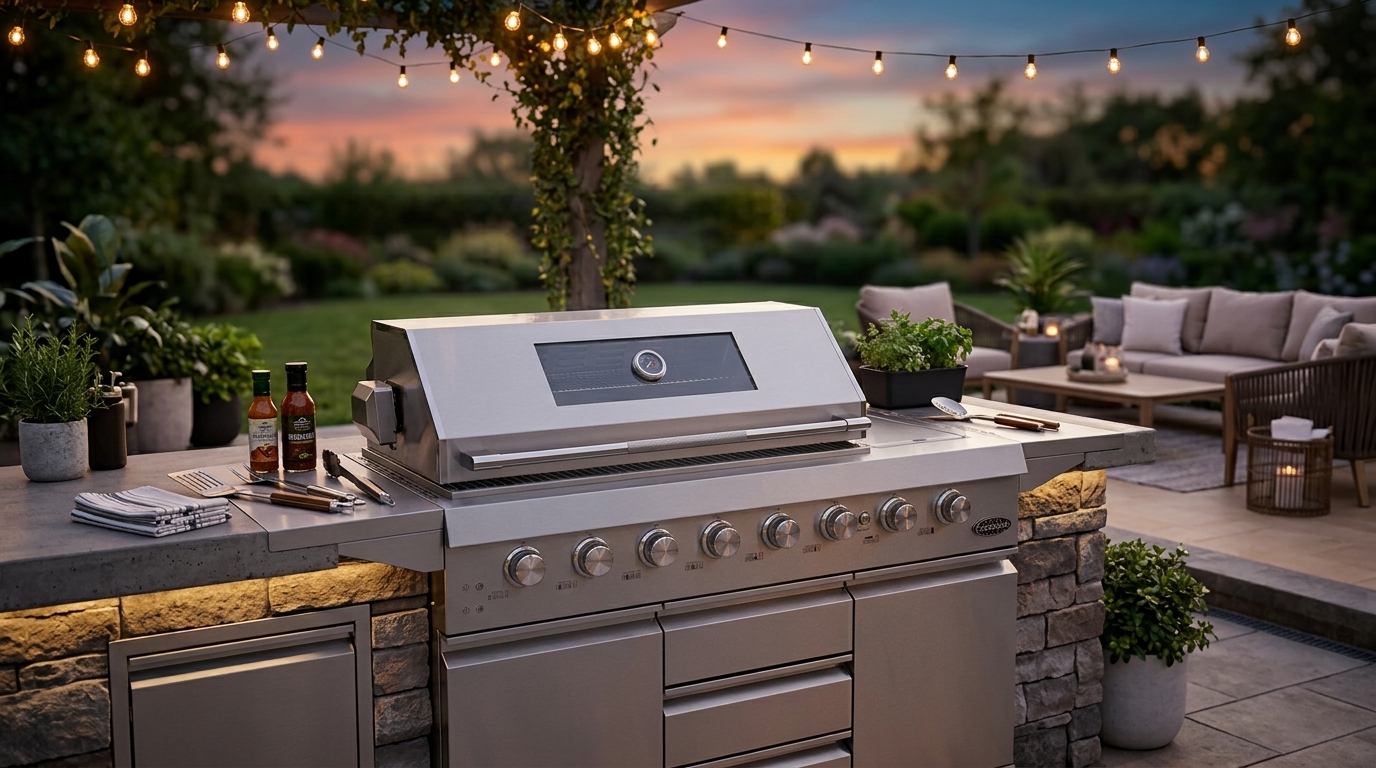
The Outdoor Kitchen Boom: Why the Backyard Has Become America’s Newest Kitchen
For much of the past decade, the outdoor kitchen occupied a narrow role in American home design: a grill, perhaps a side burner, positioned near a patio table and used sparingly outside of holiday cookouts. That role has changed considerably. In 2026, outdoor kitchens have moved decisively beyond the basic grill station, evolving into fully equipped extensions of the home that rival indoor kitchens in both capability and design ambition.
This shift reflects a broader change in how households think about outdoor space. Rather than treating the backyard as separate from daily life, homeowners increasingly view it as another room, one built around cooking, entertaining, and spending unstructured time outside the house. Designers and outdoor living companies alike point to the same pattern: built-in refrigeration, dedicated beverage centers, expansive prep counters, and premium grilling equipment are no longer reserved for luxury builds. They have become standard expectations for a well-designed outdoor space.
This guide examines what is actually driving the outdoor kitchen boom, what belongs in a well-planned outdoor cooking space, and how a centerpiece appliance such as the Cosmo COS-GGFN587GSS Newport Collection Grill anchors an outdoor kitchen built to perform at a genuinely professional standard.
From Grill Station to Full Kitchen
The defining characteristic of the current outdoor kitchen trend is scope. Where a backyard cooking setup once meant a single freestanding grill, 2026’s outdoor kitchens are being designed as complete, multifunctional spaces. Pizza ovens are increasingly specified alongside, or in place of, a traditional grill. Dedicated beverage centers, complete with built-in refrigeration, wine storage, and ice makers, are becoming a standard feature rather than an upscale add-on, allowing hosts to remain outside with guests instead of making repeated trips back to the indoor kitchen.
Modular design has emerged as one of the more significant developments within this trend. Rather than committing to a single, fixed outdoor kitchen layout, homeowners are increasingly choosing modular systems that allow a space to begin small and expand over time, adding storage, additional cooking equipment, or seating as budget and need dictate. This approach has made a genuinely capable outdoor kitchen accessible to a far wider range of households than the custom masonry builds of the past.
Smart technology has followed a similar trajectory outdoors as it has indoors. Wi-Fi-enabled grills, app-controlled refrigeration units, and connected lighting systems now appear regularly in outdoor kitchen builds, bringing the same convenience expectations from the indoor kitchen out into the yard.
What Belongs in a Well-Planned Outdoor Kitchen
Regardless of scale, the outdoor kitchens gaining the most traction in 2026 tend to share a consistent set of practical features:
- A high-capacity primary grill, sized and equipped to function as the true centerpiece of the space rather than a supplementary appliance.
- Dedicated storage, in the form of drawers, cabinets, or both, to keep tools, fuel, and serving equipment organized and protected from the elements.
- Adequate prep surface, positioned close enough to the grill to eliminate unnecessary trips back inside during cooking.
- Weather-resistant construction throughout, particularly stainless steel, which withstands sun, moisture, and temperature swings considerably better than painted or coated alternatives.
- Lighting suited to evening use, given that outdoor entertaining regularly extends well past sunset during the warmer months.
The common thread across each of these elements is durability paired with genuine functionality, a standard that distinguishes an outdoor kitchen built for daily use from one that exists primarily for appearance.
A Genuine Investment, Not Just an Upgrade
The outdoor kitchen boom is not driven by aesthetics alone. It reflects a market that has come to view outdoor cooking spaces as a legitimate home investment rather than a discretionary luxury. The U.S. outdoor kitchen market reached an estimated $10 billion in 2026, growing at an annual rate of 8 to 9 percent, with warm-climate states such as Texas, Florida, and California accounting for roughly a third of all national spending in the category.
The return on that investment holds up under scrutiny as well. Well-designed outdoor kitchens typically deliver a resale return in the range of 60 to 120 percent of their construction cost, depending heavily on design quality, materials, and regional climate, with properties in warmer regions generally realizing the strongest returns. Beyond direct resale value, real estate professionals increasingly cite a functional outdoor kitchen as a meaningful factor in a home’s overall marketability, particularly among buyers who prioritize entertaining space.
This shift matters for how the investment is approached. A well-built, versatile grill of genuine commercial caliber is not simply a purchase for immediate enjoyment. It is the foundation of an outdoor space that continues to add both usable living area and resale value to the home for as long as it remains in place.
The Centerpiece: Choosing the Right Grill
Every outdoor kitchen is organized around its grill, which makes this single purchase disproportionately important relative to nearly every other decision in the space. A grill that is underpowered, poorly organized, or built from materials unsuited to permanent outdoor installation will limit the usefulness of the entire kitchen around it, regardless of how well the rest of the space is designed.
The Cosmo COS-GGFN587GSS Newport Collection Grill was engineered specifically for this role. Constructed from premium stainless steel resistant to rust, corrosion, and prolonged outdoor weathering, the 58-inch grill delivers a combined 76,000 BTUs of output across six main 9,000 BTU burners, a 10,000 BTU rear infrared rotisserie burner, and a dedicated 12,000 BTU side griddle burner. That combination allows a single unit to handle grilling, rotisserie cooking, and griddle-style preparation simultaneously, a level of versatility that would otherwise require several separate outdoor appliances.
The rotisserie function in particular sets the Newport Collection apart from standard outdoor grills. The included motorized rotisserie kit is built for larger cuts of meat, roasting evenly and consistently in a way that direct grilling alone cannot replicate, and it transforms the grill from a searing station into a genuine outdoor roasting appliance. Paired with a built-in thermometer and a viewing window on the lid, the grill allows for precise monitoring of longer cooks without repeatedly opening the lid and losing heat, a meaningful advantage for anything beyond a quick weeknight dinner.
Built for Real Outdoor Living
Beyond raw cooking capability, the details that distinguish a genuinely well-built outdoor grill from a seasonal one tend to be practical rather than dramatic, and the COS-GGFN587GSS is built around exactly those details.
The unit includes three drawers and two cabinets, providing substantial dedicated storage for tools, fuel, and serving equipment, along with a dedicated propane tank mount that keeps fuel storage secure and out of the way. Two foldable side shelves, fitted with a combined eight hooks, extend usable prep space when needed and fold away when it is not, a practical solution for outdoor kitchens with more modest footprints. The entire unit is freestanding on lockable caster wheels, allowing it to be positioned precisely within a modular outdoor kitchen layout and secured in place once positioned.
Nighttime usability was clearly a design priority as well. LED-lit control knobs and interior halogen lighting allow the grill to be operated and monitored well after sunset, which matters considerably given how much outdoor entertaining now extends into the evening. A fitted weather cover is included as standard, protecting the unit from sun, moisture, and pests during the months or seasons it sees lighter use.
Taken together, these details reflect the same underlying premise driving the broader outdoor kitchen trend: outdoor cooking equipment is no longer expected to be a seasonal, lower-durability version of an indoor appliance. It is expected to perform, and to last, at the same standard.
Common Mistakes When Building an Outdoor Kitchen
Even with strong intentions and a reasonable budget, a few recurring missteps tend to undermine outdoor kitchen projects:
- Undersizing the grill relative to household needs. A grill sized for weeknight cooking will fall short the moment a household hosts a genuine gathering, which is precisely when the outdoor kitchen matters most.
- Neglecting storage in favor of cooking equipment alone. Without adequate drawers and cabinets, tools and supplies end up making repeated trips outside, undermining the entire purpose of a dedicated outdoor space.
- Choosing materials unsuited to permanent outdoor exposure. Anything less durable than premium stainless steel will show wear, rust, or degradation considerably faster once exposed to consistent outdoor conditions.
- Underestimating lighting needs. An outdoor kitchen designed without evening use in mind quickly becomes unusable for a significant portion of the year.
- Building without a modular mindset. A rigid, all-at-once layout leaves little room to expand the space later without a costly redesign.
- Skipping a protective cover. Even premium stainless steel benefits considerably from protection during off-season months or extended stretches of poor weather.
Planning the Layout
A well-planned outdoor kitchen generally follows the same core logic as an indoor one: cooking, storage, and prep space should be arranged to minimize unnecessary movement. The grill should anchor the space, positioned with enough clearance for safe operation and easy access from multiple sides where possible. Storage cabinets and drawers should sit within arm’s reach of the cooking surface, and any prep space, whether a dedicated counter or the grill’s own foldable side shelves, should be positioned to allow food to move directly from preparation to the grill without a detour.
For households building in phases, a modular approach allows the grill itself, arguably the single most important purchase in the entire space, to be installed first and used fully while additional elements such as a beverage center, pizza oven, or expanded seating are added over subsequent seasons.
The Bottom Line
The outdoor kitchen boom now reshaping backyards across the country is not a passing design trend. It reflects a genuine shift in how households use their outdoor space, treating it as a full extension of the home rather than a seasonal accessory. Building an outdoor kitchen that holds up to that expectation starts with a single decision: choosing a grill capable of performing as the true centerpiece of the space, not merely a supplementary appliance beside it.
That is precisely the standard the Cosmo COS-GGFN587GSS Newport Collection Grill was built to meet, combining substantial cooking capacity, genuine versatility, and construction designed for permanent outdoor living. As backyards across the country continue their transformation into fully equipped kitchens, the equipment anchoring them deserves the same level of consideration as anything inside the house.