
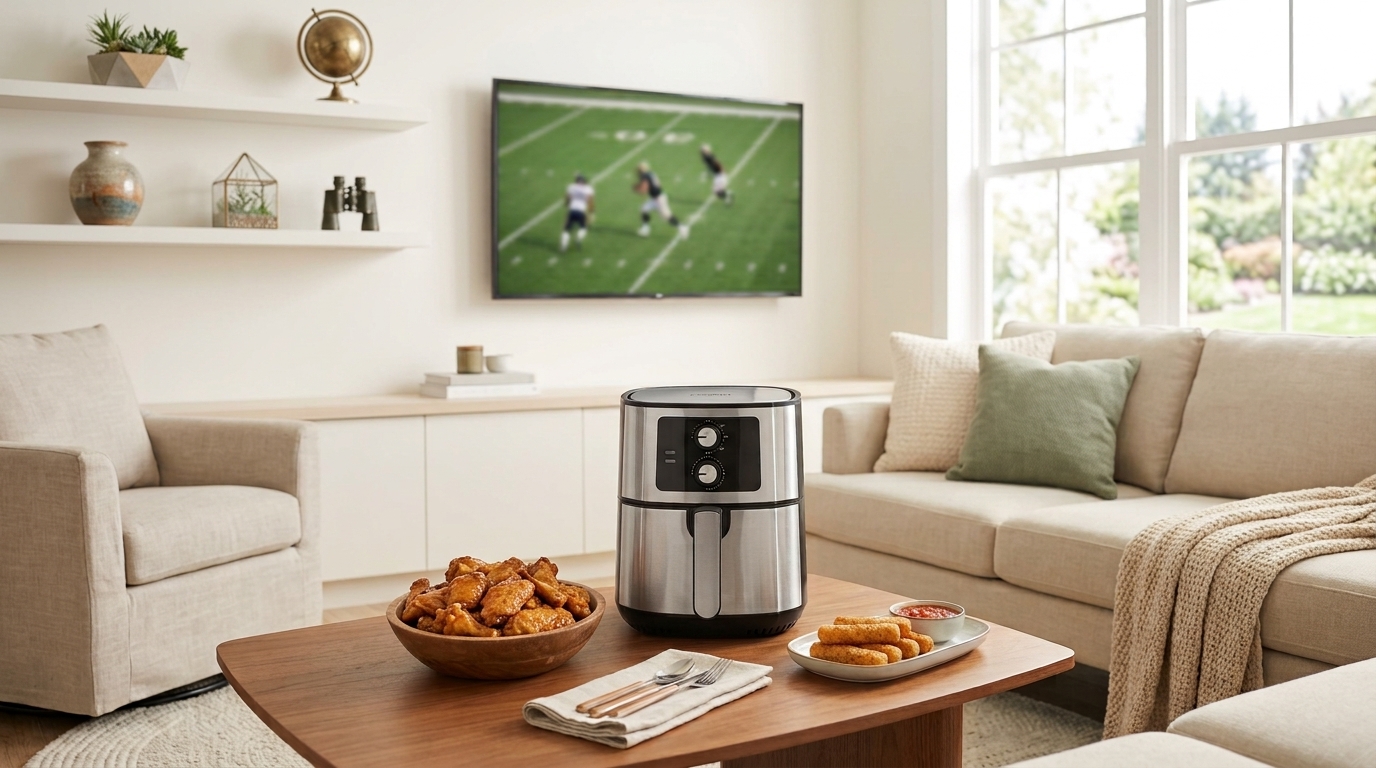
Kickoff-Ready: Getting Your Air Fryer Set for College Football Season
A Saturday Built Around Snacks, Not Just a Score
College football’s Week 0 kicks off this Saturday, August 29, 2026, and for a growing number of American households, the return of the season is as much a cue to plan the snack table as it is to check the schedule. The days of a single hot dish and a bag of chips have given way to something closer to a running buffet: wings in one bowl, mozzarella sticks in another, a tray of pretzel bites making the rounds before halftime even arrives. That shift did not happen by accident. It happened because the kitchen finally caught up to what game day actually demands, and the appliance most responsible for that catch-up has been sitting on counters for years without most hosts realizing just how much weight it can carry on a Saturday afternoon.
The Scale of a Single College Football Saturday
It is easy to underestimate just how much a single college football Saturday actually feeds. Through the middle of the 2025 season, the average SEC game alone drew more than 80,000 fans into one stadium, with the Big Ten close behind at nearly 65,000 per game and the Big 12 and ACC both averaging in the high 40,000s. Those figures only count the fans who made it through the gates. For every person tailgating in a parking lot or filling a stadium seat, several more are watching from a couch, at a friend’s place, or hosting a small group at home, particularly as more marquee matchups have shifted into national primetime windows that make watching from home just as much a part of the ritual as being there in person.
That scale repeats nearly every Saturday from late August through the conference championships in early December, not just once a season. Fewer of those Saturdays are spent exclusively at the stadium or the parking lot anymore, either. A meaningful share of college football viewing now happens at home, in front of a television with a group of friends, which shifts the burden of feeding a crowd from a tailgate grill to a home kitchen that was not necessarily built to produce bar-quality wings and fried sides for six or eight people without turning into a full-time job for whoever is hosting.
Why the Air Fryer Quietly Became the Default Game-Day Appliance
Circana’s Kitchen Audit research offers a useful data point on how deeply the air fryer has embedded itself in everyday cooking: among households that own one, roughly two-thirds report using it within just the past four weeks. That is not the behavior of a novelty appliance bought during a pandemic-era kitchen upgrade and left in a cabinet. That is a workhorse, in active weekly rotation, and game day is one of the clearest reasons why.
The appeal for a Saturday spent hosting is fairly direct. A deep fryer demands a pot of oil that takes real time to heat, cools slowly, and leaves a mess that nobody wants to deal with between kickoff and the first commercial break. A conventional oven gets the job done but ties up the one appliance most hosts also need for a dip, a casserole, or anything else in the spread, and it is slow to recover heat between batches. An air fryer solves both problems at once: it crisps frozen and fresh appetizers with little to no oil, it frees the oven for everything else on the menu, and it recovers between batches fast enough that a host can keep a rotation of wings, mozzarella sticks, and pretzel bites moving through a single basket without falling behind the game.
What a Game-Day Air Fryer Actually Needs to Handle
Not every air fryer is built for the specific demands of a hosting afternoon, and the difference shows up fast once real party volume hits the basket. A unit needs enough capacity to cook a genuine serving in a single batch rather than forcing a host to run four or five rounds through a basket built for one person’s lunch. It needs a wide, dependable temperature range, since wings, frozen mozzarella sticks, and fresh-cut vegetables all want different heat and timing to come out right. And it needs to be simple enough to operate one-handed while also keeping half an eye on the game, because nobody wants to be squinting at a touchscreen menu during a third-down conversion.
The COS-58AFAKSS, Set Up for a Full Saturday of Snacks
The Cosmo COS-58AFAKSS, a 5.8-quart electric hot air fryer rated at 1400 watts, was built around exactly this kind of everyday, high-volume use. Its basket holds enough food to cover a genuine serving of wings or a full tray of mozzarella sticks in one pass, rather than forcing a host to split a single appetizer across several rounds while guests wait. Separate temperature and timer knobs cover a range from 180°F to 400°F with a 30-minute timer, which is enough spread to move confidently from gently reheating a dip to driving a hard, crackling crust into a fresh batch of wings, and there is no meaningful preheat delay standing between one course and the next.
A top-mounted grill element browns from above while the basket crisps from below, so breaded and battered appetizers, the pretzel bites, the stuffed jalapeños, the frozen sampler platter someone always brings, finish evenly without needing to be flipped halfway through a series. An auto shut-off ends the cooking cycle the moment the timer runs out, which matters more on a day full of distractions than it does on an ordinary weeknight, since nobody hosting a watch party wants to be the one who burned a batch of wings during a replay review. The included basket and grill pan are both non-stick and dishwasher-safe, which counts for a lot once the game ends and the sauce, the cheese, and the crumbs left behind need to disappear quickly rather than sit soaking in the sink overnight. The unit is also ETL listed to recognized North American safety standards, and beyond wings and mozzarella sticks it handles frying, baking, grilling, and roasting, so it stays useful well past the final whistle of the season.
Building a Rotation That Keeps Up With the Game
A few habits make the difference between an air fryer that keeps pace with a watch party and one that falls behind by the second quarter. Starting with the least breaded, least fragrant items first, vegetables or plain proteins, and finishing with heavily sauced or breaded foods like wings or mozzarella sticks keeps flavors from carrying over between batches. Giving the basket some room rather than packing it edge to edge lets hot air circulate properly, which is the entire mechanism behind the crisp, even result an air fryer is supposed to deliver in the first place; a shake or toss halfway through a cycle helps browning happen on every side rather than just the surface touching the basket. Marinating wings or prepping breaded items the morning of, rather than during a commercial break, turns game day into a matter of timing rather than active cooking, which is really the whole point of building a snack rotation around an appliance built to run largely on its own.
Ready Before the Whistle Blows
Week 0 arrives this Saturday, and the households that have the smoothest afternoon are usually the ones who spent five minutes beforehand thinking through the menu rather than improvising it between plays. For a kitchen getting ready to host its first watch party of the season, the Cosmo COS-58AFAKSS offers a straightforward answer to the most common game-day kitchen problem: how to keep a steady stream of hot, crisp appetizers coming without spending the whole game standing over a stove. Get it out of the cabinet, set the timer and temperature knobs, and let the rest of the Saturday belong to the game.