
Global Champagne Day and the Chill Your Bubbles Actually Need
Pick up a bottle of champagne and you are holding something under serious strain. Between five and six atmospheres of pressure sit behind that cork, roughly three times what a car tire carries, all of it the product of a second fermentation that happens inside the bottle itself. Most of us never think about this until a cork leaves with more enthusiasm than anyone intended. Global Champagne Day, arriving on Friday, October 23, is a good reason to think about it, and about what happens to a bottle in the hours and weeks before it gets opened.
A Holiday With No Rules
Global Champagne Day falls on the fourth Friday of October every year. It traces back to 2009, when a California blogger named Chris Oggenfuss proposed a day to celebrate the wine, and it has since grown large enough that the Comité Champagne, the region’s trade body, runs an official page where restaurants, wine shops, and wine schools list their events. There is no tradition to follow and no protocol to observe. You open a bottle, share it, and call it a holiday.
That freedom is part of the appeal, but the name itself is anything but casual. Champagne refers only to sparkling wine made in the Champagne region of northeastern France under strict regulations, which makes the day a fair moment to appreciate how much work sits behind a single glass. Prosecco, Cava, and Crémant are excellent wines in their own right and deserve a toast too, but a bottle labeled champagne carries a specific place and a specific method. That method is built around holding carbon dioxide in solution, and nearly everything about how you treat the bottle at home should be built around respecting that.
Why Temperature Is the Whole Game
Heat is the enemy of a pressurized bottle. As a bottle warms, the dissolved carbon dioxide becomes less soluble and pushes harder against the glass and the cork. A bottle sitting at room temperature carries noticeably more pressure than one chilled for service, which makes it more likely to foam over or fire its cork when opened. Cold does the opposite, calming the gas and keeping it dissolved so the bubbles stay fine and persistent in the glass instead of rushing out all at once.
None of that means colder is better. Most producers suggest serving champagne between 46 and 50 degrees Fahrenheit, which is 8 to 10 degrees Celsius, and some sources put the comfortable window a few degrees lower. Go much colder and the bubbles diminish, the palate goes numb, and the aromas that make a good bottle worth buying fade into the background. Serve it too warm and it can taste heavy and unfocused. Storage runs slightly warmer than service, with a steady 50 to 59 degrees Fahrenheit commonly cited for bottles that will rest for a while. The important word in all of that guidance is steady, because fluctuating temperatures stress the cork and the wine alike.
The Refrigerator Is a Sprint, Not a Home
The obvious plan for most households is the refrigerator, and for a few hours before a toast it works well. Laying a bottle on its side on a lower shelf for about three hours brings it into range without shocking it. For a last minute rescue, an ice bucket filled with equal parts ice and water will do the job in somewhere between twenty and thirty minutes. Either approach is fine for the evening of a celebration.
The trouble starts when the refrigerator becomes the storage plan. A kitchen refrigerator typically runs between 35 and 38 degrees Fahrenheit, colder than any champagne wants to live, and its compressor cycles on and off all day, sending small vibrations and temperature swings through everything inside. That is tolerable for a bottle waiting a day or two. It is a poor arrangement for the extra bottles that tend to accumulate this time of year, bought on sale or received as gifts and set aside for the holidays. They deserve a spot that holds one temperature, stays dark, and does not get rearranged every time someone reaches for the milk.
The Matte Black Lumin Wine Cooler, Model COS-24BIWCS-BK
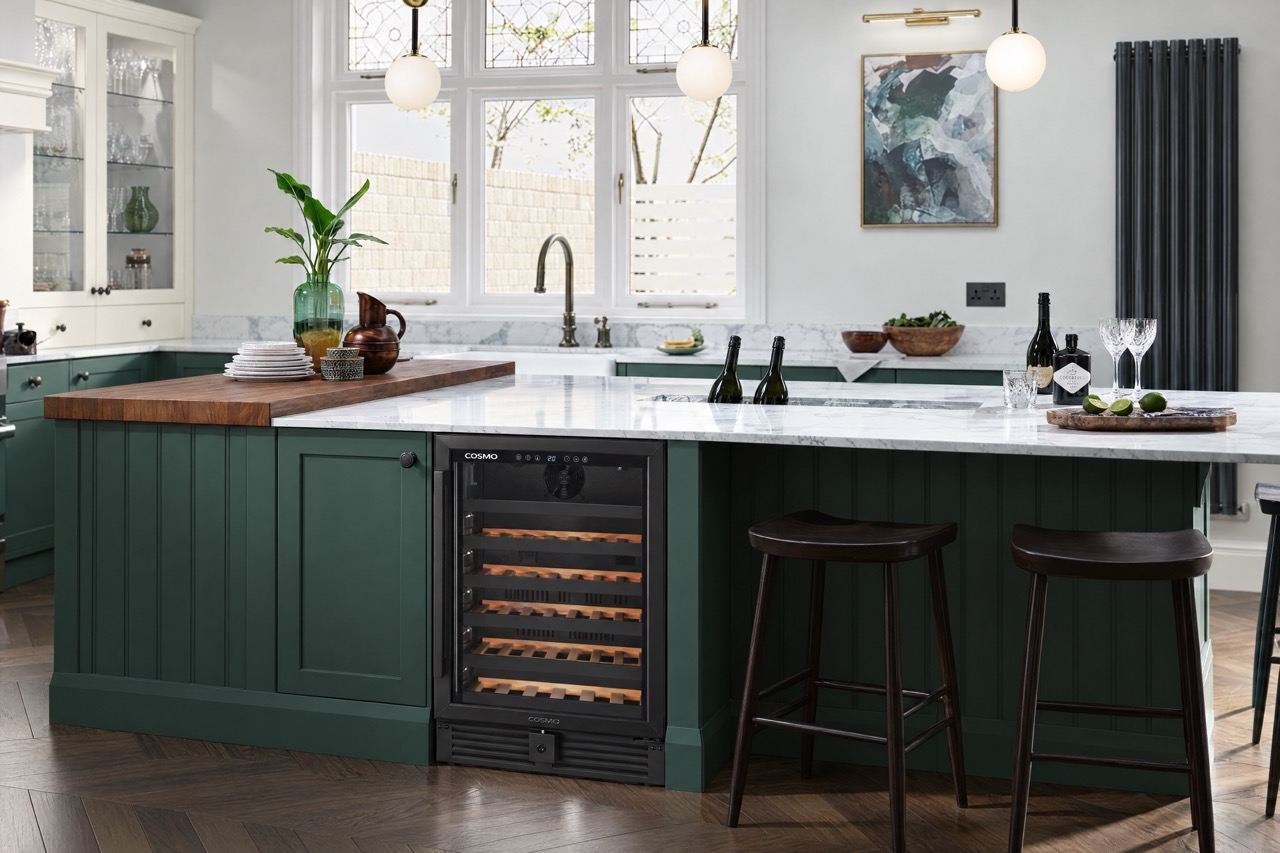
Cosmo’s matte black wine cooler is built for exactly that job. It belongs to the Lumin Collection and is a 24 inch unit with a 145 liter interior. A compressor system with advanced fan cooling holds temperatures anywhere between 41 and 68 degrees Fahrenheit, so everything champagne cares about, from a chilled serving temperature to a steady storage temperature, sits comfortably inside what the unit can maintain. Digital touch controls at the top let you dial in an exact number rather than guess at a knob, and a door lock keeps the collection undisturbed in a busy household.
The details matter for sparkling wine in particular. The insulated three layer glass door protects bottles from light while still letting you see the collection without opening it, and every unnecessary opening lets warm air in. Six beechwood shelves slide out on telescopic rails, so a bottle at the back comes forward without disturbing the ones in front, and horizontal storage keeps corks in contact with the wine. A hidden hinge keeps the front clean, LED lighting makes labels easy to read, and the unit measures 34 inches tall, 23.4 inches wide, and 22.75 inches deep, which allows it to be installed built in under a counter or freestanding in a dining room, home bar, or kitchen corner.
A few honest notes are worth making. The rated capacity of 52 bottles assumes standard 750 milliliter bordeaux style bottles, and champagne bottles are larger and heavier, so a collection of sparkling wine will hold somewhat fewer than the headline number. This is also a single zone unit, so the whole interior holds one temperature. A household that drinks mostly sparkling wine can set it for the serving range and leave it there, while a mixed collection of reds, whites, and sparkling wine will want a compromise setting. And it is built to hold bottles at temperature, not to chill them in a hurry, so the ice bucket still earns its place for last minute decisions.
Setting Up a Champagne Day Worth Remembering
A little staging goes a long way. A few days ahead, move the bottles you plan to open into a stable spot and let them rest, since a bottle that has been jostled around is more likely to misbehave when opened than one left alone. With a wine cooler, set the temperature near the upper end of the serving range, let the bottles settle, and pull them as guests arrive. With a refrigerator, start early and keep the bottles on their side.
When it is time to open, treat the bottle with respect. Hold the cork firmly, rotate the bottle rather than the cork, and ease the cork out until it releases with a sigh instead of a pop. That is how the people who make the wine do it, and it keeps the gas in the glass instead of on the ceiling. Pour in two stages to tame the foam, and choose a glass with enough room for the aromas, whether that is a classic flute or a wider tulip style glass.
Champagne is also more versatile at the table than its formal reputation suggests. Its acidity and bubbles cut through salty and fried foods beautifully, which is why potato chips, fried chicken, and crispy appetizers pair so well with it. If you want something to cook for the occasion, a batch of crispy air fryer potato skins with bacon, cheddar, and sour cream makes a natural partner, and the recipe is already on the Cosmo blog.
Bottles picked up for today may also end up waiting a while for the gatherings still ahead on the calendar. The spot a bottle rests in, and the temperature it holds, is a smaller decision than choosing the bottle itself, but it shapes what ends up in the glass more than most people realize.
Global Champagne Day asks very little of anyone. Open a bottle, share it, and enjoy it. What the first sip tastes like, though, depends on everything that happened before the cork moved, from the temperature it was held at to the way it was handled on the way to the table. Give the bottle a steady, cool place to wait, and the celebration takes care of itself.