
Why American Kitchens Are Falling Back in Love With the Knob
A Trend Running in the Opposite Direction
For most of the last decade, the story of the American kitchen has been a story of adding connectivity. Ovens that could be preheated from a phone in the parking lot, refrigerators with cameras and touchscreens bolted to the door, coffee makers that needed an app just to brew on schedule. The pitch was always convenience, and for a while, homeowners bought it. Heading into 2026, that story is starting to bend the other way.
Designers wrapping up their 2026 trend forecasts keep landing on the same, slightly surprising point: smart kitchen appliances, the very feature that dominated renovation wish lists a few years ago, are now the thing homeowners are asking their designers to dial back. Clients are telling their kitchen designers, in plain terms, that they want a kitchen where they do not need their phone to turn on the coffee maker. That is not a rejection of technology in general. It is a rejection of technology bolted onto tasks that never needed it in the first place, and it is showing up in the specific choices homeowners are making about the appliances that anchor a kitchen, starting with the range.
Why the Backlash Is Bigger Than One Complaint
It would be easy to write this off as a handful of frustrated homeowners annoyed by a laggy app or a firmware update that broke overnight. The pattern is broader than that, and it lines up with something happening well beyond the kitchen. Across home design generally, there is a documented pull back toward analog experiences, deliberately simple, tactile interactions that do not route through a screen, a login, or a cloud server that might not exist in five years. A kitchen appliance is a purchase most households live with for a decade or more, and an increasing number of them do not want that decade-long relationship mediated by an app that could be discontinued, a Wi-Fi network that could go down at exactly the wrong moment, or a touchscreen that could fail outright and take basic functionality down with it.
The complaints that show up again and again are specific rather than vague. A touch panel that misreads a wet or greasy finger mid-recipe. A companion app that requires an account, a firmware update, and a signed-in phone just to set a timer, a task a mechanical dial has handled without complaint for a hundred years. A smart refrigerator screen that homeowners describe using for exactly nothing beyond the calendar magnet it replaced. None of these are hypothetical annoyances. They are the specific, recurring reasons designers cite when clients ask for something simpler the second time around, after living with the connected version first.
What “Simple” Actually Means in a 2026 Kitchen
The shift away from smart is not a shift toward stripped-down or low-end. That distinction matters, because the appliances homeowners are choosing instead are not the budget models from a decade ago. They are full-featured, professional-grade equipment that happens to route its controls through a knob or a physical switch rather than a capacitive touch panel or an app. A sealed gas burner with a metal control knob does exactly what a homeowner needs it to do, adjusts instantly, works with wet or greasy hands, and keeps working in a power outage or a dead Wi-Fi router, all without asking anyone to open an app first.
This is really a story about where technology earns its place and where it does not. Precision temperature sensing inside a convection oven, automatic flame monitoring that relights a burner the instant it senses a gas leak, sealed burner design that keeps spills out of the internal assembly: these are places where genuine engineering improves how a kitchen performs, and homeowners are not asking designers to strip any of that out. What they are pushing back on is technology added purely for the sake of a feature list, a touchscreen for tasks a dial already handled well, an app for a function nobody actually wanted to manage from a phone.
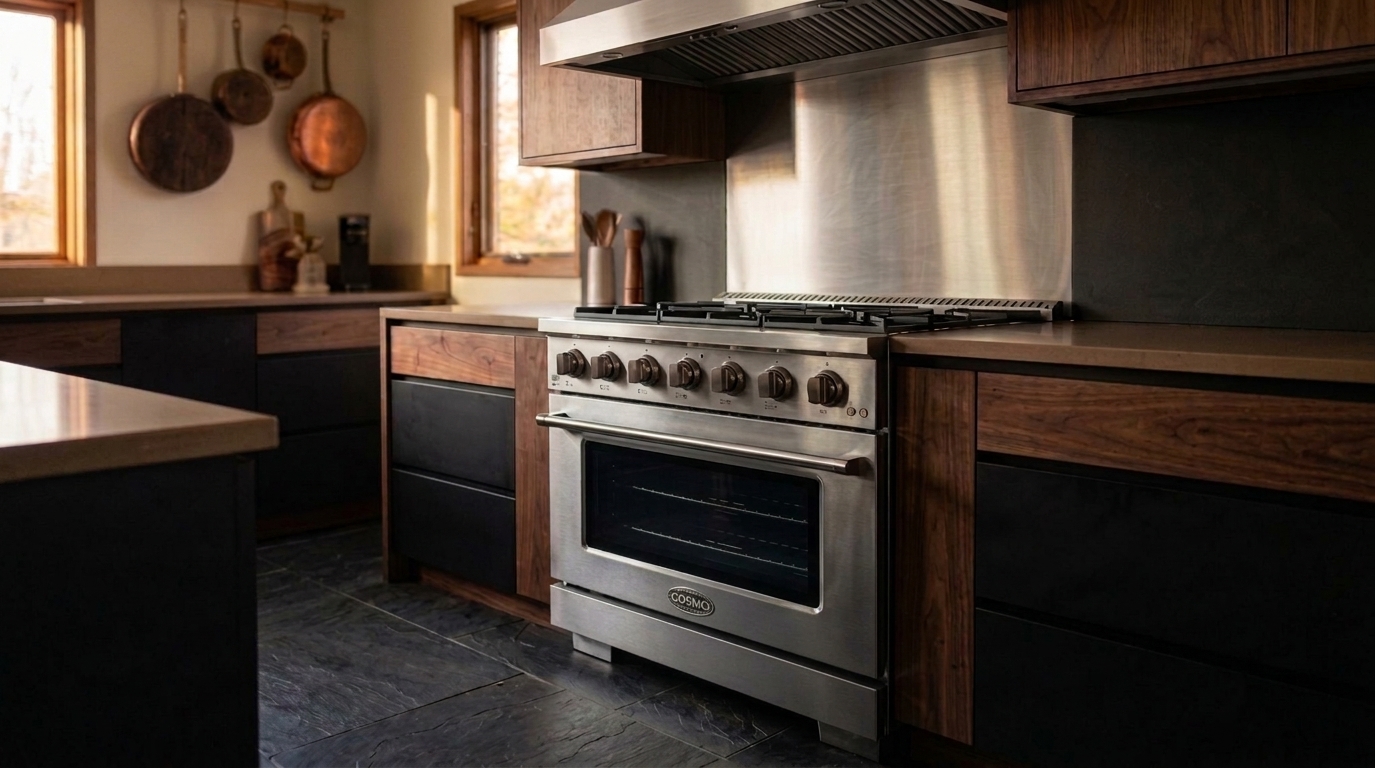
Cosmo’s COS-GRP366, a 36-inch freestanding gas range from the brand’s Italian burner lineup, is built around exactly this distinction between engineering that earns its place and connectivity that does not. Its six sealed burners are genuinely Italian-made, sitting on heavy-duty cast iron grates, and every one of them is controlled by a full metal knob rather than a touch panel, adjusted with a twist that works instantly whether a hand is dry, wet, or covered in flour. Underneath that simple control sits real engineering: an auto re-ignition system that continuously monitors each burner’s flame and automatically relights it if it goes out, preventing gas from accumulating the way an unmonitored burner could allow. That is the kind of feature homeowners in this trend actually want, technology working quietly in the background to make the appliance safer, not technology that adds a screen between a homeowner and the burner they are trying to light.
The 4.5 cubic foot convection oven underneath carries the same philosophy through six cooking modes, fan-assisted heating for even results, and an integrated broiler for high-heat, top-down finishing, along with interior lighting and multiple rack positions, all managed through the same style of metal knob rather than a digital display stack. The range’s finished sides and rear panel let it stand freely without being boxed into cabinetry, and for households that want to make the range feel specifically their own without sacrificing the tactile control at the center of this trend, Cosmo offers color handle and knob kits in black and rose gold as a separate customization option, small, physical, low-tech touches for a kitchen built around exactly that idea.
A Few Practical Notes for Anyone Weighing This Trade-Off
Not every smart feature deserves to be thrown out along with the ones that do not work. The distinction worth making is between connectivity that changes how well an appliance performs its actual job, like automatic flame monitoring or precise convection temperature control, and connectivity that only changes how a homeowner accesses a function a knob or button already handled fine.
A mechanical knob is also, in a very literal sense, a more durable investment. A physical control has no firmware to become obsolete, no manufacturer server that could be shut down years into the appliance’s life, and no software update that could change how a familiar control behaves overnight. For an appliance a household expects to keep for a decade or more, that is a meaningful difference, not a nostalgic one.
Homeowners weighing this decision during a renovation should ask a specific question about every connected feature under consideration: what does this actually do that a well-designed physical control could not do just as well? For a coffee maker’s brew schedule or a range’s burner control, the honest answer is usually not much. For a flame-monitoring safety system working invisibly in the background, the answer is considerably more, and that is exactly the kind of technology this trend is not asking anyone to give up.
A Kitchen Built to Be Used, Not Managed
What makes this shift worth paying attention to is that it is not a step backward so much as a correction. American homeowners spent years adding connectivity to a kitchen almost by default, because the option existed, and 2026 is the year a meaningful number of them are asking a more deliberate question: does this specific feature make the kitchen better to use, or does it just make it more complicated to manage? For a range in particular, the answer keeps landing on the side of a knob that turns instantly, paired with engineering that works quietly underneath it rather than a screen that sits between a cook and the burner they are trying to light. The COS-GRP366 was built around that same idea long before it became a design headline, real Italian burners, cast iron grates, and automatic flame protection, all controlled the way a range has always been controlled, with a twist of a metal knob and nothing standing in between.