
National Grilled Chicken Day Isn’t Just for the Backyard, and This Year’s Kitchen Should Prove It
A Holiday Built by the Restaurant That Made Grilled Chicken Famous
Most food holidays arrive with vague origins, a marketing calendar entry nobody can quite trace back to a source. National Grilled Chicken Day, observed on September 9th, is a rare exception. El Pollo Loco, the fast-casual chain that built its entire menu around citrus-marinated, fire-grilled chicken, formally declared the date in recent years as a way of pushing back against a grilling culture that treats beef as the default and chicken as the compromise. The chain’s argument, echoed across the trade coverage of the announcement, is that grilled chicken has spent decades as the healthier alternative on the menu rather than the dish anyone actually got excited about, and that the technique deserves better than an afterthought squeezed onto the grate next to the burgers.
It is a fair complaint, and one that home cooks quietly agree with more than restaurant menus suggest. Chicken has been the best-selling meat in America for years running, and grilled chicken breast in particular shows up in more weeknight dinners than almost anything else a household cooks. Yet it remains one of the easiest things to get wrong on a home grill or griddle, prone to drying out, sticking, or finishing unevenly in a way a burger rarely does. A holiday built specifically around grilled chicken is a useful excuse to actually get it right, rather than defaulting to the same rushed, overcooked version most households have made a hundred times without thinking much about it.
Search “how to grill chicken” and the results converge on a surprisingly short list of rules, repeated across nearly every serious food publication with a testing kitchen behind it. The Kitchen’s grilling guides emphasize pounding chicken breasts to an even thickness before they ever touch heat, since an uneven cut cooks unevenly no matter how good the grill is, and they push a brine or a simple marinade rest of at least thirty minutes as the difference between chicken that stays juicy and chicken that seizes up the moment it hits direct heat. Serious Eats, whose testing-driven approach to grilling has become something of a reference point for home cooks trying to move past guesswork, is emphatic on a single number: chicken breast pulled off the heat at 160 to 165 degrees Fahrenheit and rested for a few minutes carries over to a safe, fully cooked finish without the dry, chalky texture that comes from cooking straight to temperature over direct flame. Both publications land on the same underlying point from different angles, that grilled chicken rewards patience and a thermometer more than it rewards a hot grate and good intentions.
The other detail that shows up again and again in that coverage is about contact, not just heat. Chicken skin and flesh stick to a cool or unseasoned cooking surface in a way that beef, with its higher fat content, mostly does not, and food writers covering both outdoor grills and indoor griddles consistently point to a properly preheated, well-oiled surface as the real fix, more than any marinade or seasoning choice. Get the surface hot enough and prepped correctly, and a chicken breast releases cleanly with real grill marks. Get it wrong, and half the crust stays behind on the grate while the chicken tears apart on the way to the plate.
The Chicken That Never Makes It to the Grill
Here is where National Grilled Chicken Day runs into a problem the holiday’s own name does not account for. A meaningful share of the households who would happily grill chicken on September 9th are not going to, because an outdoor grill is not always part of the picture. Apartment dwellers without balcony access, renters under an HOA that restricts open flame, households dealing with a rainy or already-cooling September evening, or simply anyone who does not want to fire up a full propane grill for a Tuesday dinner, all default to the stovetop instead, and a stovetop pan rarely produces anything close to the char and texture that made grilled chicken worth declaring a holiday over in the first place.
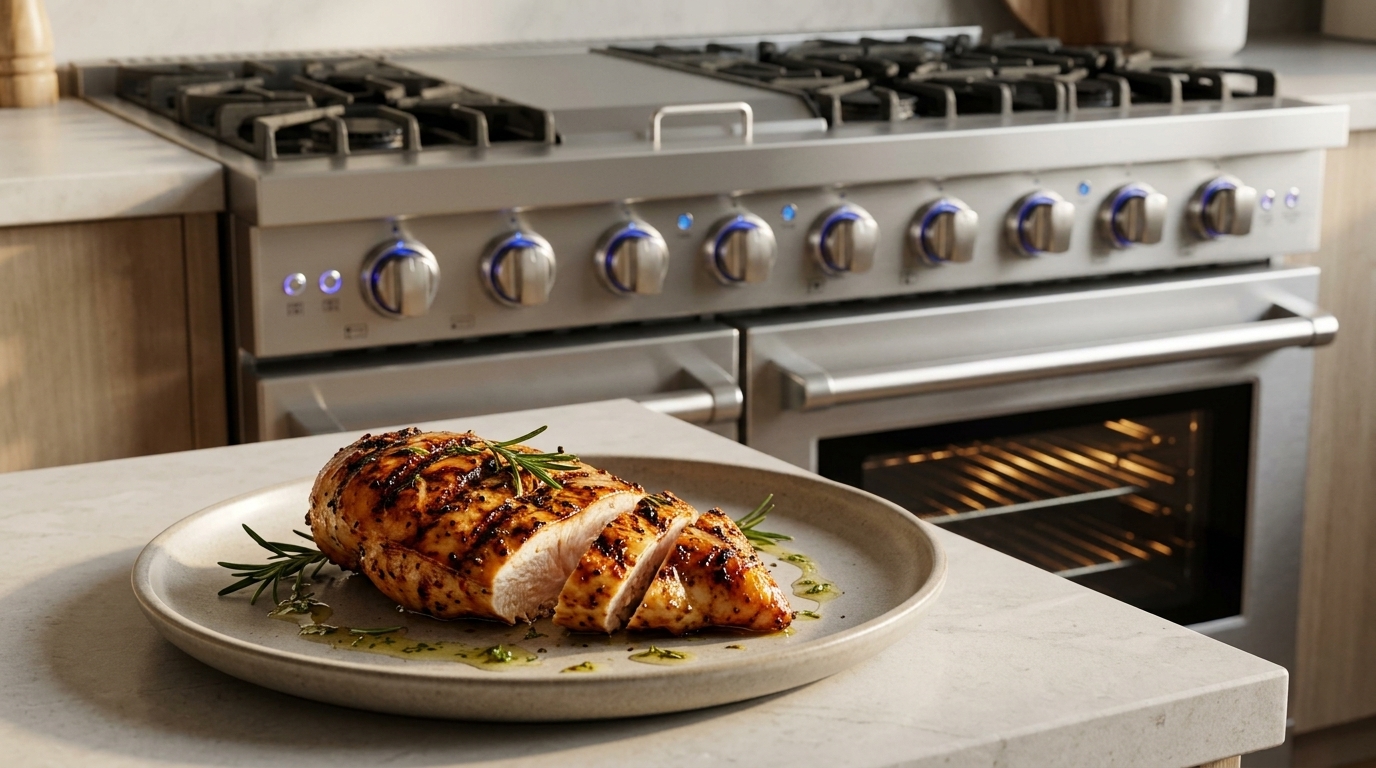
That gap is exactly what a built-in griddle on a home range is designed to close. Cosmo’s COS-EPGR486G, a 48-inch professional-style double gas range, includes a dedicated 15,000 BTU griddle built directly into its six-burner cooktop, a real, high-heat cooking surface sitting right alongside the range’s main burners rather than a separate countertop appliance that has to be dragged out, plugged in, and found room for. That distinction matters more than it sounds like it should. A griddle a household actually has installed and ready to go gets used on a random Wednesday night. A griddle stored in a cabinet under the stairs gets reserved for weekend pancakes, if it gets used at all.
The griddle’s 15,000 BTU output gives it the kind of sustained, even heat that a nonstick pan on a standard burner struggles to match, hot enough to build real color and a proper crust on chicken breasts and thighs without babysitting hot spots the way an undersized pan does. Because it sits flush with the cooktop rather than requiring its own footprint, a household can run the griddle for chicken breasts on one side while a pot of rice or a pan of vegetables works on the adjacent burners, the same kind of simultaneous cooking a backyard grill setup normally allows but a single skillet on a single burner does not.
Two Ovens Solve the Rest of the Meal
Grilled chicken rarely arrives at the table alone, and this is where the COS-EPGR486G’s second oven earns its place in the conversation rather than sitting there as a spec sheet number. The range’s primary oven, at 4.8 cubic feet with a convection fan and four cooking functions, handles a tray of roasted vegetables or a pan of cornbread at the same time the griddle is working through a batch of chicken breasts, while the 2.2 cubic foot secondary oven underneath can hold a dish warm, finish a smaller side, or keep the plates themselves heated until everyone is ready to sit down. It is the same logic that makes a real backyard cookout work, several things finishing close to the same time instead of a single burner and a single oven forcing a household to cook in shifts, just built into one indoor range instead of spread across a patio.
The range’s cooktop itself carries six sealed gas burners beyond the griddle, one 18,000 BTU burner and five 12,000 BTU burners sitting on heavy-duty cast iron grates, which gives a household running a full grilled chicken dinner room to boil, sauté, and simmer everything else the meal needs without competing with the griddle for space. A cool-to-touch oven handle and an oven cavity cooling ventilation system matter more on a weeknight than they sound like they should, since a range doing this much work at once runs considerably hotter than a single-burner dinner ever does.
A Holiday Worth Taking Indoors
El Pollo Loco built National Grilled Chicken Day around a straightforward argument: grilled chicken has been treated as the consolation prize on far too many menus for far too long, and it deserves a day built specifically around getting it right. That argument does not stop being true the moment the weather turns, the balcony is off-limits, or a Tuesday just does not leave room for a full outdoor cookout. What it actually calls for is a kitchen that can deliver the same real char, the same clean grill marks, and the same crowded, everything-finishing-together dinner a good backyard grill session produces, without needing a backyard at all.
For a household that wants to mark September 9th properly, whether the outdoor grill is an option this year or not, the Cosmo COS-EPGR486G is built for exactly that kind of night, a dedicated 15,000 BTU griddle built into a six-burner cooktop, two ovens working at once, and enough cooking surface to turn grilled chicken from a rushed weeknight compromise into the dish the holiday actually intended it to be.