
Backyard BBQ Games Everyone Will Love
The difference between a good backyard cookout and a great one rarely comes down to what’s on the grill. Food is table stakes — everyone expects it to be good. What separates the gathering people talk about for weeks from the one they politely enjoyed and then forgot is how the time between arriving and eating actually feels. Games are how you fill that time in a way that brings people together rather than leaving them stranded in small clusters trying to generate conversation with acquaintances they barely know.
Good backyard games share a few qualities that bad ones don’t: they work across a wide age range, they don’t require extensive rules explanations, they tolerate interruption gracefully when someone needs to check the grill or refresh their drink, and they generate enough friendly competition to give people something to talk about without requiring athletic ability or coordination that might embarrass less physically confident guests. The games that actually get played repeatedly at cookouts aren’t usually the most elaborate ones — they’re the ones with low setup friction, natural stopping and starting points, and enough inherent silliness to make losing feel fine.
Cornhole
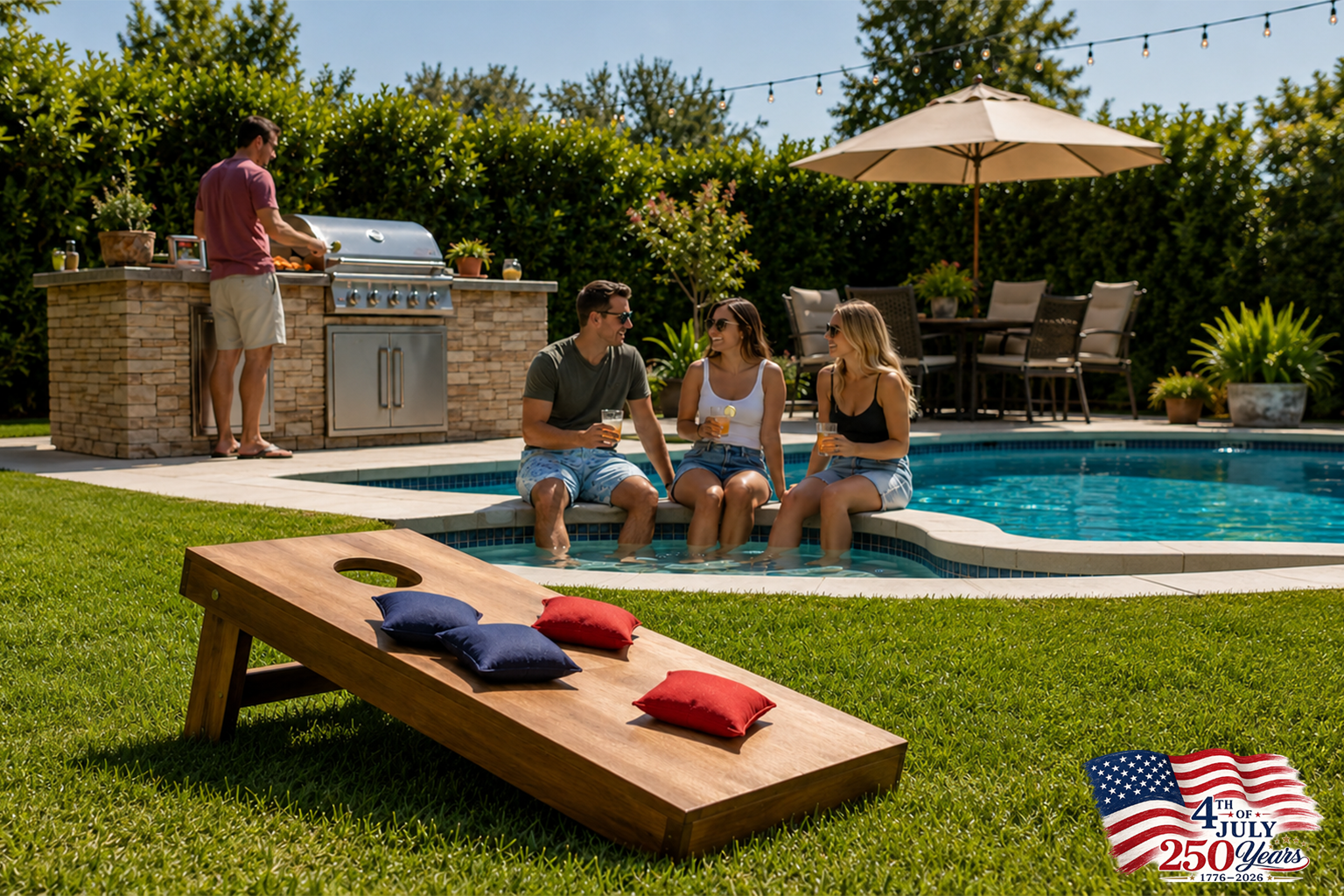
Cornhole has become the defining game of American backyard gatherings for good reasons that go beyond mere trend. It works.
How It Works: Two boards are placed 27 feet apart for official play, or closer for casual games, with a 6-inch hole at the top of each angled surface. Teams of two alternate throwing 16-ounce fabric bags filled with corn or synthetic fill, aiming to either land bags through the hole (3 points) or on the board surface (1 point). Teams cancel out each other’s points each round — if Team A scores 5 and Team B scores 3, only Team A gets 2 points for that round. First to 21 points wins.
Why It Works for Cookouts: The 27-foot distance is long enough to require skill but short enough that most adults can play competently without practice. Rounds move quickly. The cancellation scoring system keeps games from ending embarrassingly lopsidedly. Players can hold drinks while playing — genuinely important for a backyard party format.
Age Range: Kids around 8 and up can play meaningfully. Adults of all ages and fitness levels participate equally. Cornhole doesn’t advantage the young or athletic.
Setup Considerations: Official boards are 2×4 feet with a specific hole diameter. Purchased sets are consistent enough that you don’t need to build your own. Store them flat and keep the bags dry — bags that absorb moisture from wet storage become inconsistent in weight and flight.
Tournament Potential: Cornhole scales naturally to larger gatherings through bracket tournament formats. Eight teams produce a bracket that takes 3 rounds to determine a winner — achievable over a couple of hours of party time without dominating the entire event.
Bocce Ball
Bocce ball is the game that surprises people. They’ve seen it in parks and assumed it was boring until someone roped them into playing, at which point they became immediate converts.
How It Works: One player throws the pallino (small target ball) to establish its position. Teams then alternate throwing or rolling their larger bocce balls, trying to end up closest to the pallino. The team with the closest ball scores a point for each of their balls that sits closer to the pallino than the closest opposing ball. Games typically go to 12 points.
Why It Works for Cookouts: Bocce moves at a conversational pace — players are walking slowly back and forth to inspect ball positions, debating measurements, and arguing cheerfully about which ball is actually closer. This pace generates more conversation and laughter than faster-moving games that require continuous attention. The measuring disputes are half the fun.
Surface and Space: Bocce traditionally plays on packed dirt or sand. Grass works fine for casual play and actually adds strategic complexity as uneven surfaces affect ball trajectories. You need roughly 60×12 feet for a standard court, though casual play in smaller spaces with adjusted distances works well for most backyards.
Age Range: One of the most age-inclusive games available. Grandparents and young children can participate meaningfully alongside adults because the game rewards strategic positioning rather than athletic ability. Grandparent-grandchild teams are perennially competitive in bocce.
Skill Ceiling: Bocce has genuine depth that rewards experience — reading surface slopes, understanding how to knock opponents’ balls away without losing position, and managing risk when deciding whether to attempt a difficult throw versus playing it safe. Casual players enjoy it immediately while experienced players appreciate the strategy.
Kan Jam
Kan Jam fills the gap for people who want a faster-paced, more physically active game than cornhole or bocce without requiring the coordination of more athletic options.
How It Works: Two cylindrical goals (kan) are placed about 50 feet apart. Teams of two face each other — one player at each kan. The thrower attempts to hit or land the frisbee in the opposite kan. The thrower’s partner can redirect (deflect) the frisbee to help it hit or enter the kan. Scoring: hitting the kan directly scores 1 point, knocking a deflected disc into the slot on the kan’s side scores 2 points, the thrower putting the disc directly through the top slot is an instant win. First to 21 wins, but you must reach exactly 21 — going over resets you to 15.
Why It Works for Cookouts: Kan Jam is significantly more active than cornhole with satisfying moments when a good deflect-to-slot combination scores 2 points. The partner deflection mechanic means even weaker throwers can contribute meaningfully to their team’s success because their partner can adjust bad throws.
Physical Involvement: More movement than cornhole — players need to move to deflect well, and the frisbee can take erratic paths. Not so physical that fitness matters, but energetic enough that it generates more noise and spectator interest than slower-paced games.
Age Range: Best suited to teens through adults in their 50s and 60s who are reasonably mobile. Less accessible for very young children or older adults with limited mobility.
Spikeball
Spikeball is the game where once it starts, it absorbs nearby spectators who initially weren’t interested. It’s genuinely compelling to watch even when you’re not playing.
How It Works: A small circular net sits at ground level in the center. Two teams of two position themselves around it. One player serves by bouncing the ball off the net to an opposing player. Teams then alternate hits (maximum three per team before returning to the net) to spike the ball off the net in ways the opposing team can’t return. There are no designated sides — play happens 360 degrees around the net. A team scores when the ball hits the rim, bounces twice on the net, or the opposing team fails to return it.
Why It Works for Cookouts: Spikeball generates more noise, visible athleticism, and crowd energy than any other common backyard game. The circular format means players are moving constantly, diving occasionally, and making the kind of highlight plays that make people stop their conversations to watch.
Physical Requirement: This is the most athletically demanding game on this list. It rewards fast reflexes, quick lateral movement, and some athletic instinct. It can be played at varying intensity levels for casual fun, but it genuinely advantages younger and more athletic players compared to the other games here.
Age Range: Teens through adults in their 30s and 40s play this most naturally. Older adults and young children are better served by other options, though they often enjoy watching Spikeball enthusiastically.
Horseshoes
Horseshoes is old enough to be considered traditional and different enough from the modern alternatives to feel distinctive at gatherings where everyone has already played cornhole to exhaustion.
How It Works: Two metal stakes are driven into the ground 40 feet apart. Players alternate throwing steel horseshoes, attempting to land them around the stake (ringer, 3 points) or closest to the stake (1 point). As with cornhole, points cancel out between teams. Games go to 21 points.
Why It Works for Cookouts: Horseshoes generates a specific sound — the satisfying clang of metal on metal — that has become aurally associated with summer gatherings to a degree that no other game matches. It’s nostalgic in a way that adds to the cookout atmosphere beyond just the game itself.
Setup Considerations: Proper horseshoe pits use stakes driven into clay or sand-filled pits that allow horseshoes to stick and not bounce. Casual play on any surface works but produces more bouncing and less satisfying results than proper pit setup. The 40-foot official distance is considerable — most casual setups use 20-25 feet for mixed-age groups.
Age Range: The weight of steel horseshoes can challenge young children and older adults with limited grip strength or arm strength. Rubber horseshoe sets offer the same gameplay with significantly less weight, making them more inclusive.
Giant Jenga
Giant Jenga turns a game most people know from indoor settings into a surprisingly compelling outdoor spectacle when scaled up to a version where individual blocks weigh a couple of pounds.
How It Works: A tower of 54 large wooden blocks (stacked in sets of three in alternating directions) starts at around 3 feet tall. Players take turns removing one block from any level and placing it on top. The player who causes the tower to fall loses.
Why It Works for Cookouts: Giant Jenga generates sustained tension that builds throughout the game as the tower grows increasingly precarious. The moment immediately before a collapse stops conversation nearby. The collapse itself produces a noise and a moment of chaos that punctuates the game memorably.
Size and Setup: A proper giant Jenga set reaches 4-5 feet when complete. The tower should start on a stable, level surface — uneven grass can create a wobble that makes the game shorter than intended. Keep the blocks dry for storage, as moisture causes wood to swell slightly and jam blocks that should slide freely.
Age Range: Fully inclusive — children as young as 6 or 7 can participate meaningfully and often develop impressive concentration during their turns. The game doesn’t advantage younger or older players in any meaningful way.
Water Balloon Games
Water balloon activities work specifically for hot days, specifically for gatherings that include children, and work as a standalone activity rather than a competition.
Water Balloon Toss: Pairs stand facing each other and toss a filled water balloon back and forth, taking one step back after each successful catch. The pair that successfully catches from the greatest distance without breaking wins. The inevitable breaking balloons create the moments kids remember.
Water Balloon Dodgeball: Similar to standard dodgeball but with water balloons instead of rubber balls. Players hit by a breaking balloon are out. Best played in teams with a large supply of pre-filled balloons — filling them one at a time mid-game kills momentum.
Fill and Supply Logistics: Water balloons require advance filling that can take considerable time without a fast-fill attachment. Self-sealing water balloon sets that allow filling dozens simultaneously have largely replaced the tedious single-balloon filling process and make the activity practical for larger groups.
When Water Balloons Work: Days with significant heat, gatherings where children are a meaningful part of the guest list, and hosts who are genuinely relaxed about wet grass and wet guests. Water balloon activities don’t suit every gathering or every host — knowing your crowd and your comfort level matters.
Ladder Toss
Ladder toss occupies similar territory to cornhole in terms of skill accessibility and pace, offering an alternative for groups that have played cornhole extensively or want variety.
How It Works: Two ladder structures with three horizontal rungs are placed about 15 feet apart. Teams alternate tossing bolas (two golf balls connected by a cord) at the ladder, attempting to wrap them around the rungs. Top rung: 3 points. Middle rung: 2 points. Bottom rung: 1 point. Points cancel as with cornhole. First to exactly 21 wins.
Why It Works for Cookouts: Ladder toss has a higher variability of outcomes than cornhole — bolas that seem clearly on target sometimes bounce dramatically, and lucky shots from surprising angles produce unexpected scores that generate spontaneous crowd reactions. This unpredictability keeps less skilled players competitive longer than some games with more consistent skill expression.
Setup: The plastic ladder sets available at most sporting goods stores are lightweight, easy to transport, and set up in under two minutes. They’re among the easiest games to bring to a gathering hosted elsewhere or to pack for travel to parks or beaches.
Age Range: Young children can throw bolas meaningfully at shorter distances. Adults of all fitness levels compete equally.
Setting Up Games for Maximum Participation
The physical arrangement of games across your backyard affects how much they get used, and thinking through this in advance pays off once guests arrive.
Visibility Matters: Games positioned where they’re visible from the main social area attract participants more consistently than games tucked around a corner where people have to deliberately seek them out. Cornhole sets placed where they’re partially visible from the main gathering area naturally draw players as people notice ongoing games.
Multiple Options Simultaneously: Having two or three games available simultaneously rather than one allows parallel play — one group can be mid-bocce game while another plays cornhole without creating bottlenecks where people wait for a single game to open up.
Shade Positioning: Games that will run during peak afternoon heat are better sited in shade. Players standing in direct summer sun for extended periods become uncomfortable and leave games early. If shade is limited in your yard, positioning the most popular games under whatever shade exists keeps players comfortable longer.
Spectator Areas: The best games have natural spectator vantage points — places where people who aren’t playing can watch and participate in the commentary, then rotate in for the next game. Low chairs, a cooler positioned nearby, and clear sight lines to the playing area encourage the audience participation that makes competitive moments more fun for everyone involved.
Kid-Adult Inclusion: Rather than separating games into children’s activities and adult activities, choose games from this list that genuinely include all ages on equal footing — bocce, giant Jenga, cornhole, and ladder toss all work across ages without requiring separate setup for different groups. Multi-generational play creates the memorable moments that purely segregated activities don’t.
The One Rule That Makes Backyard Games Work
Everything works better when there’s no pressure to finish. Cookout games shouldn’t be mandatory, tracked with excessive formality, or used as the primary organizing structure of the day. The best backyard game culture is one where games run continuously in the background, participation is completely optional, and stopping for food, conversation, or bathroom breaks is entirely normal without disrupting anything.
Set games up and let them run themselves. Introduce them briefly to guests who might not know the rules, designate a loose tournament bracket for the most motivated competitors if that fits your crowd, and then let the day organize itself around the food and the people rather than the games. The games are there to serve the gathering, not define it — and the gatherings where that priority is clear are consistently the ones people remember as the best of the summer.