
Fire Prevention Week Reaches the Microwave, and Safer Habits Start at Counter Height
Fire Prevention Week is underway, running October 4 through 10, and the National Fire Protection Association has built this year’s campaign around something most people handle dozens of times a day. The 2026 theme, Charge into Fire Safety: Safe Charging Is a Superpower, focuses on lithium ion batteries and the habits that keep them from overheating. Those batteries power the phones, earbuds, tablets, and cordless tools that collect on kitchen counters, often within arm’s reach of the appliances that produce the most heat in the home.
Most kitchen safety advice this week centers on the stovetop, and for good reason. The microwave deserves its own attention, though. It is the appliance people use most casually and often the first one children learn to operate. That familiarity is why a few deliberate habits, along with a thoughtful choice about where it sits, can make a real difference.
Why the Microwave Belongs in the Fire Safety Conversation
A microwave has no open flame and no glowing coil, so it rarely feels like a fire risk. It can still start one. Food heated too long can char and ignite, a forgotten bag of popcorn can scorch within minutes, and metal such as foil, twist ties, or dishes with metallic trim can spark inside the cavity. Paper products that are not labeled microwave safe, including some takeout containers and brown paper bags, can also overheat and catch.
Fire is only part of the picture. NFPA notes that scald burns are the leading cause of injury from microwave ovens. Steam trapped under a plastic cover, a bowl of soup heated unevenly, or a mug of water that boils over can all cause injuries in the moments after the timer ends. Placement plays a role in those moments, because every hot dish has to travel from the cavity to the counter, and a shorter, lower trip is a safer one.
Everyday Habits That Prevent Microwave Fires
Start with what goes inside. Use only containers labeled microwave safe, and keep foil, metal utensils, and dishes with metallic accents out of the cavity. Follow package directions for popcorn and other convenience foods rather than guessing, and when in doubt, start with less time. A few extra seconds are easy to add and impossible to take back. Stay nearby while food heats, especially anything high in sugar or fat, which heats quickly and can scorch.
How the microwave is powered matters too. NFPA recommends choosing a model listed by a qualified testing laboratory and plugging it directly into a wall outlet, never into an extension cord. Keep the interior clean, since leftover splatter can burn on the next cycle, and never run the microwave empty or use it to store paper or utensils.
The minutes after cooking deserve the same care. Open covered dishes slowly and away from the face, stir food to break up hot spots, and let liquids rest briefly before lifting them out. The FDA cautions that water heated in a very clean, smooth container can become superheated without visibly boiling and erupt when it is moved. NFPA also advises never warming a baby bottle in the microwave, since uneven heating can leave dangerous pockets of hot liquid.
Placement Is a Safety Decision
NFPA’s microwave guidance includes a detail that is easy to overlook: the microwave should sit at a safe height, within easy reach of everyone who uses it. In many homes it is mounted above the range or set on a high shelf, which means lifting a hot bowl at shoulder level, sometimes over active burners. For shorter adults, older family members, and children warming their own snacks, that overhead motion is where spills and scalds often begin.
A Microwave Drawer Brings the Heat Down to Safe Reach
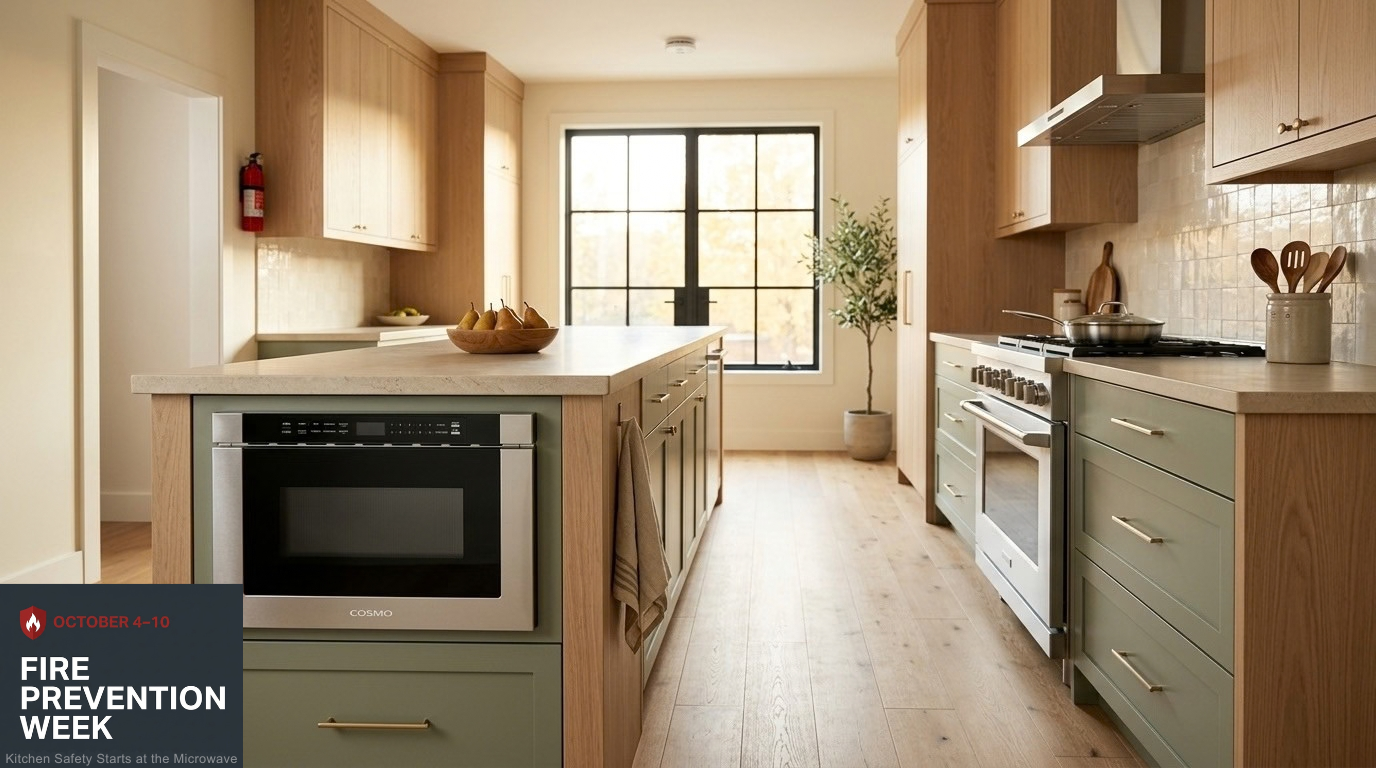
Cosmo’s COS-12MWDSS is a 24 inch built in microwave drawer designed for installation beneath the counter in standard kitchen cabinetry. Instead of a door that swings open at eye level, the drawer slides outward and the cavity faces upward, so food is lowered in and lifted out from above. The touch control panel runs along the top edge of the drawer at counter height, and Cosmo notes that this layout makes drawer microwaves accessible to a wider range of users than countertop models on high surfaces or over the range models. That design lines up closely with the safe height principle. A hot dish comes out at about waist level and goes straight onto the counter, with no reaching overhead and no stretching across a cooktop. The 1.2 cubic foot cavity runs on 1000 watts with 11 power levels, so delicate tasks like softening butter or melting chocolate can happen at lower power instead of a full blast that risks scorching. Four automatic presets for melt, soften, popcorn, and beverage take some of the guesswork out of common jobs, and weight and time defrost options work with an included defrosting rack.
The child lock carries extra weight in a drawer. Because the unit sits lower, it is within easier reach of small hands, and when the lock is engaged it disables the control panel so the drawer cannot start a cooking cycle. In homes with young children, keeping the lock on by default is a simple habit worth building.
It is worth being clear about what a drawer does not change. The COS-12MWDSS is not fire suppression equipment, and it does not ventilate the cooktop, so a range hood still has its own job to do. The drawer requires a 24 inch base cabinet cutout, a dedicated 120V outlet inside the cabinet, which fits NFPA’s advice against extension cords, and proper clearance so heat does not build up in the enclosed space. Follow the installation guide or work with a qualified installer.
Charge Devices Away From Heat, Including the Microwave
Back to this year’s theme. In many kitchens, a countertop microwave doubles as a shelf, and phones or tablets end up charging on top of it, right where warm air escapes during use. NFPA warns that lithium ion batteries can overheat, catch fire, or explode when they are damaged or charged incorrectly, and heat from nearby appliances only adds to that risk. Moving the microwave into a drawer clears counter space that can become a dedicated charging spot, away from the range, the toaster, and the sink.
- Keep chargers off appliances. Do not charge devices on top of a microwave, toaster oven, or refrigerator, or anywhere warm air vents during use.
- Use the right equipment. Charge with the cable and adapter supplied by the manufacturer, or a replacement the manufacturer approves. Replace any cord that is frayed, kinked, or damaged.
- Pick a hard, open surface. A clear section of counter or a table with air around it lets heat escape. Avoid charging under towels, inside a closed drawer, or on soft surfaces.
- Unplug once it is full. Avoid leaving devices charging overnight or while no one is home, and unplug them once they reach a full charge.
- Know the warning signs. Stop using a battery that feels unusually hot, swells, leaks, hisses, or gives off an odd smell. If it is smoking or burning, move away, alert others, and call emergency services from a safe location.
If a Fire Starts Inside the Microwave
If food catches fire inside the microwave, keep the door or drawer closed, turn the unit off, and unplug it if you can do so safely. Keeping it closed starves the flames of oxygen, while opening it too soon can feed them. Leave it closed until the fire is completely out, and have the unit serviced before using it again. If the fire does not go out promptly or spreads beyond the microwave, get everyone outside, close the door behind you, and call 911 from outside the home.
Smoke alarms are the backup to every plan. Install them on every level of the home, inside each bedroom, and outside each sleeping area, test them monthly, and walk through an escape plan with everyone in the household.
Small Habits, a Safer Kitchen
Fire Prevention Week wraps up on Saturday, but the habits it encourages are built for every day of the year. Use microwave safe containers, keep metal out, stay nearby while food heats, open dishes slowly, charge devices away from heat, and know what to do if something goes wrong. None of these steps take long.
For households planning a kitchen update this fall, the COS-12MWDSS brings 1000 watts of power, 11 power levels, four automatic presets, and a child lock into a 24 inch drawer that keeps hot food at a comfortable, reachable height. Choose a placement that works for everyone at home, install it according to Cosmo’s guidance, and keep the most convenient appliance in the kitchen one of the safest to use.