
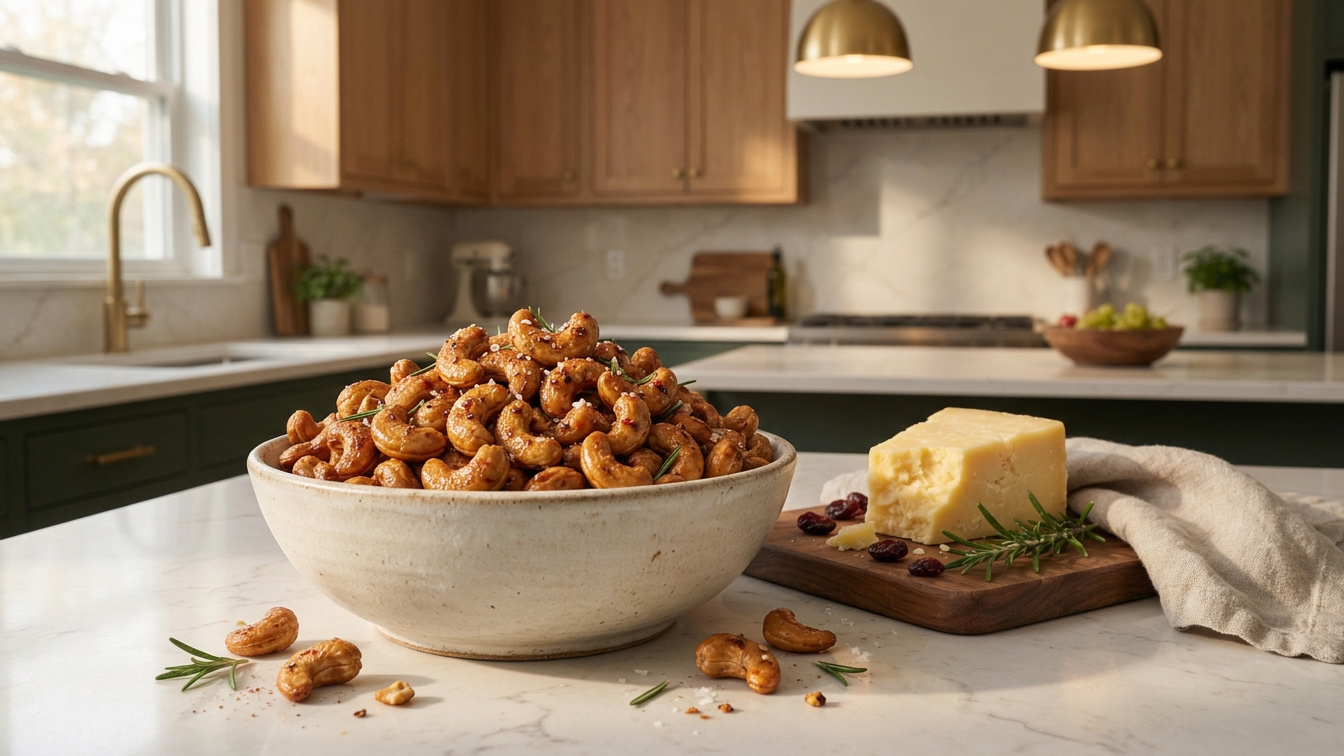
National Cashew Day: Spiced Roasted Cashews, the Make Ahead Appetizer That Keeps Guests Out of the Kitchen
Every cashew in a snack bowl has already survived a journey most people never think about. Before it was salted, roasted, or set out beside a cheese board, it hung from a tropical tree inside a shell filled with caustic oil, and it took careful handling to reach a kitchen at all. National Cashew Day, observed every November 23, is a good reason to appreciate the work behind a handful of nuts. This year the date lands three days before Thanksgiving, when a bowl of something warm, crunchy, and fragrant is exactly what a host needs.
A Seed Dressed as a Nut
The cashew is not quite what it appears to be. It grows on a tropical evergreen tree, and each one hangs below a pear shaped fruit called the cashew apple. The edible part is a kidney shaped seed that sits outside the fruit, not inside it, protected by a hard shell. Botanists classify it as a seed, although it is treated as a tree nut in the kitchen and on the allergen label.
That shell is the reason cashews are never sold whole in the husk. Inside it sits an oily liquid made of irritating compounds related to the urushiol found in poison ivy, and the cashew tree belongs to the same plant family as poison ivy and mango. Handling the shell without protection can irritate or burn skin, and eating the kernel untreated would be unsafe. Processors steam or roast the nuts to break down the oil, then shell, peel, dry, and grade the kernels. That explains a detail that surprises many shoppers: even cashews labeled raw have been heat treated. The label means nothing has been added, not that the nut has never met heat.
Why Roast Them Again at Home
If the nut has already been heated, why roast it a second time? Because flavor lives in the details. A gentle second roast dries the surface, deepens the toasted notes, and gives the cook control over salt and seasoning that a factory blend cannot match. It also fills the house with the smell of toasting nuts, which is a form of hospitality all its own.
Temperature is the whole secret. Cashews are dense and rich in natural oil, so they move from golden to bitter faster than most people expect. Many cooks settle on 325 degrees Fahrenheit for roughly 15 to 20 minutes, because that heat browns the surface and dries the center at the same pace. Higher temperatures toast the outside before the inside has dried, leaving burnt spots and a chewy bite. Low and steady is the rule.
The Appetizer That Solves a Thanksgiving Problem
Anyone who has hosted Thanksgiving knows the hour before dinner. Guests arrive early, drift toward the kitchen, and the cook is suddenly steering around a crowd of well meaning people while the gravy needs attention. The classic fix is something to eat, placed somewhere other than the kitchen. A bowl of spiced cashews on a living room table gives guests a reason to settle in, and it asks nothing of the cook on the day itself.
That last point makes them a smart choice for this particular week. Roasted nuts keep well, so they can be made on Monday or Tuesday, cooled, and stored in a sealed container until Thursday. They need no refrigerator space and no oven time on the one day when the oven is spoken for. Make two batches, and the second becomes a hostess gift or a thank you for the neighbor who lent the folding chairs.
Spiced Maple Cashews
This recipe makes about three cups, enough for a large bowl with some left to give away.
- 3 cups whole unsalted cashews
- 2 tablespoons olive oil or melted butter
- 2 tablespoons pure maple syrup
- 1 teaspoon fine sea salt
- 1 teaspoon smoked paprika
- Half a teaspoon ground cinnamon
- A quarter teaspoon cayenne pepper, or to taste
- 1 tablespoon finely chopped fresh rosemary
Heat the oven to 325 degrees Fahrenheit and line a rimmed baking sheet with parchment paper. In a large bowl, whisk the oil, maple syrup, salt, paprika, cinnamon, and cayenne together, then add the cashews and stir until every nut is coated. Spread them in a single layer on the sheet, leaving a little room between pieces so hot air can reach each one.
Roast for about 12 minutes, then stir and rotate the pan. Return it to the oven for another 6 to 10 minutes, watching closely near the end. Maple syrup adds sugar, and sugar browns quickly, so the nuts are finished when they turn a deep golden color and smell toasted, not when they feel fully crisp. They firm up as they cool. Scatter the rosemary over the hot nuts, toss once, and let them cool completely on the pan before moving them to a container. Breaking up any clumps once they are cool keeps them from sticking together.
What a Good Oven Adds
Nuts are among the least forgiving things to roast. They are small, they are oily, and the difference between perfectly toasted and scorched can be a minute or two. An oven that holds a steady temperature and heats evenly matters more here than it does for most recipes.
Cosmo’s COS-30ESWC is a 30 inch single electric wall oven with a 5 cubic foot cavity, and its design suits this kind of job. Turbo True European Convection uses a fan assisted circular heating element to move heated air around the cavity, which reduces the hot spots that leave one corner of a sheet pan darker than the rest. Convection also tends to cook faster, so many cooks lower the temperature by about 25 degrees, to 300 for this recipe, and begin checking a few minutes early. The oven offers seven cooking functions, including Convection Bake, and the soft touch digital display makes it easy to set the exact mode.
Visibility helps as well. Opening the door to check on nuts releases heat and disrupts the roast, and the generous window and interior light let a cook watch the color change without losing temperature. Two racks with six position settings make it simple to place the pan on the center rack, where air circulates most evenly. After a glaze of oil and maple syrup, the hidden bake element leaves a smooth oven floor that wipes clean, and the blue porcelain interior against the brushed stainless steel exterior looks as good as it performs. The built in temperature probe is not needed for nuts, but it earns its keep three days later, when the same oven turns to the turkey.
Serving, Storing, and Gifting
Warm or at room temperature, spiced cashews work in more places than a bowl. Chopped, they add crunch to a green bean dish or a roasted squash salad, and a few whole nuts on a cheese board pair well with sharp cheddar, soft brie, and dried cranberries. A spoonful crushed over a bowl of soup finishes it nicely.
Stored in an airtight jar at room temperature, they stay crisp for about a week, so a Monday batch is still at its best on Thursday. Packed in small jars with a ribbon and a handwritten label, they make an easy gift for the people who help carry the day.
One responsibility comes with serving any nut at a gathering. Cashews are a tree nut, and nut allergies can be serious, so place a small card beside the bowl that says what is in it, and keep the nuts and their serving spoon apart from the other dishes. Guests with allergies will notice and appreciate it.
The Bottom Line
National Cashew Day asks very little: one pan, a few spices, and about half an hour. It returns something useful at the busiest moment of the cooking calendar. A seed that hangs outside its fruit and reaches the kitchen only after careful processing deserves a little ceremony. Roast a batch on Monday, set a bowl where guests will gather on Thursday, and the kitchen stays calm for the person who needs it most.