
Quiet Enough to Stay Open: Why Kitchen Noise Is Reshaping the Open-Concept Floor Plan
Open-concept living defined American home design for the better part of two decades. Knock down the wall between the kitchen and the living room, and suddenly a house feels bigger, brighter, more social, more resellable. That logic held for a long time, and it is still true in a lot of ways. But a quieter shift has been building underneath it, one that has less to do with square footage and more to do with sound. Homeowners who fought to open up their floor plans are now, in growing numbers, asking how to close parts of them back down, and the reason showing up again and again in surveys and design coverage is not clutter or cooking smells, though those matter too. It is noise. A kitchen with no walls around it shares every sound it makes with every other room attached to it, and for a growing number of households, that has become the actual cost of an open floor plan rather than a minor tradeoff.
The Open Floor Plan Is Getting Reconsidered
Design coverage throughout 2026 has repeatedly pointed to the same pattern: a move away from fully open layouts and toward what designers are calling “broken-plan” living, spaces with soft boundaries, partial walls, sliding panels, or strategically placed cabinetry that let a home flex between fully open and meaningfully separated depending on what is happening in it. The reasoning behind the shift is consistent across the coverage. Hybrid work has put more people in the house during the day, often on calls or trying to concentrate in a room that used to be empty until dinner. Blenders, clanging pans, delivery drop-offs, running dishwashers, all of it now competes directly with a work call happening twenty feet away with nothing but air between the two spaces. As one recent piece on the trend put it plainly, open layouts share everything, and sound has turned out to be the thing households are least willing to keep sharing.
This is not a wholesale rejection of open concept. Few homeowners are rebuilding walls that took a contractor a week to remove. What is actually happening is more targeted: a kitchen island might stay open to the dining area but gain a pocket door to the living room, or a working pantry might get walled off specifically to contain the noisiest parts of meal prep and cleanup. The goal is flexibility, an “open mode” for entertaining and an ability to close things down for daily life, rather than a full return to the closed-off kitchens of a previous generation. And within that shift, the appliances that run loudest and longest, especially the dishwasher, have become one of the more specific things homeowners are trying to solve for.
Why the Dishwasher Is the Noise Problem Nobody Planned For
Of everything running in a kitchen, the dishwasher has a specific problem the others do not: duration. A blender runs for thirty seconds. A stand mixer runs for a few minutes. A dishwasher runs for one to three hours, often starting right after dinner and running well into the part of the evening when a household is trying to wind down, watch something, or put kids to bed in a room that, in an open floor plan, is acoustically connected to the kitchen in a way it never used to be. In a fully enclosed kitchen from a generation ago, that noise was contained behind a door. In an open-concept home, it is background noise for the entire downstairs, for as long as the cycle runs.
This is exactly why decibel rating has become a real, researched purchase criterion for dishwashers in a way it rarely was a decade ago, when a dishwasher’s noise level was an afterthought behind price and capacity. The rule of thumb that has emerged among appliance reviewers in 2026 is that anything at or under roughly 44 decibels counts as genuinely quiet for a modern home, quiet enough to run during a dinner party without anyone noticing, while the 45 to 50 decibel range still reads as soft background noise, closer to a quiet conversation than a disruption, noticeable if a room goes silent but not loud enough to compete with a television or a conversation at the table. The difference between a 37 decibel dishwasher and a 45 decibel one, in practical terms, is smaller than the marketing around it suggests. Both disappear once you leave the room. What actually matters is clearing that rough 45 decibel threshold in the first place, the point at which a dishwasher stops being a disruption and starts being something a household simply stops noticing.
Where the COS-DIS6502 Fits
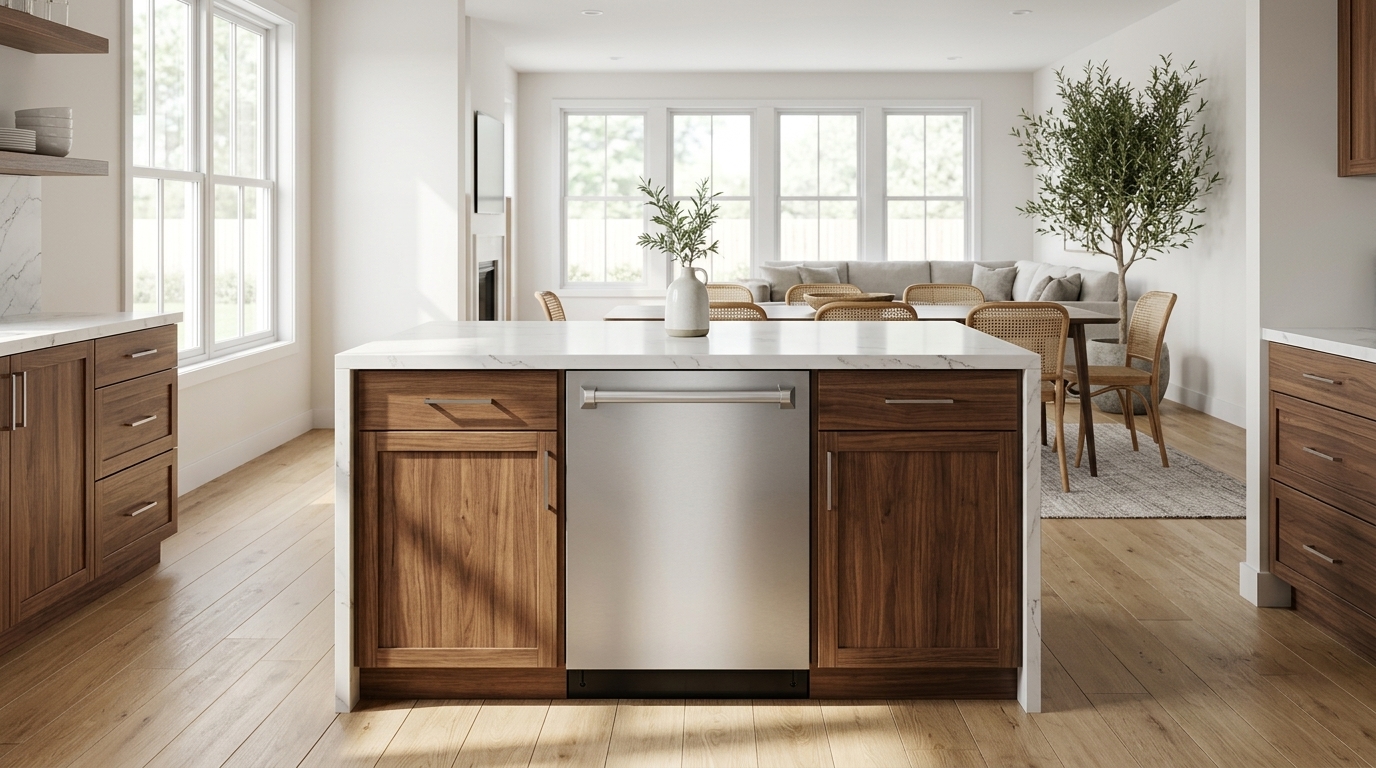
Cosmo’s COS-DIS6502, a 24-inch built-in dishwasher with a tall tub design, was engineered around exactly that threshold. It runs at 45 decibels, roughly the sound of light rain against a window, a level made possible by pre-installed noise-insulating pads built into the unit rather than added as an aftermarket fix. In an open kitchen sharing space with a living room or a dining area, that is the difference between a dishwasher a household plans meals and conversations around and one that simply runs in the background while the rest of the house goes about its evening.
The noise engineering is not the only thing doing that work. The COS-DIS6502’s hidden top control panel keeps the interface concealed when the door is closed, which matters for an open kitchen in the same way the sound insulation does: a visible, blinking control panel facing into a living room reads as noise even when the unit itself is silent, while a flush, controls-hidden door front disappears into the cabinetry the same way the sound does. Inside, a Smart Wash System automatically detects a partial or full load and adjusts the cycle accordingly, which means the dishwasher is not running a longer, louder cycle than a given load actually requires. Three racks, including a top rack with two inches of height adjustment and a dedicated silverware basket, give a household enough flexibility to run fewer, fuller cycles rather than multiple partial ones, which is its own quiet advantage: the single most effective way to reduce how much dishwasher noise a household hears over the course of a week is running the appliance less often in the first place. NSF/ANSI 184 certified sanitize technology and a rapid heated dry function round out the performance side, and an Energy Star rating keeps the unit’s roughly 249 kWh annual consumption in line with a household also trying to manage utility costs, not just sound.
What a Quiet Dishwasher Actually Solves For
For a household still living with a fully open floor plan and no near-term plans to add walls back, appliance noise is one of the few remaining levers left to pull. Layout changes are expensive and disruptive. A quieter dishwasher is neither. It is a straightforward, one-time fix for the specific noise source that runs longest and latest in a typical evening, at exactly the hours a household is trying to relax, work, or put kids down without a two-hour hum running underneath everything else happening in the house.
This matters most for a few specific situations that have become increasingly common. Households with someone working from home during the day, where a dishwasher running after a late lunch or an early dinner prep session can bleed directly into a work call happening in an adjoining space with no wall to stop it. Homes with a nursery or a young child’s bedroom near an open kitchen and living area, where evening dishwasher cycles risk interfering with a bedtime routine happening on the other side of what is functionally an open room. And households that entertain regularly in a kitchen-adjacent living space, where a loud dishwasher running through a dinner party is the kind of small, constant background noise that guests notice even if they never mention it.
Other Ways Households Are Managing Kitchen Noise
A quiet dishwasher is rarely the only change a household makes when noise becomes a real complaint about an open floor plan, and it is worth understanding where it fits alongside the other adjustments homeowners are making in 2026.
Running the dishwasher on a delayed start is one of the simplest fixes, and it is also one of the least expensive, since it requires no purchase at all beyond a feature most modern dishwashers, including the COS-DIS6502, already include. Setting a cycle to start after a household has gone to bed removes the noise question entirely for anyone sensitive to it during waking hours, at the cost of dishes not being available again until morning.
Soft-close cabinetry and drawers throughout the kitchen address a different, smaller category of noise, the sharp, sudden sounds of a cabinet door or drawer slamming shut, which register very differently to the ear than the steady hum of a running appliance even at a similar volume. Pairing a quiet dishwasher with soft-close hardware elsewhere in the kitchen tends to produce a noticeably calmer overall sound profile than either change alone.
Zoned layouts, the broken-plan approach that has become one of the defining kitchen design conversations of 2026, address noise at the architectural level rather than the appliance level: a sliding door, a partial wall, or a walk-in pantry positioned specifically to contain the loudest parts of meal prep and cleanup. This is a more expensive and disruptive fix than swapping an appliance, which is exactly why most households reach for a quieter dishwasher first and consider a layout change only if noise remains a persistent complaint afterward.
Rug and soft-furnishing placement in the adjoining living space is a smaller, often overlooked lever. Hard flooring that runs continuously from an open kitchen into a living room reflects sound rather than absorbing it, which can make even a genuinely quiet appliance feel more present in the room than its decibel rating alone would suggest. A rug, upholstered furniture, or curtains near the boundary between the two spaces absorb some of that reflected sound and soften the practical experience of a kitchen running nearby.
A Practical Middle Ground
The broader lesson in the shift away from fully open floor plans is that homeowners are not actually rejecting openness itself. What they are rejecting is the assumption that an open kitchen has to mean an acoustically open kitchen, one where every appliance, conversation, and chore is audible from every room attached to it. A quiet dishwasher is a small piece of that larger correction, but it is one of the more direct ones: it does not require a contractor, a permit, or a renovation, and it solves for the exact noise source most likely to run during the hours a household actually wants quiet.
For anyone weighing whether to keep a fully open floor plan or start walling parts of it back off, a dishwasher that clears the 45 decibel threshold, hides its controls behind a closed door, and runs fewer, smarter cycles is a genuinely useful piece of that decision. The COS-DIS6502 was built around that exact problem: a kitchen that stays open, without asking the rest of the house to listen to it work.