
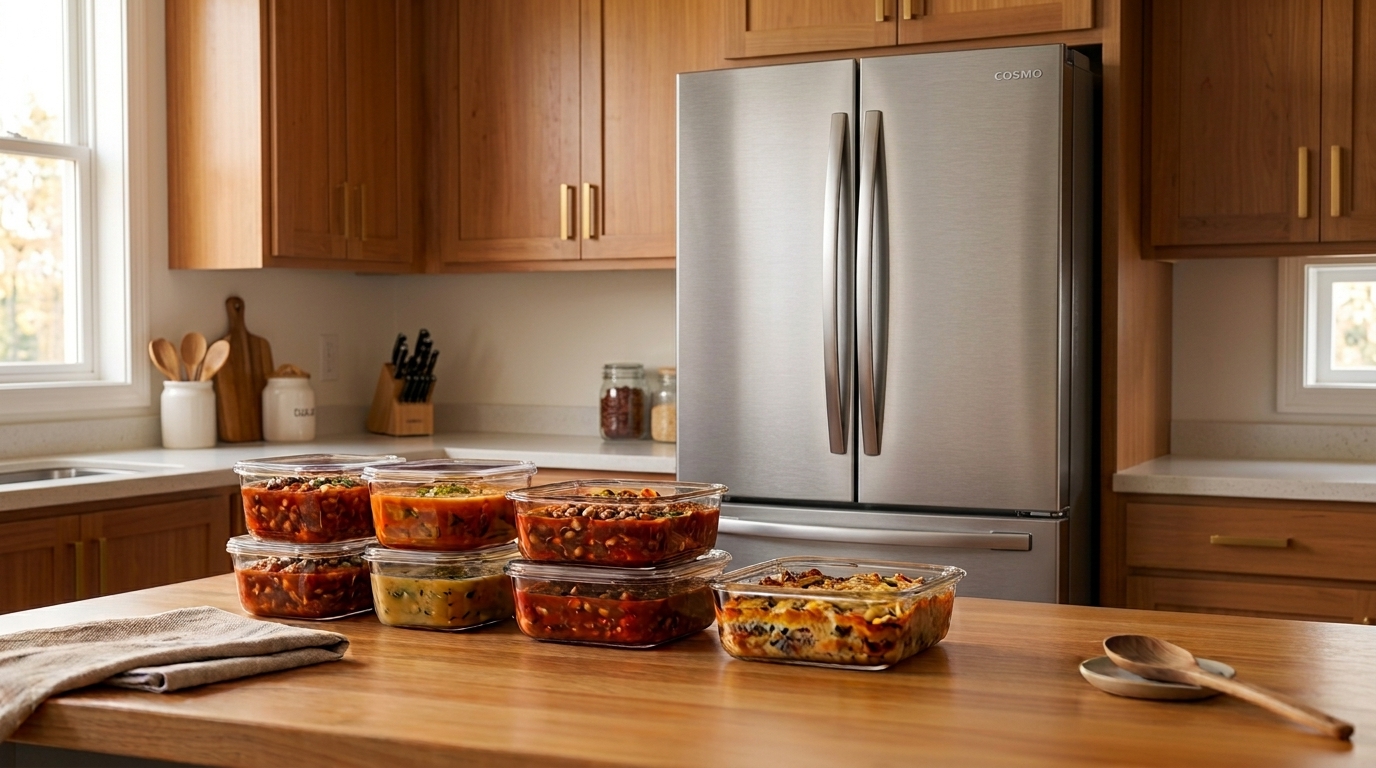
The Freezer Is the New Meal Plan
For years, the freezer was where a kitchen kept its emergency supplies: a bag of vegetables nobody quite remembered buying, a tub of ice cream, maybe a forgotten casserole from a holiday gathering months earlier. That reputation is changing fast, and August, right as school buses start running again and weeknight schedules get considerably less forgiving, is when the shift becomes most visible in American kitchens. Families who spent the summer eating on a looser, more improvised schedule are now facing five weeknights a week that need a real dinner on the table by 6:30, often squeezed between practices, homework, and everything else that comes back into rotation once the school year starts. The response, increasingly, is not more takeout. It is batch cooking, and a freezer that is finally being asked to do the job it was actually built for.
The Data Behind the Shift
This is not just a seasonal impression; the numbers back it up. According to the Food Industry Association’s most recent Power of Frozen research, 40 percent of American shoppers now eat frozen foods several times a week or more, up from 35 percent in 2019, and 77 percent of consumers say they now purchase frozen items with a specific meal already in mind, compared to 71 percent just two years prior. That is a meaningful shift in how the freezer functions in a household. It has moved from a backup plan to a planning tool, a place where a family stores decisions they have already made rather than a place they raid out of desperation on a Tuesday night.
The back-to-school season sharpens this trend considerably. Recent reporting on parent food habits found that three in four parents say they are paying closer attention to what goes into their family’s food as the school year ramps up, a shift that tracks closely with the return of packed lunches, earlier dinners, and the kind of scheduling pressure that makes ordering delivery feel like the easier option four nights out of five. Batch cooking offers a way to keep that closer attention to ingredients without adding to an already stretched schedule, because the effort gets concentrated into one or two sessions rather than spread across every single weeknight.
Why Batch Cooking Actually Works
The appeal of batch cooking is straightforward once the schedule pressure of a school year sets in. Cooking a large pot of chili, a tray of enchiladas, or a batch of soup takes roughly the same amount of active effort whether it makes four servings or sixteen. The chopping, seasoning, and cleanup do not scale up nearly as fast as the yield does, which means an hour and a half in the kitchen on a Sunday afternoon can realistically cover three or four weeknight dinners without anyone touching a cutting board again until the following weekend.
This works especially well for the kind of meals that improve, rather than suffer, from a few days of rest. Braises, stews, casseroles, and sauces almost always taste better on day two or three, once the flavors have had time to settle, which means batch cooking is not really a compromise on quality. In a lot of cases, it produces a genuinely better dinner than cooking the same dish fresh on a rushed Wednesday night would.
The other half of the equation is portioning. A large batch cooked once is only as useful as a family’s ability to divide it, freeze it in usable amounts, and actually find it again three weeks later. This is where a lot of home batch cooking quietly falls apart, not because the cooking itself failed, but because the freezer storing it was never organized in a way that made the food easy to retrieve, identify, and thaw without turning dinner into an archaeology project.
The Freezer’s New Job Description
A freezer asked to support a real batch cooking rotation is being asked to do something considerably more demanding than storing a few bags of frozen vegetables and a tub of ice cream. It needs enough usable capacity to hold several weeks of meals at once without everything becoming an unlabeled block of ice fused to the sides of a single overcrowded drawer. It needs a layout that lets a family actually see and separate what they have, rather than digging through a chest freezer one frozen bag at a time. And it needs consistent, reliable cold, because a freezer that fluctuates even slightly degrades texture over time in exactly the dishes batch cooking depends on most: sauces separate, breads and baked goods dry out, and casseroles develop the kind of freezer burn that turns a good meal into a disappointing one.
This is a genuinely different demand than what most refrigerator-freezer combinations were designed around a decade or two ago, when the freezer was treated as a secondary compartment rather than a working part of the weekly meal plan. Families leaning into batch cooking are running their freezers the way a small restaurant might run a walk-in, cycling meals in and out on a rolling basis, which means organization and capacity matter just as much as raw cold.
The Cosmo COS-FDR225RHSS, a 22.5 cu. ft. four-door French door refrigerator was built with exactly this kind of rotation in mind. Its 6.6 cu. ft. freezer section is split across two slide-out drawers rather than a single deep bin, which makes a real difference for a household storing several distinct batch-cooked meals at once, since each drawer can be organized separately instead of everything competing for space in one undivided compartment. Easy-to-reach digital touch controls let the freezer temperature be set and monitored precisely, which matters more than it sounds like it should when the goal is protecting the texture of a sauce or a casserole through weeks of storage rather than days. A soft-close mechanism keeps drawers sealing fully even during a hurried weeknight retrieval, and a door alarm that alerts if a door has been left open catches the kind of small mistake, a freezer drawer not quite latched shut after a rushed dinner scramble, that can otherwise cost an entire batch of food overnight. The 15.9 cu. ft. fridge compartment above it, with four adjustable glass shelves, gives a household room to thaw the next meal in the rotation on a lower shelf while the current week’s groceries occupy the rest, which is often the missing link in a batch cooking routine that otherwise runs smoothly.
Building a Rotation That Actually Sticks
Families who make batch cooking a durable habit, rather than a few enthusiastic weekends that fade out by October, tend to follow a few consistent patterns.
Picking two or three dishes per session, rather than one enormous pot of a single meal, keeps the week from feeling repetitive by Thursday. A chili, a tray of baked pasta, and a batch of soup cooked in the same afternoon cover considerably more ground than three pots of the same chili would, and the active cooking time is not meaningfully different.
Portioning immediately after cooking, rather than freezing one large container to be divided later, makes a real difference in how usable the food actually is on a weeknight. A single-serving or family-sized container that can go straight from freezer to oven or microwave removes the extra step of hacking a frozen block apart with a butter knife on a Tuesday when nobody has the patience for it.
Labeling both the contents and the date sounds obvious, but it is the single most common point of failure in a home freezer rotation. A freezer organized around blank, unlabeled containers stops functioning as a planning tool and reverts back to the guessing game it used to be.
Rotating stock on a first-in, first-out basis, the way a grocery store manages its shelves, keeps older meals from getting pushed to the back and forgotten. Placing new batches behind existing ones rather than in front keeps the oldest meal always within easy reach.
Building in a defrost buffer, moving the next night’s meal from the freezer to the refrigerator the evening before, avoids the last-minute scramble of trying to thaw a solid block of frozen stew twenty minutes before dinner needs to be on the table.
What Belongs in the Rotation
Not every dish freezes and reheats equally well, and part of building a rotation that survives the whole school year is learning which meals actually hold up. Braised and stewed dishes, chili, pot roast, curries, and bean-based soups, are among the most forgiving, since the slow cooking process that makes them good in the first place also makes them stable through freezing and reheating. Baked pasta dishes, lasagna in particular, freeze well either fully assembled and uncooked or baked and portioned afterward, giving a household flexibility depending on how much time is available on the night it gets pulled back out. Marinated, uncooked proteins, chicken thighs sitting in a marinade, ground beef already seasoned for tacos, are another underused category, since freezing the ingredients rather than the finished dish keeps a weeknight meal feeling fresh while still saving the prep work that usually eats up the most time.
A few categories are worth freezing selectively rather than by default. Anything built around a cream-based sauce tends to separate and turn grainy after thawing, though it can often be revived with a bit of extra stirring and gentle reheat rather than high, direct heat. Fried foods lose their texture almost entirely in the freezer and are usually better made fresh, even on a busy night, than reheated from frozen. Rice and pasta, on their own, freeze passably but hold up noticeably better when cooked fresh alongside a reheated sauce or protein rather than frozen as a complete dish.
A Trend With Staying Power
What separates this shift from a passing pandemic-era habit is how deliberately it is being adopted rather than fallen into out of necessity. The data on frozen food purchasing shows people actively planning meals around the freezer rather than treating it as a last resort, and the motivations behind that shift, cost control, reduced food waste, and a genuine desire to know what is going into a family’s meals, are the kind of practical concerns that tend to stick around well past a single school year.
For households heading into a new school year with a freezer that has spent the summer holding little more than popsicles and the occasional bag of frozen fruit, this is a natural moment to reconsider whether that freezer is actually built for the job it is about to be asked to do. A rotation of a dozen or more portioned meals, cycling in and out on a weekly basis, needs more than raw space. It needs organization, reliable temperature control, and a layout that makes the food easy to find again on a Wednesday night when nobody in the house has the bandwidth to search for it. For families ready to make the Sunday batch cooking session a permanent fixture rather than a September experiment, a refrigerator built around that kind of rotation, like the Cosmo COS-FDR225RHSS, can be the difference between a freezer that quietly supports the week and one that becomes just another thing to manage on top of it.