
Raising a Glass: What National Red Wine Day Is Really Celebrating
Every August 28th, red wine gets a day of its own on the food and beverage calendar. National Red Wine Day does not carry the pomp of a harvest festival or the marketing weight of a major spirits holiday, but it has quietly become one of the more genuine observances on the list, precisely because it does not ask anyone to do anything they were not already inclined to do. Pour a glass, let it breathe for a few minutes, and take a little more notice of what is actually in it than a Tuesday evening usually allows. That is really the whole holiday, and its simplicity is part of the appeal.
Red wine’s story stretches back further than almost any other beverage humans still drink today. Archaeological evidence places winemaking in the region of modern-day Georgia and Armenia as far back as 6,000 BCE, and from there the practice spread through Mesopotamia, Egypt, and eventually the Mediterranean basin, where Greek and Roman cultures elevated wine from a fermented staple into something bound up with hospitality, ritual, and status. By the time European settlers brought vines to the Americas, wine already carried thousands of years of cultural weight behind it.
The United States took its own path into wine culture more slowly than Europe did, shaped by Prohibition, shifting agricultural policy, and a domestic industry that had to rebuild itself almost from scratch through much of the twentieth century. California’s emergence as a serious wine region in the 1970s changed that trajectory permanently, and American red wine, from Napa cabernets to Oregon pinot noirs to increasingly respected bottles out of Washington, Texas, and Virginia, has spent the decades since building a reputation that now holds its own on any world stage. National Red Wine Day, observed each year on August 28th, is a relatively modern addition to the food holiday calendar, but it sits on top of that much older tradition, giving Americans a specific date to acknowledge a beverage that has been part of daily life, celebration, and quiet routine for centuries.
Why Red, Specifically
Red wine gets its color, and a good deal of its character, from something white wine skips entirely: extended contact with grape skins during fermentation. That contact pulls tannins and anthocyanins into the wine, the compounds responsible for both its color and much of its structure, the dry, slightly gripping sensation on the palate that distinguishes a robust cabernet from a lighter pinot noir. Those same compounds are also why red wine tends to reward patience in a way white wine often does not. A young red can taste tight and sharp-edged, while the same bottle given a few years, or even a few hours of proper decanting, can open into something considerably rounder and more complex.
This is also where red wine diverges from white in a more practical sense: how it should be stored and served. Red wine is generally served warmer than white, typically in the 60 to 68 degree Fahrenheit range depending on the variety, a lighter-bodied pinot noir sitting toward the cooler end and a full-bodied cabernet or syrah toward the warmer end. That is a narrower and more specific window than most people assume, and it is considerably warmer than a standard refrigerator, which runs cold enough to mute a red wine’s aromatics and flavor almost entirely. It is also cooler than most American homes tend to run, particularly in the stretch of the calendar when National Red Wine Day actually falls, which means a bottle left on a counter or a kitchen shelf through most of the summer is very likely being served several degrees warmer than it should be.
The Storage Problem Nobody Notices Until It Matters
Households that drink wine occasionally rarely think much about how it is stored, and for a bottle or two consumed within a week of purchase, it genuinely does not matter that much. The picture changes for anyone who has started keeping a small collection on hand, whether that is a handful of reds set aside for the holidays or a rotating stock replenished every time a favorite bottle goes on sale. Temperature swings, light exposure, and the vibration of a kitchen refrigerator’s compressor cycling on and off all work against a red wine sitting in storage for weeks or months rather than days, and the effects tend to show up quietly, a bottle that tastes slightly flatter or less balanced than it should, rather than announcing themselves obviously.
This is part of why a dedicated wine cooler has moved from a specialty item to a fairly common kitchen fixture over the past several years, and it is worth understanding what actually separates a purpose-built cooler from simply finding room in the refrigerator. A cooler built for wine, rather than food, holds a steady temperature within the range red and white wine actually want, avoids the light exposure a standard refrigerator door does nothing to prevent, and gives a collection room to sit undisturbed rather than getting shuffled around every time someone reaches past it for milk or leftovers.
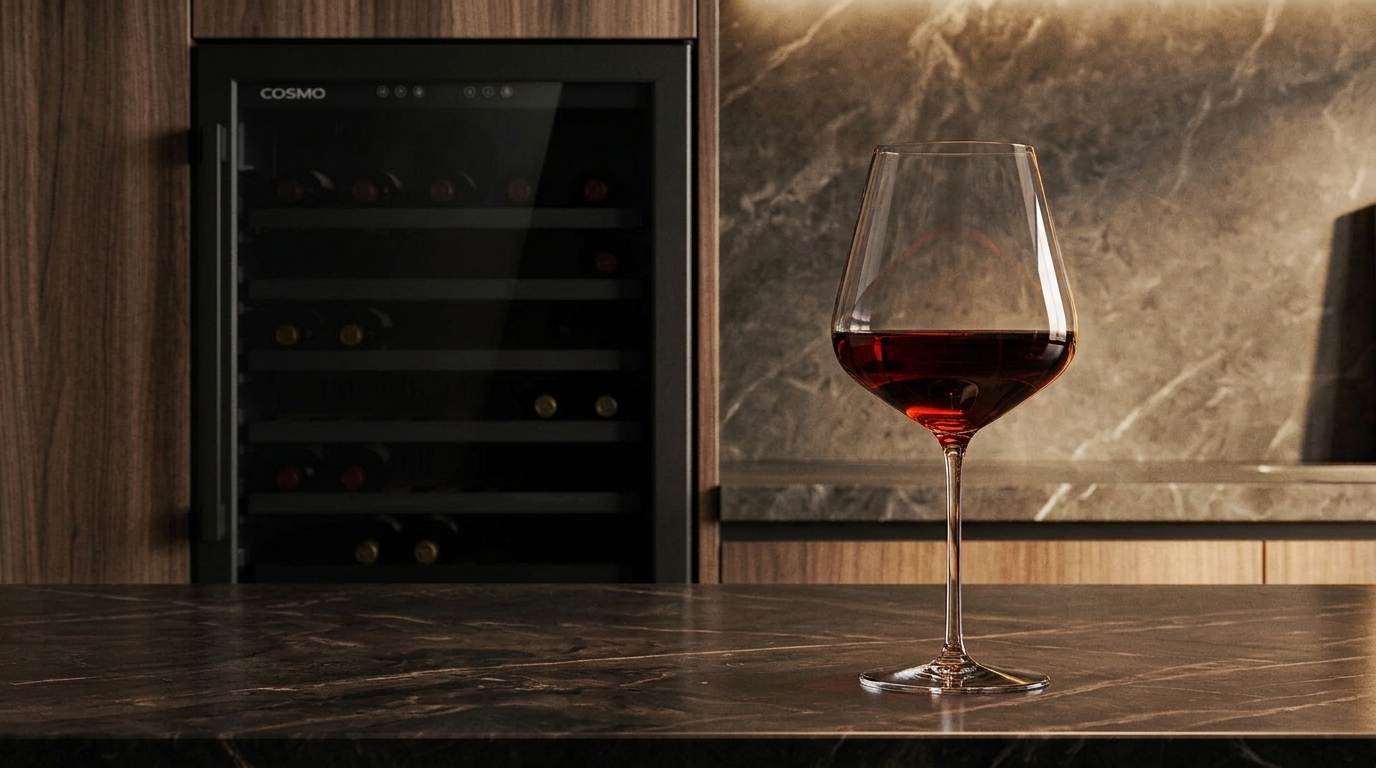
Cosmo’s COS-24BIWCS-BK, a 24-inch built-in wine cooler finished in matte black from the brand’s Lumin Collection, is built around exactly that need. It holds up to 52 bottles across a 145-liter interior, with a single-zone compressor system and advanced fan cooling that keeps temperature steady between 41 and 68 degrees Fahrenheit, comfortably spanning the range most reds are meant to be served in. A three-layer insulated glass door with a hidden hinge mechanism blocks the UV exposure that damages wine over time, while six beechwood shelves on telescopic sliding rails let a bottle be pulled fully out for a closer look without disturbing the rest of the collection sitting behind it. The matte black finish gives it a slightly different presence than the brand’s stainless steel version of the same unit, one that tends to disappear into a darker cabinetry run or stand out as a deliberate design statement, depending on how a kitchen is put together, and it installs as a true built-in or freestanding unit depending on what a space calls for.
Marking the Day Without Overthinking It
National Red Wine Day does not require a special bottle or an elaborate tasting setup to be worth acknowledging. For most households, the simplest version of the holiday is also the most satisfying one: pull a bottle that has been sitting for a little while, pour it at something closer to its intended serving temperature rather than straight from a cold refrigerator or a warm counter, and give it a few extra minutes to open up before the first sip. Pairing it with dinner is optional but rarely a mistake, a red wine’s tannins tend to soften alongside richer, fattier foods, which is part of why a glass of cabernet and a well-marbled steak have been paired together for as long as either has been common on American tables.
For anyone who finds themselves reaching for a bottle more often than they used to, or noticing that the collection on hand has quietly outgrown a spare shelf in the refrigerator, National Red Wine Day is as good an occasion as any to think a little more seriously about how that collection is being kept. A holiday built around a single glass is, in the end, also a reminder that the glass tastes better when everything leading up to it was handled with a bit of care.