
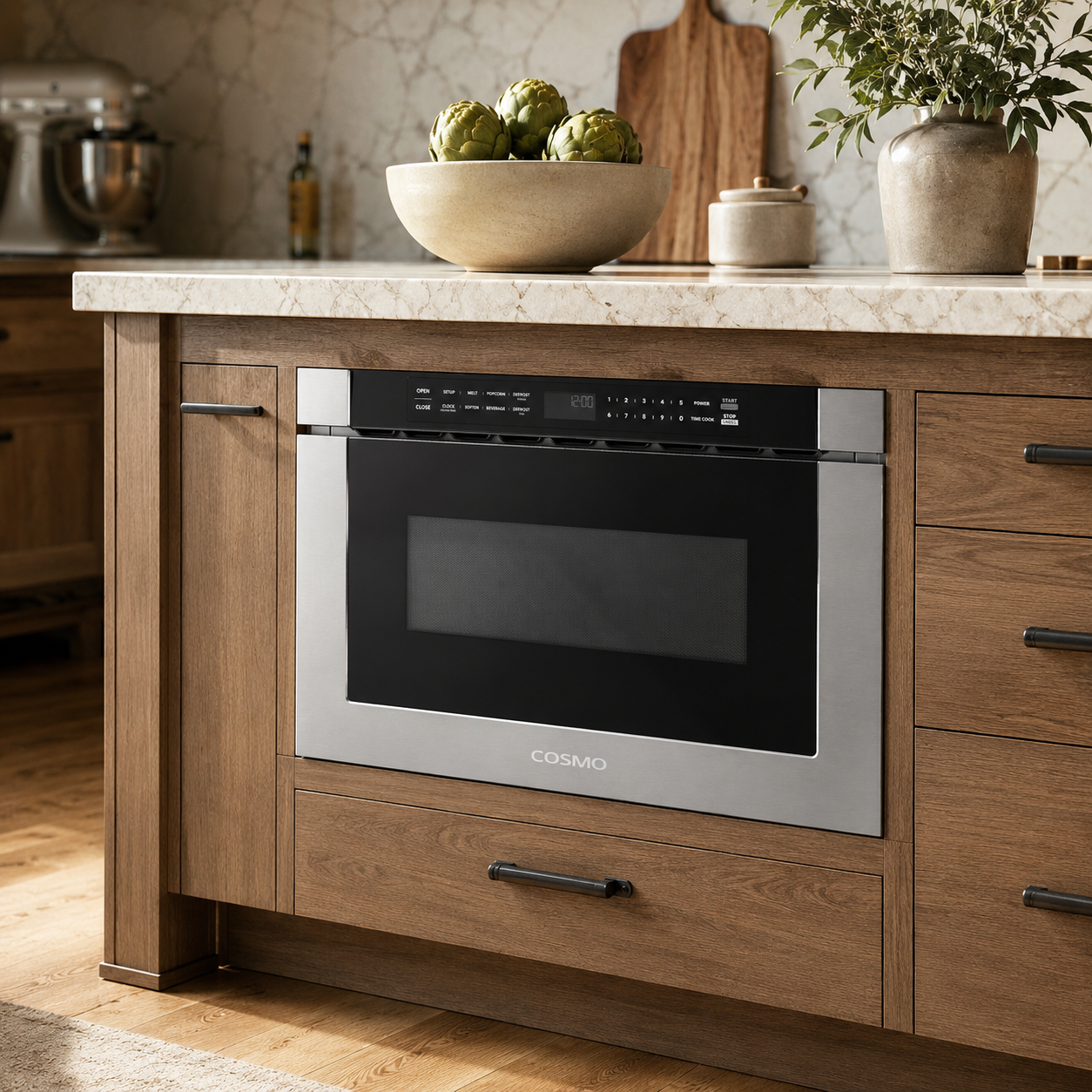
The COS-12MWDSS Microwave Drawer: 24-Inch Built-In with Touch Controls and 11 Power Levels
Countertop microwaves occupy space that most kitchens can’t afford to surrender. They sit on counter surfaces that could be used for food prep, take up real estate near outlets, and create the cluttered appearance that carefully designed kitchens spend significant effort avoiding. Over-the-range microwaves solve the counter space problem but create different ones — they position the microwave uncomfortably high, require reaching over a hot range, and make checking or stirring food genuinely awkward. The COS-12MWDSS takes a different approach entirely, integrating below the counter inside standard cabinetry where it operates as a drawer rather than a door-swing appliance.
This 24-inch microwave drawer installs into base cabinetry at counter height or slightly below, opening by sliding outward rather than swinging a door. The top-loading access that results keeps the control panel at counter level and positions the microwave cavity within easy reach without bending or overhead reaching. At 1.2 cubic feet capacity with 1000 watts of power across 11 levels, the COS-12MWDSS handles the full range of microwave tasks — reheating, defrosting, and the four automatic cooking presets for melt, soften, popcorn, and beverage — from a built-in position that preserves counter space entirely. The child lock function prevents accidental operation, and the stainless steel finish integrates with surrounding cabinetry in the same way a dishwasher or built-in oven does: cleanly and without drawing unnecessary attention.
Why Microwave Drawer Design Changes Kitchen Ergonomics
The drawer format isn’t just an aesthetic variation on standard microwave design. It addresses real ergonomic problems that both countertop and over-the-range microwaves create.
Top-Loading Access: When the drawer slides open, the microwave cavity faces upward rather than toward you. You place food in from above and retrieve it from above — the same natural motion as opening a kitchen drawer to retrieve something. This access angle is inherently more comfortable for most people than reaching into a front-loading microwave at counter height, and dramatically better than reaching up into an over-the-range unit positioned above a hot cooking surface.
Reduced Spill Risk: Retrieving hot liquids, soups, or sauces from a front-loading microwave requires pulling the container toward you horizontally, then angling it downward to set it on the counter. Hot liquids spill during this motion regularly. From a drawer microwave, you lift containers straight up from the cavity to the counter surface immediately beside it — a shorter, more controlled movement that reduces spill incidents meaningfully.
Height Flexibility: Because the drawer installs into base cabinetry, the microwave cavity sits at a height determined by cabinet configuration rather than fixed by countertop or wall placement. This makes drawer microwaves naturally accessible for a wider range of users than either countertop models positioned on high surfaces or over-the-range models that challenge shorter adults and are awkward for anyone.
Counter Space Preservation: The most direct benefit is simply that the counter stays clear. Kitchen work surfaces are finite, and every appliance that occupies counter space reduces available prep area. A built-in microwave drawer reclaims this space permanently rather than requiring temporary relocation during meal prep.
Visual Integration: Installed in cabinetry, the COS-12MWDSS becomes part of the kitchen’s built-in architecture rather than a standalone appliance competing with it. The stainless drawer front reads as cabinetry hardware rather than a separate appliance, particularly when surrounding cabinets use stainless or metallic hardware. The result is a kitchen that looks considered and intentional rather than assembled from independent pieces.
1000 Watts and 11 Power Levels
The combination of 1000-watt output and 11 discrete power levels provides the cooking range and precision that daily microwave use requires across very different food types and tasks.
1000-Watt Output: 1000 watts is the standard power output for full-size countertop microwaves — not a compromise for the drawer form factor. This output level heats food at the speeds people expect from microwaves, reheating leftovers within the same timeframes, defrosting proteins efficiently, and cooking microwave-specific preparations without extended wait times.
Why 11 Levels Matter: Many basic microwaves offer 10 power levels, with the gap between them being 10% each. The COS-12MWDSS provides 11 levels, giving you finer gradations between settings that matter most for delicate cooking tasks. The difference between level 3 and level 4 at 10-level resolution is 10% of full power. At 11-level resolution, the gradations are approximately 9% — a small difference on paper that becomes more meaningful when you’re melting chocolate or softening butter where precision at low power levels affects results noticeably.
High Power for Speed: Levels 8-11 deliver 70-100% of maximum power, handling reheating tasks where speed matters more than precision. Day-old leftovers, cold beverages, and foods that need straightforward reheating rather than careful gentle heating operate at these levels efficiently.
Mid-Range for Even Heating: Levels 4-7 cover the range where even heating without overcooking matters most. Dense foods like casseroles, stuffed items, and anything with multiple components at different temperatures benefit from mid-range power that allows heat to distribute more evenly through the food before surfaces overheat.
Low Power for Delicate Tasks: Levels 1-3 handle the tasks that separate a capable microwave from a basic one — softening butter without melting it, warming chocolate to melting point without seizing it, defrosting delicate proteins without cooking the exterior. These settings run at under 30% of full power, cycling energy on and off to maintain the gentle, controlled heating these applications require.
Four Automatic Cooking Presets
The four automatic presets cover tasks that appear in daily kitchen use often enough to justify dedicated programming, each calibrated to produce better results than manual time-and-power estimation.
Melt: The melt preset handles butter, chocolate, and other ingredients that require controlled low-power heating to liquefy without overcooking. The program cycles power and adjusts timing to bring these ingredients to liquid state consistently across different quantities. Manually melting butter or chocolate in a microwave is a common source of overcooked results when people run full power for estimated times — the preset removes this guesswork.
Soften: Distinct from melting, softening brings ingredients to pliable, workable consistency without liquefying them. Butter for creaming in baking, cream cheese for mixing, and ice cream for scooping all benefit from softening rather than melting. The preset manages the lower temperature target and gentler approach that softening requires compared to the full melt preset.
Popcorn: The popcorn preset addresses the specific challenge that microwave popcorn creates — the narrow window between underpopped and burnt. The preset calibrates timing and power for standard microwave popcorn bag sizes, monitoring operation to stop at the appropriate point. While individual bag brands vary slightly, the preset handles standard sizes reliably without requiring manual timing judgment.
Beverage: The beverage preset heats liquids — coffee, tea, soup — to appropriate drinking temperature without the overcooking that full-power manual reheating produces. Beverages heated at full power often develop hot spots and reach temperatures too high for immediate drinking. The preset brings liquids to the right range consistently.
Touch Screen Control Panel and Interface Design
The COS-12MWDSS uses a touch screen control panel positioned along the top edge of the drawer — visible and accessible from above when the drawer is closed, fully operational at counter height when the drawer opens.
Top-Edge Panel Placement: The control panel runs across the top front of the drawer, at counter level when installed. This placement means controls are visible from a standing position without bending, and accessible without opening the drawer for programming tasks. The top-loading design means you’re already looking down at the drawer during use, making the panel naturally in your sightline during operation.
Touch Interface: The touch controls respond to light finger contact, providing a clean panel surface without protruding buttons that accumulate debris. The digital display shows cooking time, power level, and preset identification clearly during operation. Programming involves touching function buttons and entering time or power through the numeric input.
Weight and Time Defrost: Two defrost programs address the most common defrost scenario differently. Weight defrost takes the food’s weight as input and calculates appropriate defrost time and power automatically. Time defrost lets you specify the duration directly when you know how long your food needs. Having both approaches covers situations where you know the food’s weight (direct from packaging) and situations where you’re estimating by eye.
Defrosting Rack: The included defrosting rack elevates food above the cavity floor during defrost cycles, allowing microwave energy to reach the underside of food more evenly. Dense items that sit flat on the cavity floor often defrost unevenly because the floor absorbs energy that would otherwise reach the food’s bottom surface. The rack prevents this uneven pattern.
Child Lock Function
The child lock provides a specific type of protection that households with young children need from a microwave positioned at accessible heights within kitchen cabinetry.
Accessible Height Risk: A standard countertop microwave positioned on a high surface is effectively inaccessible to young children through physical height alone. A drawer microwave installed in base cabinetry at counter height is completely accessible — the drawer pulls open easily and the controls are reachable. The child lock addresses this accessibility directly.
How It Engages: Child lock disables the control panel and prevents the drawer from starting a cooking cycle when engaged. The specific activation sequence — typically holding a designated button for several seconds — is simple enough for adults but outside the incidental behavior of young children pressing buttons. The lock doesn’t physically prevent drawer opening but prevents the microwave from operating.
Peace of Mind During Cooking: The child lock matters most during active cooking sessions when attention is divided between stovetop, oven, and other kitchen tasks. Having the microwave locked during these periods means you don’t need to monitor it separately — children can’t accidentally start a cooking cycle with inappropriate contents or while you’re occupied elsewhere in the kitchen.
Installation Planning and Requirements
Microwave drawer installation differs from standard appliance installation in ways that benefit from understanding before purchasing.
Cabinet Cutout Requirements: The COS-12MWDSS requires a cabinet opening sized to its specific dimensions. The 24-inch width fits standard base cabinet configurations, but height and depth requirements must match exactly. Cabinet makers or experienced kitchen installers ensure accurate cutouts during renovation or can modify existing cabinetry to accommodate the drawer.
Trim Kit Considerations: Most microwave drawer installations use a trim kit that frames the opening and creates a finished appearance between the drawer and surrounding cabinet faces. Trim kits are typically ordered separately and specified to match the drawer model. The trim creates the visual continuity between drawer front and cabinetry that makes the installation look built-in rather than dropped into a rough opening.
Electrical Requirements: Standard 120V household power runs to a dedicated outlet inside the cabinet space behind the microwave. The outlet must be accessible for plugging in the microwave without visible cord routing outside the cabinet. Electrical work during renovation or new construction positions outlets correctly during rough-in. Retrofit installations may require an electrician to add an outlet in the correct cabinet position.
Ventilation: Unlike over-the-range microwaves that include ventilation systems, drawer microwaves don’t provide cooktop ventilation. The installation space requires adequate airflow for the microwave’s own heat dissipation — follow manufacturer clearance specifications to prevent heat buildup in the enclosed cabinet space that could affect performance or component life.
Structural Support: Microwave drawers are heavier than standard kitchen drawers, and the extension rails that support the drawer when open handle significant weight during loading and unloading. Verify that cabinet construction is adequate for this weight and that the installation follows manufacturer specifications for mounting to ensure the drawer operates smoothly and safely through years of use.
Model Variants in the MWD Series
The MWD series offers six models covering 24-inch and 30-inch widths in stainless steel and matte black finishes, with handle and no-handle variants within each size and finish combination.
COS-12MWDSS (24-inch, stainless, with handle): The model covered in this post. Standard stainless steel finish with a bar handle across the drawer front. 1.2 cu. ft. capacity, 11 power levels.
COS-12MWDSS-NH (24-inch, stainless, no handle): Identical specifications to the COS-12MWDSS with the handle removed for installations where a handleless design integrates better with surrounding cabinetry — push-to-open cabinet styles, or kitchens where the drawer opening mechanism is integrated into the trim kit rather than a separate handle.
COS-MWD3012GSS (30-inch, stainless): Scales the drawer format to 30-inch width for kitchens with larger cabinet openings or where wider microwave capacity suits household needs. 1.2 cu. ft. capacity, 10 power levels.
Matte Black Variants: The series includes matte black finish versions of the 24-inch models for kitchens where black appliances or cabinetry hardware creates a design direction that stainless steel doesn’t coordinate with. The matte black finish matches the growing prevalence of matte black kitchen hardware across faucets, cabinet pulls, and appliances in contemporary kitchen design.
Handle vs. No Handle Selection: The choice between handle and no-handle variants depends on the cabinet design surrounding the installation. Kitchens with protruding cabinet handles throughout use the handled version for visual consistency. Kitchens with recessed or integrated pulls, push-to-open mechanisms, or where the trim kit incorporates its own opening mechanism use the no-handle version for a cleaner appearance.
Comparing Drawer vs. Countertop vs. Over-the-Range
Understanding where the COS-12MWDSS fits relative to other microwave installation types helps buyers evaluate whether the drawer format is right for their specific kitchen situation.
vs. Countertop: Countertop microwaves require no installation and can be placed anywhere with outlet access. They cost less than drawer models. But they occupy counter space permanently, create visual clutter, and don’t integrate into kitchen design. Drawer microwaves cost more and require installation, but they reclaim counter space and become part of the kitchen’s built-in architecture. The premium is justified by the counter space gained and the design integration achieved.
vs. Over-the-Range: Over-the-range microwaves solve counter space problems while adding cooktop ventilation — a genuine functional advantage that drawer microwaves don’t provide. But they position the microwave uncomfortably high, require reaching over hot cooking surfaces, and create burn and spill risks that drawer access avoids. For kitchens where cooktop ventilation is handled by a separate range hood, the over-the-range microwave’s ventilation benefit disappears, making the drawer format’s ergonomic and aesthetic advantages more compelling.
vs. Wall-Mounted Built-In: Wall-mounted microwave installations place the appliance at eye level in upper cabinetry or purpose-built niches. This positioning is ergonomically sound but requires sacrificing upper cabinet storage. Drawer installations use base cabinet space and don’t compete with upper cabinet storage — a meaningful difference in kitchens where upper cabinet space is at a premium.
The COS-12MWDSS microwave drawer solves real kitchen problems rather than just offering an alternative microwave format. Counter space that stays clear throughout cooking, ergonomic top-loading access that reduces spill risk, a built-in appearance that integrates with rather than interrupts kitchen design, and 1000-watt performance with 11 power levels that handles the full range of microwave cooking tasks — these combine into an appliance whose higher price relative to countertop alternatives reflects genuine functional improvements rather than aesthetic novelty. For kitchens being designed or renovated with built-in integration as a priority, the microwave drawer deserves consideration alongside the wall ovens, dishwashers, and refrigerators that typically receive more planning attention.