
The Double Oven Debate Is Back, and Entertaining Season Is the Reason Why
A Feature That Was Supposed to Be Fading
For a few years now, the double oven has had an odd status in kitchen design conversations. It shows up on plenty of wish lists, and just as often gets talked out of the plan. Compact single ovens got better, air fryers and multicookers absorbed some of the workload a second oven used to handle, and a number of kitchen designers spent the last several renovation cycles steering households toward one very good oven instead of two adequate ones. Heading into the fall of 2026, that conversation is shifting again, and not in the direction most of that advice pointed.
Coverage of 2026 kitchen appliance trends keeps circling back to the same households: the ones hosting more, cooking for more people at once, and running into the same problem every time a holiday or a dinner party requires a main dish and two sides to hit the table warm at the same moment. For those households, a second oven has stopped being a luxury line item and started being the thing that actually solves a real, recurring scheduling problem in the kitchen. September, specifically, is when that problem starts showing up again. It is the month batch baking ramps up, the month a household starts test-running the dishes it plans to serve at Thanksgiving, and the month “how do I cook a roast and two side dishes at completely different temperatures without a four-hour relay” stops being hypothetical.
Why the Argument Against a Second Oven Was Never About Capability
The case against a double oven was rarely that one oven could not cook well. It was almost always about space, cost, and the sense that a second full-size oven sat empty most of the year, a large, expensive appliance justified by maybe a dozen days annually. That argument holds up fine for a household that cooks for two or three people on a normal Tuesday. It holds up much less well the moment a household counts how many days a year it is actually hosting, prepping ahead for a gathering, or trying to get a casserole and a tray of rolls out of the oven at the same time without either one finishing wrong.
The households renewing interest in double ovens in 2026 tend to describe the same specific frustration: a single oven forces a choice between cooking everything at one temperature, which means something is always slightly overdone or underdone, or cooking in relays, which means the first dish is cold by the time the second one is ready. Neither option is a hardship on an ordinary weeknight. Both become a real problem the moment a household is feeding eight people instead of three, which is exactly the situation fall and winter entertaining season creates for a few months every year, even in households that otherwise cook fairly simply the rest of the time.
The Compact-Appliance Counterargument, and Where It Actually Falls Short
To be fair to the other side of this debate, there is a legitimate alternative gaining ground alongside it: rather than one large second oven, build a bank of smaller specialized appliances, a compact steam oven, a warming drawer, a speed oven, each handling a narrower job. That approach genuinely works for some households, particularly ones with the cabinetry budget and wall space to stack three or four separate units. It is also, in practice, a more expensive and more complicated build than it sounds, and it solves a different problem than a double oven does. A warming drawer keeps food hot. A speed oven reheats quickly. Neither one gives a household two full ovens capable of running two different recipes, at two different temperatures, for two different lengths of time, simultaneously, which is the specific capability a household actually needs the week it is hosting a real dinner.
For a household weighing the two paths honestly, the deciding question is not which setup sounds more advanced. It is how often the household is cooking multiple substantial dishes at once, and for how many people. A household that hosts occasionally but seriously, holidays, birthdays, a rotating dinner-party habit, tends to get more consistent use out of one genuine second oven than out of several narrower single-purpose units that each do one smaller job well.
Where the COS-30EDWC Fits
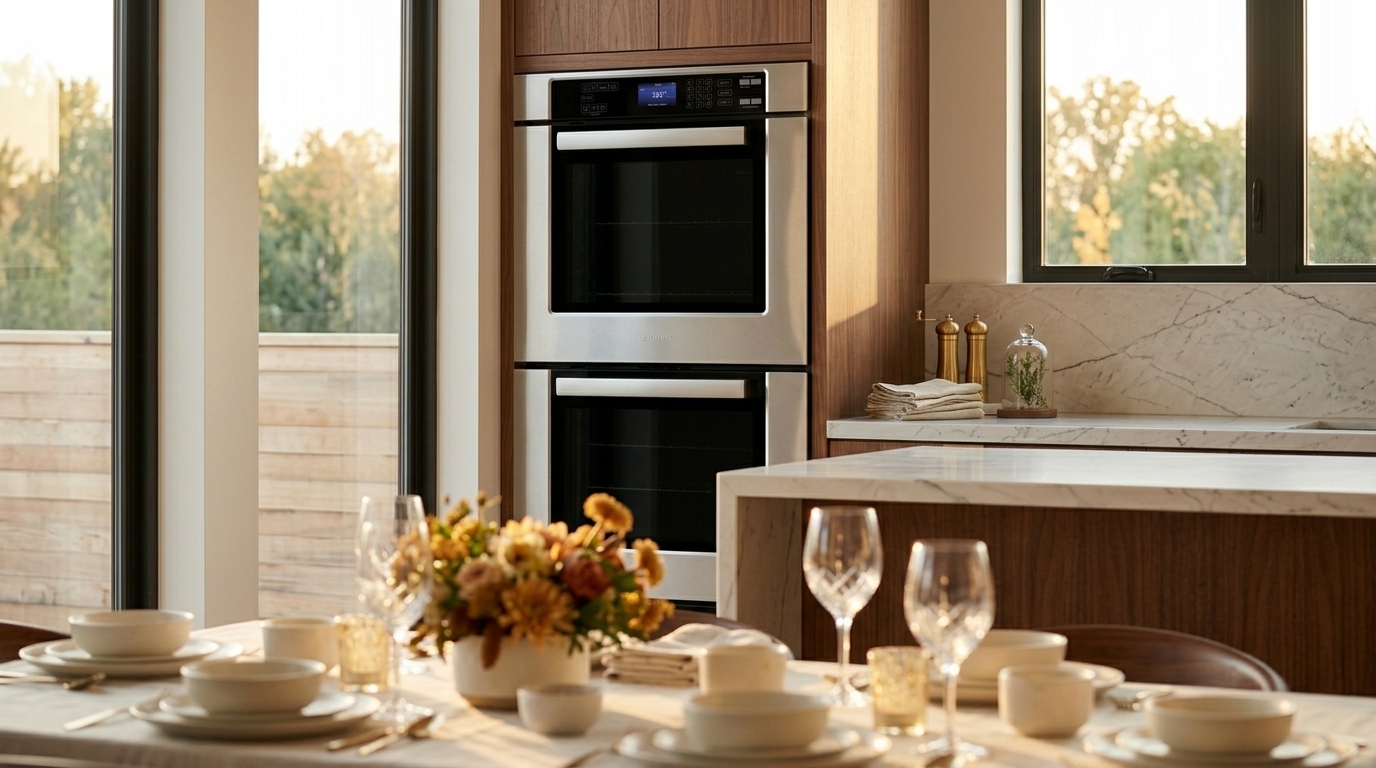
Cosmo’s COS-30EDWC, a 30-inch double electric wall oven, is built around exactly the scenario driving renewed interest in this feature: two full 5-cubic-foot cavities, upper and lower, each capable of running its own temperature and cooking mode independently. That is enough room in each oven to actually matter, a full sheet pan of sides in one cavity while a roast or a turkey runs in the other, rather than a second cavity so small it only handles reheating.
Both ovens run Turbo True European Convection, a fan-assisted circular heating element that distributes heat evenly across the cavity and, according to the manufacturer’s testing, cooks roughly 25 degrees cooler and about 10 percent faster than a conventional oven, a meaningful difference on a day when timing several dishes against each other is the entire challenge. Seven cooking functions per oven, bake, broil, warm, proof, convection bake, convection broil, and convection roast, give a household the range to run genuinely different recipes in each cavity rather than two identical settings running in parallel. A built-in temperature probe in the upper oven takes the guesswork out of a roast or a turkey specifically, the dish most likely to be the one a household cannot afford to get wrong in front of guests.
The details underneath that core capability are built for a kitchen that is actually in use during a gathering, not just showing well before one. A brilliant blue porcelain interior with six rack positions per oven and large windows with interior lighting means a household can check two dishes at once without opening either door and losing heat. Digital soft-touch controls, a self-cleaning function with a high-temperature cycle, delay start, and a hidden bake element for easier cleanup all handle the parts of running two ovens at once that would otherwise add real friction on a day already packed with prep. A Sabbath mode rounds out the practical feature set for households that need it.
A Few Practical Notes for Anyone Weighing This Decision
Count actual hosting days honestly before deciding either way. A household that hosts four or five times a year, holidays included, gets real, recurring value out of a second oven. A household that hosts once a year is probably better served by one excellent oven and a genuinely good countertop appliance for the rest.
Think about simultaneous cooking, not just oven volume. The value of a double oven is not that it can hold more food. It is that two dishes can run at two different temperatures and two different cook times without either one waiting on the other, which a single large oven, no matter how spacious, cannot do.
If cabinet space is the real constraint, compare a double wall oven against a bank of smaller specialized units on what each one actually solves, rather than assuming the more modern-sounding setup is the better fit. A warming drawer and a speed oven are excellent additions. They are not usually a substitute for a second real oven if simultaneous full-size cooking is the goal.
Plan installation height with real use in mind. A double wall oven set at counter height for the lower cavity and a comfortable eye-level position for the upper one removes a lot of the bending and reaching that makes a single oven awkward during a long cooking day, which matters more, not less, once two ovens are both running at once.
And do not wait until the week before a holiday to solve this. September and October are exactly when households renovating for entertaining season should be finalizing an oven decision, well ahead of the point where a kitchen actually needs to perform under real holiday-cooking pressure.
A Kitchen Built for the Days That Actually Matter
The double oven was never really fading because it stopped being useful. It was fading because a lot of kitchens were being planned around an average Tuesday rather than the handful of days a year that actually stress-test a kitchen’s real capacity. As entertaining season approaches, that math is shifting back in the other direction for a meaningful number of households, and the question worth asking is not whether a second oven is excessive for daily use. It is whether one oven is enough for the days a household is actually counting on it most.
A double wall oven like the COS-30EDWC is built around exactly that handful of days, two full cavities, independent temperatures, and enough real capacity that a holiday dinner does not have to run in relays to get everything to the table at once.