
Warm Minimalism Is Replacing Stark Modern: The Kitchen Trend Softening 2026’s Clean Lines
For most of the last decade, minimalist kitchens have meant the same handful of ingredients: white lacquer cabinetry, polished chrome hardware, glossy quartz in a cool gray, and enough negative space to make a room feel more like a showroom than a place anyone actually cooks. That look photographed well, and it dominated renovation inspiration boards for years. Heading into 2026, designers are describing a clear evolution of it rather than a rejection of it. The clean lines are staying. The clinical, cold feeling that used to come attached to them is not.
Design coverage this year keeps landing on the same term for what has replaced it: warm minimalism, a kitchen that keeps the restraint and simplicity of a minimalist layout but swaps in materials and tones that feel inviting rather than sterile. Matte plaster walls instead of glossy tile. Honed limestone or warm-veined marble instead of stark white quartz. Brushed brass or bronze hardware instead of polished chrome. The underlying discipline of minimalism, few visible objects, clean sightlines, nothing on the counter that does not need to be there, has not gone anywhere. What has changed is the palette doing the work.
Why the Cold Version of Minimalism Stopped Working
It is worth being specific about what homeowners are actually pushing back on, because the complaint is not about simplicity itself. A well-edited kitchen with few visible objects and clear counters is still exactly what most households say they want. The issue is with a specific version of that idea, one built almost entirely around cool tones and hard, reflective surfaces, that ended up reading as impersonal rather than calm. A kitchen finished in white gloss, chrome, and gray stone can look striking in a photograph and still feel like the least comfortable room in the house to actually spend time in, especially once the novelty of the look wears off after a few years of daily use.
That disconnect is the specific thing warm minimalism is correcting. Designers writing about the trend in 2026 describe it less as a stylistic pivot and more as a course correction, homeowners realizing that a kitchen can be simple without being cold, and that texture, warmth, and a bit of tactile interest are not the enemy of a clean, uncluttered room. A honed stone counter, a wood island, or a plaster hood surround does not clutter a minimalist kitchen any more than a white lacquer one did. It just changes how the room feels to stand in.
The Materials Actually Driving the Shift
A handful of specific choices show up again and again in the kitchens design publications are pointing to as this trend’s clearest examples. Matte and honed stone finishes are replacing high-polish quartz and granite, trading shine for a softer, more matte reflection that reads as calmer under both daylight and warm interior lighting. Warm wood tones, oak, walnut, and other natural grains, are showing up on islands, open shelving, and even full cabinet runs in kitchens that would have specified white lacquer a few years ago, a shift that lines up directly with the broader move toward wood-tone cabinetry documented across major design surveys this year. Plaster and lime-wash wall finishes, with their soft, slightly irregular texture, are replacing the flat, uniform tile backsplashes that defined the previous decade of minimalist kitchens. And hardware finishes have moved decisively toward brushed brass, warm bronze, and soft matte black, away from the polished chrome and nickel that used to be the default neutral.
None of these choices add visual clutter in the way a maximalist kitchen would. A warm minimalist kitchen still has clear counters, hidden storage, and a restrained material palette, usually two or three finishes total rather than five or six. The difference is that every one of those finishes now leans warm rather than cool, and the room ends up feeling considerably more livable without giving up any of the discipline that made minimalism appealing in the first place.
Where Appliances Fit Into a Warmer, Quieter Kitchen
Appliances carry real weight in a kitchen built around this idea, because they are some of the largest, most visually dominant surfaces in the room. A cooktop covered in visible grates, burner caps, and control knobs breaks up a warm minimalist kitchen’s clean sightlines in the same way a cluttered countertop would, regardless of how warm the surrounding cabinetry and stone happen to be. This is part of why induction cooking has become such a natural fit for the trend. A flush ceramic glass surface with no exposed burners or grates reads as a single, uninterrupted plane rather than a cluster of hardware sitting on top of the counter, which is exactly the kind of visual quiet a warm minimalist kitchen is built around. The cooktop can sit next to a wood island or a plaster hood surround without introducing the busy, industrial look that a traditional grate-covered range often brings into an otherwise calm room.
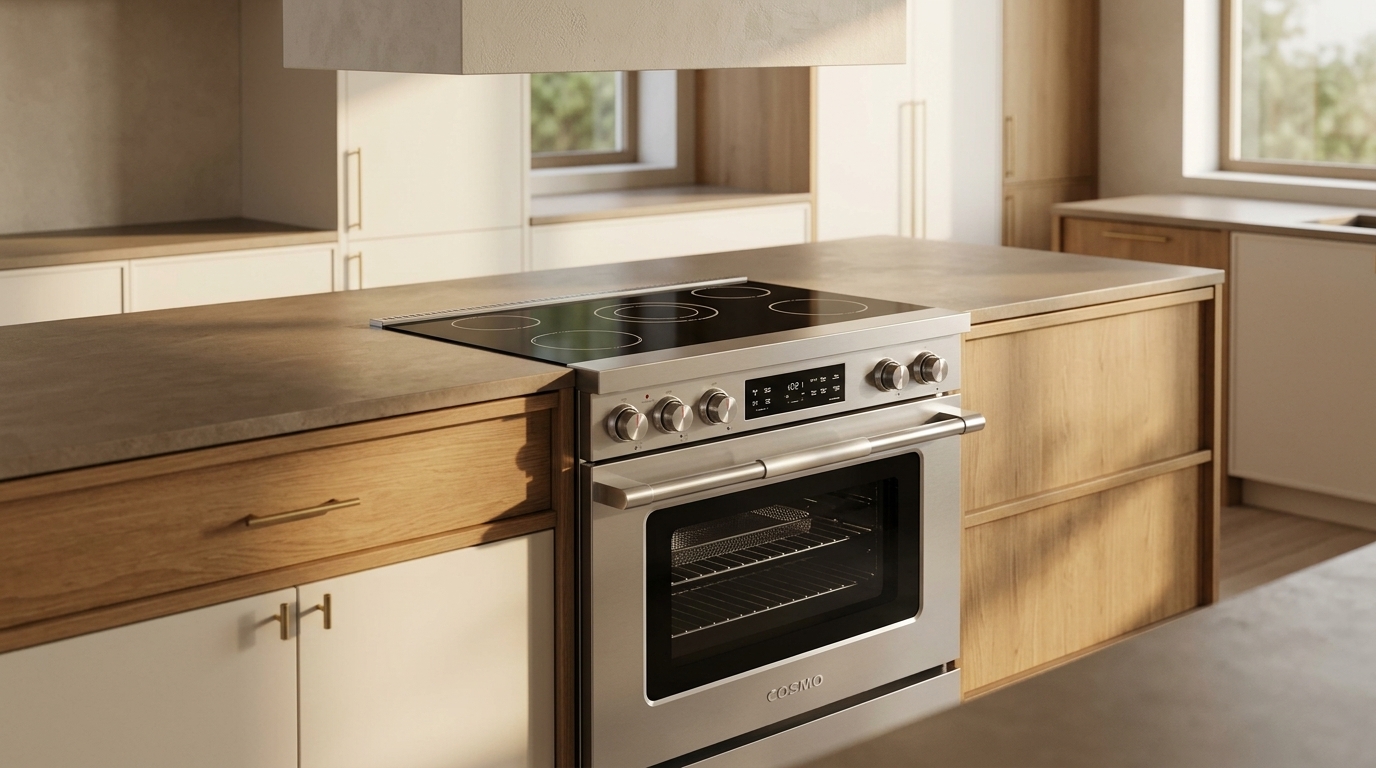
Cosmo’s COS-RIS365SS, a 36-inch induction range from the Stellar Collection, is built around exactly that kind of visual restraint. Its five-burner ceramic glass cooktop sits completely flush, with no grates, caps, or exposed hardware breaking up the surface, so it reads as a single clean plane rather than a collection of parts, a detail that matters considerably more in a warm minimalist kitchen than it did in the stark, hardware-forward kitchens minimalism used to mean. The induction burners themselves, a 2,500-watt element, two 1,600-watt elements, two 1,200-watt elements, and a 3,600-watt sync bridge for oversized cookware like griddles, heat cookware directly through electromagnetic energy, which means the cooktop itself stays cooler to the touch and cleans in a single wipe rather than requiring the grate removal and scrubbing a gas range demands.
The 6.1 cubic foot convection oven underneath carries that same quiet functionality through a genuinely wide range of use, bake, convection bake, broil, air fry, delay start, and keep warm, all run through a digital display rather than a bank of dials, and finished with a steam clean cycle that loosens baked-on residue without a separate cleaning product. A large window and interior lighting let the oven stay visually calm even while in use, and the enamel interior with a hidden bake element keeps the cavity itself free of visible hardware, consistent with the same restraint that defines the cooktop above it. Cool-to-touch handles, an oven cooling ventilation system, and overheat protection round out the safety features without adding anything to the range’s visual footprint. Finished in stainless steel with high-quality metal knob accents, it is a genuinely neutral appliance, one that sits comfortably next to warm wood cabinetry, honed stone counters, or a plaster hood surround without pulling attention away from any of them.
Bringing Warm Minimalism Into a Kitchen Without a Full Renovation
Not every household weighing this trend is planning a gut renovation, and the good news is that warm minimalism scales down further than the design coverage usually suggests. Swapping polished chrome or nickel cabinet hardware for brushed brass or warm bronze is one of the least expensive, most immediate ways to shift a kitchen’s temperature without touching a single cabinet box. A honed or matte sealant applied to existing polished stone counters can soften their reflectivity considerably, and open shelving finished in a warm wood tone, even a single run above a sink or stove, introduces texture into a kitchen without a full cabinetry replacement. For anyone specifically evaluating a cooktop or range as part of this shift, the same principle that applies to cabinetry and counters applies here too: choose the option with the fewest visible components and the least visual noise, and let the warmth come from what surrounds it rather than from the appliance competing for attention.
A Kitchen That Feels as Good as It Looks
What makes warm minimalism worth paying attention to is that it does not ask anyone to give up the discipline that made minimalist kitchens appealing in the first place. Clear counters, restrained material palettes, and clean sightlines are all still the goal. What has changed is the temperature of the materials doing that work, and a growing number of homeowners heading into 2026 are discovering that a kitchen can be genuinely simple without feeling like it was designed for a magazine spread rather than an actual family. An appliance built around the same quiet, uninterrupted surfaces, like the COS-RIS365SS, fits naturally into that shift, proof that clean lines and real warmth were never actually in conflict to begin with.