
Why Your Oven Temperature Is Probably Lying to You
Set your oven to 350°F and there’s a meaningful chance the interior never actually reaches that temperature, or reaches it briefly before swinging well above or below it for most of the cooking cycle. This isn’t a defect specific to any particular oven brand or price point — it’s a near-universal characteristic of how home ovens regulate temperature, and understanding it explains a surprising number of cooking frustrations that get blamed on recipes, ingredients, or cooking skill when the actual cause is sitting quietly in the appliance itself.
Most home cooks assume their oven dial or digital display represents reality — that setting 350°F means the oven interior holds steady at 350°F throughout the cooking process. The actual behavior is considerably messier, and the gap between displayed and actual temperature explains everything from inconsistent baking results to recipes that work perfectly for some people and fail mysteriously for others using what should be identical instructions.
How Oven Temperature Regulation Actually Works
Understanding the mechanism behind oven temperature control reveals why the temperature swings happen and why they’re largely unavoidable with standard residential oven technology.
The Cycling Behavior: Home ovens don’t maintain constant heat output. Instead, they cycle the heating elements on and off, turning elements on when the interior temperature drops below the set point and off when it rises above it. This cycling creates a sawtooth temperature pattern rather than a flat line — the actual interior temperature oscillates above and below the target setting continuously throughout cooking, rather than holding steady at the displayed number.
Typical Swing Range: Standard residential ovens typically swing 15-25°F above and below their set temperature during normal cycling, meaning an oven set to 350°F might actually range between 325°F and 375°F throughout a cooking session, repeatedly. Budget ovens with simpler thermostats can swing more dramatically — sometimes 30-40°F in either direction. Higher-end ovens with more sophisticated temperature sensors and control systems typically swing less, but even premium ovens rarely hold dead-steady at the exact set temperature.
Why This Design Exists: Continuous, perfectly steady heat output would actually require more sophisticated and expensive heating element control than the simple on/off cycling that most ovens use. The cycling approach is a cost-effective engineering compromise — elements run at full output when on, rather than modulating to a precise partial output, because full-output heating elements are simpler and cheaper to manufacture than elements capable of precise variable output.
The Thermostat Placement Problem: Oven thermostats and temperature sensors are positioned at a single point, typically near the back or side wall of the cavity. This single-point measurement doesn’t account for temperature variation throughout the rest of the cavity — areas near the door, the corners, and spaces close to heating elements can run at meaningfully different temperatures than the area immediately surrounding the sensor, even when the sensor itself accurately reads its local temperature.
Why Your Specific Oven Might Be Worse Than Average
Beyond the inherent cycling behavior that all ovens exhibit, specific factors can make individual ovens run significantly hotter or cooler than their displayed settings.
Calibration Drift Over Time: Oven thermostats can drift out of calibration through normal use and aging, particularly in older units or those that have experienced significant temperature cycling over years of regular use. An oven that was accurately calibrated when new might run 20-30°F off from its displayed temperature after several years without anyone noticing, because the gradual nature of the drift makes it hard to detect through normal cooking experience.
Door Seal Degradation: Oven door gaskets degrade over time, losing their ability to seal completely. A compromised seal allows heat to escape continuously, which can cause the oven to run its heating elements more frequently to compensate, sometimes creating different cycling patterns than a properly sealed oven, and occasionally causing the displayed temperature to diverge further from actual cavity conditions.
Sensor Position and Damage: Physical damage, buildup of food residue, or even minor sensor positioning issues from manufacturing variance can all affect how accurately the temperature sensor reflects actual cavity conditions. A sensor partially shielded by buildup reads differently than a clean sensor exposed directly to cavity air.
Installation and Leveling Issues: An oven that isn’t properly leveled during installation can experience uneven heat distribution that interacts with the cycling behavior in ways that create more pronounced hot and cold zones than a properly leveled unit would show.
How to Find Out What Your Oven Is Actually Doing
Rather than assuming your oven’s temperature display is accurate or inaccurate, directly testing it removes the guesswork and gives you information that immediately improves your cooking results.
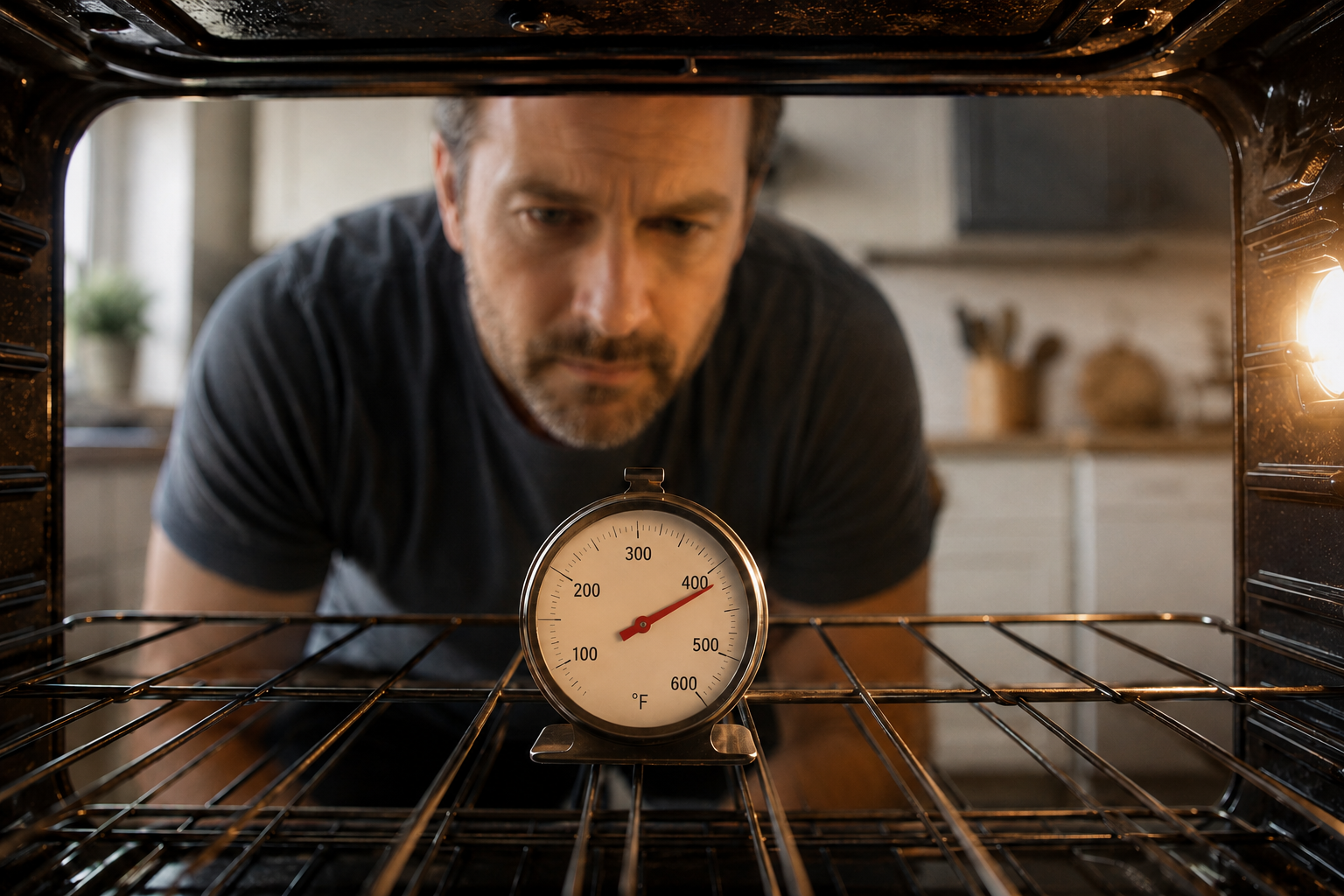
The Oven Thermometer Method: A simple, inexpensive oven thermometer — the dial or mechanical type that doesn’t require batteries or calibration of its own — placed in the center of the oven and left there during a normal preheat and cooking cycle reveals the actual temperature your oven reaches and maintains. This is the single most useful and accessible tool for understanding your specific oven’s real behavior, and it costs under $10 in most cases.
Reading the Pattern, Not Just One Number: Rather than checking the thermometer once and noting a single reading, observe it periodically throughout a 20-30 minute period after the oven indicates it has preheated. This reveals the cycling pattern — how high the temperature swings above the set point, how low it drops, and how long each cycle takes. This pattern information is more useful than a single snapshot reading because it shows you the actual range your food experiences during cooking rather than one moment in that range.
Multi-Position Testing: Testing temperature at multiple rack positions and locations within the cavity — center, near the door, in back corners — reveals whether your oven has significant hot or cold zones beyond the standard cycling behavior. Many home cooks discover their oven runs notably hotter in the back than the front, or that one side consistently browns faster than the other, information that directly explains baking inconsistencies they may have attributed to other causes.
Comparing to Recipe Assumptions: Standard recipes are developed assuming reasonably accurate, reasonably stable oven temperatures. If your testing reveals your oven runs consistently 25°F hot, you now have actionable information — either adjust your set temperature down to compensate, or adjust your expectations about timing since a hotter oven cooks faster than the recipe anticipates.
What This Explains About Your Cooking Results
Once you understand temperature cycling and potential calibration drift, several common baking and cooking frustrations become explicable rather than mysterious.
Inconsistent Cookie Batches: The same cookie dough, same recipe, same oven, producing one batch of perfectly baked cookies and a subsequent batch that’s noticeably over or under-baked despite identical timing often reflects where in the temperature cycle the cookies happened to bake. A batch that spends most of its time in the oven during a high point in the temperature cycle bakes differently than one that bakes predominantly during a low point.
Recipe Results That Don’t Match Reviews: When other people report excellent results from a recipe that produces mediocre results for you despite following identical instructions, oven temperature accuracy is one of the most likely explanations, particularly for temperature-sensitive baking like delicate cakes, soufflés, or precise candy work. The recipe writer’s oven and your oven may simply be running at meaningfully different actual temperatures despite both displaying the same setting.
Browning Inconsistencies Across a Single Bake: Items that brown unevenly within a single baking session — some cookies on a sheet browning faster than others, one side of a cake darker than the other — often reflect the cavity hot and cold zones that exist independent of overall cycling, requiring physical rotation during baking to compensate rather than any change to the temperature setting itself.
Bread and Pastry That Underperforms: Yeasted breads and laminated pastries are particularly temperature-sensitive, with specific temperature thresholds that trigger important chemical and physical transformations — oven spring in bread, butter layer separation in puff pastry. An oven running consistently cooler than displayed can produce bread that doesn’t develop proper structure, or pastry that doesn’t achieve proper lift, even when the baker has followed every other aspect of the recipe correctly.
Practical Adjustments Once You Know Your Oven’s Behavior
Testing your oven’s actual temperature behavior is only useful if you act on what you learn, and the appropriate response depends on what the testing reveals.
If Your Oven Runs Consistently Hot or Cold: A consistent offset — running reliably 20°F hot across multiple tests, for example — can often be compensated for simply by adjusting your set temperature. If your oven runs 20°F hot, setting recipes that call for 350°F to 330°F instead compensates for the consistent bias, assuming the offset remains stable across different temperature settings (worth verifying, since some ovens have offsets that vary at different temperature ranges rather than a flat consistent difference).
If Recalibration Is Available: Some ovens, particularly newer models with digital controls, include a calibration adjustment feature in their settings menu that lets you offset the displayed temperature to better match actual performance. Check your oven’s manual for this feature — it can resolve a consistent calibration drift more elegantly than manually adjusting every recipe’s temperature.
If the Swing Range Is the Problem Rather Than a Consistent Offset: When testing reveals wide temperature swings rather than a consistent offset — the oven accurately averages to 350°F but swings between 310°F and 390°F — temperature setting adjustment doesn’t solve the underlying issue. In these cases, techniques that reduce sensitivity to temperature fluctuation become more valuable: rotating items partway through baking, using an oven thermometer to time the start of baking to coincide with a more stable point in the cycle, or accepting slightly longer baking times with visual and internal temperature doneness checks rather than relying purely on recipe timing.
When Professional Service Makes Sense: If testing reveals a dramatic offset — 50°F or more — or if the oven seems to be malfunctioning rather than simply exhibiting normal cycling behavior, professional service to inspect and potentially recalibrate the thermostat and sensor system is worth pursuing rather than permanently compensating through workarounds.
The Role of Convection in Reducing This Problem
Convection ovens, which actively circulate air with a fan, address some of the temperature consistency issues that plague conventional ovens, though they don’t eliminate the underlying cycling behavior entirely.
Reduced Spatial Variation: While conventional ovens can have meaningfully different temperatures in different cavity locations due to proximity to heating elements and natural heat stratification, convection’s active air circulation distributes heat more evenly throughout the cavity. This doesn’t eliminate the temperature cycling over time, but it does reduce the spatial inconsistency between different rack positions and cavity locations.
Faster Recovery After Door Openings: Convection systems typically recover temperature more quickly after a door opening interrupts the cavity’s heat than conventional radiant systems, partially because the active air movement more efficiently redistributes heat from the elements throughout the cavity rather than relying on passive heat radiation and natural convection currents.
Why This Still Doesn’t Solve Everything: Convection improves spatial consistency but doesn’t change the fundamental on/off cycling behavior of the heating elements themselves. A convection oven still swings above and below its set temperature over time, even though that temperature is more uniformly distributed throughout the cavity at any given moment. Testing with an oven thermometer remains valuable even for convection ovens to understand the actual temperature range you’re working with.
Living With the Reality Rather Than Fighting It
Understanding oven temperature behavior doesn’t mean every cooking session requires obsessive monitoring and adjustment. It means developing a more accurate mental model of what’s actually happening, which improves troubleshooting and reduces frustration when results don’t match expectations.
Trust Visual and Internal Temperature Cues Over Timer Precision: Recipes provide timing as a starting estimate, not a guarantee, precisely because oven behavior varies enough between units that identical timing produces different results across different ovens. Learning to read visual doneness cues — color, texture, the way a cake springs back, the sound of bread when tapped — alongside or instead of relying purely on stated cooking times produces more consistent results than treating recipe timing as gospel.
Use a Probe Thermometer for Proteins: For meats and other temperature-sensitive proteins, using an internal temperature probe rather than relying on oven time and temperature settings sidesteps the entire oven accuracy question. The protein’s actual internal temperature is what matters for safety and doneness, and measuring it directly removes the oven’s temperature inconsistency from the equation entirely.
Recognize When Precision Actually Matters: Not every dish requires worrying about oven accuracy. A casserole, a roasted vegetable tray, or a braised dish tolerates the normal temperature swing range without meaningful impact on results. Delicate baking — soufflés, macarons, precise candy work, laminated pastry — is where oven temperature accuracy matters enough to justify the testing and compensation strategies described above. Calibrating your level of concern to the actual sensitivity of what you’re cooking prevents unnecessary anxiety about ovens that are performing within normal parameters for the vast majority of everyday cooking tasks.
The gap between displayed and actual oven temperature is one of the more under-discussed realities of home cooking, hiding in plain sight behind a digital display that projects far more precision than the underlying heating system actually delivers. Testing your specific oven with a simple thermometer removes the mystery and gives you the information needed to either compensate for consistent inaccuracies or recognize when normal cycling behavior, rather than recipe failure or cooking error, explains results that don’t match expectations.