
Why the Beverage Station Has Become the Kitchen Feature American Homeowners Want Most in 2026
For most of the last two decades, the wine rack lived wherever there was leftover space, on top of the refrigerator, tucked into a builder-grade cabinet insert, hanging from the ceiling over an island. It was a nice-to-have, rarely a planned feature, and almost never something a homeowner designed a renovation around. That has changed. Walk through any kitchen showroom or scroll through a renovation gallery in 2026 and a new fixture keeps showing up in the plans: a dedicated beverage station, a purpose-built zone with its own cooling, its own storage, and its own place in the layout, sitting right alongside the pantry and the range as one of the features homeowners are specifically requesting rather than squeezing in afterward. The shift is not a small one, and the data behind it explains why appliance makers, including Cosmo, are paying close attention.
The Numbers Behind the Shift
The 2026 U.S. Houzz Kitchen Trends Study put real numbers behind what designers have been describing anecdotally for the past couple of renovation cycles. Seventy-six percent of homeowners undertaking a kitchen project have incorporated, or plan to incorporate, at least one built-in feature beyond the standard cabinetry and appliances. Pantry cabinets top that list at 47 percent, which makes sense given how much storage a modern kitchen is expected to absorb. But close behind, beverage stations came in at 24 percent, a striking number for a feature that barely registered as its own category in kitchen planning a decade ago. Built-in wine fridges pulled another 17 percent on their own, tied with built-in seating, meaning that once beverage-specific storage and built-in seating are counted together, dedicated drink space is competing directly with some of the most established kitchen must-haves.
That is not a fringe number. A quarter of homeowners planning a renovation are now asking their designer or contractor specifically for a place to store, chill, and serve drinks, separate from the refrigerator, separate from a generic cabinet. It is worth sitting with why that request has become so common, because the reasons trace back to a few real, measurable shifts in how Americans actually use their kitchens.
Why a Dedicated Beverage Zone Makes Sense Now
The most obvious driver is the return of home entertaining as a routine part of American life rather than an occasional event. Coverage of 2026 bar and cocktail trends has pointed repeatedly to a home entertaining resurgence, driven in part by a generation that spent formative years hosting at home during a period when going out was not an option, and never fully went back to treating a night out as the default. Hosting a few friends for drinks on a Friday, rather than meeting them somewhere, has become a normal, recurring plan rather than a special occasion, and a kitchen built for that reality needs somewhere for the bottles, the glassware, and the ice to live that is not a chaotic scramble through three different cabinets and the refrigerator door.
The second driver is less obvious but just as important: American drinking habits have diversified in a way that a single refrigerator shelf cannot accommodate. The same bar and cocktail trend coverage tracking 2026 has documented continued growth in the non-alcoholic and low-alcohol category, sitting alongside, not replacing, the wine, beer, and spirits already common in most households. A household hosting today is often stocking wine for some guests, craft beer or seltzer for others, a full non-alcoholic lineup for anyone opting out entirely, and mixers for cocktails on top of all of it. That is a genuinely wider range of beverages than a kitchen was designed to store a generation ago, and cramming all of it into a standard refrigerator crowds out the food storage the refrigerator is actually supposed to handle. A dedicated beverage station solves a real logistics problem, not just an aesthetic one.
There is also a straightforward practical case that has nothing to do with entertaining at all. Wine, in particular, does not store well in a standard kitchen refrigerator. A refrigerator built to keep food cold runs colder than wine wants, cycles its temperature more than wine tolerates well, and exposes bottles to the light and vibration every time the door opens, all of which affect how a bottle ages and tastes over time. Homeowners who have started building even a modest wine collection, rather than buying a bottle the day they plan to drink it, run into that problem quickly, and a dedicated cooler solves it in a way a refrigerator shelf simply cannot.
What Homeowners Are Actually Asking For
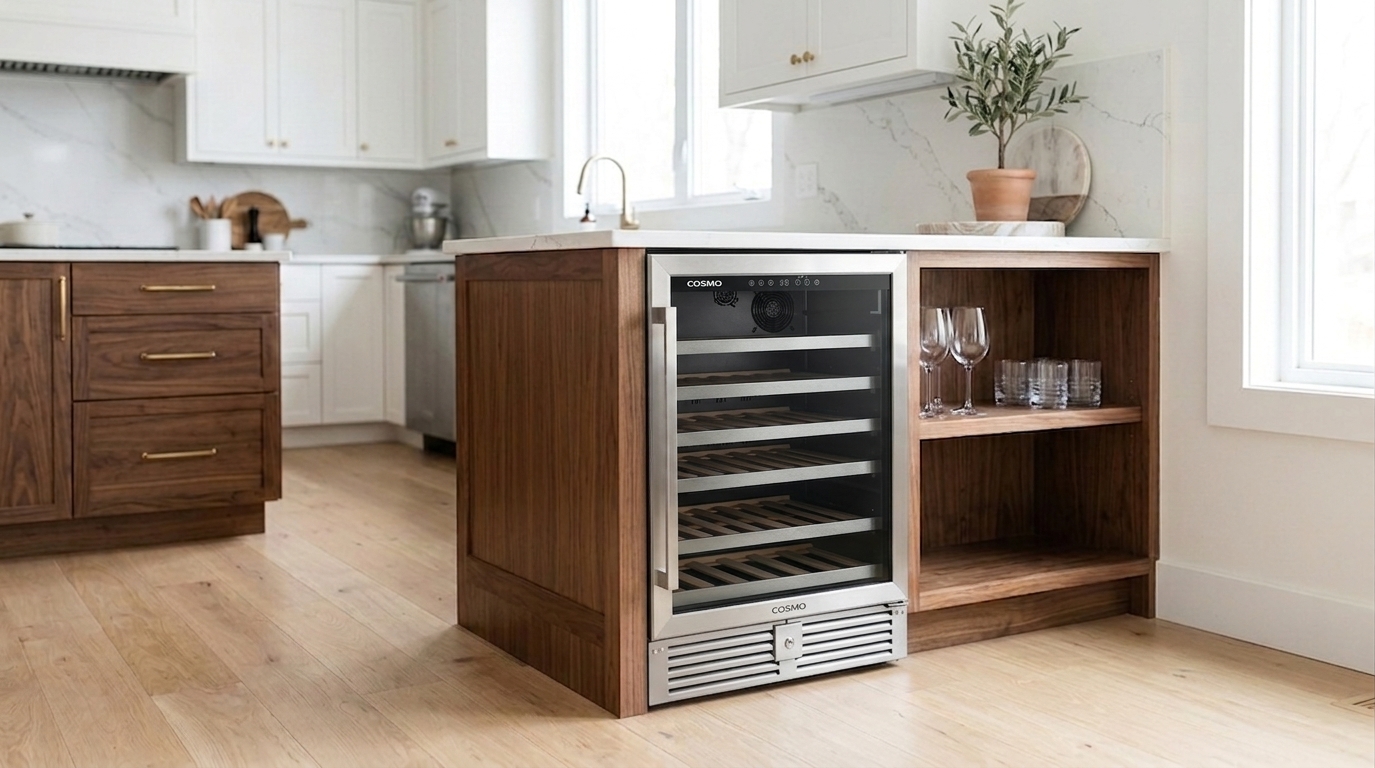
Design coverage of the beverage station trend has been consistent about what makes one work well, and it comes down to a few specific things: a home for the appliance itself, usually a built-in wine or beverage cooler rather than a freestanding unit sitting on a counter, real storage nearby for glassware and bar tools, and enough counter space to actually make a drink without displacing whatever else is happening in the kitchen. This has made beverage stations a particularly good fit for the broken-plan and zoned layouts gaining ground in American kitchen design more broadly, where a kitchen retains an open feel while carving out small, purpose-built areas for specific tasks. A beverage station tucked into an island end cap or a run of cabinetry near the dining area lets a household entertain without funneling every guest through the working part of the kitchen to get a drink.
That is where the appliance choice actually matters. A beverage station built around a generic mini-fridge or a countertop cooler tends to disappoint quickly, either because it does not hold enough to matter or because it does not actually protect what is stored inside it the way a proper wine cooler does. Homeowners who have gone through the trouble of designing a dedicated space for this are, understandably, looking for a cooler built specifically for the job.
This is also where the beverage station trend overlaps with a broader shift toward zoned, purpose-built kitchen design more generally. Rather than one large, undifferentiated space where every task competes for the same counter and the same appliances, American kitchens in 2026 are increasingly being planned as a set of smaller, specific zones: a baking station, a coffee bar, a beverage station, each with its own storage and its own small footprint of dedicated appliances. A beverage station is simply the most visible and fastest-growing version of that pattern, in part because it is one of the easier zones to build well. Unlike a full baking station, which typically needs extra counter space and specialized storage for bakeware, a beverage zone can be built around a single appliance, the cooler itself, plus a modest amount of adjacent cabinetry, which makes it an accessible addition even for a kitchen that is not being fully gutted and rebuilt.
Who Is Actually Driving This Trend
The beverage station is not showing up equally across every kind of renovation, and the pattern in where it lands tells its own story. It is most common in kitchens undergoing a full remodel rather than a light refresh, which makes sense given that carving out dedicated cabinetry and running power for a built-in cooler is easier to plan into a full renovation than to retrofit into an existing layout later. It also skews toward households with a dedicated dining or entertaining area adjacent to the kitchen, since the whole point of the feature is proximity to where guests actually gather rather than proximity to the stove.
Multigenerational households have become an unexpected driver as well. A home with adult children, an aging parent, or an in-law suite sharing the same kitchen often has genuinely different beverage preferences under one roof, and a dedicated station lets those preferences coexist without turning the shared refrigerator into a negotiation. The same logic that has made a second kitchen or a portable cooktop useful in these arrangements applies here: separate zones for separate needs tend to reduce daily friction far more than a single combined space ever manages to. And households that host recurring gatherings, holiday dinners, a standing game night, a rotating group of neighbors for drinks, report the station getting used constantly rather than sitting as a design flourish, which is really the test of whether a kitchen feature earns its square footage over time.
Cosmo’s COS-24BIWCS, a 24-inch built-in wine cooler from the brand’s Lumin Collection, was built around exactly the storage and preservation problem a dedicated beverage station is meant to solve. It holds 52 bottles across a 145-liter interior, enough capacity for a household actually building a collection rather than restocking a bottle or two at a time, and it is built to install flush into cabinetry as a true built-in unit or to stand freestanding, which gives it the flexibility to slot into an island end cap, a run of lower cabinets, or a dedicated bar nook depending on how a kitchen is laid out.
The preservation details are where the unit earns the difference between a wine cooler and a repurposed mini-fridge. A single-zone compressor system with advanced fan cooling holds a steady temperature between 41 and 68 degrees Fahrenheit, avoiding the wide temperature swings that damage wine over time, while an insulated three-layer glass door with a hidden hinge mechanism blocks the UV exposure that a standard refrigerator door does nothing to prevent. Six beechwood shelves on telescopic sliding rails let bottles be pulled fully out for inspection or serving without disturbing the rest of the collection, a small detail that matters more than it sounds like it should once a household actually starts using the unit regularly. LED interior lighting keeps the display visible without adding heat, a digital touchpad keeps temperature control precise rather than a rough dial-based guess, and a door lock adds a layer of security for a household with kids or frequent guests moving through a shared entertaining space. The unit is ETL listed to North American safety standards and runs on standard 115V power, so it installs without any special electrical work beyond a standard outlet.
A Feature Built for How Households Actually Entertain Now
What makes the beverage station trend worth paying attention to is that it is not really a luxury add-on in the way a butler’s pantry or a plunge pool might be. It is a response to a genuine change in how American households use their kitchens day to day: more entertaining happening at home rather than out, a wider and more varied range of beverages that households are actually stocking, and a growing recognition that wine in particular needs conditions a kitchen refrigerator was never designed to provide. A quarter of renovating homeowners asking for this feature specifically is not a fluke of one survey. It reflects a kitchen that has to do more than it used to, host more than it used to, and store a wider range of things than a single refrigerator and a spare cabinet shelf can reasonably handle.
For a household weighing whether a dedicated beverage station belongs in a renovation, or simply looking to solve the everyday problem of wine crowding out the refrigerator, the appliance at the center of that space matters as much as the layout around it. A cooler built for actual wine preservation, with real capacity, stable temperature control, and UV protection, is what turns a beverage station from a nice-looking cabinet into a feature a household actually uses for years. The COS-24BIWCS was built around exactly that job: a dedicated home for a growing, changing collection of what a household is drinking now, built to keep it in the condition it deserves.
A Few Practical Notes for Anyone Planning One
Placement matters as much as the appliance itself. A beverage station works best positioned away from the primary cooking zone, near a dining or living area where guests naturally gather, so pouring a drink does not mean walking into the middle of active meal prep.
Capacity is worth overestimating rather than underestimating. A collection tends to grow faster than most households expect once there is a proper place to keep it, and a 52-bottle unit like the COS-24BIWCS leaves real room to grow rather than filling up within the first year.
Single-zone versus dual-zone matters mainly for households storing both red and white regularly, since the two are typically served at different temperatures; a single-zone unit set in the mid-range of its temperature spectrum works well for a household that is not particular about serving temperature down to the degree.
Ventilation and clearance around a built-in installation should follow the manufacturer’s spec exactly. A compressor-based cooler needs airflow to run efficiently and quietly, and a cabinet opening built too tight around the unit can shorten its working life and undercut the steady temperature control the appliance is designed to provide.
Finally, treat the beverage station as its own design decision rather than an afterthought bolted onto the end of an island. The households getting the most use out of this trend are the ones who planned the counter space, the glassware storage, and the cooler itself together, as one working zone rather than three separate decisions made at different points in a renovation.
The kitchen has always evolved around how people actually live in it, and the beverage station’s rise from afterthought to top-tier request is one of the clearer signs of where American entertaining habits have landed in 2026: at home, more often, with a wider range of what is being poured, and a kitchen finally being designed to keep up with it.