
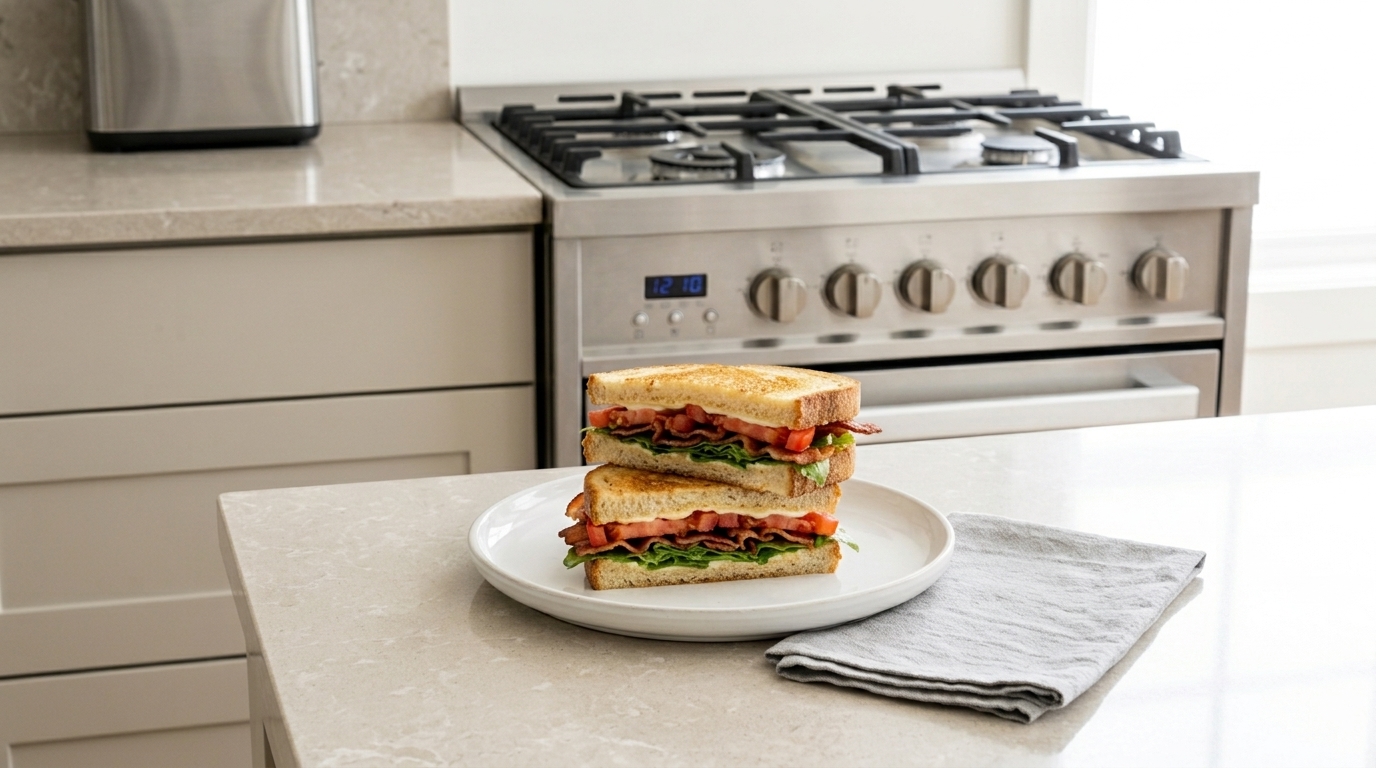
The BLT Deserves More Respect Than It Gets
Of all the sandwiches that have earned a permanent place on American menus, the BLT might be the least fussed-over. It rarely gets the reverent treatment a good burger or a well-built panini receives. There is no national day built into most people’s calendars for it, no cult following arguing about the “correct” build the way people argue about pizza toppings or barbecue regions. And yet it endures, quietly, on diner menus, lunch counters, and home kitchens across the country, largely unchanged for the better part of a century. That staying power is worth paying attention to, because a sandwich this simple only survives that long if it is actually, genuinely good, and because getting a BLT right turns out to depend on a surprising amount of technique for something built from three ingredients and two slices of bread.
A Sandwich Older Than It Looks
The BLT’s ingredients trace back further than the sandwich itself. Bacon and tomato pairings show up in American cookbooks as far back as the late 1800s, and club sandwiches built around bacon, lettuce, and tomato were common by the early twentieth century, often served open-faced or stacked three layers deep on toast points at hotel restaurants and tea rooms. The BLT in its now-familiar closed, two-slice form became a fixture of American diner culture as sliced bread and the modern toaster made quick, consistent toasting a home and restaurant staple rather than a specialty. By the mid-twentieth century, the BLT had settled into the shape most people recognize today: crisp bacon, cool lettuce, ripe tomato, and mayonnaise, stacked between two pieces of toasted bread, simple enough to make in minutes and satisfying enough to earn a permanent spot on nearly every diner and deli menu in the country.
Part of what has kept the BLT so durable is exactly that simplicity. It does not require a specialty ingredient, an unusual technique, or advance planning. It scales from a single lunch to a table of six with no real change in method. And it happens to hit a combination that is hard to replicate elsewhere: salty and smoky against cool and fresh, crisp against soft, all held together by a layer of mayonnaise that ties the whole thing together rather than sitting on top of it. It is a sandwich built entirely around contrast, and contrast is exactly what makes it satisfying.
Why a “Simple” Sandwich Is Easy to Get Wrong
The trouble with a three-ingredient sandwich is that there is nowhere for a mistake to hide. A slightly limp piece of bacon, a tomato that was sliced too far ahead of time and has gone watery, or bread that never developed real structure under the toaster all show up immediately, because there is nothing else in the sandwich to distract from them. Most disappointing BLTs fail for one of the same handful of reasons: bacon that is cooked unevenly, chewy in some spots and raw-soft in others, rather than uniformly crisp; bread that is toasted just enough to feel warm but not enough to actually hold up to the moisture from the tomato and mayonnaise; or a tomato that was salted too early and released its liquid straight into the bread before the sandwich was ever assembled.
Getting a BLT right is really about controlling heat with more precision than the sandwich’s reputation suggests. Bacon wants a steady, even surface over enough sustained heat to render its fat and crisp without scorching one end before the other side has caught up, which is much harder to manage on a burner that runs hot in the center and cool at the edges, or one that cannot hold a steady temperature once a full pan of bacon strips is added and starts pulling heat away. Bread wants real, consistent heat as well, whether that comes from a broiler or a hot oven, enough to dry out and crisp the surface fully rather than leaving a soft center that wilts the moment tomato juice touches it.
Where the Range Actually Matters
This is where the cooktop and oven underneath a BLT do more work than most people give them credit for. Cosmo’s COS-244AGC, a 24-inch compact gas range built for exactly this kind of everyday cooking, is a useful example of what that means in practice. Its 17,400 BTU triple ring burner puts out enough sustained, evenly distributed heat to render a full pan of bacon strips without the center scorching while the edges lag behind, which is the single biggest factor in getting bacon that is crisp edge to edge rather than crisp in patches. The two 6,900 BTU semi-rapid burners give a second pan enough power to warm bread in butter or toast it directly in a skillet, while the 5,000 BTU auxiliary burner is sized right for something gentler running alongside, warming mayonnaise-based sauce or keeping a component at a low simmer without needing to babysit it. Heavy-duty cast iron grates underneath hold that heat steady once a full pan is on the burner, rather than letting the flame’s output sag the moment real weight and cold ingredients hit the pan.
The oven does its share of the work too. A dedicated 5,800 BTU broil burner gives bread the kind of direct, high heat needed to dry and crisp the surface fully in a couple of minutes rather than leaving it merely warm, and the COS-244AGC’s rapid convection function circulates that heat evenly across two rack positions, which matters when toasting several slices of bread at once for a full table rather than one sandwich at a time. A 2.7 cubic foot oven cavity is compact enough for a 24-inch range but still gives enough room to lay bread flat rather than stacking it, and an interior oven light makes it easy to catch the exact moment toast goes from golden to overdone without opening the door and losing heat. For anyone building several BLTs back to back for a family lunch or a weekend gathering, that combination, a burner strong enough to crisp a full pan of bacon evenly and an oven that toasts bread consistently across more than one slice at a time, is the difference between a sandwich assembly line that keeps moving and one where the first sandwich is excellent and the fourth is lukewarm and unevenly done.
Building the Sandwich Itself
Technique matters as much as equipment once the ingredients are actually ready. Bacon should rest briefly on a rack or paper towel after cooking so excess grease drains off rather than soaking straight into the bread. Tomatoes are best salted just before assembly, not ahead of time, since salt draws moisture out of a tomato almost immediately and that moisture has nowhere to go but into the bread if the sandwich is not built right away. Mayonnaise belongs on both slices of bread rather than just one, since a thin layer on each side does more to hold the sandwich together and protect the bread from tomato moisture than a thicker layer on a single side. And bread should go from oven or skillet to sandwich while it is still fully hot, since a piece of toast that has cooled back down loses much of the structural crispness that kept it from going soft in the first place.
A Sandwich Worth Taking Seriously
The BLT does not need a marketing campaign or a manufactured holiday to earn its place in regular rotation. It has already done that on its own, across a century of diner counters, home kitchens, and lunch tables, on the strength of getting a handful of textures and flavors to work together with almost no room for error. Treating it with a bit more care than its reputation suggests, even heat under the bacon, real heat behind the toast, and a little discipline in the assembly, is usually the entire difference between a forgettable sandwich and the one people remember ordering twice.